What are Customer Reviews? The Ultimate Guide
Explore genuine customer reviews with honest feedback and real experiences to help you make smarter, more confident purchase decisions.

Explore genuine customer reviews with honest feedback and real experiences to help you make smarter, more confident purchase decisions.
You do solid work, yet customer feedback feels rare. You’re not imagining it. Many businesses deliver a good experience and still hear nothing afterward. That silence creates a blind spot. You can’t tell what’s landing, what needs work, or how people actually talk about you. Potential buyers notice too.
Reviews often shape decisions, and when they find none, they move on to someone who has them. More than 99.9% of consumers say they read reviews when shopping online at least sometimes.
Missing feedback doesn’t just feel awkward; it slowly chips away at trust and sales. The good news is this can change. There are simple, proven ways to get customers talking without sounding pushy or scripted. We’ll walk through practical ways to ask for reviews and nudge customers to share honest feedback that actually helps you improve and grow.
A customer review is feedback provided by someone who has purchased or used a product or service. It shares their personal experience, satisfaction level and opinions about what they bought. Customer reviews show others what to expect and give businesses a clearer view of how their products or services work in real life.
When customers make a purchase, they’re often invited to leave a review afterward. They rate the product or service on a scale (typically 1-5 stars) and write about their experience. The reviews appear on websites or apps where others can read them before deciding what to buy. Companies also analyze this feedback to identify trends and improve their offerings.
Key objectives:
Let’s understand why customer reviews matter so much. They reveal what customers truly think after using your product or service, not what you hope they feel.
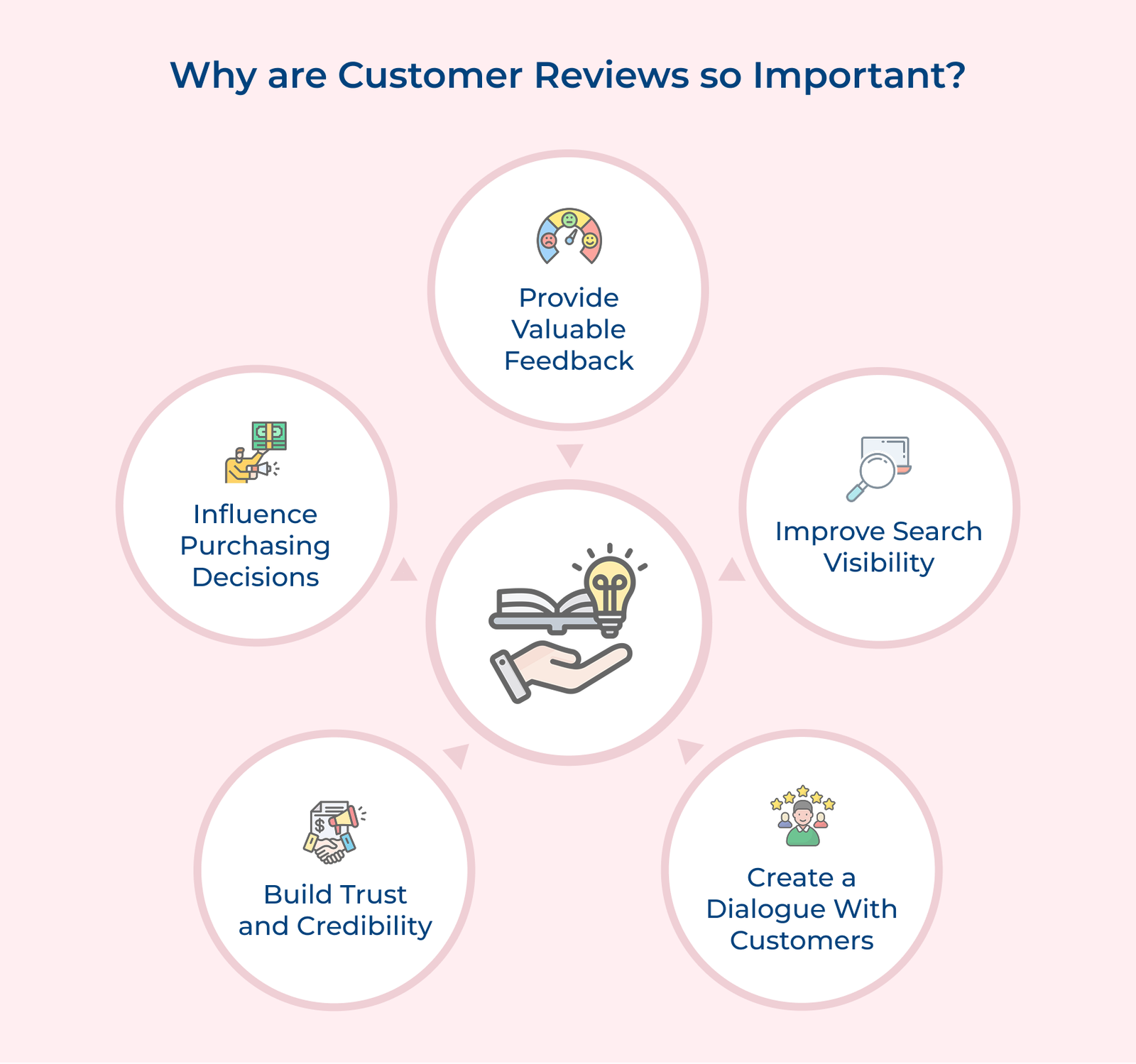
1. They Build Trust and Credibility
Customer reviews act as social proof that your product or service delivers on its promises. People tend to trust other customers more than companies because reviews come from real experiences, not from someone trying to make a sale. The authentic feedback helps establish credibility in a crowded marketplace.
2. They Influence Purchasing Decisions
Most shoppers read reviews before buying products online. The firsthand accounts help potential customers visualize how a product might work for them in real life. When people hear how others with similar needs had good experiences, they feel comfortable deciding to buy. On average, reviews produce an 18% uplift in sales.
3. They Provide Valuable Feedback
Reviews give businesses direct insight into what customers truly think about their products or services. The unfiltered feedback highlights strengths to emphasize and weaknesses to improve. Companies can use this feedback to understand what works and what doesn’t, helping them improve for their customers.
4. They Improve Search Visibility
Fresh user-generated content in the form of reviews helps improve a website’s search engine ranking. Search engines view sites with regularly updated content as more relevant and active. Being easier to find means more people looking for what you offer can discover your business.
5. Create a Dialogue with Customers
Reviews open a channel for conversation between businesses and customers. Replying to all good reviews or bad reviews shows that a company listens and cares about its customers. The ongoing dialogue builds relationships and fosters loyalty over time.
Check out the steps necessary to ask for and receive those invaluable reviews, ensuring your business shines in the eyes of potential customers.
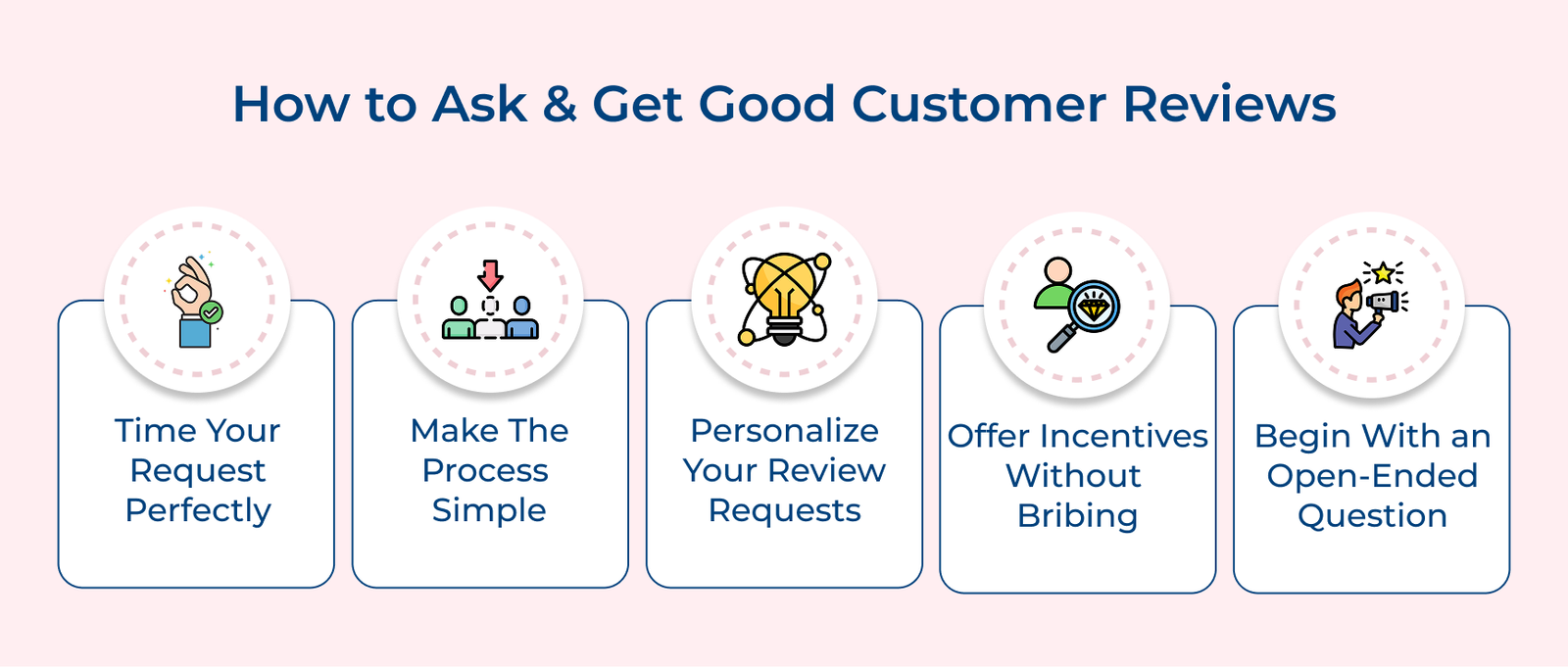
Asking for a review at the right moment, when customers are still using or thinking about your product, makes them more likely to reply. Asking at the right moment increases response rates and helps capture authentic feedback while the experience is still fresh.
Asking for reviews at the wrong time can seriously backfire. Asking for feedback right after a customer reports a problem but before it’s fixed can feel off and may lead to a negative review that better timing could avoid. Here are four perfect moments to request customer reviews throughout their journey with your business:
Timing isn’t just about when but also about context. Choosing the right moments when customers are happy with their experience helps you get more and better reviews.
Keeping the review process easy helps customers share their thoughts. Even happy customers won’t leave feedback if it feels too tricky or takes too long. Here are three effective ways to simplify the customer review process:
Every extra step in the review process makes it less likely that customers will finish. Try the process yourself and fix anything that feels tricky or frustrating.
Personalizing review requests shows customers you value them as individuals rather than just generic feedback sources. The approach usually gets more responses because customers feel their individual experiences matter.
Before crafting personalized review requests, consider these important questions to ensure your approach is effective:
Make review requests personal by using the customer’s name, mentioning their purchase, how long they’ve been with you, or any feedback they’ve shared before. Small personal touches help customers feel noticed and appreciated, making them more likely to share their feedback.
Offering appropriate incentives can motivate customers to leave reviews without crossing ethical lines into bribery. The main point is that incentives thank customers for sharing their feedback, not for giving a certain rating or saying only positive things. Here are some effective incentives businesses can offer to encourage more customer reviews:
The incentives work because they acknowledge the value of customers’ time without directly influencing the content of their feedback. When done right, incentives make it easier for customers to leave reviews without affecting how honest or useful those reviews are.
Starting your review request with an open-ended question invites thoughtful responses instead of quick ratings. The approach invites customers to describe their experience in their own words, giving you more detailed and helpful feedback.
Direct questions usually get brief answers. Open-ended ones let customers share what stood out to them, often revealing things you wouldn’t learn from a survey. Consider using these conversation-starting questions that encourage detailed responses:
Open-ended questions reveal the reasons behind the rating, giving you useful feedback and helping others see what it’s really like to choose your business. The descriptive feedback they generate is invaluable for both marketing and improvement efforts.
Consistently exceptional service forms the foundation for generating positive customer reviews. When you consistently do more than customers expect, they’re more likely to tell others about their experience. Here are three effective ways to deliver exceptional service that leads to better reviews:
For example, a small bookstore might add a handwritten note or a bookmark that matches the customer’s reading taste. The minimal-cost touch creates a memorable moment that customers frequently mention in their five-star reviews.
Responding to reviews demonstrates your commitment to customer feedback and creates an ongoing dialogue with your audience. Engaging with reviews shows that you listen and are willing to improve based on what customers share. It helps others see that their voices matter.
Address negative feedback constructively
When replying to negative reviews, acknowledge the concerns calmly and explain how you’re addressing the issue. It turns criticism into a chance to show you’re willing to improve, building trust with potential customers who notice your response.
Thank positive reviewers personally
Recognize customers who leave positive feedback by responding with specific details that reference their comments. Personalized thanks reinforce a positive experience and show customers you truly appreciate their feedback.
Creating memorable customer experiences goes beyond merely satisfying needs. It creates emotional connections that inspire customers to share their stories. The standout moments often become the heart of detailed, enthusiastic reviews that influence potential customers.
Working through this checklist helps you create experiences that customers want to share, making reviews happen naturally.
1. Does this interaction solve the customer’s problem unexpectedly or delightfully?
2. Have we personalized this experience based on what we know about this specific customer?
3. Are we addressing both functional needs and emotional needs throughout the customer journey?
4. Does this experience include at least one moment that will surprise the customer positively?
5. Will the customer still remember this interaction a week from now?
Remember that memorable experiences don’t always require grand gestures or significant investments. The strongest memories often come from small acts, like remembering preferences or following up to check satisfaction.
Sharing customer reviews across multiple channels amplifies their impact and creates a virtuous cycle where existing reviews help generate more reviews. When customers see that their feedback has been noticed, they feel appreciated and are more willing to share again. Below are a few places where you can share a review:
The strategy works because it creates social proof while simultaneously showing customers that their input matters. For example, when a restaurant shares a customer’s review about a special anniversary dinner on social media, it draws new guests. It often encourages the reviewer to return and share more feedback after future visits.
Let’s look at a few practical ways that businesses can use to make better use of their customer service reviews.
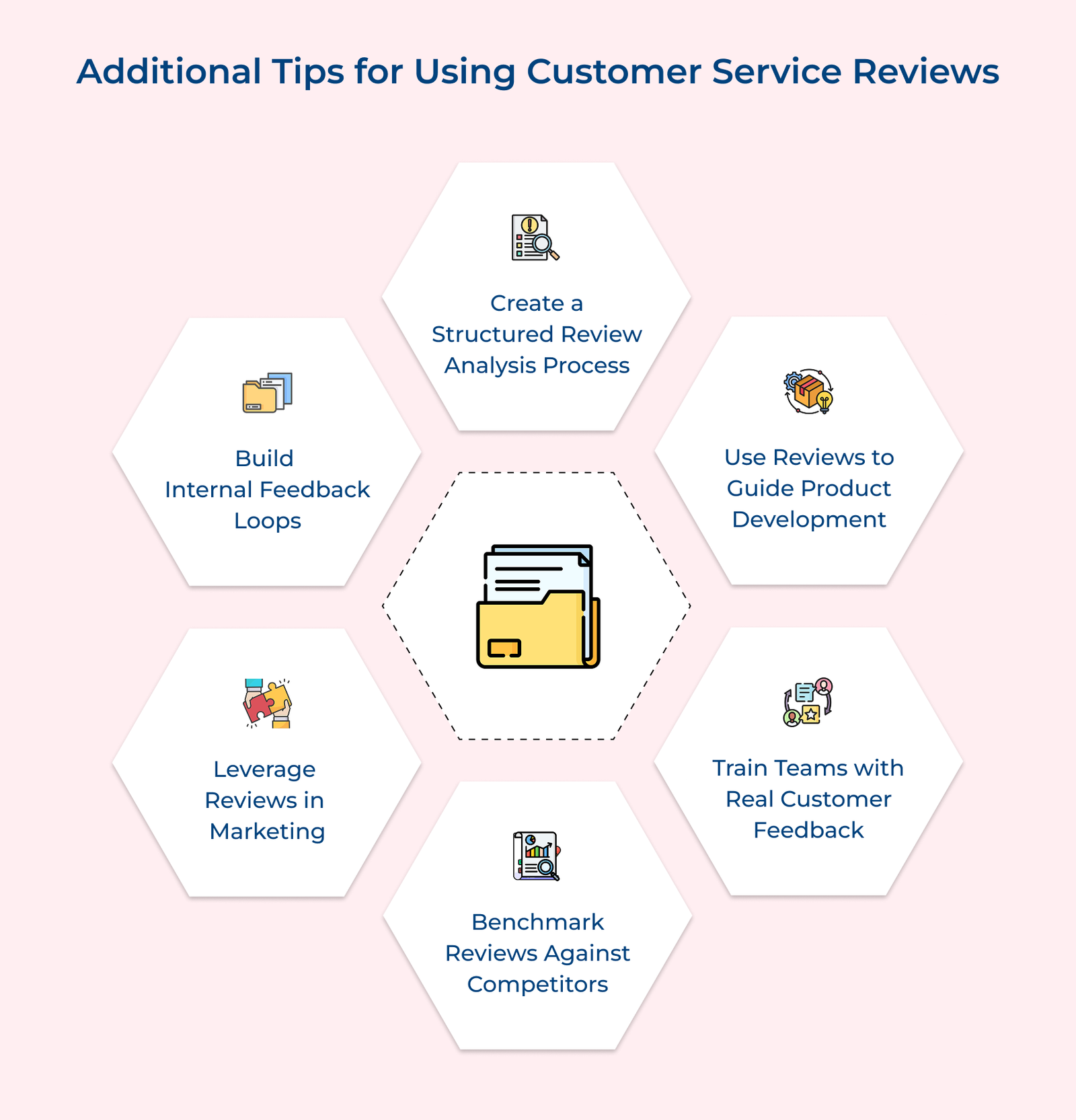
1. Create a Systematic Review Analysis Process
Develop a regular schedule for analyzing reviews across all platforms and categorize feedback by themes like product quality, customer service, or pricing. A clear system helps spot repeated issues that might be missed and makes sure important feedback doesn’t get overlooked.
2. Use Reviews to Guide Product Development
Customer reviews often contain specific suggestions for improvements or new features that customers want. Using direct feedback in your product plans helps you focus on changes that truly matter to customers. The approach improves satisfaction and avoids unnecessary work.
3. Train your Team Using Real Review Examples
Share both positive and negative reviews during team training sessions to illustrate what customers truly value. Clear feedback shows employees how their actions affect customers and gives real examples of what good service looks like, instead of vague ideas.
4. Compare Reviews Against Competitors
Regularly review what customers are saying about your competitors to identify your relative strengths and opportunities for differentiation. Competitive analysis highlights areas where your competitors fall short, giving you a chance to meet needs they’re missing and stand out.
5. Include Reviews in Marketing Materials
Incorporate authentic customer testimonials into your marketing campaigns to add credibility to your claims. Customer voices carry more weight than company messages because they show real proof that your product works.
6. Create Feedback Loops with Internal Teams
Establish a process for sharing relevant reviews with appropriate departments so everyone understands how their work affects customer satisfaction. When team members see how their work affects customers, they’re more motivated to provide quality and fix problems early.
The examples and response templates will help you effectively manage both positive and negative reviews while maintaining professional relationships with your customers.
Positive reviews reflect satisfied customers who experienced exceptional service. The reviews often mention what stood out, like friendly staff, fast fixes, or extra effort. They help build trust with new customers.
Tips for Responding to Positive Reviews
Template Response:
“Hi [Customer Name], thank you so much for your kind words about your experience with [Team Member Name]! We’re thrilled that we could help you with [specific situation mentioned]. Our team works hard to provide exceptional service and we look forward to serving you again soon!
Warmly,
[Your Name]
[Company Name]”
Negative reviews indicate customer disappointment with some aspect of their experience. Tough reviews point out what needs work and let you show that you’re serious about making it better.
Tips for Responding to Negative Reviews
Template Response
“Hi [Customer Name], thanks for your feedback. We’re sorry to hear your experience didn’t go as expected. We’d like to learn more about your experience, so please contact us at [contact information] when you’re available and we’ll make it right.
Thank you,
[Team Member Name]”
Neutral reviews typically contain both positive and negative observations. Balanced reviews are helpful because they come from customers sharing honest, thoughtful feedback, not just quick reactions.
Tips for Responding to Neutral Reviews
Template Response
“Hi [Customer Name], we appreciate you taking the time to share your thoughtful feedback with us. We’re glad you enjoyed [positive aspect] and thank you for pointing out [area of improvement]. We’re actively working on enhancing this aspect of our service. We hope to see you again so we can show you the improvements we’ve made!
Best regards,
[Team Member Name]
[Company Name]”
Product-specific reviews focus primarily on the item purchased rather than the service experience. The reviews often offer useful feedback on things like product instructions, packaging, delivery and other parts of the overall experience.
Tips for responding to product reviews:
Template Response
“Hi [Customer Name], thank you for your detailed feedback about [Product Name]. We’re pleased to hear that you enjoyed [positive feature mentioned]. Regarding [issue or question raised], we’d love to help you get the most out of your purchase. Please reach out to us at [contact information] for personalized assistance!
With appreciation,
[Team Member Name]
[Product Support Team]”
Despite the tremendous value of customer reviews, businesses often encounter significant obstacles when attempting to collect this valuable feedback from their clients.
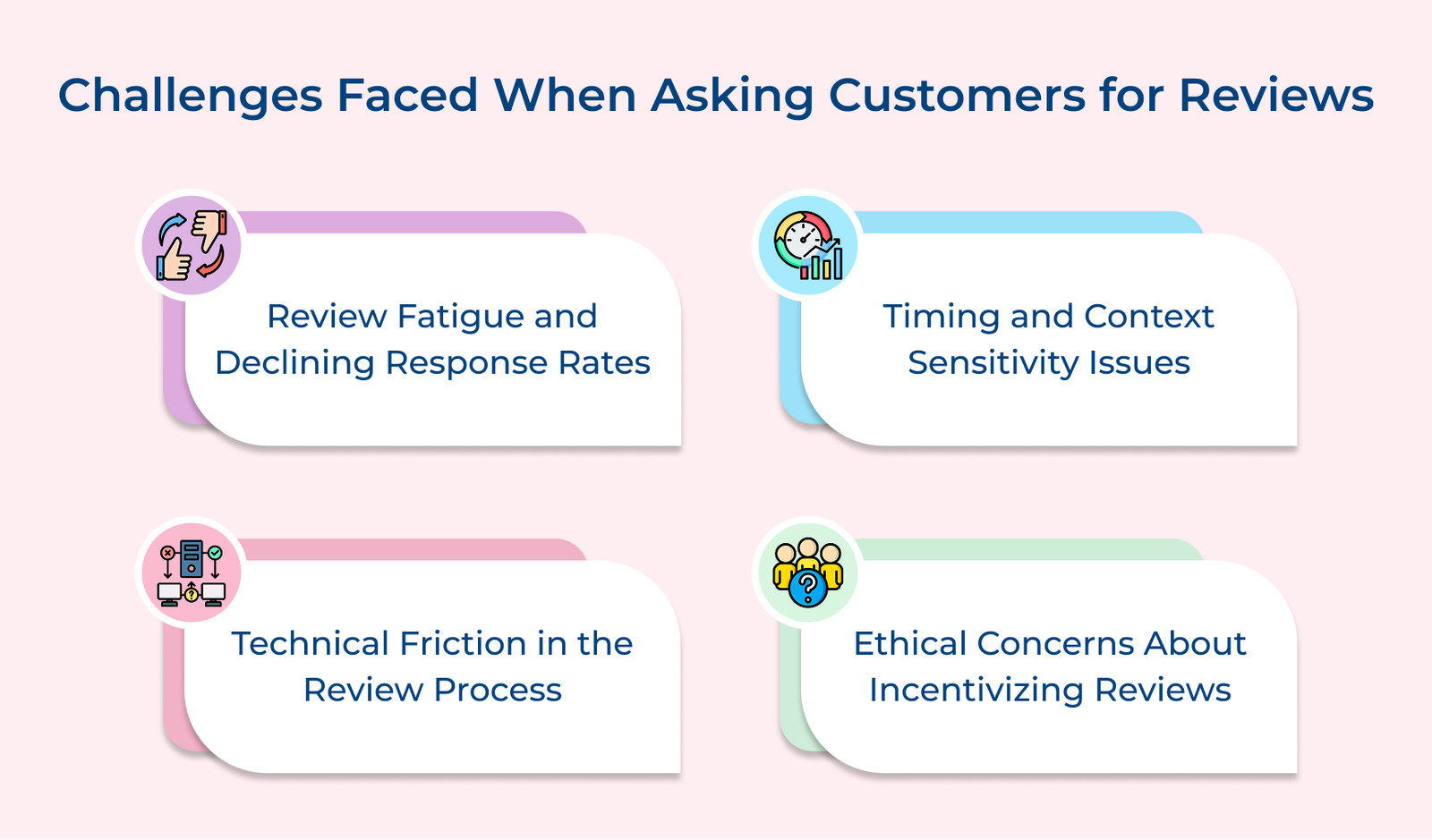
1. Review Fatigue and Declining Response Rates
Customers today are bombarded with review requests from nearly every business they interact with, leading to widespread review fatigue. Many review requests can lead to fatigue, making even satisfied customers ignore yours, lowering response rates despite better service.
2. Timing and Context Sensitivity Issues
Asking for reviews at the wrong moment in the customer journey can dramatically reduce both the quantity and quality of responses. Asking at the wrong time, during a bad moment, too soon or too late, can lead to harsh reviews or no response at all.
3. Technical Friction in the Review Process
Many businesses make it harder to leave feedback by adding too many steps, using confusing layouts or forcing account sign-ups first. Each additional click dramatically reduces completion likelihood, with rates dropping by approximately 50% with each added step.
4. Ethical Concerns about Incentivizing Reviews
Offering incentives creates challenging ethical dilemmas and potential policy violations on major review platforms. Incentives can boost response rates but might skew feedback, break platform rules and cause reviews to be flagged as less genuine.
Addressing these obstacles requires a strategic approach that respects the customer’s time while making the review process as frictionless and meaningful as possible.
Customer reviews are powerful tools that build trust, provide valuable insights, and drive business growth. Using these strategies, you can build a strong feedback process that gathers reviews and turns them into real improvements that make your business stand out.
Remember that authentic reviews aren’t just testimonials, but they’re ongoing conversations with your audience. When you request, respond to and share real customer experiences, you build connections that strengthen your brand. It keeps your customers coming back.

When evaluating, look for specific details rather than vague statements. Consider the overall pattern across multiple reviews instead of focusing on outliers. Pay attention to how recent the reviews are, as older feedback may no longer reflect current operations. Look for recurring strengths or weaknesses in reviews to spot consistent patterns in how your business is doing.
Start by mentioning what you purchased and when to write a helpful customer review. Describe your specific experience with concrete details rather than general opinions. Include both positives and areas for improvement to provide balance. Share why you gave that rating and if you’d buy the product again. Remember that specific details help both businesses and potential customers.
Improve your reviews by addressing the root causes of customer dissatisfaction uncovered in feedback. Use a clear process to fix problems from fake reviews and build on what’s praised in positive ones. Help employees see how their work affects reviews and create focused plans to address common issues.
Reviews and testimonials provide social proof that builds trust with potential customers who are increasingly skeptical of traditional marketing. Reviews share honest views from real users, shaping buying decisions more than company content. They also reveal customer preferences, highlight hidden issues and boost your search rankings.
Respond to negative reviews promptly and professionally, beginning with a sincere apology for the customer’s disappointing experience. Respond to each concern personally instead of using a generic reply. Clearly explain how you’re fixing the problem without excuses. Offer to discuss the issue privately to find a solution and encourage the customer to update their review.
Quality matters more than quantity, but research suggests businesses should aim for at least 40 reviews to establish credibility. Fresh reviews matter as 85% of consumers ignore those older than three months. Build a steady review process instead of gathering feedback sporadically. For local businesses, prioritize Google reviews since they greatly affect visibility.
Grow Customer Relationships and stronger team collaboration with our range of products across the Conversational Engagement Suite.
Omnichannel Customer Support & Help Desk Software
AI Enabled Business Messaging and Chatbot Software
Sales Engagement & CRM Software
Call Center Software & Virtual Phone System
Product Marketing & Experience Platform
Customer Experience & Feedback Management Software

 How to Create an Internal Wiki? Benefits, Types & Key Steps (2026)
Scroll to top
How to Create an Internal Wiki? Benefits, Types & Key Steps (2026)
Scroll to top