How to Write a Follow Up Email? The Complete Guide
Learn how to write a follow up email that is clear, timely and effective. It includes practical tips, templates and best practices to maintain professional communication.
Learn how to write a follow up email that is clear, timely and effective. It includes practical tips, templates and best practices to maintain professional communication.
Ever sent a solid email and then waited…and waited? It happens to everyone. Even strong messages get lost because people are juggling crowded inboxes all day. If you skip the follow up, the conversation usually fades along with the momentum you worked to create. 80% of all sales take at least 5 follow-ups.
Plenty of people feel stuck on how to write a follow up email. You want to give a gentle nudge without sounding pushy. Staying silent isn’t great either because it can close a door that was already cracked open. Timing feels tricky, the phrasing feels awkward and the whole thing starts to feel heavier than it should.
This guide keeps it simple. You’ll see how to follow up with confidence, write messages that sound natural and reach out at the right moment. You get templates, timing cues and clear examples that make follow ups easier to send and harder to overlook.
A follow-up email refers to a thoughtful message sent after an earlier interaction, usually when you haven’t received a reply or when you want to continue the conversation. The emails are useful in many settings: to gently remind someone of your previous message, to show that you’re still interested or to move things forward after a meeting or proposal.
What makes follow-up different from any other email is that it builds on a past exchange. It’s not a cold start but a nudge. Whether you’re reconnecting with a lead, checking in after an interview or following up on a collaboration, the goal is to keep the dialogue going without coming across as pushy.
Done well, a follow-up email shows that you’re reliable, respectful of the recipient’s time and genuinely invested in continuing the conversation. It’s not about pressure but about presence.
Key principles:
Let’s go through the key benefits of follow-up emails. See how they not only boost response rates but also keep important conversations from slipping through the cracks.
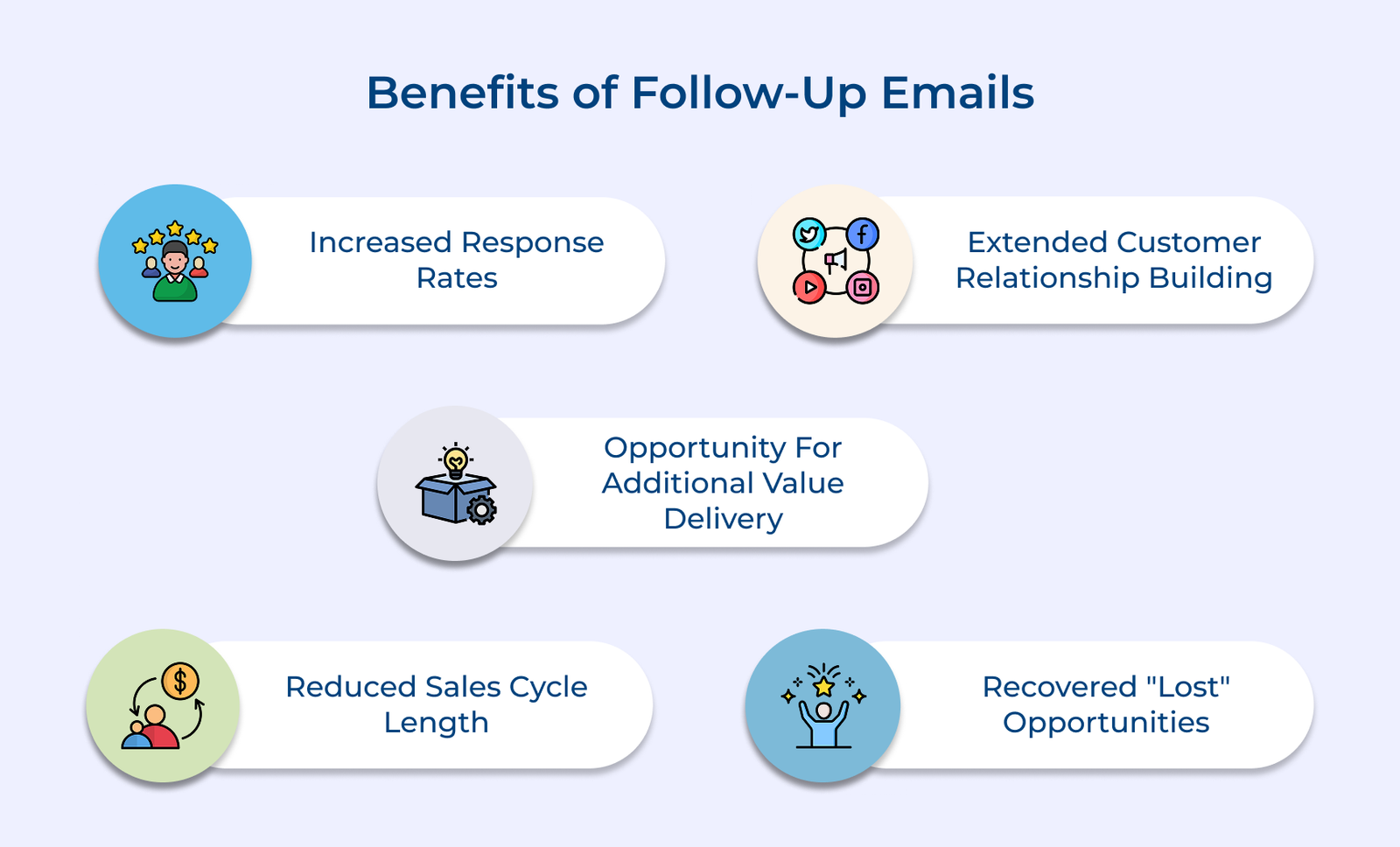
1. Increased Response Rates
People often miss or forget emails, especially on busy days. Following up gives your message more chances to be seen and acted on. Sending more than one follow-up can more than double your response rate compared to just sending one email.
2. Extended Customer Relationship Building
Every follow-up is a chance to build familiarity. Instead of dropping off after one message, staying in touch shows reliability and genuine interest. Just like any real-world connection, relationships grow through regular, thoughtful interaction, not one-off conversations.
3. Opportunity for Additional Value Delivery
Instead of repeating yourself, use each follow-up to offer a helpful tip, an article, or a relevant solution. It turns your emails from interruptions into something the other person actually looks forward to and makes you someone worth listening to.
4. Reduced Sales Cycle Length
Conversations can stall when someone isn’t sure what to do next. Follow-up emails that address their concerns or clarify next steps can gently move things forward, often faster than waiting for them to come back on their own.
5. Recovered “Lost” Opportunities
A “no” today might turn into a “yes” next month. People’s priorities shift and follow-ups give the dormant conversations a second chance. Sometimes, all it takes is showing up again at the right time.
Below are the straightforward steps to crafting the perfect follow-up email that resonates with your audience and elevates your communication skills.
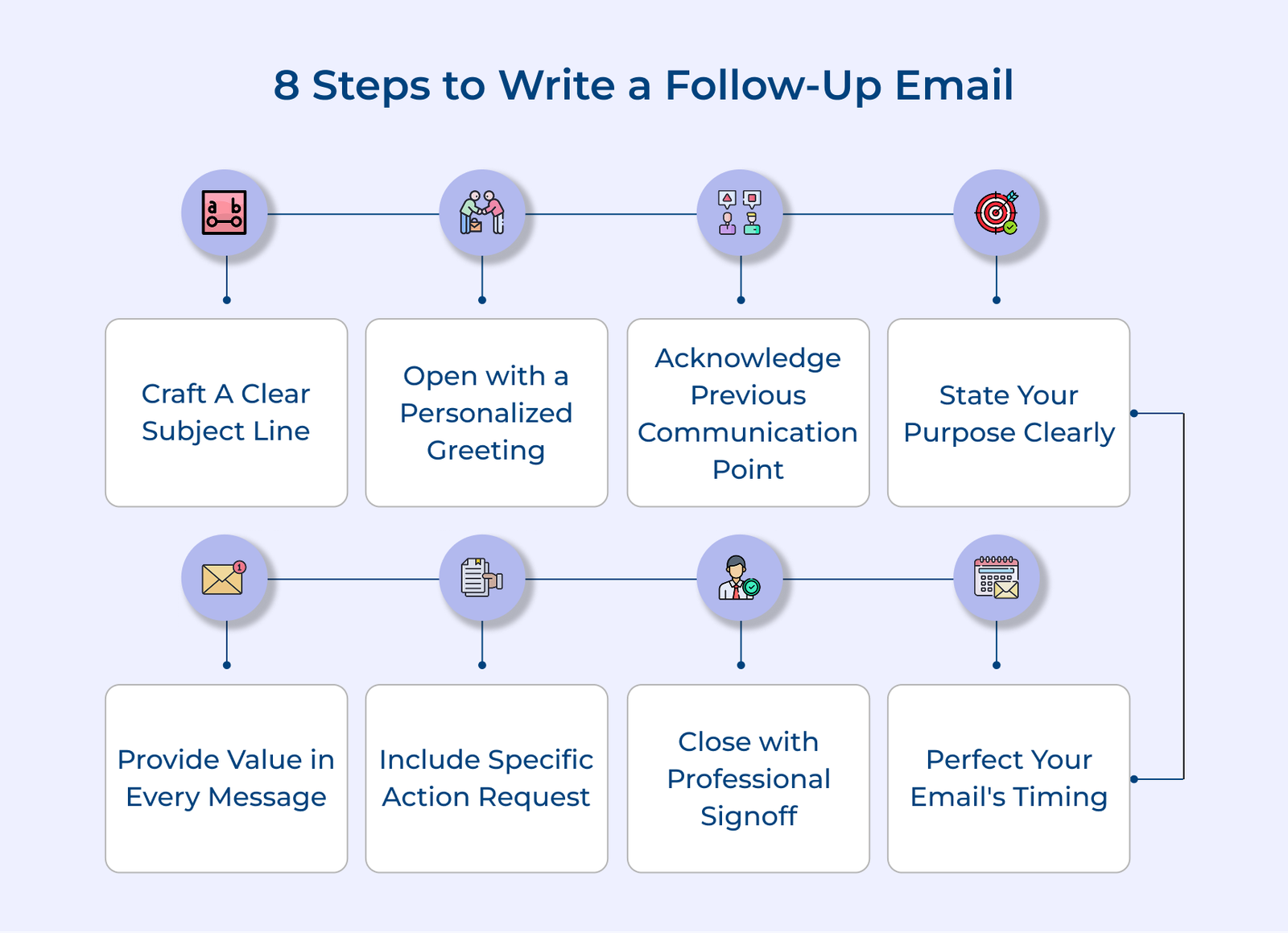
The subject line is your first and sometimes only shot at getting noticed. It has to be clear, relevant and respectful of your reader’s time. No gimmicks just a direct, thoughtful message that gives them a reason to click.
Key types:
Value-oriented: “Extra resources we discussed on marketing automation.” It sets the expectation that there’s something useful inside, not just a nudge.
Timeline-based: “Quick follow-up before Friday’s proposal deadline.” It’s a gentle reminder that helps them manage their own schedule without pressure.
Question format: “Still considering the timeline we outlined?” Opens the door for a conversation, not just a reply. People are more likely to respond to questions.
Reference-specific: “Re: Your request about pricing details.” A simple, effective way to signal that this isn’t a cold email. It connects the dots immediately.
Keep it short; under 50 characters is best for mobile visibility. Don’t use ALL CAPS or flashy punctuation that triggers spam filters or test your subject line by asking whether it would make you open an email from someone else.
The way you open a follow-up email can shape how it’s received before they even reach the second sentence. A genuine, well-considered greeting signals that the message isn’t just another copy-paste; it’s from you, to them.
Use the Recipient’s Preferred Name
Address your recipient exactly as they sign their emails or introduce themselves. The small detail shows you’re paying attention to their preferences and builds instant rapport. Notice if they use their full name, nickname or professional title in previous communications and mirror the approach to create comfortable familiarity from the first line.
Reference Specific Previous Interaction
Begin with a brief, specific mention of your last communication to provide immediate context. It might include referencing a particular conversation topic, meeting date or shared experience that connects you. The specificity proves your follow-up is thoughtful and personalized rather than a generic template, immediately distinguishing your message from mass emails.
Set a Friendly, Professional Tone
Match your tone to the relationship depth. The tone should reflect your previous interactions while remaining respectful of business boundaries. The careful calibration helps create comfort without seeming overly familiar, establishing a communication environment where the recipient feels both respected and valued as you move into the main content.
When you acknowledge a previous interaction, you’re not just being polite, you’re showing the other person that you’re listening, paying attention and treating your conversation as a thread worth continuing. The small step makes a big difference in how your follow-up is received.
You don’t need to retell the whole story, but just enough to remind them of the context. A quick nod to an earlier point keeps the conversation flowing and signals that your message fits into a larger, meaningful exchange rather than a random grab for attention.
Clearly stating your purpose avoids confusion and shows respect for the recipient’s time. It tells them right away why you’re reaching out and what you’d like them to do, which helps them stay engaged rather than losing interest halfway through your message.
Adding something useful in every follow-up shifts your message from being a nudge to being a genuine contribution. Instead of just reminding someone you’re waiting on a reply, you’re giving them a reason to welcome your message and maybe even look forward to the next one.
Sharing a relevant industry report during a follow-up can shift the whole conversation. Highlight the parts that speak directly to the client’s challenges so they can see you get what they’re dealing with. This move gives them something useful right away and shows you’re thinking about their growth, not just trying to close a deal. It builds trust and nudges them to respond.
A clear, specific action request turns your follow-up into something useful and not just a polite nudge. It tells the recipient exactly what you’re hoping for, when you need it and why it matters, making it far easier for them to respond without overthinking or deferring it until “later.”
When following up after sending a proposal, a weak action request might be “Let me know what you think.” A stronger alternative would be: “Could you please review the proposal by Thursday and let me know if you’d like to proceed with Option A or B? I’ve reserved implementation time for next week based on our previous conversation and your decision will help us maintain that timeline.” The request is specific, time-bound and explains both what you need as well as why it matters.
Your closing isn’t just the end of your email; it’s your final chance to leave a strong, respectful impression. A good sign-off shows you’re thoughtful, approachable and professional, all while making it easy for the recipient to respond or stay in touch.
After sending a follow-up about a potential partnership opportunity, you might close with: “I appreciate your consideration of this collaboration. I’m available for a 15-minute call on Thursday or Friday to address any questions. The approach expresses appreciation, offers specific availability, maintains positive momentum and provides multiple contact options, all elements that make responding feel easy.
The timing of your follow-up email often decides if it gets noticed or ignored. When you send your message matters just as much as what it says. A well-timed email shows you’re considerate of the recipient’s schedule and gives your message the best chance of being seen.
Consider the Recipient’s Likely Schedule
Understanding your recipient’s typical work patterns helps you choose the ideal sending time. Consider their industry norms, time zone and known busy periods when selecting when to send.
Space Multiple follow-ups Appropriately
Creating a thoughtful cadence between follow-ups shows persistence without becoming annoying. The appropriate interval varies by context, like 24-48 hours might be suitable for urgent matters, while 5-7 days works better for non-urgent requests. The balanced approach demonstrates your continued interest while respecting the recipient’s autonomy and timeline.
Follow-up emails can feel tricky, yet they often decide how a conversation moves forward. The following set of templates and examples shows you what to say, when to say it and how to keep the exchange warm without sounding pushy.
A good sales follow-up strikes a careful balance as it keeps the conversation going without coming across as pushy. The goal is to re-engage a prospect who’s shown some interest but hasn’t taken the next step. Done right, a follow-up feels more like helpful problem-solving than another sales pitch.
The most effective messages reference earlier conversations to show you’ve been paying attention and they offer something useful that helps the prospect move forward. Rather than pushing a product, the focus should be on their needs and how you can help. A clear and easy next step, like a short call or specific question, makes it simple for the recipient to respond without much effort.
Example:
Subject: Thought more about your inventory challenge
Hi [Name],
I’ve been thinking about the inventory issue you mentioned in our call last Tuesday. I came across a short case study where a company in your space cut stockouts by 37% —thought it might be relevant.
Would you be open to a quick 15 minutes call this week to see if something similar could work for [Company]? I’m free Tuesday or Wednesday afternoon—just let me know what works best.
Best regards,
[Your name]
———-
The no-response follow-up addresses the common scenario where your initial email received no reply. Its purpose is to gently resurface your message without making the recipient feel guilty or pressured. The template strikes a balance between persistence and understanding that people have busy lives.
The key to the template is offering a fresh perspective or new information rather than simply repeating your original request. It acknowledges that the recipient likely has many priorities and provides them with a graceful way to re-engage without awkwardness about their previous silence.
———
Example:
Subject: A quick follow-up on [topic/project]
Hello [Name],
I know things can get hectic and it’s easy for emails to slip through the cracks. Since I last reached out, I’ve come across a few new ideas on [insert relevant topic] that I thought might be useful given what you’re working on.
Would you be open to a quick 10-minute chat this week? If now’s not the right time, I’m happy to circle back later—just let me know what works best for you.
Regards,
[Your name]
—
The meeting follow-up email does two important things: it captures what was discussed and helps move things forward. It shows that you were paying attention, helps everyone stay on the same page and prevents tasks from slipping through the cracks.
The most effective follow-ups are sent within a day of the meeting, while the conversation is still fresh. They include a short recap of key points, clear next steps with who’s doing what by when and any promised materials or links. It keeps the momentum going and shows that the meeting mattered.
——
Example:
Subject: Recap & Next Steps – Website Redesign
Hi [Name],
Thanks again for a focused and productive conversation yesterday about the website redesign. I’ve attached the timeline we walked through during the meeting.
Next steps:
• You’ll share the brand guidelines by Friday
• I’ll send over the first wireframe draft by next Wednesday
• We’ll meet again on Thursday at 2 PM to review
Please let me know if I’ve missed anything important!
Best,
[Your name]
——–
Marketing follow-up emails are designed to build on a prospect’s initial interest, like if they downloaded a guide, joined a webinar or explored your pricing page. The goal is to stay relevant and helpful by offering content that aligns with what they’ve already engaged with.
Strong marketing follow-ups don’t push a sale too soon. They continue the conversation by sharing useful resources, answering unspoken questions and guiding the prospect naturally toward the next step in their decision-making process.
—–
Example:
Subject: Your [webinar name] questions answered
Hello [Name],
Thank you for joining yesterday’s webinar on content marketing strategies. I saw your question about measuring ROI and thought you might find the simple tracking template useful—it’s designed to make the process clear and actionable.
If it would help, I’d be happy to walk you through how to adapt it for your industry. Would a quick 15-minute chat work sometime this week?
Regards,
[Your name]
——–
The cold lead re-engagement email is your chance to restart a stalled conversation without sounding pushy or frustrated. It’s meant for prospects who once showed interest but have been quiet for a while.
Instead of highlighting the silence, the emails offer something new in the form of an update, a relevant shift in the industry or a helpful resource. A good re-engagement email feels like you’re picking up where you left off, with something timely and worthwhile to share. Referencing the lead’s earlier goals or concerns helps you stay relevant and shows you’re reaching out with their interests in mind, not just chasing a sale.
—–
Example:
A while back, we talked about your team’s challenges around customer retention. Since then, we’ve refined a new approach that’s helped teams at [similar company] cut churn by 23%.
Is retention still something you’re working to improve? I’d be glad to walk you through what’s working. Something like this adds no pressure or expectations.
Best,
[Your name]
——
The networking follow-up email helps turn a brief introduction into a meaningful professional connection. It shows genuine interest in staying in touch and opens the door to future conversations.
The most effective messages mention something specific from your initial interaction to make it personal and memorable. They also suggest a simple, low-pressure next step, like sharing a useful resource or grabbing time for a short call, to keep the relationship moving forward.
—-
Example:
Subject: Good to meet you at [event name]
Hi [Name],
It was great talking with you about remote team management challenges at yesterday’s conference. I especially appreciated your take on virtual team-building—simple ideas with real impact.
I came across an article that expands on the virtual coffee chat idea you brought up and thought it might be worth a look. Would you be open to connecting on LinkedIn? I’d enjoy staying in touch and continuing the conversation.
Regards,
[Your name]
—-
Check out the pivotal roles of AI and automation in sending follow-up emails and how they can help you maximize your engagement while minimizing your workload.
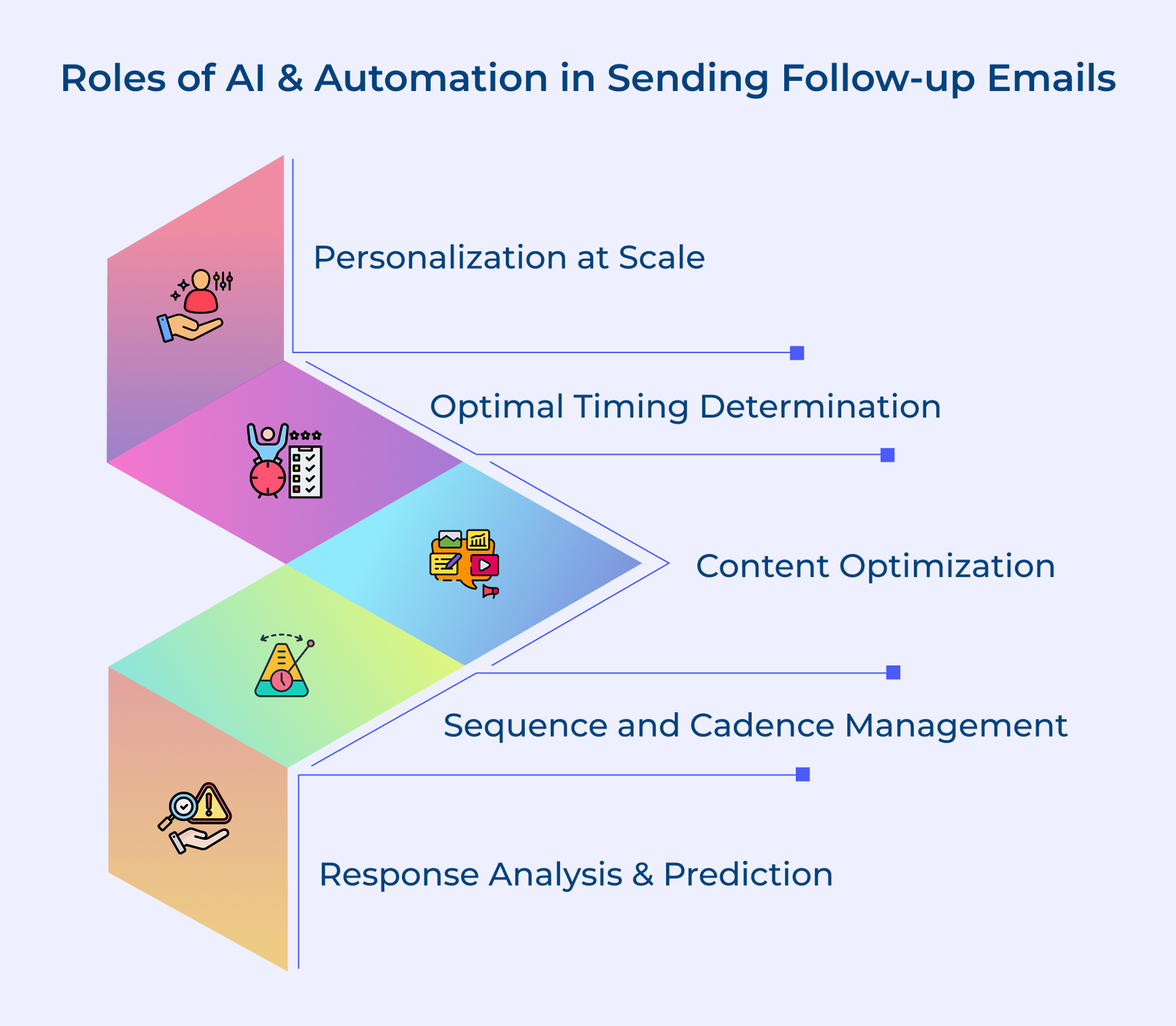
1. Personalization at Scale
AI can scan past interactions and recipient data to tailor each follow-up message with relevant details, without needing to write every email from scratch. It helps you avoid generic messages while keeping the tone personal, even at scale.
2. Optimal Timing Determination
Instead of guessing the right time to follow up, AI analyzes when each person usually opens or responds to emails. Messages arrive when they’re most likely to be read and not buried under a flood of other notifications.
3. Content Optimization
Machine learning tools figure out which messages get better responses by testing different subject lines and email formats. Over time, it helps you adjust your approach based on real results and not just hunches.
4. Sequence and Cadence Management
AI-powered tools can schedule and space out your follow-up messages so they don’t come across as pushy. You get a steady rhythm of communication that moves things forward without overwhelming the person on the other end.
5. Response Analysis and Prediction
AI doesn’t just send messages; it can also read between the lines. It flags which leads seem ready to move forward and which ones may need a different approach by analyzing how people respond (or don’t). It lets you focus your time where it’s most likely to make a difference.
Below are the key mistakes you should steer clear of to maximize the impact of your follow-ups and enhance your professional relationships.
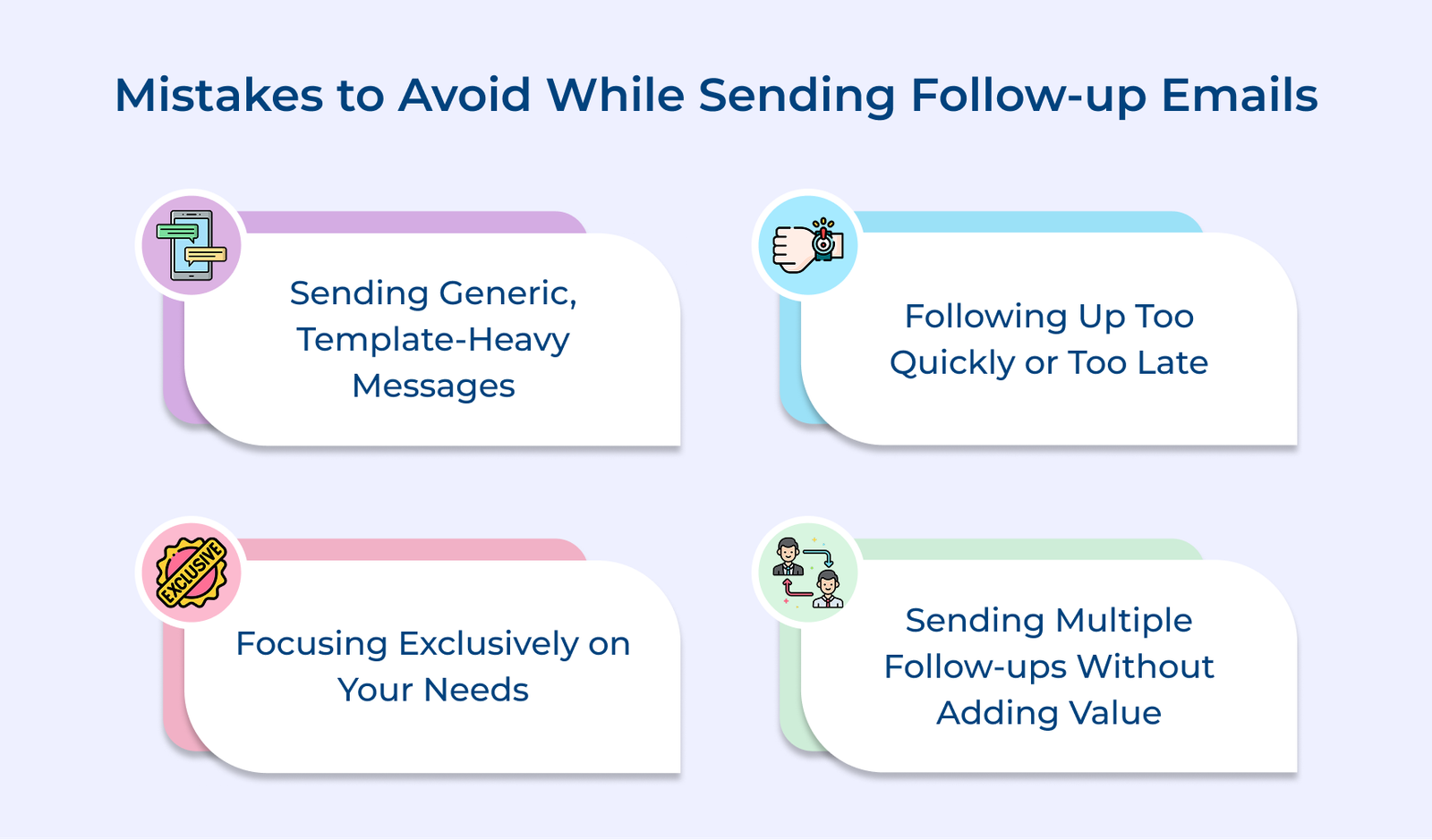
1. Sending Generic, Template-Heavy Messages
Using the same message for every follow-up makes your email feel like it was written for a list, not a person. When there’s no sign you’ve considered the recipient’s situation, it’s no surprise they don’t take the time to reply.
2. Following Up too Quickly or Too Late
Following up too soon can come off as impatient and waiting too long makes it easy for the recipient to forget who you are. The right timing shows respect for their time and helps keep the conversation relevant.
3. Focusing Exclusively on Your Needs
When a follow-up focuses only on what you want like the feedback, a meeting, or a decision, it can feel like a one-way street. If the message doesn’t show why responding helps them, people are far less likely to bother.
4. Sending Multiple Follow-ups Without Adding Value
Sending the same message again and again with just a new subject line doesn’t increase your chances. If each follow-up doesn’t offer something useful or new, it quickly becomes background noise or worse, a red flag.
Implementation steps:
The follow-up email is one of the most overlooked tools in professional communication. Done well, it is more than a reminder as it keeps conversations alive, shows genuine interest and often turns silence into opportunity. What sets an effective follow-up apart is not persistence alone, but timing, relevance and a clear next step.
When you treat each message as a chance to add value, not just get a reply, you shift from chasing roses to building real connections. Follow-ups aren’t just administrative tasks. When written with care and purpose, they become one of the most useful tools for moving conversations forward.

Send your first follow-up email 3-5 business days after your initial message if it requires action, or 24-48 hours after time-sensitive communications like interview thank-you notes. Wait about a week after proposals for sales contexts. Consider the recipient’s likely workflow or industry norms—legal and financial professionals often need longer response windows than marketing or technology contacts.
Two to three follow-ups are usually enough in most professional settings. Try spacing them out—start with 3 days, then 5–7 days later, then 10–14 days for the final one. Beyond that, continuing might cross into unwelcome territory. Persistence only works when paired with respect for people’s time and bandwidth.
Instead of repeating the same message, try something new. Reach out on a different channel, like a quick call or a LinkedIn message. If you have a shared connection, ask for an intro. If nothing lands, consider sending a short, polite final email to pause the conversation while leaving the door open for the future.
Use the Schedule Send feature in Gmail by clicking the arrow next to the send button and selecting your preferred timing. Try Gmail plugins like Boomerang or Right Inbox for automated sequences. Use the Delay Delivery option in Outlook under Options > More Options > Delay Delivery or set up Rules to create automated workflows for certain message types.
Automation helps you stay consistent even when you’re busy. It keeps messages from falling through the cracks, helps test what works best like subject lines or send times and scales your outreach without sounding robotic. Smart tools can even pause a sequence when someone replies, so you’re not spamming people who’ve already engaged.

Grow Customer Relationships and stronger team collaboration with our range of products across the Conversational Engagement Suite.
Omnichannel Customer Support & Help Desk Software
AI Enabled Business Messaging and Chatbot Software
Sales Engagement & CRM Software
Call Center Software & Virtual Phone System
Product Marketing & Experience Platform
Customer Experience & Feedback Management Software
 Sales Performance Review: The Complete Guide
Scroll to top
Sales Performance Review: The Complete Guide
Scroll to top