What is Sales Objection? Key Types, Examples and Steps
Sales objections are a natural part of selling. Understanding their root causes, knowing common types and using structured response steps helps reps handle pushback confidently.

Sales objections are a natural part of selling. Understanding their root causes, knowing common types and using structured response steps helps reps handle pushback confidently.
Have you ever been in a situation where you’re having a solid sales conversation and then the prospect drops an objection that brings everything to a sudden stop? Well, we get it. It can be frustrating because one misstep can cost you a deal you’ve spent weeks building. More than 60% of salespeople are losing business because of improperly resolved objections.
Every B2B rep deals with sales objections, but the difference between closing and losing often comes down to how you respond in that moment. The gap between expecting objections and handling them well is what separates top reps from those who lose deals.
The guide will help you learn proven frameworks that turn customer objections from deal-killers into opportunities. It shows how those moments can strengthen your relationship with prospects and move conversations forward.
A sales objection refers to a concern or hesitation a buyer raises that prevents them from moving forward. It signals what’s holding them back and gives you a chance to address the real issue instead of guessing.
An objection is something you can work through with the right information or approach. The prospect has genuine concerns about price or timing or fit that can be addressed through conversation and problem-solving.
An obstruction is a real barrier that stops the deal completely. Think of situations like a company hiring freeze or a competitor’s existing contract that cannot be broken for another year.
Key objectives:
Let’s go through the reasons why handling sales objections matters. Addressing them well keeps conversations moving and helps you turn hesitant prospects into confident buyers.
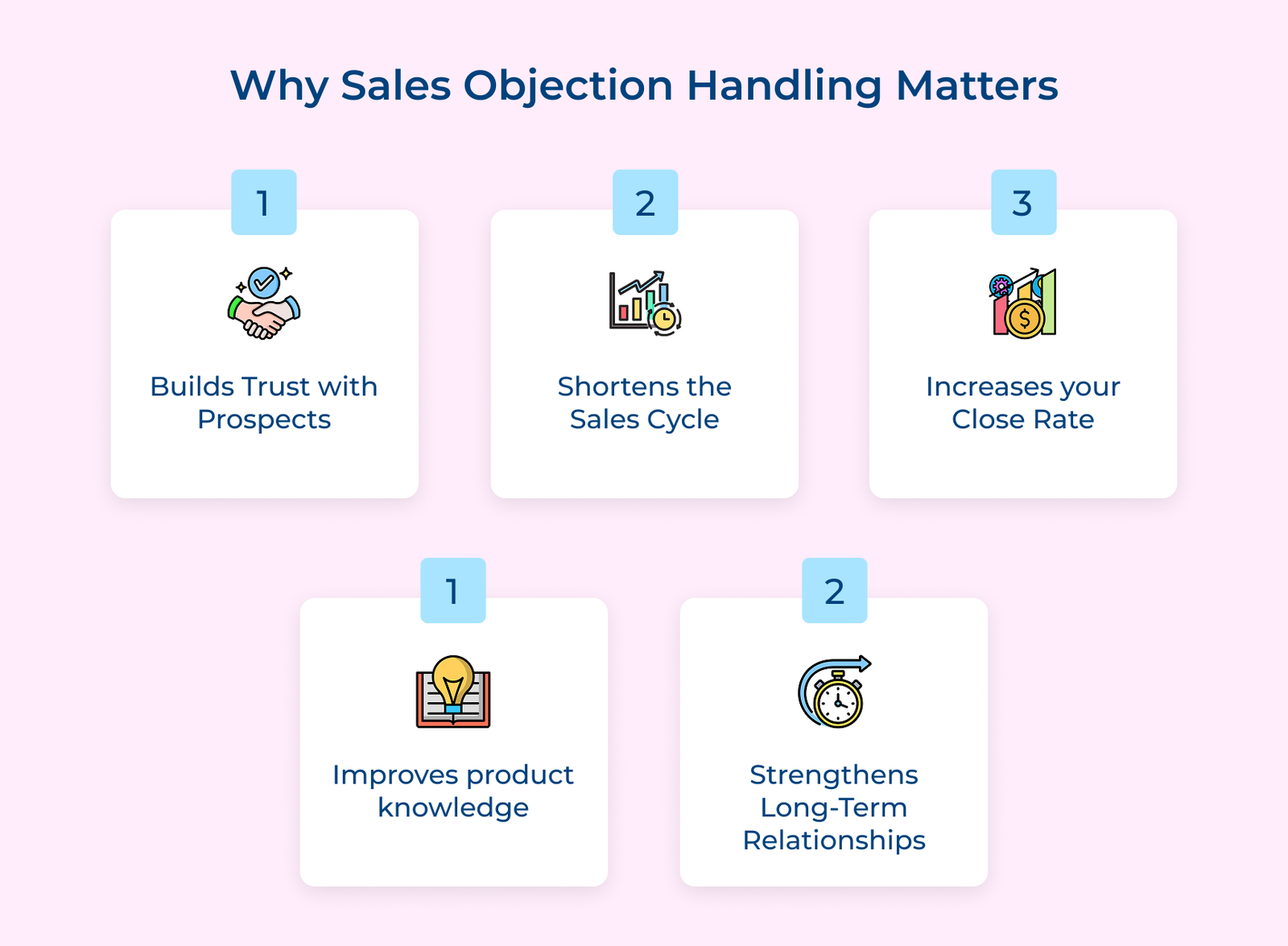
Builds Trust with Prospects
When you take concerns seriously instead of brushing them aside, prospects see that you’re focused on helping them, not just closing a deal. Honesty builds real trust.
Shortens the Sales Cycle
Objections left hanging slow everything down. Addressing them early gives prospects the clarity they need to move forward instead of getting stuck in indecision.
Increases Your Close Rate
Many deals faded simply because concerns were never resolved. When you handle objections well, more conversations stay alive and more of them end in a “yes.”
Improves Your Product Knowledge
Each objection teaches you how buyers view your solution. Over time, you get better at explaining value, anticipating concerns and refining your message.
Strengthens Long-term Relationships
People remember how you supported them during the buying process. When prospects feel heard, they stay longer, buy more and recommend you to others.
The following are the five most common types of sales objections you’ll face and how to understand each one. Let’s check them out in more detail.
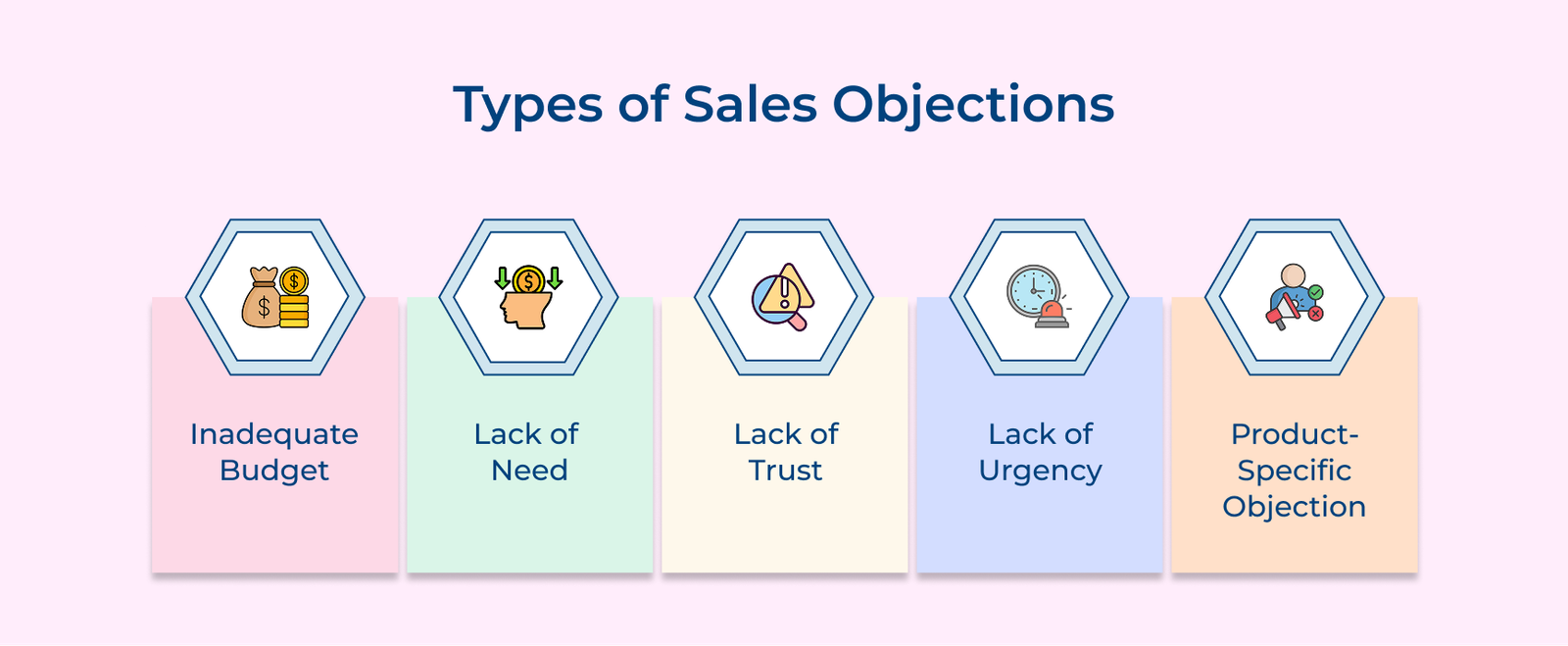
The prospect claims they don’t have enough money allocated for your solution right now. The objection surfaces when the perceived value doesn’t justify the investment or when budget planning cycles don’t align with your timing.
Sometimes it reflects a real financial constraint but often it means you haven’t demonstrated ROI clearly enough. The prospect might have a budget available but they’re prioritizing other initiatives that seem more critical to their immediate business goals.
Common variations:
If a prospect says they don’t need your solution, it usually means they don’t see the problem clearly, or they believe their current setup is “good enough.” Your role is to help them see gaps they may have overlooked and connect those gaps directly to their goals.
Key statements:
The prospect isn’t confident in your company or your ability to deliver what you promise. Trust issues often come from not knowing your brand well or hearing negative feedback from industry peers. They might worry about implementation challenges or question if you’ll provide adequate customer support after the sale.
Past experiences with vendors who overpromised and underdelivered make prospects hesitant to commit to a new, unproven partner.
The prospect agrees your solution could help them but sees no compelling reason to act now. They plan to revisit the decision in a few months or next quarter when things feel less hectic or uncertain.
The objection often masks other concerns they haven’t voiced yet or reflects competing priorities demanding their attention. Without a clear downside to waiting, prospects stick to the status quo even if they see your solution’s value.
The prospect raises concerns about particular features or limitations within your actual product offering. They need functionality you don’t provide or they’re worried about technical compatibility with their existing systems and workflows.
Such types of sales objections are concrete and specific rather than vague hesitations about general concepts. The prospect might compare your solution unfavorably to a competitor’s feature set or question if your product can scale with their growing needs.
Key phrases:
Below are the ways to understand what prospects really mean and how to respond in ways that move the conversation forward.
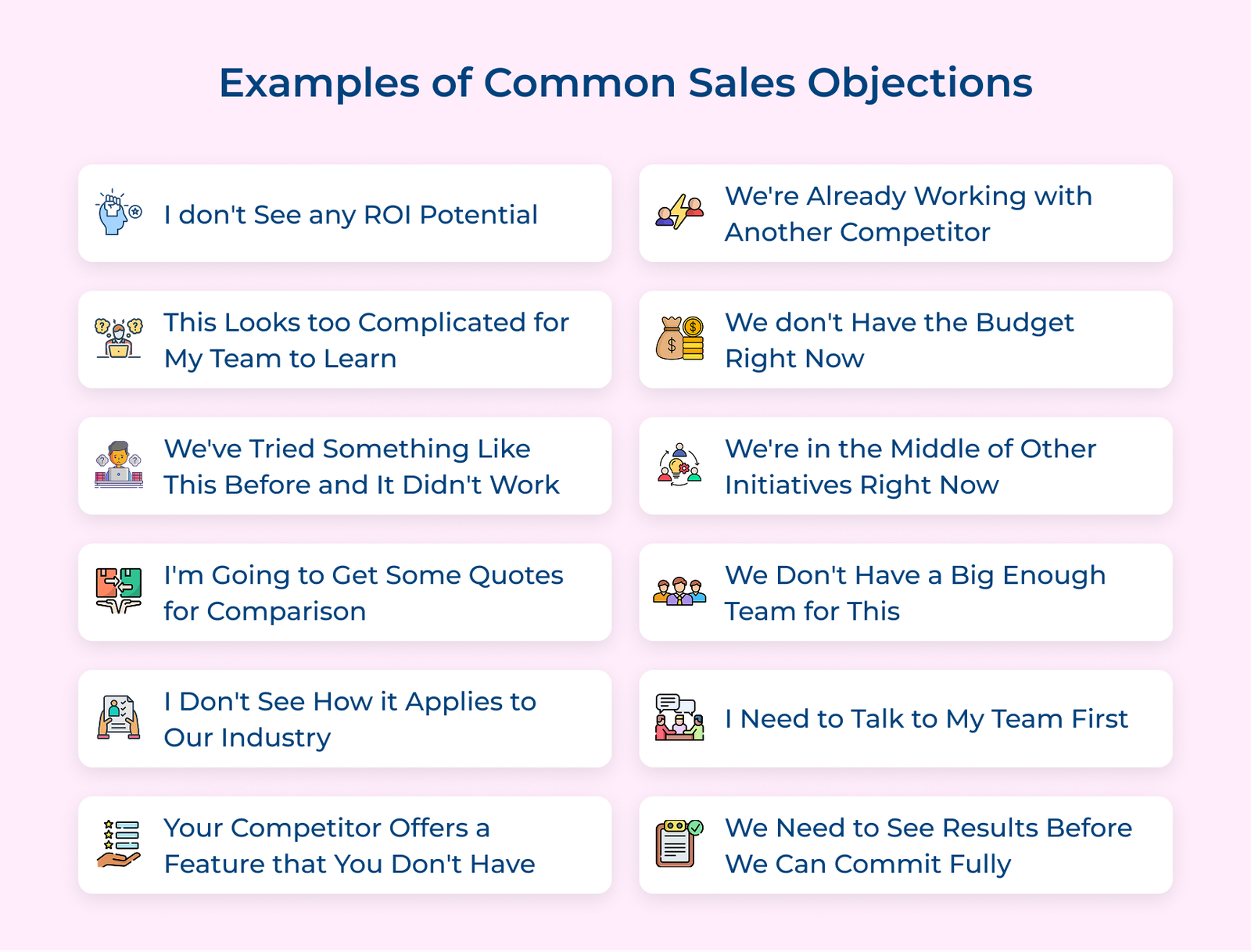
1. “I don’t See any ROI Potential.”
When a prospect says it, it means they can’t yet connect your solution to real, measurable impact. They’re unsure how it would help their numbers or improve their daily operations. Your job is to help them see the practical outcomes, not just the features.
Response: “Let me share how similar companies in your situation saw returns within the first quarter through reduced operational costs and improved efficiency.”
2. “We’re Already Working with Another Competitor.”
When a prospect says it, it means they’re not starting from scratch; they already have a solution they depend on. Your goal isn’t to attack their current vendor but to understand what’s working, what isn’t and where you can offer something genuinely better.
Response: “That’s good to hear. You already have a system in place. What parts of it are serving you well and where do you feel it falls short or slows your team down?”
3. “This Looks too Complicated for My Team to Learn.”
Here, the prospect is worried about the learning curve. They fear lost time, slower workflows and pushback from a team that’s already juggling multiple tools. Their concern isn’t about the product itself; it’s about the transition.
Response: “Our implementation includes hands-on sales training sessions and our average team gets fully operational within two weeks with dedicated onboarding support throughout.”
4. “We don’t Have the Budget Right Now.”
The prospect indicates that money is allocated elsewhere or that purchasing authority is limited at this moment. It requires you to understand their budget cycle and if the constraint is temporary or reflects a genuine inability to invest.
Response: “I get it. Budgets are tight everywhere. Can we talk about when your next planning cycle begins or look at a smaller, phased start that fits your current limits?”
5. “We’ve Tried Something Like This Before and It Didn’t Work.”
A past failure can make any prospect cautious. They remember wasted time, messy rollouts or tools that were never delivered, so they hesitate even if your solution takes a different approach.
Response: “Can you walk me through what didn’t work last time? If I understand the issues, I can show you exactly how we handle those parts differently.”
6. “We’re in the Middle of Other Initiatives Right Now.”
The prospect’s attention and resources are consumed by competing priorities that feel more urgent than your solution. They’re not rejecting your value but rather indicating that timing conflicts with their current focus areas and bandwidth limitations.
Response: “That makes sense. What projects are taking priority right now? That’ll help me get a sense of your timeline and when it makes sense to reconnect.”
7. “I’m Going to Get Some Quotes for Comparison.”
The prospect wants to check what else is available before deciding. It’s a normal part of B2B buying, especially when multiple people need to approve the purchase.
Response: “Absolutely, comparing options is smart. What criteria matter most to you so I can help you evaluate vendors effectively during your research?”
8. “We Don’t Have a Big Enough Team for This.”
The prospect assumes your solution needs more staff than they currently have. They’re worried their small team will be stretched thin or won’t have the bandwidth to manage something new.
Response: “Our solution actually helps small teams accomplish more without adding headcount. Let me show you how automation handles the heavy lifting.”
9. “I Don’t See How it Applies to Our Industry.”
Your prospect isn’t convinced your solution fits the realities of their industry. They want to know you’ve actually helped people who deal with the same rules, pressures, and day-to-day challenges they face, not just broad business issues.
Response: “We work with several companies in your industry facing these same challenges. Can I share specific examples of how they applied this?”
10. “I Need to Talk to My Team First.”
The prospect lacks confidence to make the decision independently and needs input from colleagues or stakeholders. It indicates either shared decision-making authority or a need to build internal consensus before moving forward with any commitment.
Response: “That’s a wise approach. Would it help if I joined that conversation to answer any technical questions your team might have?”
11. “Your Competitor Offers a Feature That You Don’t Have”.
The prospect points out a feature they’ve seen elsewhere and wants to know if your solution can still solve their problem without it. They’re really testing if the missing feature affects the outcome they care about.
Response: “You’re right that we approach that differently. Let me show you how our method achieves the same outcome through an alternative approach.”
12. “We Need to See Results Before We Can Commit Fully.”
The prospect wants to test your solution in a low-risk way before making a bigger commitment. They’re looking for proof it works in their environment, not just in theory.
Response: “We can definitely start with a pilot program for one department so you can see concrete results before expanding company-wide.”
The following are the key steps to overcome the most common sales objections businesses face. Let’s check them out in more detail.
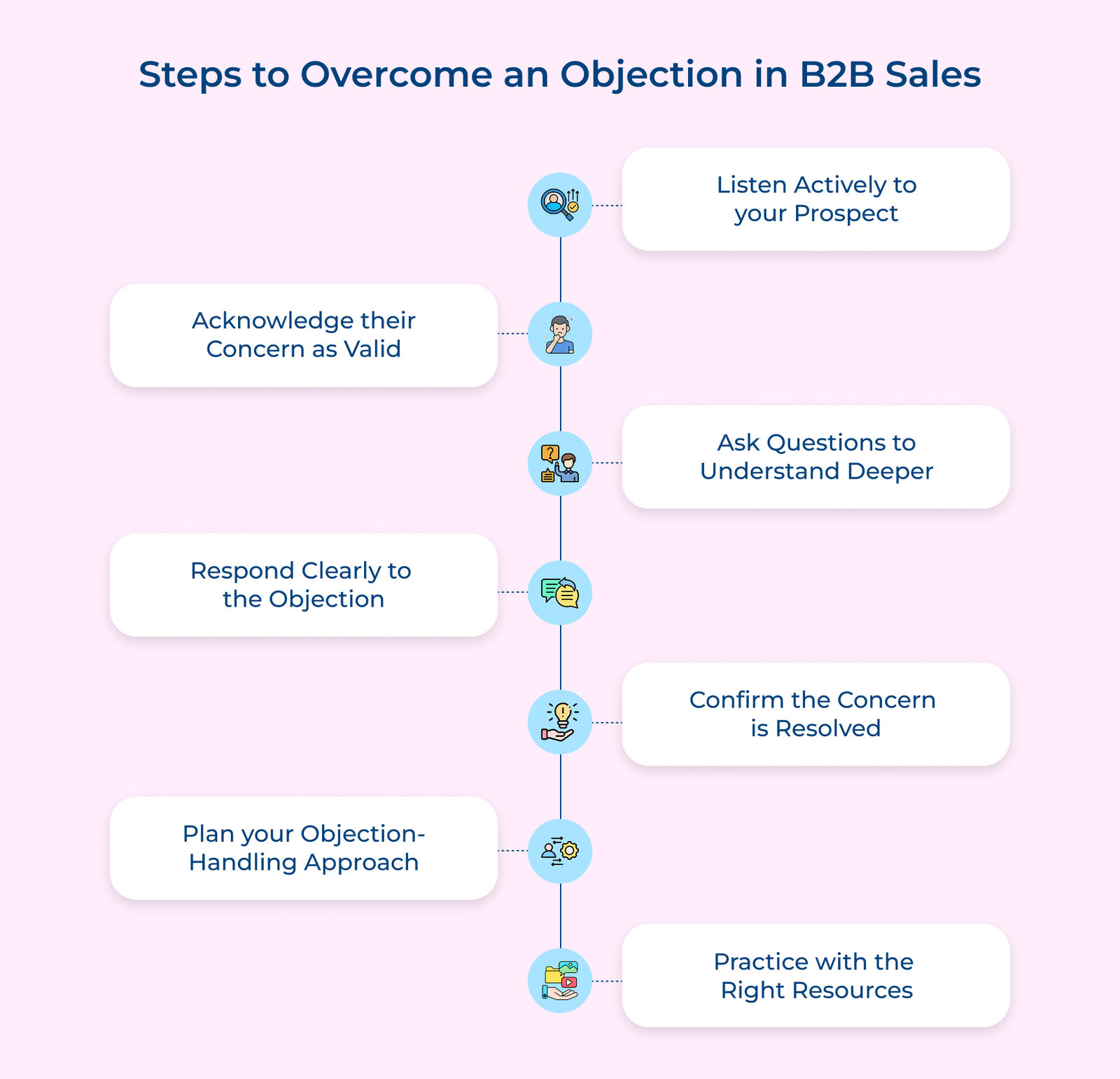
Active listening means giving your full attention to what your prospect says, without thinking ahead to your response. When done well, it shows you truly understand their concerns, not just your next talking point. Active listening can improve sales performance by 8%. It also helps you pick up on subtle cues and emotional undertones that reveal what matters most.
Pro tips:
Start by recording your sales calls and listening back to count how often you interrupt prospects. The gap between how well you think you listen and how well you actually listen often surprises people. Practice with a colleague where they share a concern and you must wait five seconds before responding.
Acknowledging an object means showing the prospect that their concern makes sense from their perspective. When they feel understood, defenses drop and the conversation shifts from argument to collaboration. Ignoring validation often leads to more resistance.
You use acknowledgment by explicitly stating that their concern is reasonable given their situation. Phrases like “that makes complete sense” or “I can see why that would worry you” create a connection. It transforms the dynamic from adversarial to collaborative problem-solving.
Actionable tips:
Clarifying questions uncover the true concern behind a surface-level objection. Without them, you risk solving the wrong problem and leaving the real issue unresolved.
Before asking questions, consider what information gaps exist in your understanding of their situation. Think about assumptions you’re making that might be wrong. The quality of your questions depends on recognizing what you don’t yet know.
Key questions:
The questions move the conversation from positions to interests and reveal what success means to them. Sales representatives should understand their prospects’ industry challenges before asking the questions. Coming in informed shows respect and helps you ask smarter follow-ups.
Responding directly means addressing the exact objection with clear, specific information. Vague answers signal that you either didn’t understand or can’t solve the problem. Prospects need confidence that you can handle their problem.
Best practices:
Let’s assume that if a prospect worries about implementation time, you might say, “I understand you can’t afford downtime. Our last three manufacturing clients went live in under three weeks because we handle data migration overnight.”
Key phrases:
Confirmation means checking that your response truly addressed the prospect’s concern rather than assuming it’s resolved. The step is unique because most salespeople move forward too quickly and leave unresolved doubts that silently kill deals later.
You use confirmation by asking direct questions after your response to verify they feel satisfied. It creates a checkpoint where prospects voice lingering concerns instead of politely nodding
while harboring doubts. The conversation only advances when you have genuine agreement.
Key takeaways:
Planning means preparing how to respond to objections before they arise. Thinking on the spot often leads to weak answers, while a strategy gives you confidence, consistency and faster resolution.
Key questions:
The questions force you to analyze patterns rather than treating every objection as unique. Understanding frequency and severity lets you prioritize which responses need development effort.
Gather your sales team for a session where everyone shares objections they encountered last month. Map them into categories and assign team members to develop response frameworks for each. The collaborative approach ensures your plan reflects real-world experience.
Preparation means entering sales conversations equipped with practiced responses and quick-reference materials. Without it, handling objections becomes inconsistent and ready competitors often win.
Role-playing builds muscle memory so responses flow naturally when pressure hits during real conversations. Practice reveals gaps in your logic and helps you refine phrasing until it sounds conversational rather than scripted.
Key ways:
Creating a reference guide gives you quick access to proven responses without memorizing everything. Your guide should include specific customer examples for each objection type and key data points.
Keep it short and searchable rather than a lengthy document. Practice plus solid resources turns objection handling from stressful improvisation into confident, smooth execution. Your preparation shows prospects you’ve thought deeply about their concerns.
Sales objections aren’t roadblocks but rather invitations to have deeper conversations about what truly matters to your prospects. Each concern reveals what truly matters to your prospect and highlights what needs to be addressed before they commit.
Mastering objection handling shifts your approach from pushy to consultative, focusing on solving real problems rather than just pitching features. The steps we covered give you a framework that builds trust and moves deals forward through genuine understanding rather than aggressive tactics.

Common objections include budget constraints, lack of urgency or limited authority to make decisions. Prospects may also question your company’s trustworthiness or if they truly need your solution. Product-specific concerns about features or compatibility are frequent as well.
Active listening forms the foundation because you must truly understand concerns before addressing them effectively. Empathy connects you with prospects, while critical thinking uncovers the root causes behind their objections. Strong communication skills let you articulate responses clearly without sounding defensive or scripted.
Create a shared library of common objections with proven responses. Run regular role-playing sessions with feedback and encourage sharing of wins or losses so the team learns from real experiences.
Discounting should be your last resort after you’ve addressed the actual concerns behind a price objection thoroughly. Offering discounts too soon encourages prospects to always demand lower prices and reduces your solution’s value. Most price objections mask other issues like unclear ROI or lack of urgency that discounts won’t solve.
Second Nature offers AI-powered roleplay simulations where salespeople practice objection handling in realistic scenarios. The platform provides instant feedback and tracks improvement over time, building muscle memory before real conversations.
Grow Customer Relationships and stronger team collaboration with our range of products across the Conversational Engagement Suite.
Omnichannel Customer Support & Help Desk Software
AI Enabled Business Messaging and Chatbot Software
Sales Engagement & CRM Software
Call Center Software & Virtual Phone System
Product Marketing & Experience Platform
Customer Experience & Feedback Management Software

 How to Write a Follow Up Email? The Complete Guide
Scroll to top
How to Write a Follow Up Email? The Complete Guide
Scroll to top