Sales Performance Review: The Complete Guide
A sales performance review evaluates team results and provides actionable feedback. It aligns goals, boosts accountability and drives continuous improvement in sales performance.

A sales performance review evaluates team results and provides actionable feedback. It aligns goals, boosts accountability and drives continuous improvement in sales performance.
Many sales managers approach performance reviews with hesitation because delivering feedback that motivates instead of discouraging a team is not easy. A meeting begins with the right intention, yet the lack of preparation often turns the conversation into something tense and unproductive.
Lack of a clear structure makes the situation worse. Sales performance reviews are slowly turning into vague conversations that circle targets and numbers without leading to meaningful direction. More than 90% of managers are dissatisfied with their company’s performance review system.
High performers start to feel their effort goes unnoticed, while reps who are struggling leave without the clarity required to improve their results. A meeting meant to strengthen performance ends up creating more confusion than progress. So let’s dive in to understand how to fix it!
A sales performance review refers to a structured evaluation where managers assess how well salespeople meet goals and contribute to company growth. It considers metrics like deals closed, alongside behaviors such as client relationship management and teamwork. Think of it as both a report card and a roadmap for improvement.
Sales representatives can use the review to understand both their current performance and the direction of their career growth. It gives you clarity on which of your efforts are paying off and which areas need adjustment. Think of it as a GPS for your career, showing progress and guiding you toward higher commissions. It identifies top performers for recognition and those needing support or training.
Key factors:
The following are the key reasons sales performance reviews are essential for long-term sales success. Let’s check them out in more detail.
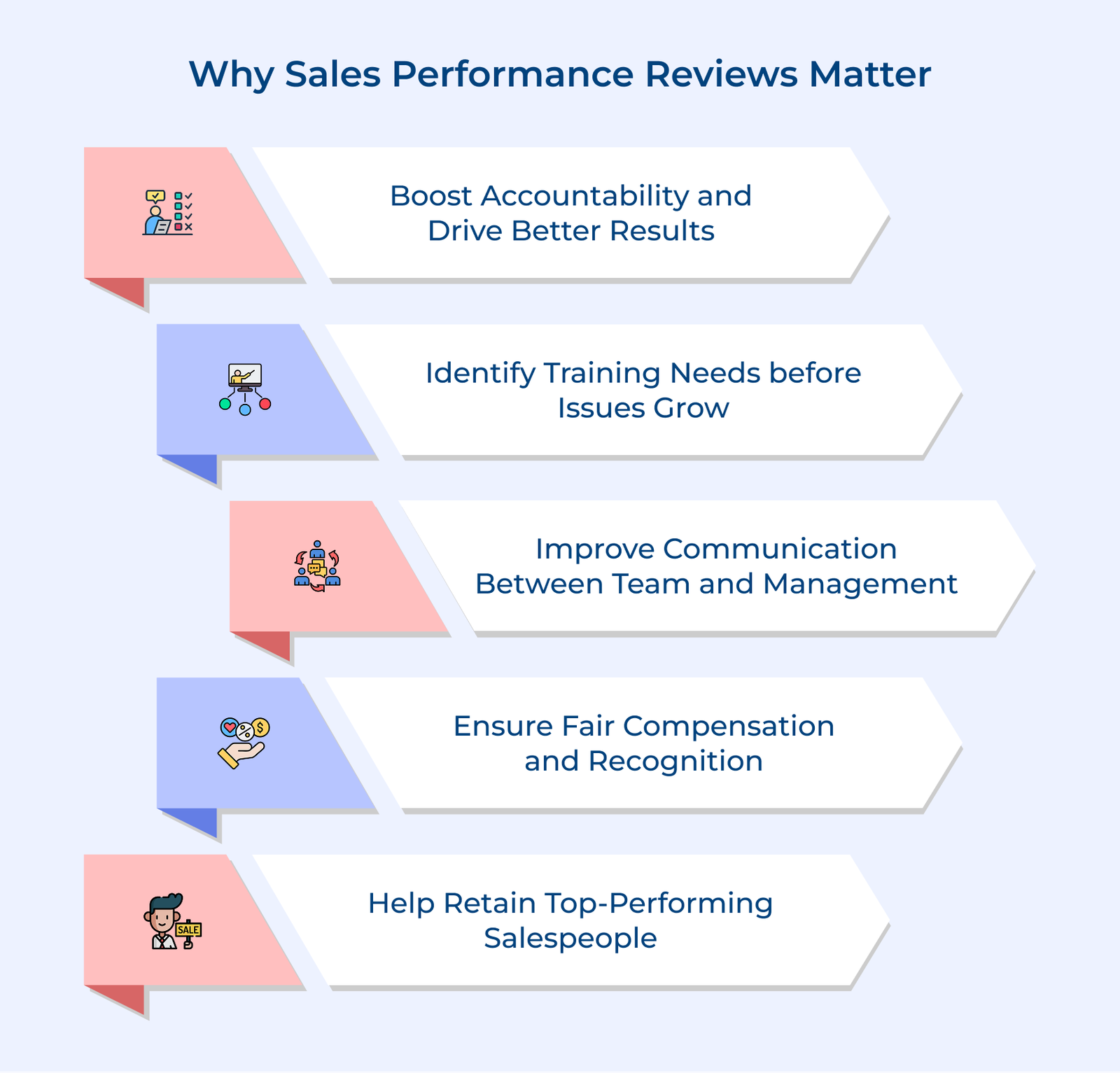
Create Accountability and Drive Results
Regular performance reviews help everyone stay aligned on expectations. When reps know their work will be discussed openly, they tend to focus on the activities that actually move deals forward. It builds steady, team-wide improvement without pressure tactics.
Identify Training Needs Before Problems Escalate
Performance reviews reveal skill gaps early so you can address them through targeted coaching or training programs. A rep struggling with objection handling can get help before losing too many deals. The approach saves money and prevents talented salespeople from leaving.
Improve Communication Between Reps and Management
The conversations give reps a chance to talk about real challenges they face with customers. Managers get clarity on issues like pricing pushback, product limitations or process roadblocks. The honest exchange leads to smarter decisions and fewer surprises.
Support Fair Compensation and Recognition Decisions
Documented performance makes promotions, bonuses and recognition more transparent. Instead of relying on guesswork, you reward people based on clear effort and outcomes. It builds trust and keeps the environment fair.
Help Retain Your Best Salespeople
High performers stay when they feel heard and supported. Regular reviews show that you’re paying attention to their growth, not just their numbers. It reduces turnover and preserves the strength of your team.
Check out the essential tips to help you conduct impactful sales performance reviews that will propel your team and your bottom line to new heights.
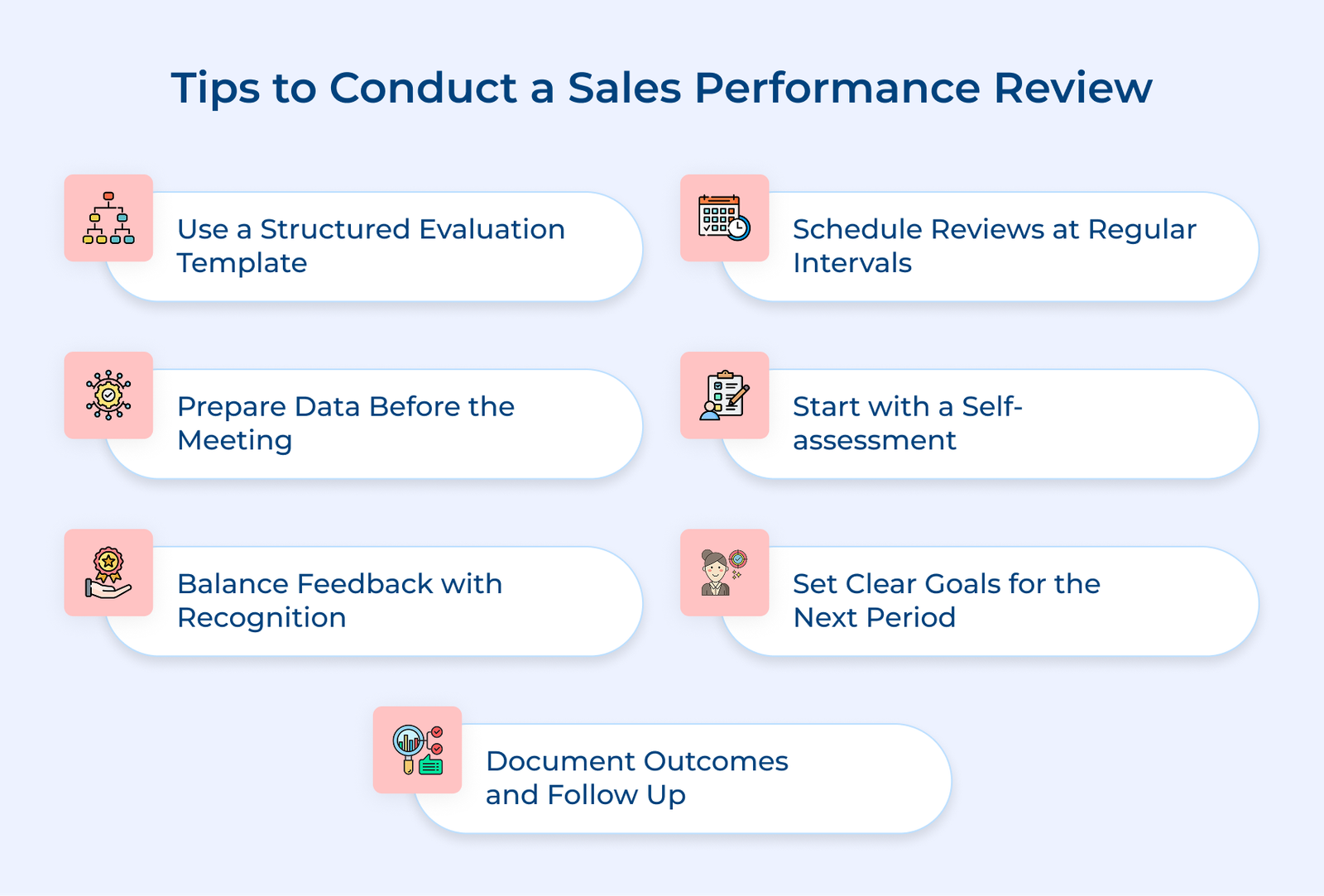
A consistent template keeps every review fair and structured. It removes guesswork, reduces bias and helps you compare results across months or between team members. You can spot patterns more easily and see how each person is developing over time, with everything documented the same way.
Key factors:
Key types:
A predictable review schedule helps everyone stay prepared and keeps performance conversations from getting lost in day-to-day urgency. When reviews happen on time, you can spot patterns early instead of reacting when problems have already grown.
Key ways:
Showing up to a review without preparation wastes time and undermines trust. When you collect solid data beforehand, the conversation becomes clear, fair and grounded in facts, not memories or assumptions.
Key ways:
The data turns your review from opinion-based to evidence-based and helps you identify patterns you might have missed. A rep who “seems slow” might actually be working fewer but higher-value deals and doing it well.
Pull a standard CRM report a week before the review and send a quick message to a few teammates for brief feedback. The whole process takes about thirty minutes per person when you build it into your routine.
Starting the review with the rep’s own evaluation gives them room to speak first and often reveals things you wouldn’t have noticed on your own. When they’ve already reflected on their performance, the discussion feels more balanced and less like you’re delivering a verdict.
Key questions:
Balancing praise with honest criticism helps reps stay open to feedback instead of shutting down. If you jump straight into what went wrong, the conversation becomes tense and unproductive. If you only praise them, nothing actually improves.
Start by pointing out specific things they did well, not generic compliments. Then move into the areas that need work using real examples so your guidance feels fair and grounded. Close by reminding them of what they’re capable of when they’re at their best.
Best practices:
Clear goals give reps something concrete to aim for and remove any guesswork about what “good performance” actually means. Vague directions like “do better” don’t help anyone because they offer nothing to measure.
Key questions:
The questions force you to define success in a way that’s measurable and easy to evaluate later. When goals are measurable, there’s no room for disagreement later about if the expectations were met. You also need to make goals clear enough that anyone could judge progress without your explanation. Instead of saying “improve negotiation skills,” you might say “complete the advanced negotiation training by March and successfully close two deals over $50K.”
Key ways:
Documenting your performance review gives both you and the rep a clear record of what was discussed or agreed on. It prevents confusion later and keeps expectations visible rather than relying on memory.
Key factors:
You can document reviews using your HR system or a simple shared Google Doc that both you and the rep can access anytime. The format matters less than ensuring the information is recorded accurately and stored where you’ll actually reference it later.
Documentation without action is just paperwork that sits in a folder collecting digital dust. Schedule a 30-day check-in to review early progress and make adjustments before small issues become bigger ones.
Below are the best sales performance review practices for creating meaningful conversations that actually change behavior and drive results.
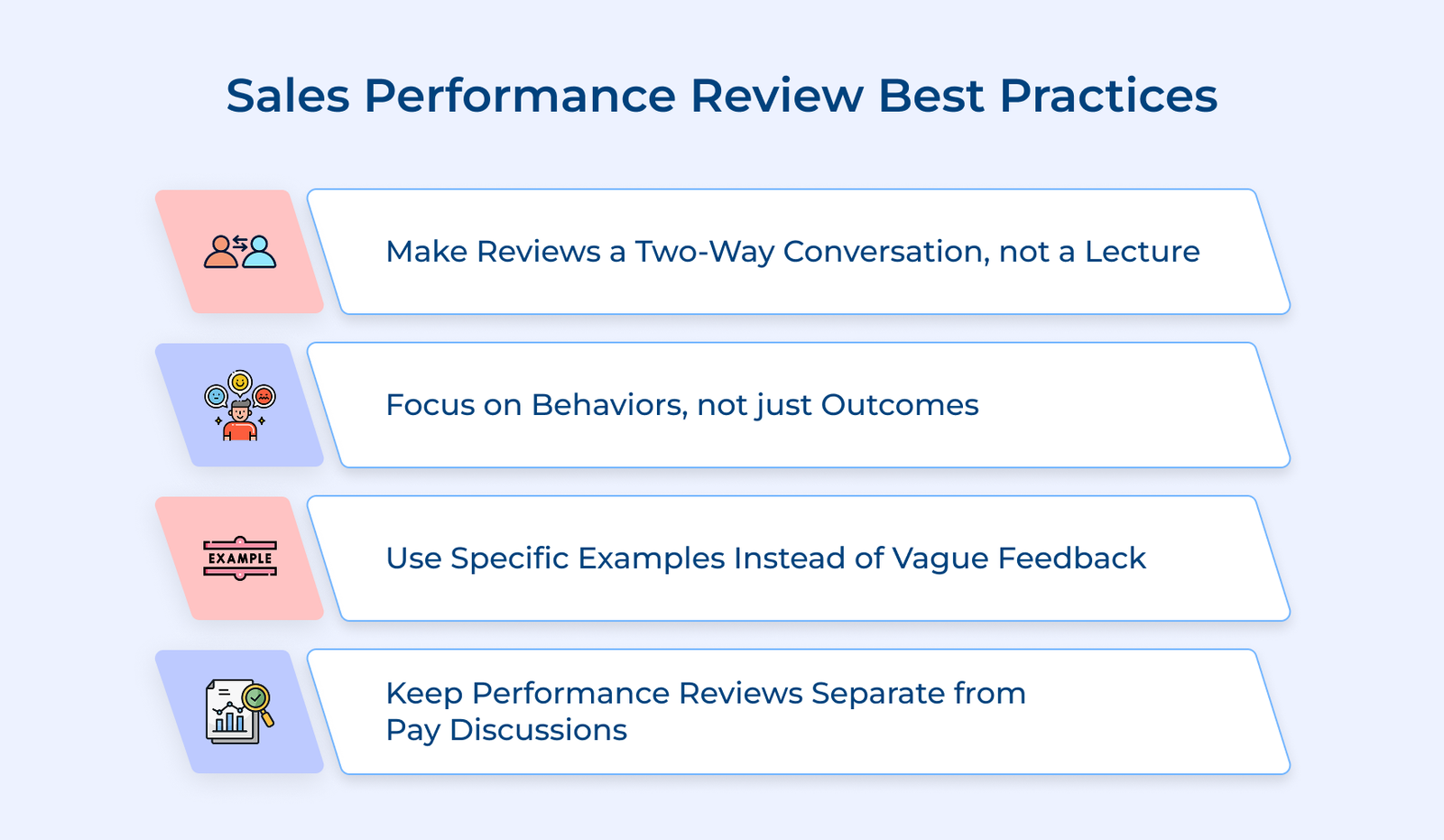
Make Reviews Two-Way Conversations, Not Lectures
The strong reviews feel like open discussions, not one-sided speeches. When reps can share what they’re seeing in the field, you get clearer context and better solutions. A real dialogue builds trust and leads to more honest conversations about improvement.
Focus on Behaviors, Not Just Results
Metrics show what happened, but daily habits explain why. A rep who hits quota from one lucky deal needs different coaching than someone who steadily moves opportunities forward. Looking at behaviors helps you predict future performance instead of reacting to past numbers.
Use Specific Examples Instead of General Statements
General feedback feels vague and unhelpful. Pointing out three proposals with pricing mistakes is far more useful than saying, “Your communication needs work.” Examples give the rep a clear path to improvement and reduce defensiveness.
Separate Performance Reviews from Pay Discussions
When feedback and pay are mixed, reps stop listening to anything except the compensation number. Hold performance reviews first so they can focus on development, then discuss pay later when emotions are lower and conversations are clearer.
Train Managers to Give Better Feedback
Many managers were strong sellers but never learned how to coach. Teaching them how to give constructive feedback leads to better reviews and faster improvement across the whole team. Skilled managers make average reps better and good reps great.
Check out the real-world examples to show you how to frame feedback that recognizes achievements while identifying specific areas for growth and development.
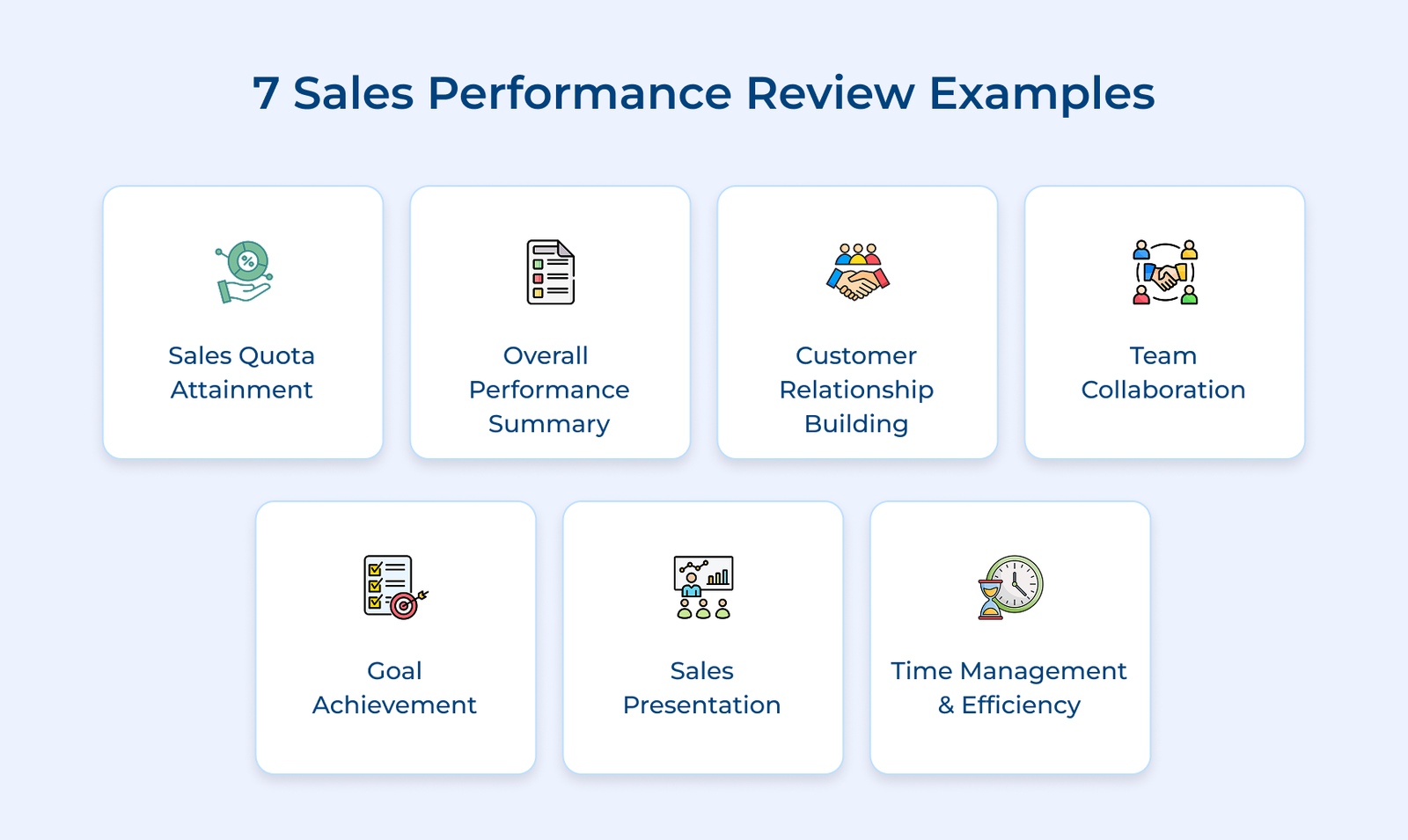
Quota attainment shows how well a rep meets their revenue targets and if they perform steadily or swing between good or bad quarters.
Positive examples:
Improvement examples:
The section gives a clear picture of how a rep is contributing across revenue, skills and teamwork, not just raw numbers.
Positive examples:
Improvement examples:
The section measures how well a rep maintains meaningful client relationships that support renewals, referrals and long-term account growth.
Positive examples:
Improvement examples:
Team collaboration measures how well a rep works with teams to support customers and keep deals moving smoothly.
Positive examples:
Improvement examples:
The section focuses on if the sales rep made progress on the goals set in the last review, not just on hitting revenue numbers.
Positive examples:
Improvement examples:
The section assesses how well a sales rep explains the product, keeps the audience engaged and tailors presentations to the people in the room.
Positive examples:
Improvement examples:
The section reflects how well a sales rep organizes their work, prioritizes tasks and uses time in a way that supports steady, meaningful progress.
Positive examples:
Improvement examples:
Thoughtful performance reviews can turn a sales team from a set of individuals into a group that works in sync and delivers steady results. Clear expectations, honest conversations and specific metrics help everyone understand where they’re succeeding or where they need support. It keeps small issues from piling up and gives you a clearer view of who needs coaching and who’s ready for more responsibility.
The key is treating reviews as ongoing conversations rather than annual formalities that everyone dreads. Regular check-ins with proper documentation and follow-through show your team that you’re invested in their success. The approach builds trust and motivates top performers to stay while giving struggling reps the support they need to improve and contribute meaningfully.

Leading a sales associate review requires you to prepare data beforehand and create a comfortable environment where honest dialogue can happen. Start by asking the associate to share their own assessment first, then discuss specific achievements and improvement areas using concrete examples. End by collaboratively setting clear goals for the next period with defined support resources.
Common KPIs include quota attainment, total revenue, pipeline size and conversion rates at each stage of the sales process. Activity metrics, such as outreach volume and meetings held give context to the results. Customer satisfaction scores and average deal size help you understand the quality of the rep’s work, not just the output.
Strong evaluations balance numbers with behavior. Look at results, but also at the habits and decisions that led to them. Use a consistent template so every rep is evaluated fairly and hold reviews throughout the year instead of treating them as an annual chore. Celebrate progress, acknowledge strengths and give clear, actionable feedback for anything that needs improvement.
The first stage is preparation where you gather data and schedule the meeting with adequate notice for the rep to prepare. Next comes the review conversation itself where you discuss performance and set goals collaboratively. The third stage involves documenting everything discussed and agreed upon in writing. Lastly, you follow up regularly to track progress on goals.
Avoid discussing only recent events while ignoring performance from earlier in the review period because recency bias creates unfair evaluations. Never surprise a rep with serious performance concerns they haven’t heard about before in previous conversations. Skip vague generalizations like poor attitude and instead use specific examples of observable behaviors that need to change for improvement.
Grow Customer Relationships and stronger team collaboration with our range of products across the Conversational Engagement Suite.
Omnichannel Customer Support & Help Desk Software
AI Enabled Business Messaging and Chatbot Software
Sales Engagement & CRM Software
Call Center Software & Virtual Phone System
Product Marketing & Experience Platform
Customer Experience & Feedback Management Software

 Time Management Sales Guide: Benefits & Strategies
Scroll to top
Time Management Sales Guide: Benefits & Strategies
Scroll to top