Self Service Metrics: How to Measure & Improve Self Service?
Self service metrics refer to the KPIs used to measure the effectiveness and efficiency of self-service systems. They are crucial for assessing the performance of self-service channels.

Self service metrics refer to the KPIs used to measure the effectiveness and efficiency of self-service systems. They are crucial for assessing the performance of self-service channels.
Struggling to track and measure the success of self service initiatives? Understanding the self service metrics that matter is crucial for optimizing self service strategy and improving customer satisfaction.
Businesses are increasingly investing in self service options such as chatbots, knowledge bases and interactive FAQs. 75% of customers think self-service is a convenient way to address customer service issues. It makes it important to evaluate the impact of such tools.
Here we’ll explore the key metrics businesses should be tracking to gauge the effectiveness of the self service efforts. Understanding the self service KPIs metrics will help the organization deliver value to both customers and the business.
Self service metrics refer to the key performance indicators that companies use to measure the effectiveness of their self service processes such as customer support portals, FAQ sections and automated chatbots. They help organizations track things like customer satisfaction, resolution times and successful self service interactions to improve the overall customer experience.
Self service metrics fundamentally transform how organizations interact with their data by removing gatekeepers. When you let the teams directly access the metrics they need for daily operations, they can make faster decisions based on current information rather than wait for reports to be generated by specialists. This immediate access helps companies respond more quickly to market changes and customer needs.
Key principles:
Let us learn about the critical role of self-service KPIs and how leveraging them can drive substantial improvements in customer service.
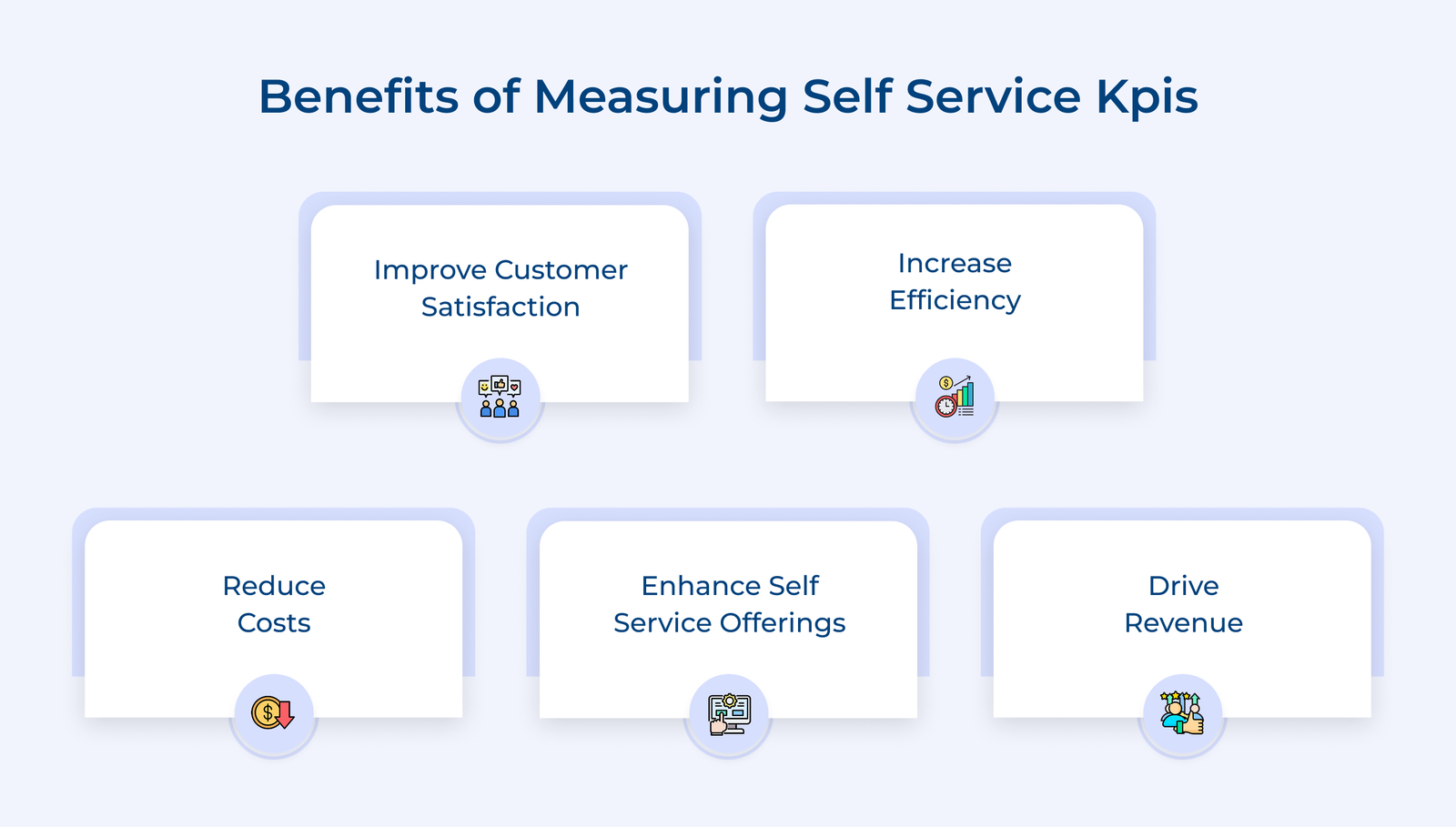
1. Improve customer satisfaction: Businesses can better understand how satisfied customers are with the level of service provided by measuring the performance of self-service options. Self service KPIs such as customer satisfaction feedback can help identify areas for improvement and ensure that customers are getting the support they need.
2. Increase efficiency: When businesses measure self service metrics, they can track how quickly customers can resolve their issues using self service options. Businesses can identify bottlenecks in the self service process and make necessary improvements to streamline operations by analyzing metrics.
3. Reduce costs: Effective self service KPIs can help businesses reduce the amount of resources needed to handle customer inquiries. Businesses can identify cost-saving opportunities and allocate resources more efficiently by measuring metrics such as call deflections or cost per contact.
4. Enhance self service offerings: Measuring self service KPIs can provide valuable insights into how customers are utilizing self service options or which features are most popular. The information can help businesses identify areas for improvement and enhance their self service offerings to better meet the needs of customers.
5. Drive revenue: Businesses can increase customer loyalty and drive revenue by improving the overall customer experience through self service KPIs. Self service metrics such as escalation rate and customer lifetime value can help businesses track the impact of self service on revenue generation.
Below are the key metrics to assess the success of your self-service platforms, ensuring they deliver value both to your business and your customers.
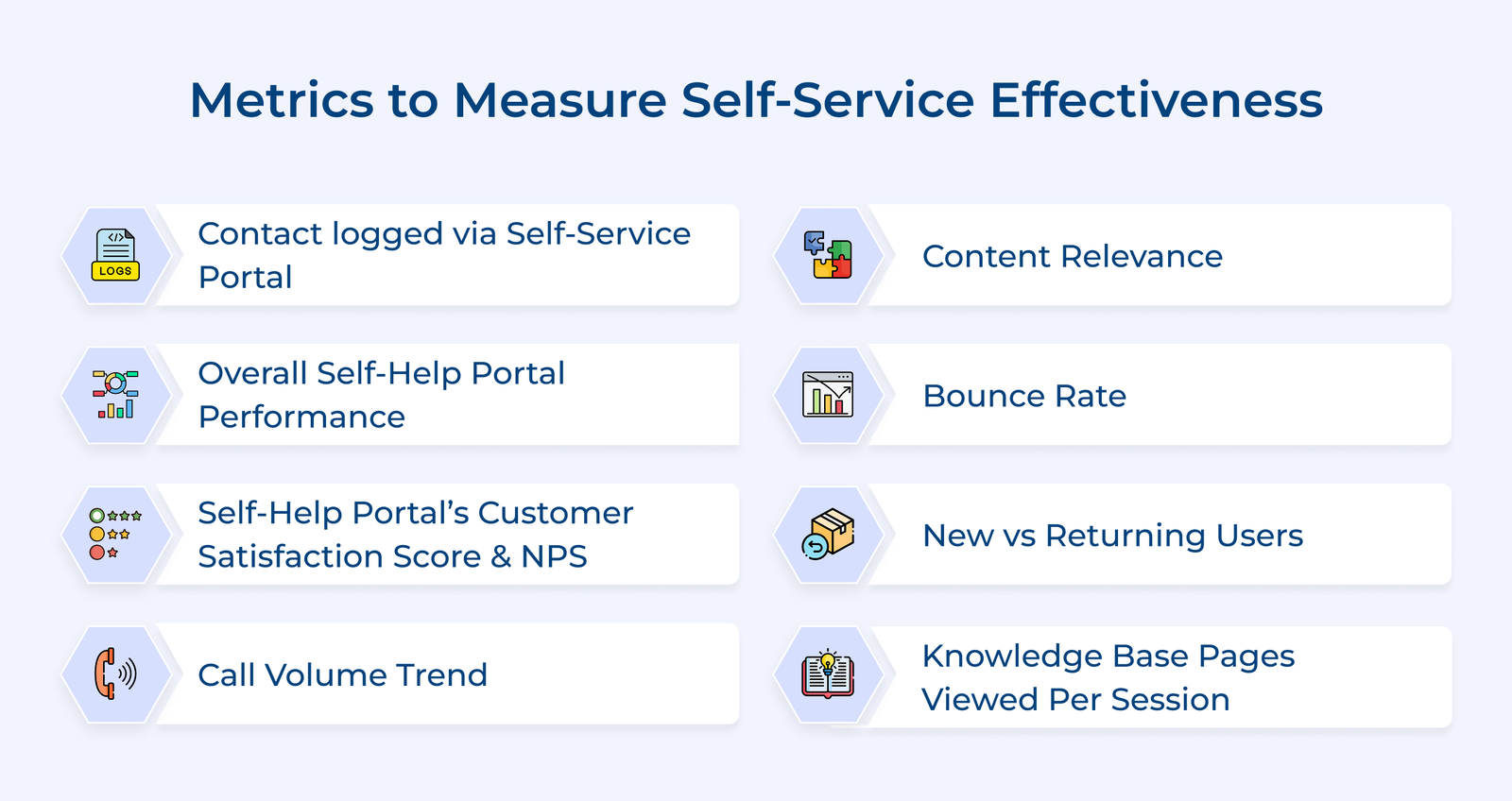
When it comes to measuring and improving self service performance, one key metric to consider is the number of contacts logged via the self-service portal. The metric indicates how often customers use the self-service option to find answers to their questions or resolve issues independently.
The target of this metric is to increase the percentage of customer inquiries that are resolved through self-service. It improves customer satisfaction and success rates. The formula for this metric is:
The number of contacts logged via self-service portal / Total number of customer contacts x 100.
Best practice:
One important metric to measure the effectiveness of a self-help portal is overall self-help portal performance. It focuses on the overall performance of the portal in terms of user satisfaction, resolution rates and efficiency. The business value of the metric lies in its ability to assess how well the self-help portal is meeting the needs of users and helping them find solutions to their problems.
A high-performance score indicates that the portal effectively provides valuable support to customers, leading to increased customer satisfaction and loyalty. The target of the self service metric is to achieve a high-performance score, indicating that the portal is user-friendly, easy to navigate and provides relevant information to users.
The formula for calculating overall self-help portal performance can be: Performance Score = (Number of resolved issues / Total number of issues reported) x 100
Best practices:
Measuring customer satisfaction and loyalty is crucial in determining the effectiveness of self-help resources. Two key self service KPIs for evaluating this are the Customer Satisfaction Score (CSAT) and the Net Promoter Score (NPS). The CSAT measures how satisfied customers are with the self-help portal’s services, often through a survey or rating system.
The NPS measures customer loyalty by asking how likely customers are to recommend the portal to others. The business value of these metrics lies in the ability to identify areas for improvement in the self-help portal, leading to better customer retention and satisfaction. The target of these metrics is to continuously enhance the portal’s usability and effectiveness in meeting customers’ needs.
The formula for calculating CSAT is (Number of satisfied customers / Number of survey responses) x 100. The NPS is calculated by subtracting the percentage of detractors from the percentage of promoters.
Best practices:
The Call Volume Trend metric is a key indicator of how many customer inquiries are being directed toward the virtual agents. Monitoring the self service KPIs allows businesses to understand the volume of calls, identify trends over time and make strategic decisions to improve self-service options. Its business value lies in the ability to highlight areas where self-service options may be lacking or ineffective.
Businesses can lower their customer service costs and improve overall customer satisfaction by reducing the number of calls coming in. Its target is to reduce call volume by providing customers with easy-to-use self-service options such as FAQs, chatbots or online knowledge bases.
The formula for this metric:
(Total number of calls received / Total number of calls answered) x 100
Best practices:
Content relevance is a crucial aspect to measure and improve self service rate. It analyzes how well the content provided to users aligns with their needs and expectations. The business value of content relevance lies in ensuring that the information presented to users is timely, accurate and easy to understand. Businesses can optimize their self-service platforms to provide relevant content that enhances the overall customer experience by measuring the self-service performance.
The target of content relevance is to increase customer satisfaction and reduce the need for additional support by delivering content that directly addresses user queries or issues. The formula for calculating Content Relevance is the number of relevant interactions divided by the total number of interactions, multiplied by 100 to get a percentage.
Best practices:
Bounce rate is a key metric to measure and improve self-service effectiveness on the website. It represents the percentage of visitors who navigate away from the site after viewing only one page. A high bounce rate can indicate that visitors are not finding what they are looking for or that the website is not engaging enough. If you run a self-service portal, it can fall between 10 to 30%.
The target of the bounce rate is to keep it as low as possible, ideally below 50%. It can be achieved by providing clear navigation, relevant content and a user-friendly layout on the website. The formula for bounce rate is Bounce Rate = a total number of bounces / Total number of website visits.
Best practices:
New vs returning users is a crucial metric to measure self service effectiveness. It helps businesses understand the breakdown of their website or app visitors into two key categories: new users who visit for the first time and returning users who have visited before. The business value of this metric lies in its ability to provide insights into user behavior and engagement levels.
Businesses can tailor their marketing strategies and content to better meet the needs of both types of users by understanding the ratio of new vs returning users. The target of the self service KPI is to achieve a balance between attracting new users and retaining existing users. A healthy ratio of new vs returning users indicates that a business is successfully acquiring new customers while also keeping them engaged over time.
The formula for calculating this metric is:
(New users / Total users) x 100 = New user percentage
(Returning users / Total users) x 100 = Returning user percentage
Best practices:
Knowledge base pages viewed per session is one of the crucial self service KPIs used to measure and improve self-service effectiveness. It calculates the average number of knowledge base pages a user views during a single session on a website or platform. The business value of the metric lies in its ability to gauge the level of engagement and satisfaction users have with the self-service knowledge base.
A high number of pages viewed per session indicates that users are actively seeking information and finding value in the content provided. The target of such self-service KPIs is to increase the average number of pages viewed per session, leading to higher levels of customer self-service success and reduced support costs.
The formula for calculating this metric is – Knowledge base pages viewed per session = Total knowledge base pages viewed / Total number of sessions.
Best practices:
Check out the most common challenges businesses face with self-service metrics along with insights on how you can effectively overcome them.
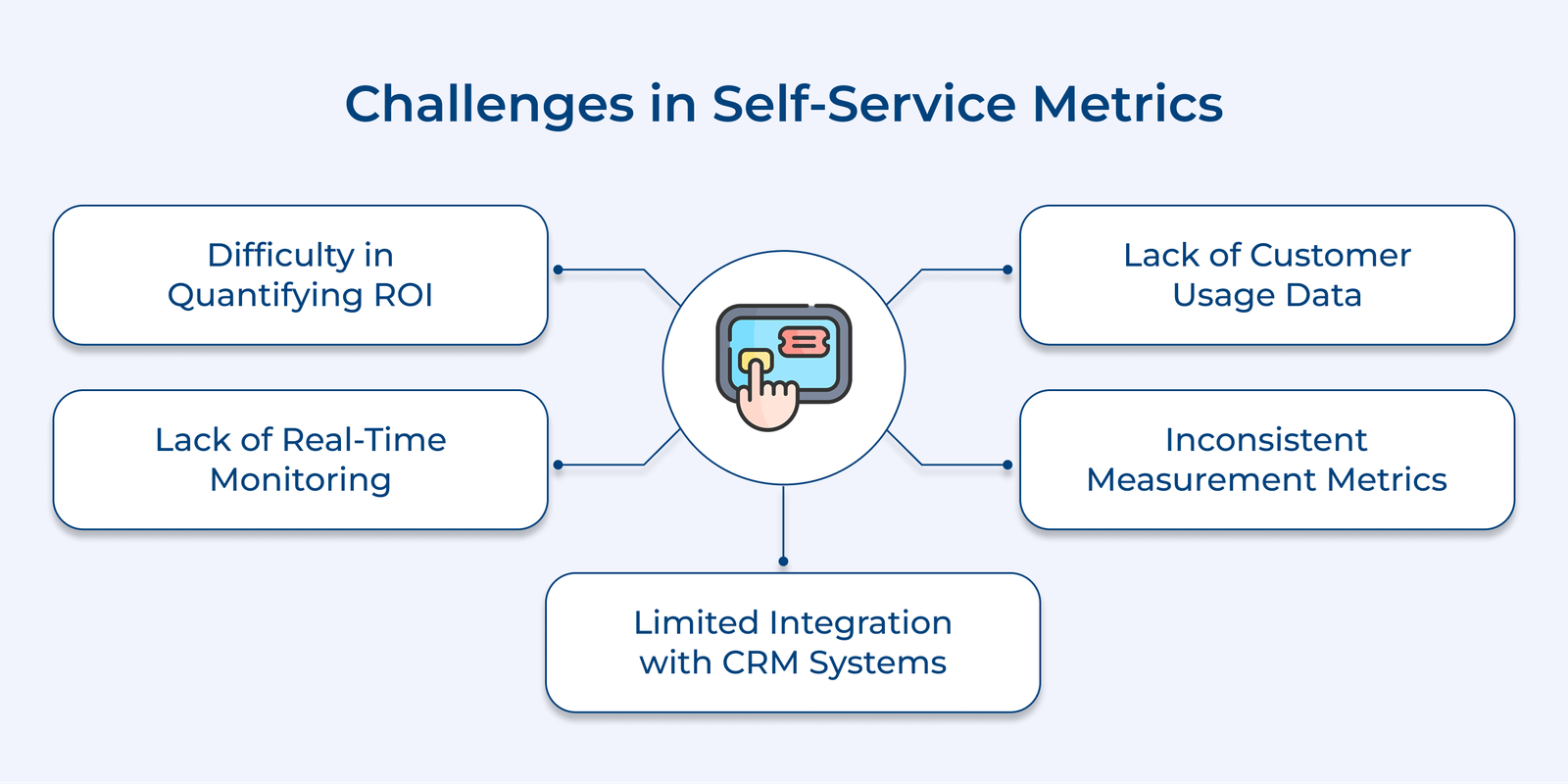
One of the biggest self service metrics challenges is the lack of accurate customer usage data. Without the data, it’s difficult to understand how customers are interacting with the self service options. Implement tools and technologies that analyze customer interactions with self-service channels. It can include customer analytics software, customer surveys and feedback mechanisms to gather insights into user behavior.
Different self-service channels may require different measurement metrics, making it difficult to compare performance across platforms. Define clear and consistent measurement metrics for each self-service channel. It could include metrics such as usage rates, response times, resolution rates, customer satisfaction scores and cost per transaction.
Self-service options may not be integrated with customer relationship management (CRM) systems, making it challenging to track customer interactions and outcomes. Integrate self-service channels with CRM systems to capture and analyze customer data seamlessly. It can help in tracking customer interactions, identifying opportunities for improvement and personalizing customer experiences.
Monitoring self-service performance in real-time can be challenging, especially when dealing with high volumes of customer interactions. Implement real-time monitoring tools that provide actionable insights into self-service performance, customer behavior and trends. It can help in identifying issues quickly, making adjustments on the fly and improving the overall customer experience.
Measuring the return on investment (ROI) of self-service options can be challenging, as it may not always directly translate into tangible benefits. Develop a comprehensive ROI framework that factors in both hard metrics and soft metrics. It can help in quantifying the impact of self-service on business outcomes and justifying future investments.
Let us now go through the crucial steps to accurately measure and enhance your self-service platform’s success.
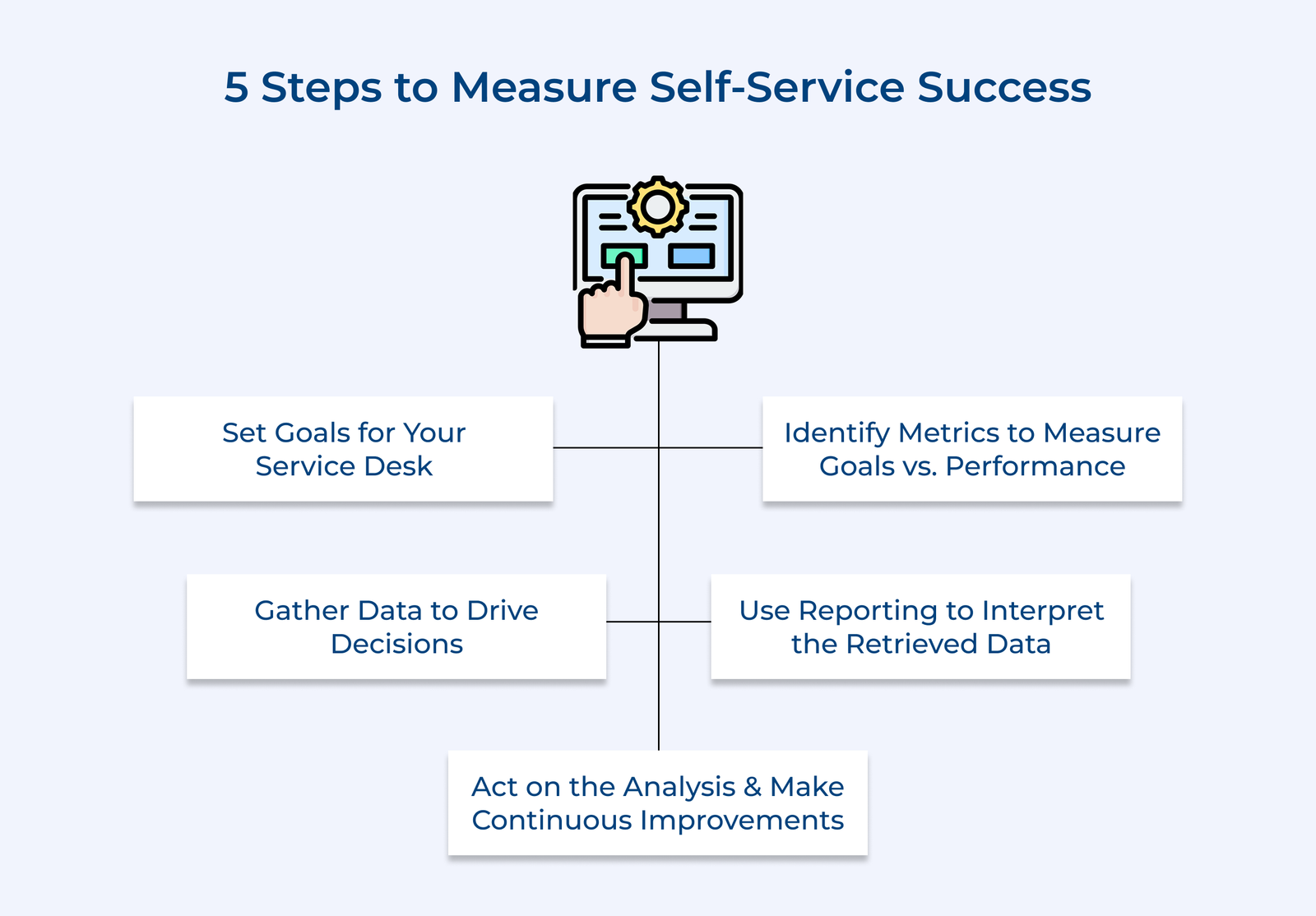
The first step in measuring self-service success is to establish clear, measurable goals for the service desk. What do businesses hope to achieve with the self-service options? Increased customer satisfaction? Quicker resolution times? Lower costs? Setting specific goals will help businesses track the progress and measure the effectiveness of their self-service strategy.
Once businesses have set their goals, the next step is to identify the key metrics that will allow businesses to measure how well they are meeting those goals. The self service KPIs could include things like the number of self-service transactions, customer satisfaction ratings, resolution times and cost savings.
Gathering data is crucial to measuring self-service success. Make sure to have the tools in place to collect data on the metrics that matter most to businesses. It might involve implementing a customer feedback system, tracking self-service usage data or conducting surveys to gauge customer satisfaction. The more data businesses have, the better equipped they will be to make informed decisions about their self-service strategy.
Once businesses have gathered the necessary data, it’s time to analyze it and draw conclusions. Reporting tools can help businesses visualize their data and identify trends or patterns that can inform their decision-making. Look for areas where businesses are excelling and areas where they may need to make improvements. Use the information to refine the self-service strategy and make it more effective.
Take action based on the data analysis. If businesses identify areas where the self-service strategy is falling short of goals, make changes to address those shortcomings. Continuously monitor the metrics and make adjustments as needed to ensure that the self-service options are delivering the results the organization wants.
Taking control of data with self service metrics is essential for maximizing digital marketing efforts. Utilizing techniques to analyze data allows businesses to gain valuable insights into their audience, campaign performance and overall marketing strategy. The ability to monitor business metrics in real time allows businesses to make informed decisions that will drive success and growth for businesses. Empower with the tools and knowledge needed to harness the power of data to take digital marketing efforts to the next level.

Self service metrics are important for customer success because they provide valuable insights into customer behavior and preferences. Businesses can identify areas for improvement, optimize their self-service offerings and enhance the overall customer experience by tracking metrics. The metrics are crucial for measuring the effectiveness of self-service solutions and driving customer success.
Some best practices for optimizing self service metrics include:
A good self-service score measures the effectiveness of a company’s self-service options in providing customers with the information and support they need. It reflects the ease of navigation, availability of resources and overall customer satisfaction with the self service experience. A high score indicates that customers can easily find answers to their questions and resolve issues on their own.
Improving self-service options for customer success can be achieved by optimizing the website’s FAQ section, creating video tutorials for common issues, implementing chatbots for instant assistance and providing self-service portals for account management. Empowering customers to find solutions on their own allows businesses to enhance their overall experience and increase customer satisfaction.
Measuring self-service success can be done by tracking metrics such as customer satisfaction ratings, usage rates of self-service options and resolution times. Analyzing feedback and conducting surveys can also provide valuable insights into the effectiveness of self-service tools. Businesses can identify areas for improvement and continue to enhance the overall customer experience by regularly monitoring these metrics.
Grow Customer Relationships and stronger team collaboration with our range of products across the Conversational Engagement Suite.
Omnichannel Customer Support & Help Desk Software
AI Enabled Business Messaging and Chatbot Software
Sales Engagement & CRM Software
Call Center Software & Virtual Phone System
Product Marketing & Experience Platform
Customer Experience & Feedback Management Software

 Self Service Help Center: A Comprehensive Guide
Scroll to top
Self Service Help Center: A Comprehensive Guide
Scroll to top