9 SLA Best Practices for Businesses to Follow in 2026
Explore key SLA best practices to improve service quality, ensure accountability and enhance customer satisfaction. Learn how to create effective SLAs that align with business goals.

Explore key SLA best practices to improve service quality, ensure accountability and enhance customer satisfaction. Learn how to create effective SLAs that align with business goals.
Imagine losing millions in revenue because your team consistently missed service level agreements (SLAs), leading to contract penalties and damaged client relationships. Many organizations struggle with SLA management, treating these agreements as mere paperwork rather than critical business commitments.
The consequences of poor SLA management cascade throughout your organization: frustrated customers jumping ship to competitors and executives facing uncomfortable questions about reliability. But there’s hope – implementing proven SLA best practices can help businesses transform their service delivery from a source of stress into a competitive advantage. Let’s explore how you can build a robust SLA framework that not only meets customer expectations but exceeds them, turning your service commitments into a powerful tool for business growth.
A Service Level Agreement (SLA) refers to a formal contract that defines the expected service levels between a provider and a customer. It details key aspects such as quality, availability and responsibilities, ensuring both parties have clear expectations.
SLAs establish measurable metrics, including response times, uptime percentages and issue resolution timelines. They also outline consequences for not meeting these standards, often involving penalties or service credits. Regular monitoring and reporting mechanisms track performance against the metrics to ensure accountability.
Key use cases:
Let’s explore the key benefits of SLAs to understand why they are a cornerstone for successful business relationships and operational efficiency.
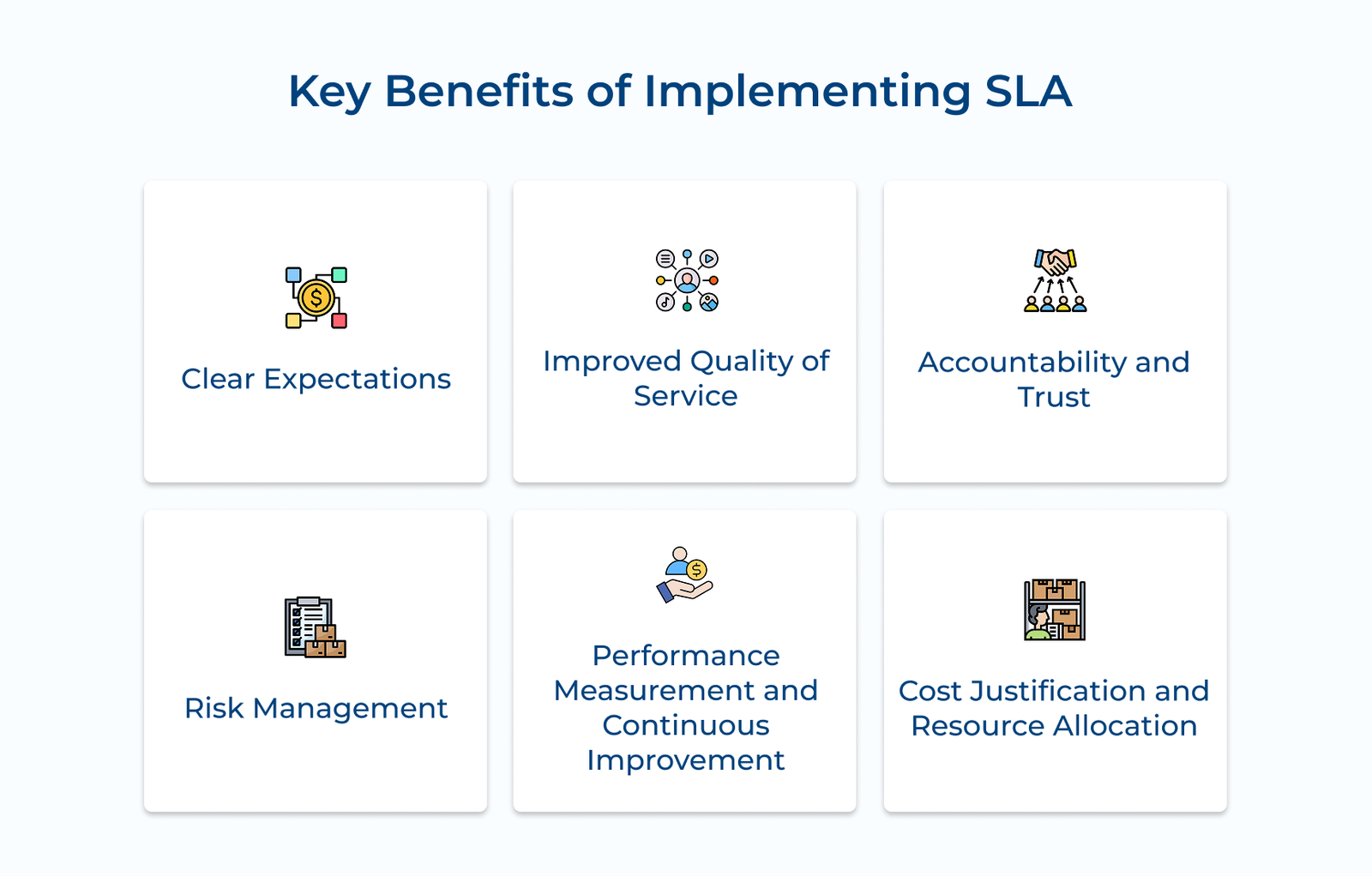
1. Clear expectations: SLAs set clear, measurable standards for service delivery, preventing misunderstandings and aligning expectations. Customers know what level of service to expect, while providers have defined targets to meet, minimizing disputes.
2. Improved quality of service: SLAs motivate service providers to uphold high standards by establishing clear performance metrics. The potential for penalties and regular performance reviews drives improvements in service quality, boosting customer satisfaction.
3. Accountability and trust: SLAs establish a framework for accountability in which the providers are held responsible for their performance with clear metrics and consequences for non-compliance. It enhances trust, allowing customers to rely on a documented commitment to service quality.
4. Risk management: SLAs play a crucial role in identifying and mitigating risks in service delivery. They offer a safety net for both parties by outlining procedures for managing disruptions or failures. The proactive approach helps prevent minor issues from becoming major problems.
5. Performance measurement and continuous improvement: Regular monitoring and reporting mandated by SLAs deliver valuable insights into service performance. The data helps identify trends, highlight areas for improvement and drive continuous service enhancement, enabling data-driven decision-making in management.
6. Cost justification and resource allocation: SLAs connect service costs to the value received for customers, aiding in budget justification and ensuring a worthwhile investment. SLAs enable efficient resource allocation by clarifying provider requirements, helping reduce costs while maintaining service standards.
Check out the three primary types of service level agreements to get valuable insights and make informed decisions that can strengthen the future of your business partnerships.
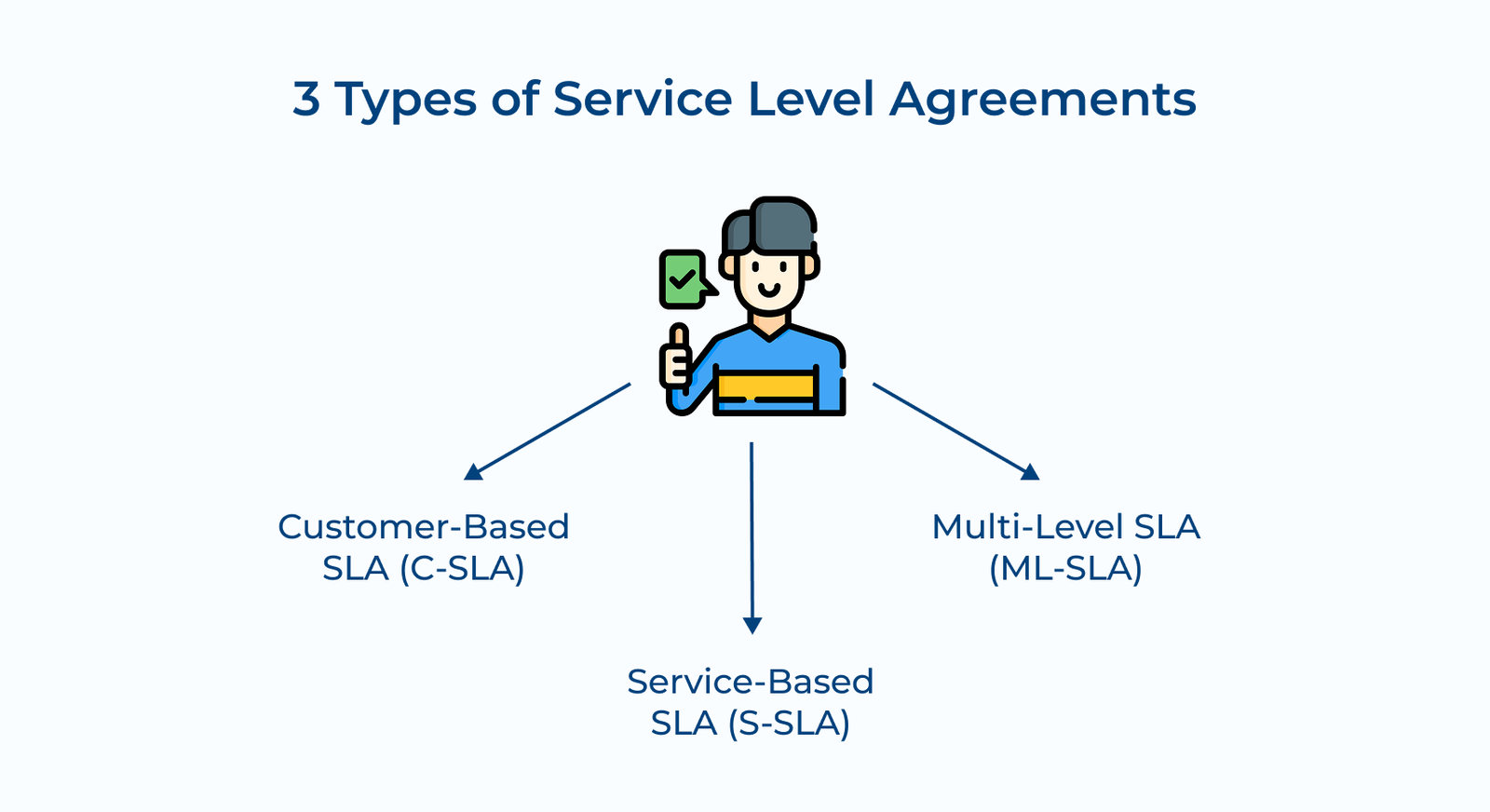
A Customer-Based SLA (C-SLA) is customized for a specific client or customer group, encompassing all services tailored to their unique needs and expectations. The SLA is particularly beneficial for managing relationships with key accounts or clients with distinct requirements.
Example: A large multinational corporation enters into a C-SLA with an IT service provider. The agreement covers a range of services, including network management, software support and cybersecurity, all specifically designed to meet the corporation’s global operations.
A Service-Based SLA (S-SLA) focuses on a specific service offered to all customers, outlining standard terms, conditions and performance metrics that apply universally. The approach is efficient for service providers delivering the same service to multiple clients, ensuring consistency in service delivery and management.
Example: A cloud storage provider implements an S-SLA for their file hosting service, specifying uptime guarantees, data security measures and support response times. The SLA applies equally to all customers, from individual users to large enterprises.
A Multi-Level SLA (ML-SLA) combines elements of both customer-based and service-based agreements, structured in multiple tiers: corporate-level, customer-level and service-level agreements. The approach offers a detailed yet flexible framework that addresses both overarching company policies and specific customer or service needs.
Example: A managed service provider implements an ML-SLA for a retail chain. The corporate level covers general terms, the customer level caters to the retailer’s unique requirements and the service level outlines performance metrics for each service, such as POS system support, inventory management or customer data analysis.
Let’s delve into the fundamental elements of a Service Level Agreement that will help you set clear expectations and pave the way for successful outcomes.
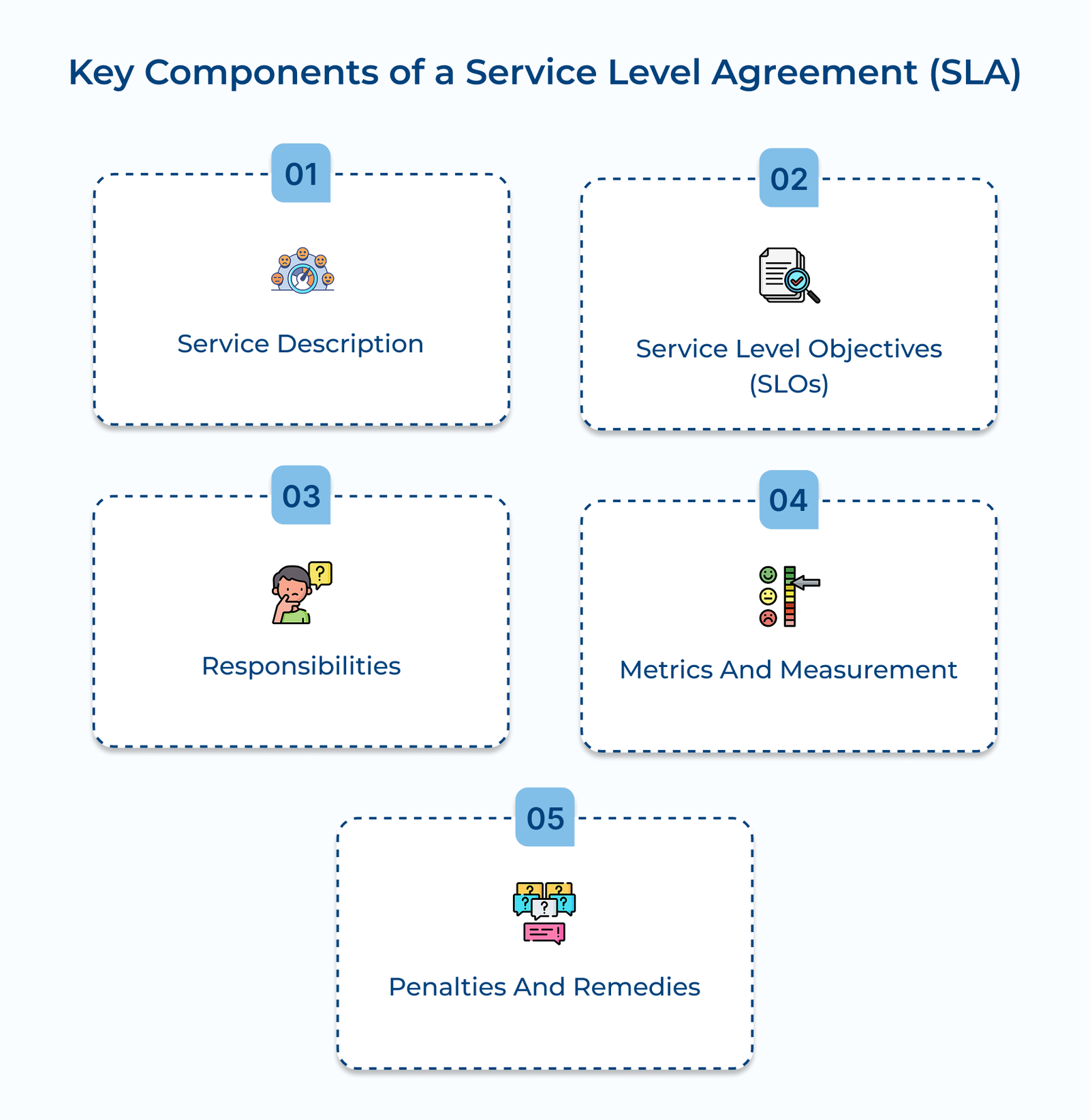
1. Service Description
The component precisely outlines the services included in the agreement, detailing their nature, scope and specifics. A thorough service description helps avoid misunderstandings and establishes clear expectations for the provider along with the customer.
2. Service Level Objectives (SLOs)
SLOs are specific, measurable targets for service performance, often including metrics like availability (e.g., 99.9% uptime), response times and resolution times. The goals give service providers concrete benchmarks to meet, enabling objective evaluation of service quality.
3. Responsibilities
The section outlines the responsibilities of both the service provider and the customer, specifying what each party must do to ensure successful service delivery. Clearly defining the responsibilities helps prevent disputes and promotes smooth service operations.
4. Metrics and Measurement
The component outlines how service performance will be measured and reported. It highlights the key metrics to monitor, the methods for accurate measurement and a streamlined reporting process for transparency. Accurate measurement practices are essential for determining whether SLOs are being met.
5. Penalties and Remedies
The section details the consequences for the service provider if they fail to meet the agreed-upon SLOs, which may include financial penalties, service credits or other compensation. It also outlines the process for addressing and resolving service issues, including escalation procedures.
Following are the best practices that can elevate your SLAs from average to exceptional, helping you build stronger relationships and achieve greater satisfaction with your service offerings.
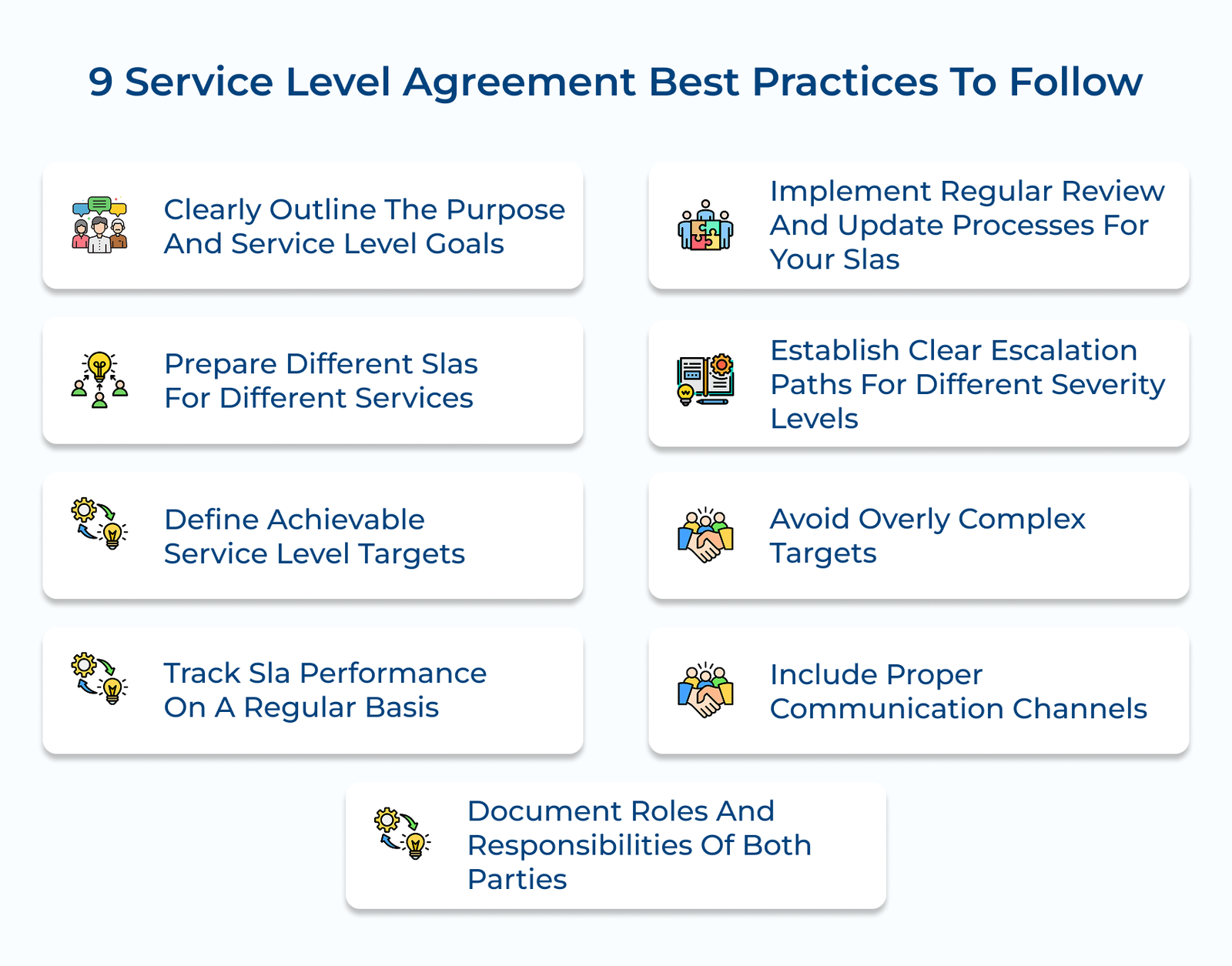
A well-defined SLA begins with a clear statement of its purpose, typically focused on ensuring high-quality service delivery and enhancing a positive relationship between the service provider along the customer. KPIs should be explicitly outlined, offering measurable benchmarks for service quality.
Aligning SLA goals with broader business objectives is essential for supporting the organization’s strategic direction. The alignment helps both parties understand how the services contribute to the customer’s success, laying the groundwork for mutual growth and cooperation.
Actionable tips:
Tailoring agreements to specific service offerings allows for precise definitions of expectations and performance metrics, ensuring that all unique aspects from technical specifications to customer support needs are adequately addressed.
Organizations can create more relevant and effective SLAs by moving away from a one-size-fits-all approach. The customization enhances clearer communication, more accurate performance measurement and, higher customer satisfaction as each service is managed according to its specific needs.
Actionable tips:
Setting realistic performance metrics involves analyzing historical data and current operational capabilities to establish achievable service levels. Striking a balance between ambitious targets that encourage improvement and realistic goals that can be consistently met is crucial.
Balancing customer expectations with operational realities is key. While aiming for high customer satisfaction is important, setting unrealistic targets can lead to frustration, increased costs and damaged relationships. Open communication with customers about what is achievable enhances trust and effectively manages expectations.
Actionable tips:
The systems should deliver real-time or near-real-time data on key metrics, enabling quick identification and resolution of issues. Establishing a regular reporting frequency (weekly, monthly or quarterly) keeps all stakeholders informed about service levels.
Leveraging data analytics for performance insights goes beyond basic metric tracking. Advanced analytics can uncover trends, predict potential issues and highlight opportunities for improvement. The proactive approach to performance management enhances more efficient operations and enhances customer satisfaction.
Actionable tips:
Scheduling regular SLA evaluations is essential for keeping the agreement relevant and effective. The reviews should assess whether current terms align with business needs and technological capabilities, while also identifying areas for improvement.
Adapting to evolving business demands and technologies is an ongoing process. SLAs should be living documents that grow with the business environment. Involving stakeholders in the review process ensures that all perspectives are considered, helping the SLA continue to meet everyone’s needs.
Actionable tips:
Defining incident severity categories is the essential first step in establishing an effective escalation process. Each category should be clearly understood by all parties, with corresponding actions and timelines to ensure critical issues receive the attention they deserve.
Outlining step-by-step escalation procedures brings clarity and consistency to service issue management. The procedures should specify who to notify at each escalation stage, the required actions and the timeframes involved. Setting clear response times for each severity level establishes expectations for both the service provider and the customer.
Actionable tips:
Focusing on key metrics that truly matter helps maintain clarity and direction in service management. While it’s tempting to track numerous metrics, concentrating on a core set of important indicators often yields better outcomes.
Using clear and straightforward language in SLAs ensures all parties understand their obligations. Avoiding technical jargon and complex legal terms makes the agreement more accessible, reducing the risk of misunderstandings. Clearly defined, measurable targets further enhance SLA management and compliance.
Actionable tips:
Establishing primary and secondary contact methods ensures all parties know how to reach each other in various situations. Designating specific individuals or roles as points of contact for different types of issues helps prevent delays and misunderstandings in service delivery.
Defining communication protocols for different scenarios provides a framework for effective interaction between the service provider and the customer. It includes setting up reporting mechanisms, ensuring both parties are promptly informed about service performance, issues and improvements.
Actionable tips:
Clearly defining the obligations of both provider and customer is vital for a successful service relationship. It includes detailing each party’s responsibilities for service delivery, maintenance and support, which helps prevent gaps in service.
Outlining specific tasks creates a roadmap for day-to-day operations or service management, encompassing both regular activities and procedures for exceptional circumstances. Including provisions for dispute resolution establishes a clear process for addressing and resolving conflicts that may arise.
Actionable tips:
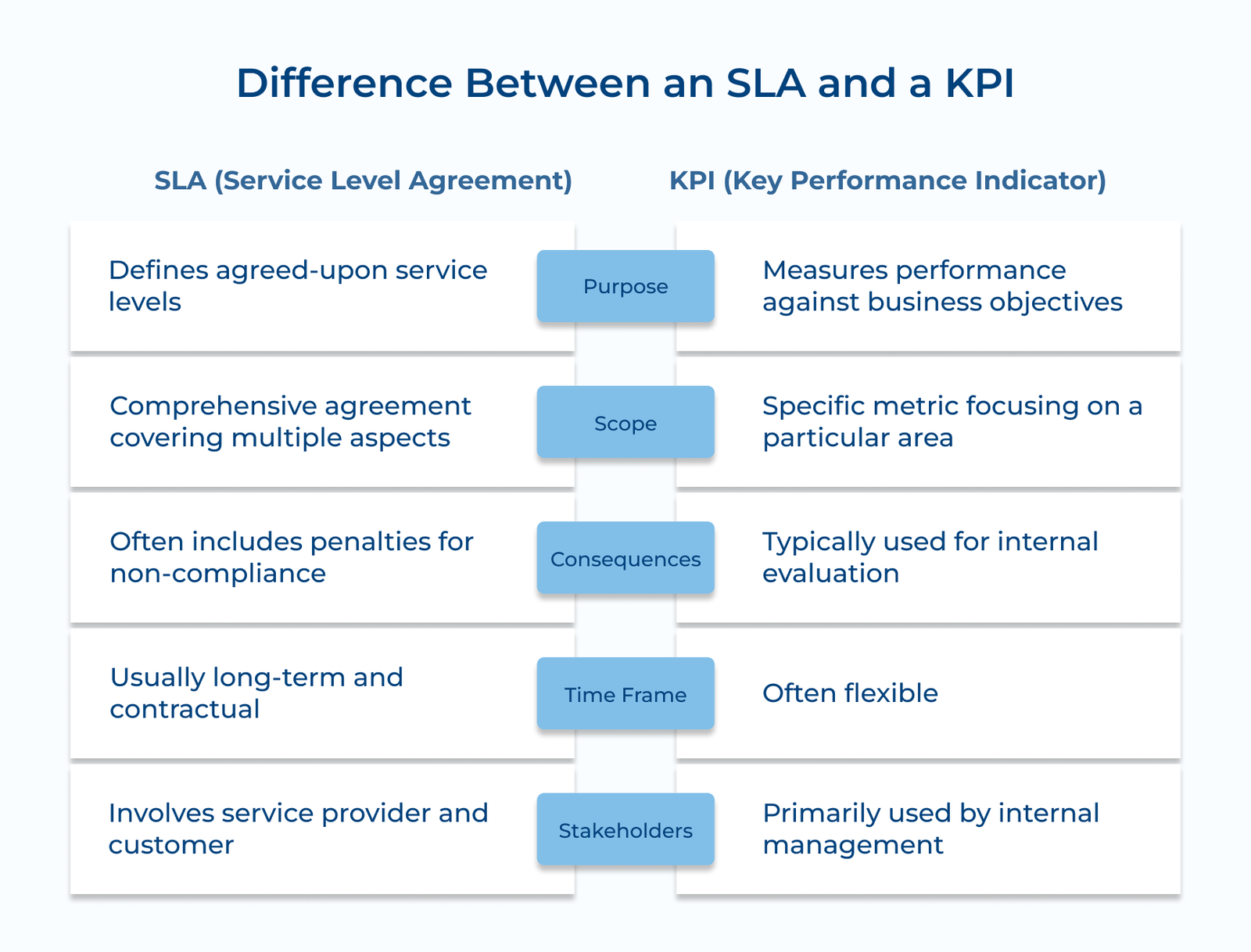
Below is the break down of the fundamental differences between SLAs and KPIs, helping you navigate the world of performance metrics with confidence.
1. Purpose
An SLA is a formal agreement that outlines the expected service levels between a provider and a customer, setting clear standards for quality, availability or responsibilities. It ensures both parties share a mutual understanding of service delivery expectations.
KPIs are metrics that measure the performance and success of an organization or specific business activities. They serve as tools for tracking progress toward strategic goals, helping businesses assess their effectiveness and efficiency across various operations.
2. Scope
SLAs are comprehensive documents that encompass various aspects of service delivery, including service descriptions, performance metrics, responsibilities, communication protocols and remedies for service failures. They offer a holistic view of the relationship between provider and customer.
KPIs are focused and specific, measuring individual aspects of business performance or outcomes. While businesses may track multiple KPIs, each one serves as a distinct metric that provides insight into a specific area of operation or strategic objective.
3. Consequences
SLAs often specify penalties or remedies for failing to meet agreed-upon service levels, which can include financial penalties, service credits or termination clauses. The consequences help ensure accountability and motivate the service provider to meet or exceed standards.
KPIs, while crucial for performance management, typically do not carry direct contractual consequences. Instead, they are used for internal evaluation, goal-setting and continuous improvement. Poor KPI performance may prompt internal actions or strategy adjustments, but it generally doesn’t result in predefined penalties.
4. Time Frame
SLAs are typically long-term agreements that remain in effect for the duration of the service contract, providing a stable framework for the ongoing relationship. They are usually reviewed and renewed at set intervals, often annually or when significant changes arise in service offerings or business needs.
KPIs offer more flexibility in their time frames. Some KPIs track long-term strategic goals, while others focus on short-term operational targets. They can be adjusted more frequently to align with changing business priorities or market conditions, enabling agile performance management.
5. Stakeholders
SLAs involve multiple stakeholders, primarily the service provider and the customer. As external-facing documents, they govern the relationship between the two parties, requiring agreement and sign-off from both sides. SLAs serve as a reference point for managing expectations and resolving disputes throughout the engagement.
KPIs are primarily utilized by internal stakeholders within an organization. They serve as tools for management to track and enhance various aspects of business performance. While KPIs may influence external relationships, they are fundamentally internal metrics used for decision-making, resource allocation and strategic planning.
We’ll explore the common challenges faced when implementing SLAs and provide insights on how to navigate them effectively.
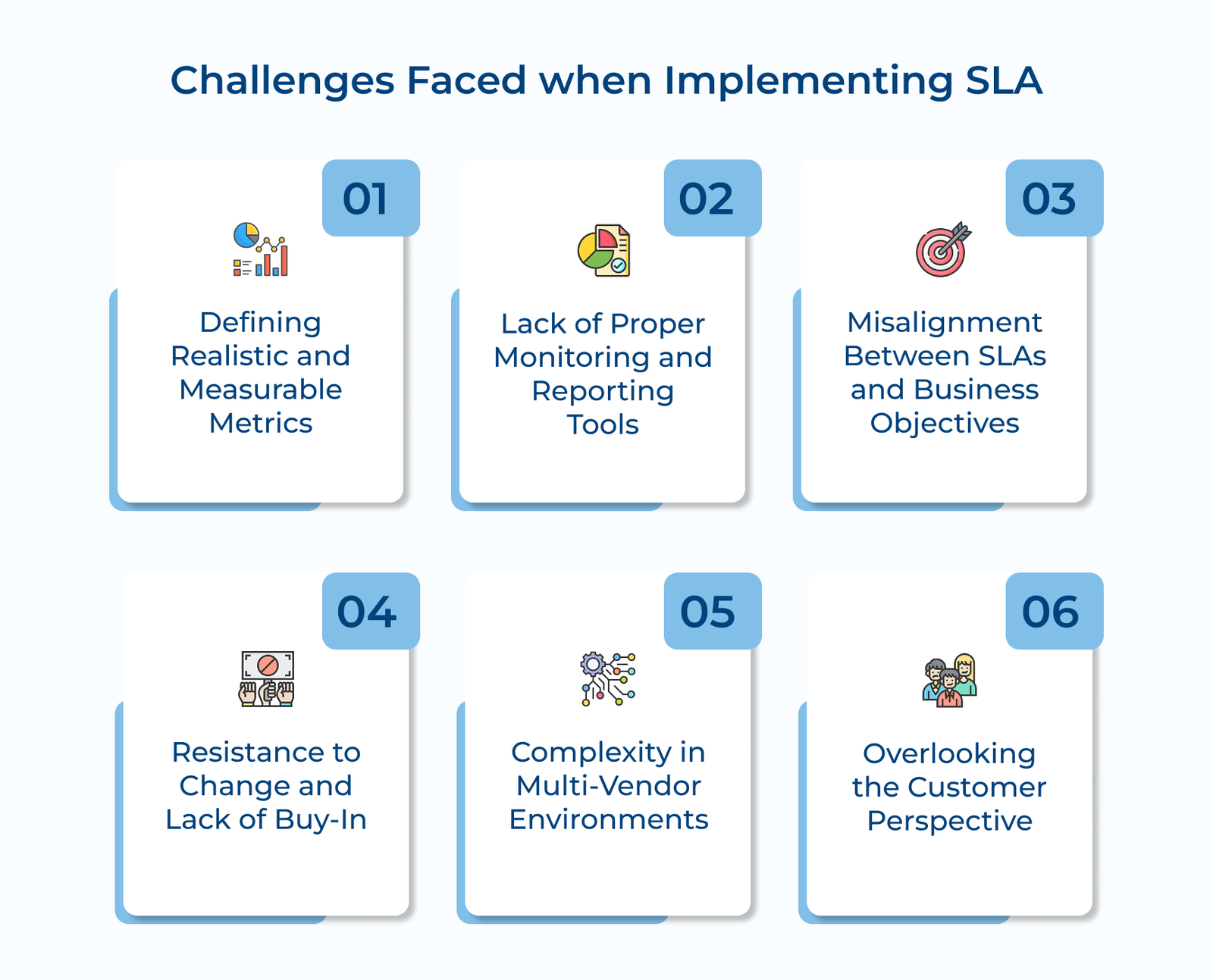
Challenge: Establishing metrics that are both achievable and meaningful can be a major obstacle. Organizations often find it difficult to balance ambitious targets with realistic expectations, resulting in unrealistic SLAs that set both parties up for failure.
Solution: Conduct thorough baseline assessments, involving both technical and business stakeholders in defining metrics. Use historical data and industry benchmarks to establish initial targets. Implement a phased approach, starting with conservative metrics and gradually raising expectations as processes improve.
Challenge: Without strong monitoring and reporting tools, tracking SLA compliance becomes a manual process. It can lead to disputes over service levels and hinder the prompt resolution of performance issues.
Solution: Invest in automated monitoring and reporting systems that deliver real-time visibility into service performance. Create dashboards that provide clear, actionable insights and set up automated alerts for potential SLA breaches. Regularly review and upgrade these tools to meet evolving needs.
Challenge: SLAs that don’t align with overall business goals may improve metrics but fail to deliver real business value, leading to wasted resources and missed opportunities for meaningful improvements.
Solution: Regularly review SLAs in light of broader business objectives. Involve key stakeholders in the design and review process to ensure alignment. Establish a clear connection between SLA metrics and business outcomes.
Challenge: Implementing new SLAs often necessitates changes in processes and behaviors. Resistance from staff who see SLAs as punitive rather than constructive can impede effective implementation and compliance.
Solution: Cultivate a culture of continuous improvement and transparency. Offer comprehensive training on the purpose of SLAs and involve staff in the development process to boost buy-in. Highlight how SLAs enhance service quality and customer satisfaction.
Challenge: Defining and managing SLAs becomes increasingly complex in environments with multiple service providers. Interdependencies can complicate the attribution of responsibility for failures and hinder end-to-end service quality.
Solution: Establish clear governance structures for multi-vendor environments. Implement end-to-end service management processes that define handoff points and responsibilities. Consider appointing a service integrator to oversee service delivery and ensure SLA compliance across vendors.
Challenge: SLAs that prioritize technical metrics without considering the customer experience can result in meeting all targets while leaving customers dissatisfied. The disconnect undermines the value of the SLA process.
Solution: Integrate customer satisfaction metrics into SLAs. Regularly collect and analyze customer feedback to ensure SLAs reflect what matters most to end-users. Conduct periodic service reviews with key customers to align SLAs with their evolving needs and expectations.
Check out the real-world examples of service level agreement best practices that can transform your approach, ensuring clarity, accountability and mutual satisfaction in every agreement you create.
1. Amazon Web Services (AWS)
Amazon offers various SLA tiers for its services, with well-defined uptime commitments. Their Compute SLA guarantees 99.99% availability for Amazon EC2 and Amazon EBS. They also provide automated monitoring tools and transparent reporting on service health.
The strategy has significantly enhanced customer trust in AWS’s reliability. The clear SLAs play a crucial role in attracting and retaining enterprise customers, bolstering AWS’s dominance in the cloud market. AWS reported $80.1 billion in revenue in 2022, a 29% increase from the previous year, driven in part by its strong service commitments.
2. Apple
Apple has established strict response time SLAs for customer support across multiple channels, including phone, chat and in-store assistance. They commit to answering support calls within 90 seconds and aim to complete most repairs within five business days.
The customer-centric approach has significantly bolstered Apple’s reputation for exceptional customer service, enhancing high customer loyalty and repeat purchases. Apple’s services segment, including AppleCare, generated $78.13 billion in revenue in 2022, underscoring the positive impact of its service-focused strategy.
3. Spotify
Spotify has established stringent SLAs for music streaming quality, targeting a start time of under 200 milliseconds for song playback. They also set SLAs for app responsiveness across various devices and platforms, along with goals for the frequency of updates.
The SLAs have enabled Spotify to maintain a competitive edge in the crowded music streaming market, enhancing user satisfaction and retention. As of 2023, Spotify reported 551 million monthly active users, including 220 million premium subscribers, showcasing the success of their focus on service quality.
4. Airbnb
Airbnb has implemented a 24-hour response time SLA for hosts, promoting prompt communication with potential guests. They established SLAs for initial response and issue resolution times for customer support. Their review system, with clear guidelines, acts as a form of peer-to-peer SLA.
The practices have greatly enhanced the user experience for both hosts and guests. The focus on quick responses and reliable support has enhanced trust in the platform. Airbnb reported 393.7 million nights and experiences booked in 2022, highlighting the success of their service-oriented approach.
5. Netflix
Netflix has established stringent SLAs for video streaming quality, aiming for fast start times and minimal buffering. They also set SLAs for the accuracy of their content recommendation engine, committing to ongoing improvements in personalization. They have targets for regularly adding new content to their library.
The SLAs have reinforced Netflix’s position as a leading streaming service. Their emphasis on streaming quality and personalized recommendations has driven high user engagement. As of 2023, Netflix reported over 231 million paid memberships globally, highlighting the success of their service quality commitments.
Implementing SLA best practices is crucial in a competitive landscape. The practices create a framework for setting clear expectations, measuring performance and driving continuous improvement in service delivery. Organizations can stand out in the market by defining standards and processes.
Adopting SLA reporting best practices elevates service standards by enhancing accountability and ongoing enhancement. The practices help align service delivery with business objectives, ensuring consistent quality and responsiveness to evolving customer needs. Companies can proactively tackle issues with robust monitoring, regular reviews and clear communication channels.

Organizations can identify the right metrics for their SLAs by aligning key performance indicators with business objectives. Engaging stakeholders helps prioritize what truly matters. Analyzing historical performance data provides insight into achievable targets. Regular reviews of SLA outcomes ensure metrics stay relevant and adapt to evolving organizational needs.
Failing to meet Service Level Agreement (SLA) commitments can have serious repercussions, including financial penalties, strained client relationships and loss of credibility. Customers may look for alternatives, jeopardizing future business opportunities. It can diminish team morale and increase management scrutiny. Consistently missing SLAs threatens a company’s reputation and stifles its growth potential.
SLAs should be reviewed regularly—ideally annually or when significant changes occur in the service landscape. Triggers for a review can include shifts in technology, business objectives or market conditions impacting service delivery. Regular updates ensure SLAs stay relevant and effectively manage expectations.
The best way to handle SLA violations is through a clear, predefined process. It includes immediate notification, root cause analysis and a corrective action plan. Consequences should be fair and proportional, emphasizing continuous improvement over punishment. Regularly reviewing recurring violations can help uncover systemic issues that need to be addressed.
Engage key stakeholders in the design process and clearly connect SLA metrics to specific outcomes to align SLAs with business objectives. Regularly review SLAs within the broader business strategy, adjusting as necessary. Employ a balanced scorecard approach that incorporates both technical metrics and business-focused measures like customer satisfaction.
Automation is essential for effective SLA management, providing real-time monitoring, automated reporting and instant alerts for potential breaches. The tools streamline performance data collection, generate compliance reports and trigger predefined actions when needed. It not only minimizes manual effort and boosts accuracy but also enables more proactive management of SLAs.
Grow Customer Relationships and stronger team collaboration with our range of products across the Conversational Engagement Suite.
Omnichannel Customer Support & Help Desk Software
AI Enabled Business Messaging and Chatbot Software
Sales Engagement & CRM Software
Call Center Software & Virtual Phone System
Product Marketing & Experience Platform
Customer Experience & Feedback Management Software

 How to Start Sales Conversations: A Detailed Guide
Scroll to top
How to Start Sales Conversations: A Detailed Guide
Scroll to top