Most Important Conversational AI Statistics for 2026
Discover the trends, growth and key conversational AI statistics shaping AI-driven interactions. Learn how they transform customer service and user experiences.

Discover the trends, growth and key conversational AI statistics shaping AI-driven interactions. Learn how they transform customer service and user experiences.
Customers demand instant, personalized communication, leaving traditional customer service struggling to keep up. Enter Conversational AI – a game-changer offering 24/7 support, tailored experiences and rapid responses. It’s expected that 95% of interactions between brands and customers will involve AI.
We’ve gathered the must-know conversational AI statistics to help you understand the full impact of the technology. The insights will showcase why conversational AI is a vital tool for businesses across all industries, transforming customer interactions and improving service efficiency.
Conversational AI statistics refers to computers engaging in human-like dialogue by using technologies that understand, process and respond to natural language. Through NLP, the systems break down user inputs into components that are easy for the machine to interpret and act upon.
Advanced conversational AI goes beyond basic interactions by incorporating context awareness, sentiment analysis and personalization, creating more dynamic conversations. It allows for smarter, more intuitive exchanges that mimic human interactions, making AI a powerful tool for businesses seeking to improve customer service and streamline communication.
Key objectives:
Check out the key statistics that highlight the transformative advantages of conversational AI in business, shedding light on why you can’t afford to overlook the opportunity for growth.

1. Sales increased by an average of 67% when chatbots were used
The statistic underscores the powerful effect of chatbots on sales performance, with businesses reporting an average 67% revenue increase after integrating them into their sales processes.
Chatbots enhance the sales journey by providing round-the-clock engagement, instantly addressing customer inquiries and smoothly guiding prospects through the sales funnel. As a result, they drive higher conversion rates and boost revenue.
2. 80% of customers say using chatbots to solve problems was a good experience
The statistic highlights the strong customer satisfaction with chatbot interactions, with the majority of users reporting positive experiences when using chatbots to resolve issues. It shows that AI-powered tools are effectively meeting customer expectations for problem-solving.
The high satisfaction rate emphasizes the value of conversational AI in elevating customer support. Chatbots deliver fast, accurate responses, resolving issues efficiently and enhancing the customer experience, which can enhance greater loyalty.
3. 90% of companies that use chatbots for customer service save up to 4 minutes per question and only pay $0.70 per interaction
The statistic underscores the operational efficiency gained by using chatbots in customer service. Companies save valuable time per inquiry while keeping costs low, showcasing a major improvement over traditional support methods.
The time and cost savings highlight the clear business advantages of conversational AI. Businesses can cut operational expenses, boost response times and free up human agents to tackle more complex issues by automating routine queries, enhancing the quality of customer service.
4. 37% of individuals employed in advertising or marketing had utilized AI for tasks related to their work in a survey of professionals in the United States
The statistic highlights the rising adoption of AI, particularly conversational AI, in the marketing and advertising industries. Over a third of professionals are already incorporating AI to optimize their strategies and results.
The growing use of AI in the fields demonstrates its tangible benefits. Conversational AI assists with tasks like data analysis, customer segmentation and personalized marketing, leading to more impactful campaigns.
5. 43% of people who use digital banking prefer to use a live chat or robot to solve a problem in the US
The statistic reveals a strong preference for AI-driven solutions in the banking sector, with nearly half of U.S. digital banking users choosing chatbots or live chat to resolve issues. The growing trend showcases the increasing trust in conversational AI for financial services.
Conversational AI enhances the customer experience, reduces wait times and eases the load on human support agents by offering quick problem-solving options. It leads to improved satisfaction and operational efficiencies for banks.
6. 57% of businesses believe robots provide a high return on investment (ROI) with little work
The statistic highlights the growing positive perception of AI and robotics among businesses, with over half of companies seeing substantial returns on their investment in the technologies. The benefits far outweigh the effort on deployment and maintenance.
The high ROI of AI, particularly conversational AI, underscores its value in streamlining operations. Businesses can achieve significant gains with minimal ongoing effort by automating tasks, enhancing efficiency and improving customer interactions, making it a smart investment.
Here are the must-know statistics that will shape your understanding of conversational AI in the coming year.
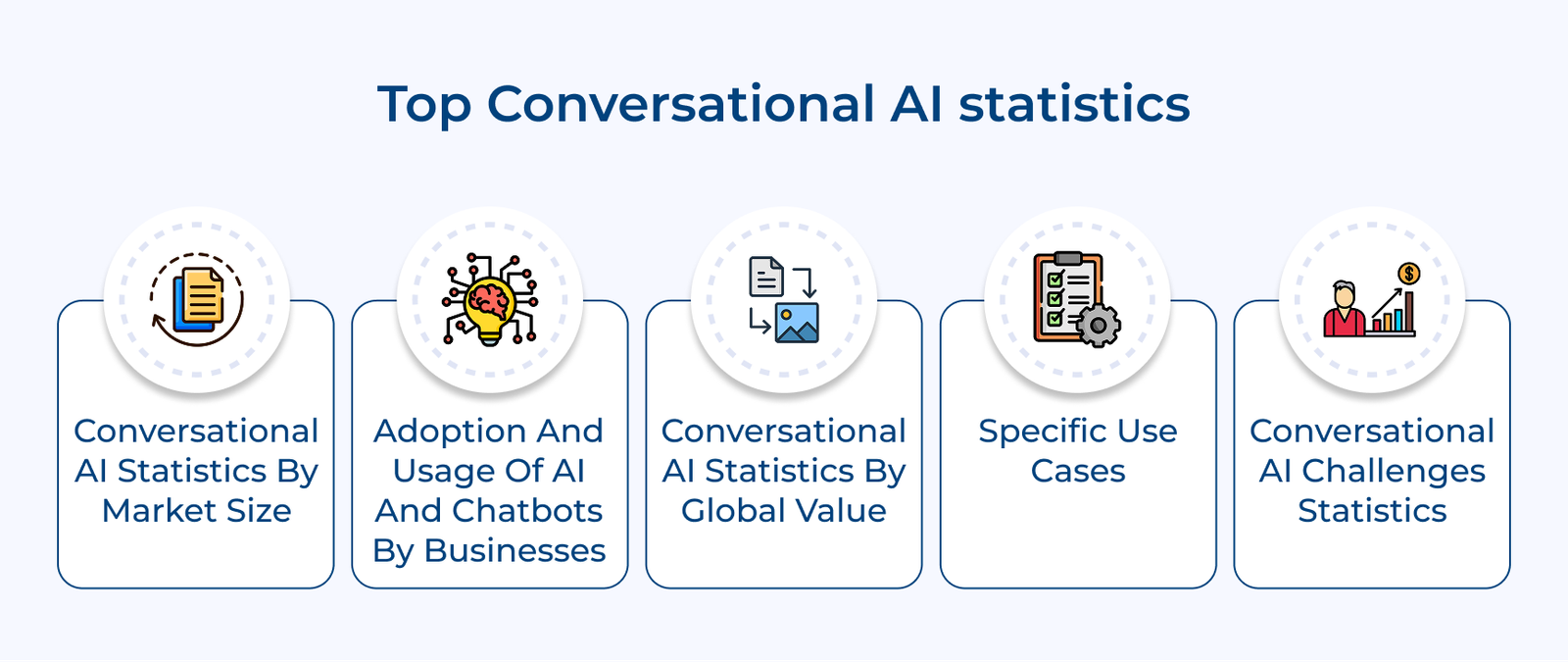
Dive deep into the current statistics surrounding the conversational AI market size, exploring not only its growth trajectory but also the factors propelling it forward.
7. The global conversational AI market size is expected to grow to at a CAGR of 30.2% to $22.6 billion by 2028:
The statistic underscores the explosive growth of the conversational AI market, with a projected compound annual growth rate (CAGR) of 30.2%. The market is expected to reach $22.6 billion by 2028, signaling widespread adoption across industries.
Such rapid growth highlights the growing demand for conversational AI as businesses increasingly recognize its value in improving customer interactions, optimizing operations and securing a competitive edge.
8. The volume of interactions handled by conversational AI increased by 250% since the pandemic:
The statistic highlights the dramatic rise in conversational AI usage following the COVID-19 pandemic, with AI-handled interactions increasing by 250%. The surge underscores how critical AI has become in helping businesses stay operational and meet shifting customer demands during the crisis.
The rapid adoption of conversational AI during this time demonstrates its value in managing high volumes of inquiries, providing support and keeping customer engagement strong. The shift solidified AI’s role as an essential tool in modern business operations.
Let’s explore the compelling statistics that highlight the current state of conversational AI in the business world and the benefits it offers.
9. The adoption of AI for digital marketing increased from 29% in 2018 to 85% in 2028
The statistic reveals a massive jump in AI adoption for digital marketing, with usage growing from 29% to 85% over the past decade. The shift reflects how AI has become an integral tool in modern marketing strategies.
The rapid adoption highlights businesses’ growing recognition of AI’s potential to transform digital marketing. Companies can personalize customer interactions, analyze data and optimize campaigns by leveraging conversational AI, driving more impactful marketing outcomes.
10. 74% of companies that incorporate chatbots into their customer service plans are satisfied with the outcomes
The statistic highlights the strong satisfaction businesses have with chatbots in customer service. Nearly 75% of companies report that chatbots meet or surpass their expectations, demonstrating the technology’s impact on service operations.
The high satisfaction rate underscores the significant benefits of conversational AI, including faster response times, cost savings and better customer experiences. The positive outcomes are driving businesses to increasingly adopt and integrate chatbots into their customer service strategies.
11. Due to advancements in conversational AI technologies, nearly 80% of CEOs have modified or plan to modify their client engagement strategies
The stat underscores the growing influence of conversational AI at the executive level. Conversational AI is seen as a game-changer for customer interactions with 80% of CEOs reshaping their client engagement strategies.
The widespread shift towards AI-driven engagement strategies reflects businesses’ recognition of its transformative potential. CEOs understand that conversational AI can enhance service quality, drive innovation and provide a competitive edge, prompting major changes in how companies connect with clients.
Check out the compelling figures that underscore the value of conversational AI and what they mean for the future of business communications.
12. Around 90% of companies mentioned faster complaint resolution and over 80% reported increased call volume processing using conversational AI solutions
The statistic highlights the powerful operational benefits of conversational AI. Most companies report faster complaint resolution, with over 80% able to handle higher call volumes. The improvements significantly boost efficiency and service capacity.
Conversational AI enhances customer satisfaction and reduces wait times by enabling quicker responses and managing more inquiries without raising costs. It leads to better service quality, greater operational efficiency and a potential increase in customer loyalty.
13. Opportunity for between 15 – 70% cost reduction, depending upon the customer channel interactions deflected into conversational-enabled channels
The statistic showcases the impressive cost-saving potential of conversational AI, with businesses able to reduce costs by 15-70% by shifting customer interactions to AI-powered channels. The variation in savings depends on how effectively AI is implemented.
Companies can dramatically cut operational expenses while maintaining or even enhancing service quality by automating customer interactions. The savings not only improve profitability but also free up resources for further business growth and innovation.
14. The global value of conversational AI will be worth $5.72 billion by 2027
The projection highlights the rapid growth of the conversational AI market, expected to reach $5.72 billion by 2027. The surge in adoption and investment across industries reflects the growing demand for AI-driven customer solutions.
Conversational AI is set to become a game-changer in customer interactions, operational efficiency and innovation with its projected market value. The increasing global recognition of its potential underscores its pivotal role in transforming businesses worldwide.
Following are the compelling statistics surrounding conversational AI across specific use cases that highlight its effectiveness and potential for growth.
15. 37% of users prefer booking travel or comparing booking options with an intelligent chatbot rather than a human
Over a third of consumers now prefer AI-powered chatbots for travel bookings and comparisons, signaling a growing trust in automated systems for complex tasks. The shift in consumer behavior highlights the increasing comfort with AI in the travel industry.
Chatbots are proving highly effective in the space, offering quick comparisons, instant responses and round-the-clock availability. The capabilities make them valuable tools for travel businesses, enhancing customer experience while streamlining the booking process.
16. Two-thirds of respondents find a travel chatbot helpful for managing their business and work trip plans:
The majority of users now see the value in AI-powered chatbots for managing business travel, underscoring their effectiveness in handling the complexities of work-related trips. The growing acceptance reflects the convenience and efficiency that chatbots bring to business travel planning.
Business travel chatbots are proving to be a game-changer with high user satisfaction. They streamline travel arrangements, boost employee productivity, ensure compliance with company policies and can even help reduce travel costs.
17. 73% of customers prefer chatbots for checking the status of an order:
Nearly three-quarters of customers prefer using chatbots to track their orders, highlighting the technology’s effectiveness in delivering quick and accurate updates. The strong preference shows that chatbots are meeting, if not exceeding, customer expectations for real-time order tracking.
The growing demand for AI-powered order tracking demonstrates the value of conversational AI in e-commerce and logistics. Chatbots ease the burden on virtual agents, improve response times and boost customer satisfaction in retail services by automating the process.
The following statistics shed light on the pressing challenges within conversational AI and explore what can be done to address them effectively.
18. Only 33% of consumers find chatbots to be very effective at solving their issues on the first attempt.
Two-thirds of users report that chatbots struggle to resolve issues efficiently, revealing a significant gap between user expectations and AI performance. The highlights a key challenge in conversational AI: the need for more accurate and effective issue resolution.
Businesses can invest in advanced natural language processing (NLP) models and machine learning algorithms to bridge the gap. Companies can significantly improve chatbot accuracy by continuously training AI on diverse datasets and enabling context-aware systems.
19. 54% of users become frustrated when chatbots can’t understand the context of their queries or maintain conversation history.
Over half of users feel frustrated when AI fails to maintain context during conversations, particularly when it can’t recall previous interactions or grasp the broader context of their inquiries. It highlights a critical challenge in conversational AI.
Businesses should implement advanced dialogue management systems and leverage long-term memory capabilities. Companies can deliver more coherent, context-aware responses by enabling AI to track conversation history and understand user intent across multiple interactions.
20. 59% of customers prefer to speak with a human agent for complex issues or when they need detailed explanations.
The statistic highlights a key limitation of current AI systems: their struggle to handle complex or nuanced queries. The majority of users still prefer human intervention for intricate issues, indicating that AI falls short in delivering detailed explanations and solving sophisticated problems.
Businesses can implement hybrid systems that combine AI with human expertise. Companies can improve AI capabilities by using smart routing algorithms to identify and transfer complex queries to customer service teams while allowing the AI to learn from the interactions.
Take an in-depth look at the current state of conversational AI across different industries, revealing compelling data that underscores its impact and potential for growth.
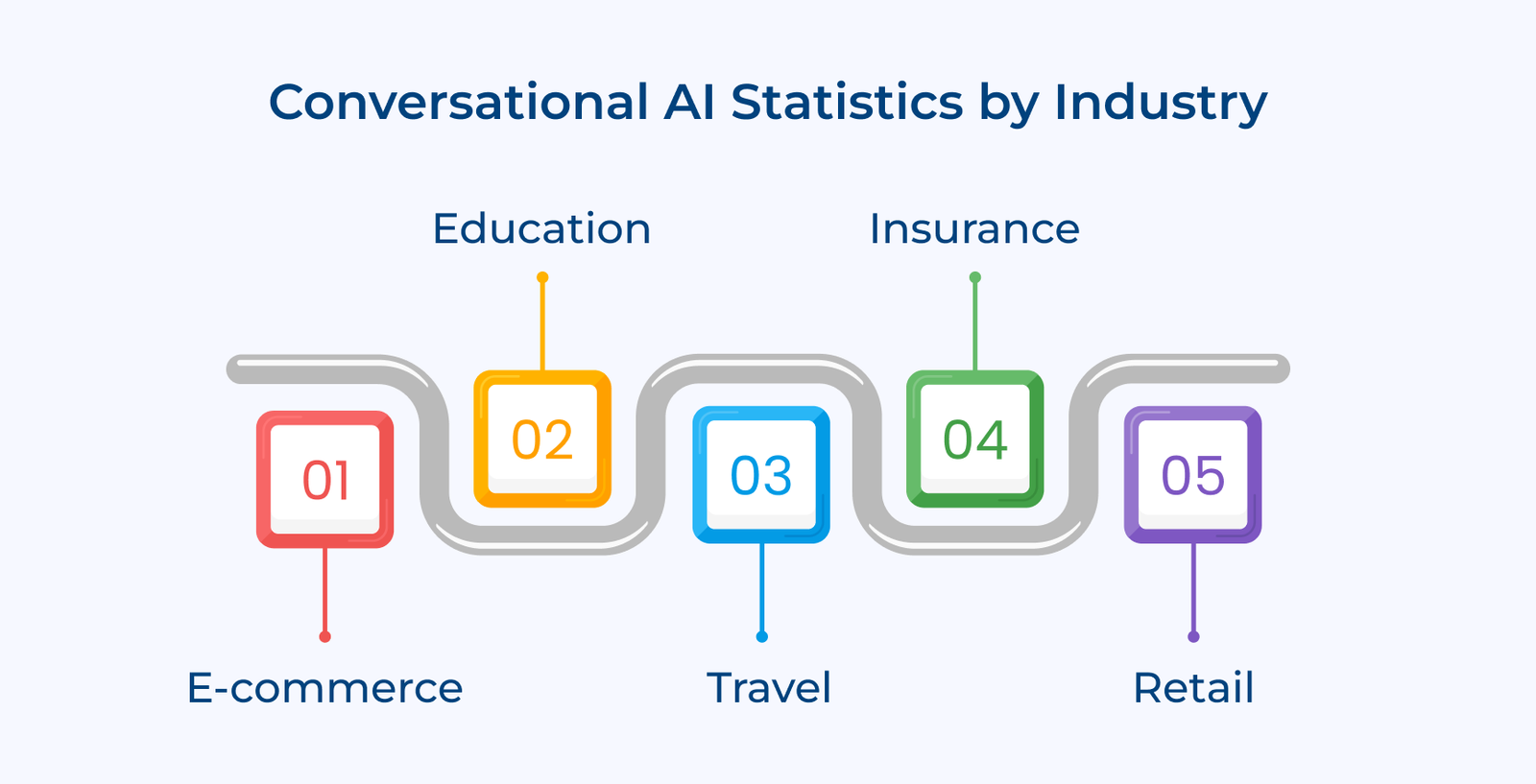
21. Global e-commerce sales reached $4.2 trillion in 2021 and are predicted to surpass $9.5 trillion by 2028
The statistic highlights the explosive growth of e-commerce, with projected sales soaring from $4.2 trillion to $9.5 trillion in just seven years. The rapid expansion reflects the growing shift toward online shopping and increasing consumer demand for seamless digital experiences.
As e-commerce continues to grow, conversational AI becomes essential for handling the surge in customer interactions. AI-powered chatbots are key to efficiently managing inquiries, providing personalized recommendations and processing transactions, all of which enhance the customer experience.
22. Improving CX and providing exceptional customer service increases consumers’ brand loyalty and trust by 40 percent
The statistic highlights the strong link between customer experience (CX) and brand loyalty, with a 40% boost in trust showing just how pivotal great service is for building lasting consumer relationships in e-commerce.
Conversational AI is central to enhancing CX in the digital retail world. AI-powered chatbots elevate customer service with 24/7 availability and the ability to offer instant, personalized responses, driving increased loyalty in a highly competitive market.
23. 97% of consumers look for deals when they shop —virtual assistants can provide referrals, and rewards to loyal customers and boost companies’ loyalty programs
The statistic underscores that nearly every consumer is motivated by deals, emphasizing the importance of promotions and rewards in retaining customers in e-commerce.
Conversational AI can tap into this deal-seeking behavior by delivering personalized offers and rewards through virtual assistants. AI drives repeat purchases, boosts sales and strengthens customer retention in the competitive e-commerce landscape by enhancing customer engagement.
24. Georgia Institute of Technology used a chatbot to answer 10k messages a semester with a 97% success rate
The statistic highlights the impressive effectiveness of AI chatbots in managing high volumes of student inquiries. The chatbot delivers accurate and timely information on a large scale with a 97% success rate in handling 10,000 messages.
The strong performance of conversational AI in education demonstrates its potential to transform student support services. Chatbots free up human resources for more complex issues by automating routine questions.
25. Artificial intelligence in education is being widely adopted, growing at an annual rate of around 50%
The statistic highlights the swift adoption of AI in education, with a 50% annual growth rate signaling increasing recognition of its value. Educational institutions are turning to AI to enhance learning experiences and streamline operations.
The rise of AI in education underscores the growing role of conversational AI. Chatbots can offer personalized learning support, quickly address student queries and assist with administrative tasks.
26. AI and automation could save the travel industry since it is the most impacted one with an estimated loss of $5 trillion in 2028
The statistic underscores the looming $5 trillion loss expected in the travel industry by 2028, highlighting the urgent need for innovative solutions to recover and thrive.
Conversational AI can be a game-changer in the travel sector, streamlining operations, cutting costs and improving customer service. AI-powered chatbots can assist with bookings, provide instant travel updates and offer personalized recommendations.
27. 66% of respondents claim they find travel chatbots ‘useful’ when organizing business and leisure travel arrangements
The statistic highlights the growing appreciation for chatbots in travel planning, with a majority of travelers valuing AI assistance. The positive response reflects a shift towards greater acceptance of automated travel services.
The rising popularity of travel chatbots underscores their importance in the industry. AI chatbots enhance the travel experience by streamlining booking, offering instant updates and providing tailored recommendations.
28. 95% of insurance executives intended to start or continue investing in AI capabilities in the future
The stat highlights the strong support for AI within the insurance industry, with the majority of executives planning to invest in the technology. The widespread confidence signals a clear belief in AI’s transformative potential for the sector.
The growing investment in AI underscores the value of conversational AI in insurance. Chatbots can simplify claims processing, deliver instant policy updates and provide personalized insurance advice, significantly improving customer service.
29. The disruptive impact of conversational AI in the insurance world is expected to grow exponentially, leading to cost savings to the tune of $5 billion by 2026–a steep rise from $300 million a few years ago
The statistic underscores the substantial financial impact of conversational AI in the insurance industry, with cost savings projected to rise from $300 million to $5 billion. The dramatic increase highlights AI’s ability to drive efficiency and reduce costs at scale.
The potential for significant savings emphasizes why AI is a game-changer for insurance companies. Conversational AI helps insurers lower operational costs while improving service quality by automating repetitive tasks, enhancing customer service and streamlining workflows.
30. Over 80% of all chatbots accessed will be retail-based by 2026
The statistic highlights the retail sector’s dominance in chatbot adoption, with over 80% of chatbots expected to be retail-based. It shows that conversational AI is becoming a central tool in retail customer service.
The widespread use of chatbots in retail underscores their growing importance in delivering personalized, real-time support. As consumer expectations rise for quick and tailored experiences, AI chatbots are essential for answering inquiries and enhancing the shopping journey.
31. Chatbot ecommerce transactions will reach $112 billion annually
The statistic underscores the impressive financial impact of chatbots in e-commerce, with AI-driven conversations facilitating $112 billion in annual transactions. It highlights the increasing role of conversational AI in boosting online sales.
The substantial value of chatbot-driven transactions emphasizes the growing importance of AI in retail. Chatbots are key drivers of sales growth in the online shopping world by streamlining purchases, offering personalized recommendations and providing instant support.
32. Retail sales from chatbot communication will double every year by 2027
The statistic projects explosive growth in chatbot-driven retail sales, with sales doubling every year. The rapid increase reflects growing consumer trust and the effectiveness of AI-powered interactions in the retail industry.
The anticipated surge in chatbot-driven sales highlights the transformative role of conversational AI in retail’s future. As customer service chatbots become more widely adopted, they will be essential for boosting sales, enhancing customer engagement and reshaping the retail experience.
Check out the future expectations about AI and chatbots, providing insights into how they will continue to revolutionize the way businesses meet evolving customer demands.
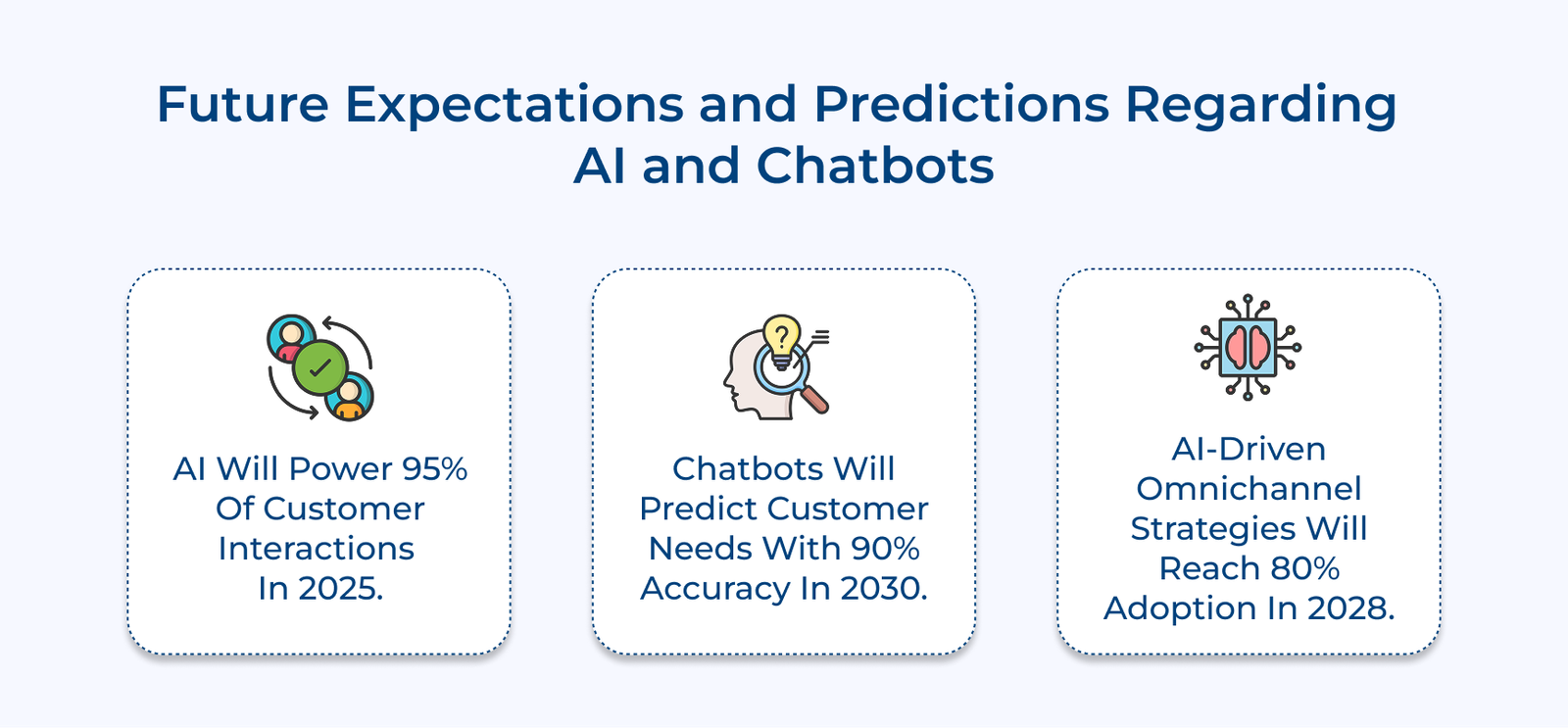
33. 95% of customer interactions will be powered by AI by 2026, including natural language processing, machine learning and emotional AI.
The prediction points to a major shift towards AI-driven customer interactions shortly. Businesses are set to invest heavily in AI technologies to manage communications across multiple channels, transforming how they engage with customers.
Virtual assistants will become more intuitive with the integration of advanced AI, such as natural language processing and emotional AI. The advancements will enable AI systems to understand context, sentiment and nuanced conversations, significantly improving the customer experience.
34. AI-powered chatbots will be able to predict customer needs with 90% accuracy by 2030, leading to proactive customer service.
The forecast highlights the next step in AI’s evolution: predictive capabilities. Future AI systems won’t just respond to customer queries, they’ll anticipate needs by analyzing past interactions and data trends.
The proactive approach could transform customer service by addressing issues before they arise. Anticipating customer needs will boost satisfaction, reduce support ticket volumes and enable businesses to offer highly personalized experiences.
35. 80% of businesses will have implemented AI-driven omnichannel communication strategies by 2028, seamlessly integrating chatbots across multiple platforms.
The prediction underscores the growing trend of AI adoption for creating seamless customer experiences across multiple channels. Businesses will increasingly leverage AI to ensure consistent interactions whether customers engage via social media, websites or mobile apps.
Companies can offer a unified customer journey by implementing omnichannel AI strategies. AI-powered chatbots and assistants will access data across touchpoints, providing more contextual support, no matter the platform or device the customer uses.
Conversational AI is transforming how businesses engage with customers, offering 24/7 support, personalized interactions and fast problem resolution. As demand for instant, high-quality customer service rises across industries, AI solutions are becoming essential for meeting expectations.
The statistics we’ve reviewed showcase the powerful impact of conversational AI on business performance. AI-powered chatbots are delivering measurable benefits across sectors like e-commerce, insurance, education or travel from boosting customer satisfaction and streamlining operations to driving revenue growth.

The global conversational AI market is booming, with estimates predicting it will hit $20-30 billion by 2026-2028. The rapid growth underscores the widespread adoption of the technology and its rising importance in shaping business strategies.
Studies reveal impressive boosts in customer service efficiency with conversational AI. Businesses report up to 70% cost savings and 90% faster complaint resolution. AI chatbots handle high volumes of inquiries around the clock, allowing human agents to focus on more complex issues.
Adoption rates of conversational AI are soaring across industries. AI usage is set to hit 85% by 2028 in digital marketing, while 95% of insurance executives plan to invest in AI. The figures reflect the growing recognition of AI’s business value.
Conversational AI is driving impressive growth in e-commerce. Sales jumped by an average of 67% with chatbot integration and annual chatbot transactions are projected to hit $112 billion. Retail sales through AI-driven chats are expected to double each year by 2027.
Consumer sentiment toward chatbots is largely positive, with 80% of customers satisfied with problem-solving interactions. 66% find chatbots helpful for trip planning in travel. 59% still prefer human agents for complex issues, highlighting room for AI improvement.
Grow Customer Relationships and stronger team collaboration with our range of products across the Conversational Engagement Suite.
Omnichannel Customer Support & Help Desk Software
AI Enabled Business Messaging and Chatbot Software
Sales Engagement & CRM Software
Call Center Software & Virtual Phone System
Product Marketing & Experience Platform
Customer Experience & Feedback Management Software

 Reduce First Response Time: 9 Easy-to-Use Strategies
Scroll to top
Reduce First Response Time: 9 Easy-to-Use Strategies
Scroll to top