How to Improve Team Productivity: 10 Practical Ways
Explore some practical strategies to improve team productivity, focusing on communication, collaboration, task management and motivation to help your team work more efficiently.

Explore some practical strategies to improve team productivity, focusing on communication, collaboration, task management and motivation to help your team work more efficiently.
Managers are constantly pressured to do more with fewer resources. Productivity challenges aren’t just about hitting targets—they directly impact a team’s ability to function. With 40% of teams missing deadlines and struggling with backlogs, the consequences are clear: burnout, low morale and growing disconnects between team members.
Despite using productivity tools, many teams remain stuck in a cycle of inefficiency, where longer hours and tighter deadlines only add to the problem. The real solution isn’t working harder, it’s working smarter. Let us explore the practical strategies on how to improve team productivity while maintaining team well-being and quality of work.
Team productivity refers to the collective ability of a group to work efficiently and effectively toward shared goals. It measures how well team members combine their skills, resources and efforts to deliver quality results while maximizing time.
Team productivity thrives on synergy, where the group’s output is greater than the sum of individual efforts. Clear communication, coordinated actions, shared responsibilities and mutual support enable team members to leverage each other’s strengths, cover weaknesses or innovate together to solve problems.
Key principles:
Let’s go through the reasons why businesses should improve team productivity, highlighting how it drives efficiency and contributes to business success.
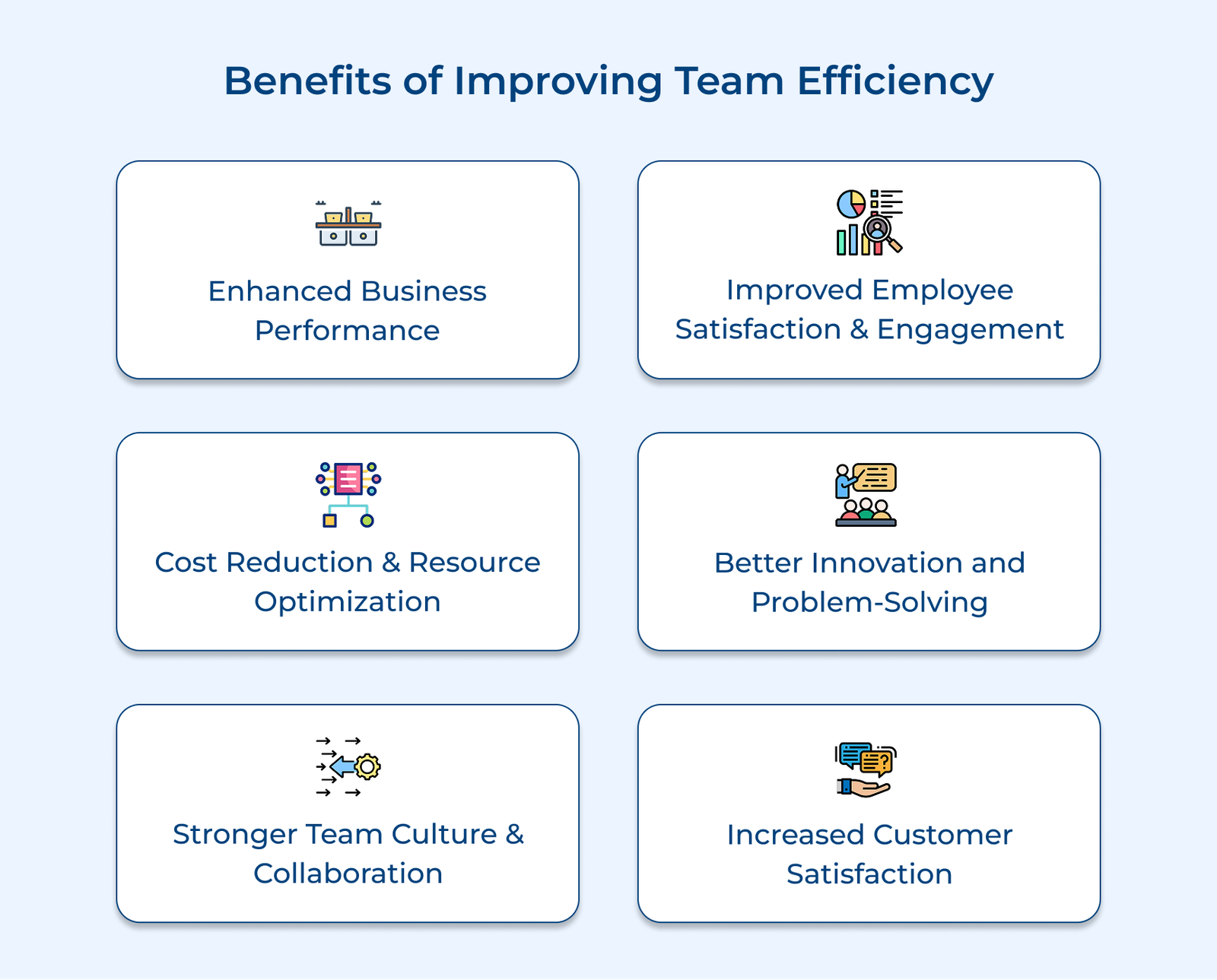
Enhanced Business Performance
Boosting team productivity directly drives the bottom line by increasing output, improving quality and optimizing resources. Teams achieve more in less time, leading to faster project completion and greater revenue potential, giving you a competitive edge.
Improved Employee Satisfaction and Engagement
When teams work productively, members experience less stress and frustration. When teams boost productivity, they feel a greater sense of accomplishment and purpose. It enhances job satisfaction, promotes work-life balance and fuels motivation to contribute to team goals.
Cost Reduction and Resource Optimization
Productive teams minimize the waste in time, effort and resources. Teams eliminate inefficiencies, streamline processes and reduce redundancies. It cuts operational costs, improves resource allocation and boosts the organization’s return on investment.
Better Innovation and Problem-solving
Productive teams free up time to focus on creative solutions and innovation. Members can dedicate more energy to strategy and tackling new challenges with streamlined processes.
Stronger Team Culture and Collaboration
Boosted productivity creates a positive team culture where successes are celebrated and challenges are tackled together. It builds stronger relationships, improves trust among team members and creates a culture of mutual support.
Increased Customer Satisfaction
Efficient teams deliver higher-quality work and respond to customer needs faster. It helps boost satisfaction, strengthen client relationships and enhance their market reputation – all while driving business growth.
Below are the actionable ways to elevate your team’s productivity, helping you create a thriving, engaged workforce that meets and exceeds its objectives.
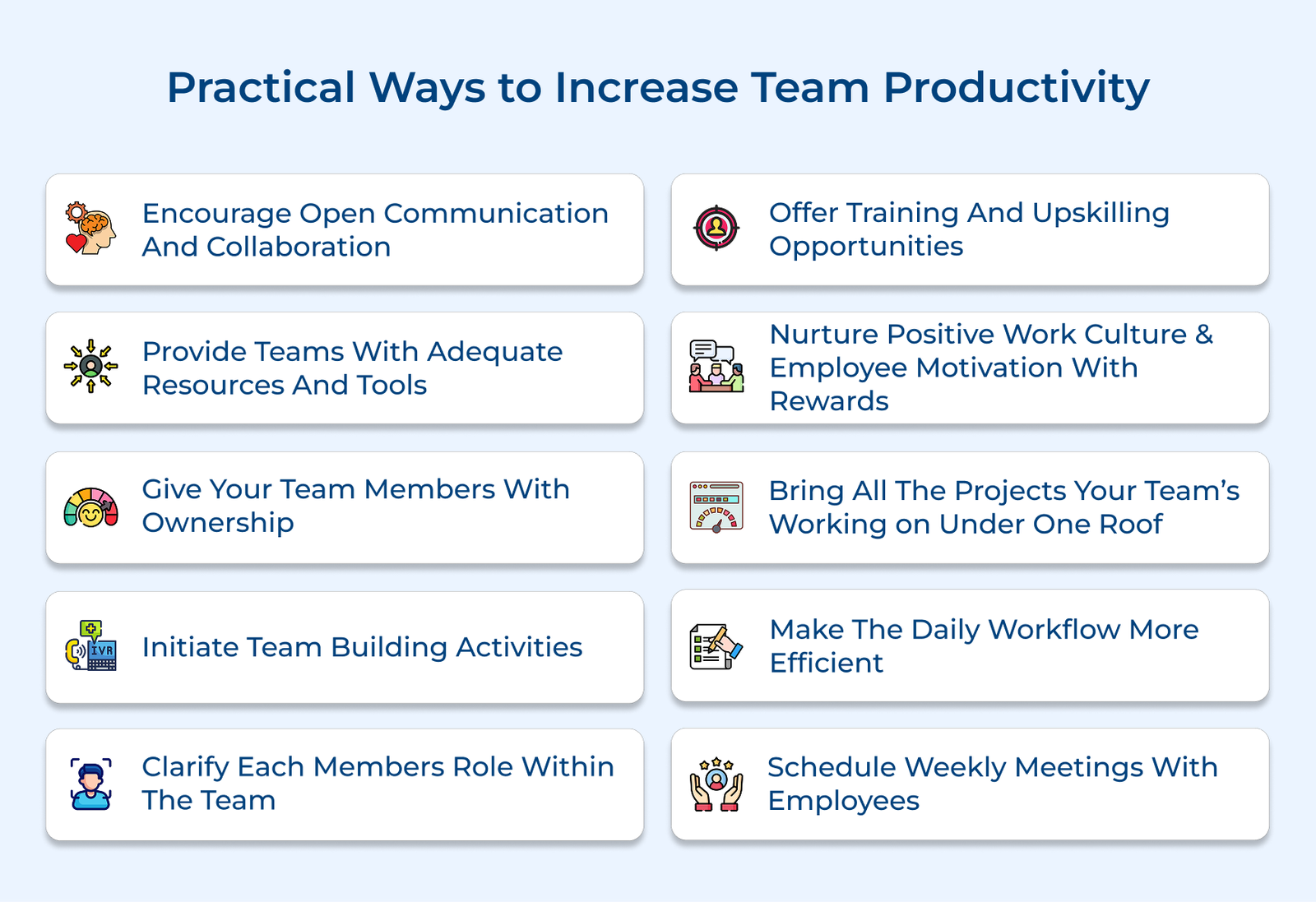
Creating open channels where members can share ideas, concerns and feedback without judgment enhances a positive work environment. On the other hand, teams who communicate effectively may increase their productivity by as much as 25%. Challenges such as geographical differences, language barriers and tech gaps can hinder smooth communication.
Let’s assume that a software development team adopted a multi-channel communication strategy, using quick update tools, weekly video stand-ups for face-to-face interaction and a shared documentation system for project details. The approach led to faster problem-solving and stronger team engagement, as members felt more connected.
Actionable tips:
Providing teams with the right tools and resources is key to sustaining productivity. It includes the necessary hardware, software licenses, training materials and industry-specific tools. Teams should regularly assess their needs, maintain an up-to-date inventory and ensure resources are allocated within budget through smart planning.
Choosing the right tools should align with team goals—whether it’s project management software, collaboration platforms, development tools or analytics software. Regularly evaluating tool performance and user adoption helps teams optimize resource allocation.
Pro tips:
Teams can enhance ownership by recognizing individual strengths and aligning responsibilities. Successful delegation involves setting clear expectations, providing support and maintaining open communication. Balancing accountability with autonomy ensures team members feel trusted while staying responsible for their deliverables.
Regular check-ins, defined success metrics and feedback loops keep everyone on track, with a focus on outcomes rather than micromanaging the process. Take the example of a product development team assigned ownership of features to individual members, giving them full responsibility from concept to launch. Each feature owner made key decisions, collaborated with other departments and provided regular updates, resulting in increased motivation.
Best practices:
Team-building activities are powerful tools for strengthening relationships and promoting collaboration. The key is selecting activities that match team dynamics and organizational culture from virtual games to off-site retreats.
Success is measured by improved communication, stronger collaboration and higher team morale. Regular feedback ensures the activities effectively impact team dynamics, allowing for adjustments and continuous improvement. The goal should always be to enhance meaningful connections, not just offer entertainment.
Pro tips:
A clear role definition is key to avoiding overlap and ensuring all responsibilities are covered. It includes creating detailed job descriptions with primary duties, performance indicators and reporting lines. Regularly updating roles keeps them aligned with team goals and individual growth, while periodic assessments help identify areas for improvement.
Picture a content marketing team that created clear role cards spelling out responsibilities, collaboration touchpoints, and what success actually looks like. Regular quarterly reviews gave everyone space to talk through what was working and what wasn’t. The result was simpler handoffs, fewer overlaps, and tasks landing with the right people at the right time.
Actionable tips:
Effective training programs blend traditional methods with modern digital platforms to boost team skills. It includes technical training, soft skills development, leadership courses and industry certifications. Measuring the ROI of training should focus on both quantitative and qualitative outcomes.
Let’s consider that a digital marketing team introduced a peer-learning program, with monthly workshops led by team members in their areas of expertise. They also created a learning library of recorded sessions, offering flexible access to training resources.
Pro tips:
Recognition should blend formal and informal methods to celebrate team achievements. It includes structured rewards like performance bonuses, career growth opportunities and public recognition. Reward systems must be transparent, fair and consistently applied. Clear criteria for recognition and meaningful rewards ensure personal excellence.
Let’s assume that a sales team introduced a points-based system where members earned points for individual accomplishments and for helping colleagues. Points could be redeemed for rewards like extra time off, professional development or team celebrations.
How to implement:
Centralization brings major benefits in project visibility and resource management by implementing a unified project management system. When selecting centralization tools, consider team size, project complexity and integration needs. Success should be measured by improved collaboration, fewer communication gaps and better resource utilization. Regular system audits ensure the platform remains aligned with team needs.
Let’s consider that a creative agency consolidates all projects into a single platform that combines project management, time tracking and resource allocation. Its streamlined approach eliminated confusion and optimized resource distribution across projects.
Actionable tips:
Workflow analysis involves reviewing current processes to identify bottlenecks and inefficiencies. It includes mapping task sequences, understanding dependencies and finding areas for automation to boost productivity. The goal is to eliminate redundant steps while preserving quality and key checkpoints. Optimization should be gradual, with clear time management strategies and consistent progress tracking through dashboards or updates.
Let’s assume that a customer service team analyzed their ticket resolution process and implemented automated routing based on issue types. They also created standardized response templates for common queries, allowing for faster resolutions and higher customer satisfaction.
Pro tips:
The meeting structure should strike a balance between information sharing and active problem-solving. It includes standardized agendas covering progress updates, challenges, upcoming priorities and team concerns while keeping meetings focused. Agenda planning should be collaborative, with team input on discussion topics.
Follow-up should include clear action items, assigned responsibilities and deadlines.
Imagine a project team adopted a weekly meeting format: 15 minutes for updates, 30 minutes for problem-solving and 15 minutes to set next week’s priorities. Key decisions and action items were recorded in a shared document, accessible to all.
Best practices:
The following are the various technologies that can revolutionize team dynamics, ensuring that your group not only meets its targets but thrives in the market.
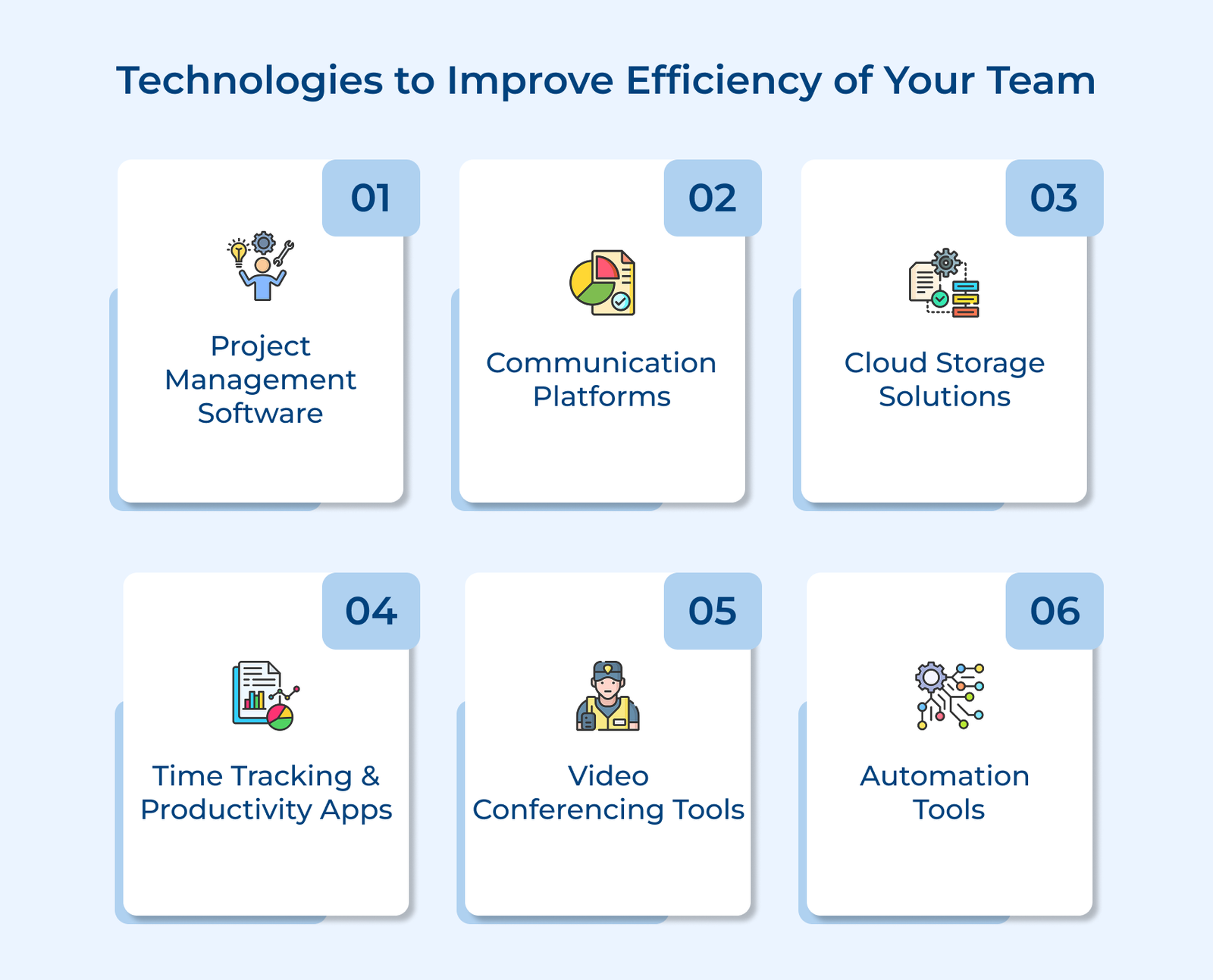
1. Project Management Software (Like Asana, Trello, or Monday.com)
The platforms centralize task management and project tracking, allowing teams to organize workflows with visual boards. They enable real-time progress monitoring and ensure clear accountability throughout all project phases.
2. Communication Platforms (Like Slack or Microsoft Teams)
The tools facilitate instant messaging and file sharing within teams. The platforms facilitate both group discussions and private chats, seamlessly integrating with other productivity tools to enhance communication.
3. Cloud Storage Solutions (Like Google Drive or Dropbox)
Cloud storage allows teams to access and collaborate on documents anytime, anywhere. It ensures data security while keeping files easily accessible to authorized members with version control and real-time editing.
4. Time Tracking and Productivity Apps (Like Rescue Time or Toggl)
The applications help monitor time spent on different tasks and projects. The tools offer insights into productivity trends and time-wasting activities, helping teams optimize their schedules.
5. Video Conferencing Tools (Like Zoom or Google Meet)
The platforms enable face-to-face communication for remote teams. The tools enable screen sharing for enhanced collaboration, with features like breakout rooms and virtual whiteboards for interactive, engaging sessions.
6. Automation Tools (Like Zapier or Microsoft Power Automate
The solutions automate repetitive tasks across platforms, reducing manual effort and minimizing errors. Teams can create custom workflows tailored to their specific needs.
Let’s go through the challenges you may encounter and uncover practical solutions to transform your workplace into a highly productive environment.
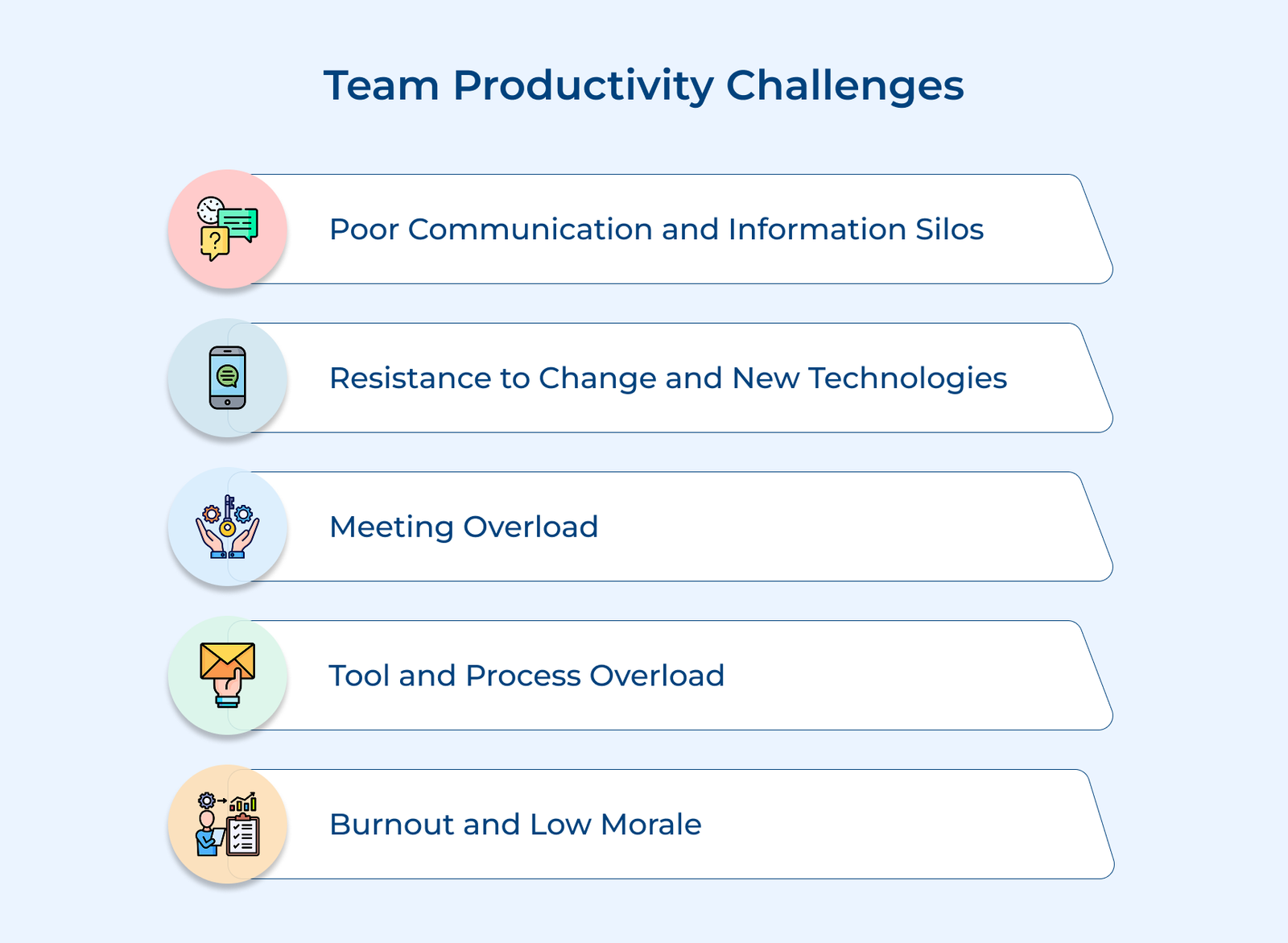
Teams often face fragmented communication, with key information getting trapped in silos. Without standardized channels, updates get missed and important details are buried in emails or chat messages, causing confusion.
Implement a clear communication protocol with designated channels for specific information. Create a centralized knowledge base for key documents and hold regular cross-departmental meetings to share insights. Standardize templates for important communications to ensure clarity and consistency across teams.
Team members often resist new tools or processes, fearing disruption to their familiar workflows. The learning curve can create hesitation and some may view changes as unnecessary or threatening.
Introduce changes gradually, highlighting the benefits. Offer comprehensive training during transitions and empower team champions to guide others. Regularly collect feedback to show that concerns are heard and addressed.
Excessive meetings drain time and energy, especially when they lack clear purposes or agendas. Frequent context-switching disrupts focus, leading to wasted time and decision fatigue.
Audit current meetings to eliminate unnecessary ones. Introduce a “meeting-free” day each week for deep work. Establish strict meeting protocols with required agendas, time limits and clear action items. Use asynchronous updates where possible to cut down on meeting frequency.
Teams often struggle with too many tools and complex processes, causing confusion. Software sprawl results in scattered information, multiple logins and workflow bottlenecks, wasting valuable time.
Conduct a tool audit and consolidate wherever possible. Opt for integrated solutions that address multiple needs. Standardize processes and document workflows, then gather feedback regularly to streamline systems.
Continuous pressure, long hours or poor work-life balance contribute to team burnout, leading to mistakes, poor communication and a loss of creativity. It creates a vicious cycle that further reduces productivity.
Set realistic workload expectations and monitor team capacity. Encourage regular breaks, implement wellness initiatives and provide opportunities for team bonding. Celebrate small wins and recognize individual contributions to keep motivation high.
Let’s go through some practical examples of team productivity that can inspire your group to reach new heights and transform the way you work together.
1. Amazon
Amazon adopted the “two-pizza rule,” ensuring teams stay small enough to be fed by two pizzas, with clear ownership and decision-making power. They leverage data-driven metrics and automated tracking to monitor productivity, along with daily stand-ups to quickly address blockers.
The approach accelerated decision-making, cut down on bureaucracy and made teams more agile in responding to customer needs. The autonomous structure fueled rapid scaling of new initiatives, boosted innovation cycles and increased employee engagement through clearer ownership of outcomes.
2. Apple
Apple organizes teams into small, focused groups with clear project ownership, using the “Directly Responsible Individual” (DRI) system to assign one person accountable for each task. Regular design reviews ensure high standards while maintaining productivity and cross-functional collaboration is emphasized through clear communication channels.
The DRI system enhanced accountability, sped up project completion and maintained high product quality. Development cycles became more efficient, team morale improved with clear ownership and innovation flourished in the dynamic small-team structure.
3. Spotify
Spotify created the “Squad” model, where small, cross-functional teams work autonomously on specific features, while “Guilds” enhance knowledge sharing across teams. Regular “hack days” spark innovation and flexible work arrangements ensure clear communication.
The model accelerated feature development and deployment, boosting employee satisfaction with greater autonomy. Innovation thrived through ongoing experimentation and cross-team collaboration, all while maintaining platform stability.
4. Airbnb
Airbnb prioritizes data-driven decision-making, with clear metrics for each team. They introduced “Belong Anywhere” weeks for remote work and emphasized cultural values through team bonding activities, both virtual and in-person.
The flexibility boosted productivity and work-life balance, while diverse perspectives from various locations sparked innovation. Faster problem resolution led to improved customer satisfaction and a stronger workplace culture enhanced employee retention.
5. Zappos
Zappos implemented holacracy to promote self-management and eliminate hierarchical barriers. They prioritize culture fit with thorough training and offer regular skill development opportunities for all team members, enhancing open communication across all levels.
The empowered employees to resolve customer issues faster, boosting team satisfaction through autonomy. The flat structure fueled innovation, while improved service delivery strengthened customer loyalty.
Boosting team productivity is crucial for both survival and growth. Organizations must be adaptable to changing work dynamics while ensuring they maintain high levels of efficiency and quality. The approach helps them remain competitive and responsive to market demands.
Enhanced productivity directly contributes to business success by accelerating project completion, optimizing resources and improving customer satisfaction. Efficient teams lower costs, enhance innovation and boost employee engagement, creating a foundation for sustainable growth. The approach not only drives immediate results but also sets the stage for long-term organizational success.

An effective team brings a few essential elements together and makes them work as one. Clear goals give people a shared direction and a reason to care about the outcome. Defined roles remove confusion and help everyone focus on what they do best. Open communication builds psychological safety, so ideas get shared without hesitation. Trust allows team members to rely on each other’s strengths. A mix of skills and perspectives leads to better problem solving and fresh thinking.
Teamwork improves when you first establish clear expectations and goals that everyone commits to. Create regular opportunities for collaboration through structured meetings and informal interactions. Develop communication protocols that respect different working styles. Build trust through transparency and following through on commitments. Make sure you regularly have team-building activities that develop relationships beyond work tasks.
Improving departmental efficiency starts with understanding how work actually moves today. Look closely at existing workflows to spot bottlenecks and repeated effort. Compare where time goes with where it should go. Use the right tools to take administrative work off people’s plates. Ask frontline teams where things slow down and what would make their work easier.
Motivating without burnout requires understanding individual drivers beyond financial incentives. Connect daily work to meaningful purpose and impact. Provide autonomy over how work gets done while maintaining accountability for outcomes. Ensure workloads remain reasonable and sustainable over time. Always remember to recognize effort and progress, not just final results.
Addressing underperformance starts with understanding root causes through private, specific conversations focused on behaviors and outcomes, not personality. Determine if the issue stems from skill gaps, motivation problems or external factors. Develop a collaborative improvement plan with clear milestones and support resources. Schedule regular check-ins to provide feedback and adjust the plan as needed. If significant improvement doesn’t occur despite adequate support, consider reassignment or, as a last resort, separation.

Grow Customer Relationships and stronger team collaboration with our range of products across the Conversational Engagement Suite.
Omnichannel Customer Support & Help Desk Software
AI Enabled Business Messaging and Chatbot Software
Sales Engagement & CRM Software
Call Center Software & Virtual Phone System
Product Marketing & Experience Platform
Customer Experience & Feedback Management Software

 8 Effective Ways to Celebrate Customer Service Week
Scroll to top
8 Effective Ways to Celebrate Customer Service Week
Scroll to top