How to Build a Sales Pipeline Successfully? The Ultimate Guide
Uncover the essential steps on how to build sales pipeline effectively. Learn the key strategies to nurture prospects, optimize stages and drive revenue growth for your business.

Uncover the essential steps on how to build sales pipeline effectively. Learn the key strategies to nurture prospects, optimize stages and drive revenue growth for your business.
Many businesses struggle to generate quality leads and convert them into loyal customers. Without a clear, structured sales approach, companies face unpredictable revenue and missed growth opportunities. The solution? A well-built sales pipeline. A strong pipeline provides a clear roadmap for your sales team, streamlining lead management, tracking progress and closing deals faster.
We’ll cover some key steps to build a sales pipeline that drives results. The strategies will help transform your sales process and unlock your business’s revenue potential. Let’s dive in and learn how to build sales pipeline that fuels success.
A sales pipeline refers to a visual tool that maps the journey of prospects from initial contact to final purchase. It breaks down the stages a lead goes through, helping sales teams track and manage opportunities effectively.
The pipeline allows reps to assess deal potential, prioritize actions and apply the right strategies to nurture leads by categorizing leads based on their stage in the sales cycle.
Key objectives:
Let’s explore the key benefits of establishing a sales pipeline and how it can enhance your strategy, driving meaningful results for your business.
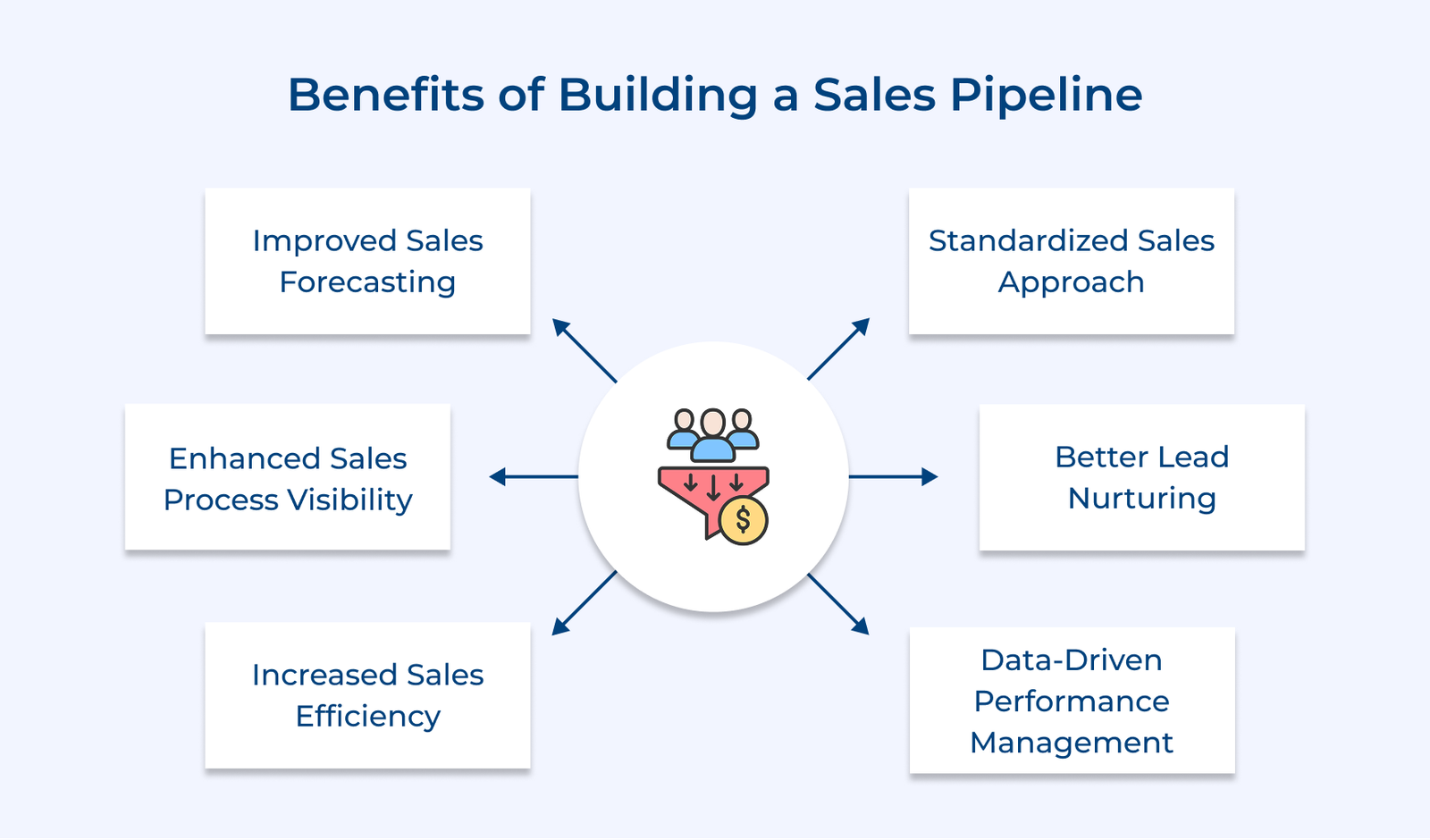
1. Improved sales forecasting
A well-structured sales pipeline offers key insights into deal status, value and closing probability, enabling sales managers to forecast revenue accurately.
2. Enhanced sales process visibility
Sales pipelines provide a clear, visual view of the sales process, helping teams quickly spot bottlenecks and take proactive steps to keep deals advancing smoothly.
3. Increased sales efficiency
Sales pipelines organize prospects into stages, helping prioritize leads and optimize resource allocation. It enables reps to focus on high-potential opportunities, maximizing their efforts for the best results.
4. Standardized sales approach
A sales pipeline creates consistency across the team by standardizing the process for advancing deals. It ensures best practices are followed, leading to more predictable and successful outcomes.
5. Better lead nurturing
Sales pipelines track each prospect’s journey, enabling personalized, timely interactions. The structured approach helps sales teams nurture leads more effectively, delivering the right support at every stage to boost conversion rates.
6. Data-driven performance management
A sales pipeline enables managers to track KPIs like conversion rates, deal size and sales cycle length. The data-driven approach empowers better coaching, highlights areas for improvement and supports targeted training to boost team performance.
Let’s go through the different stages of the sales pipeline and understand their significance in driving sales success.
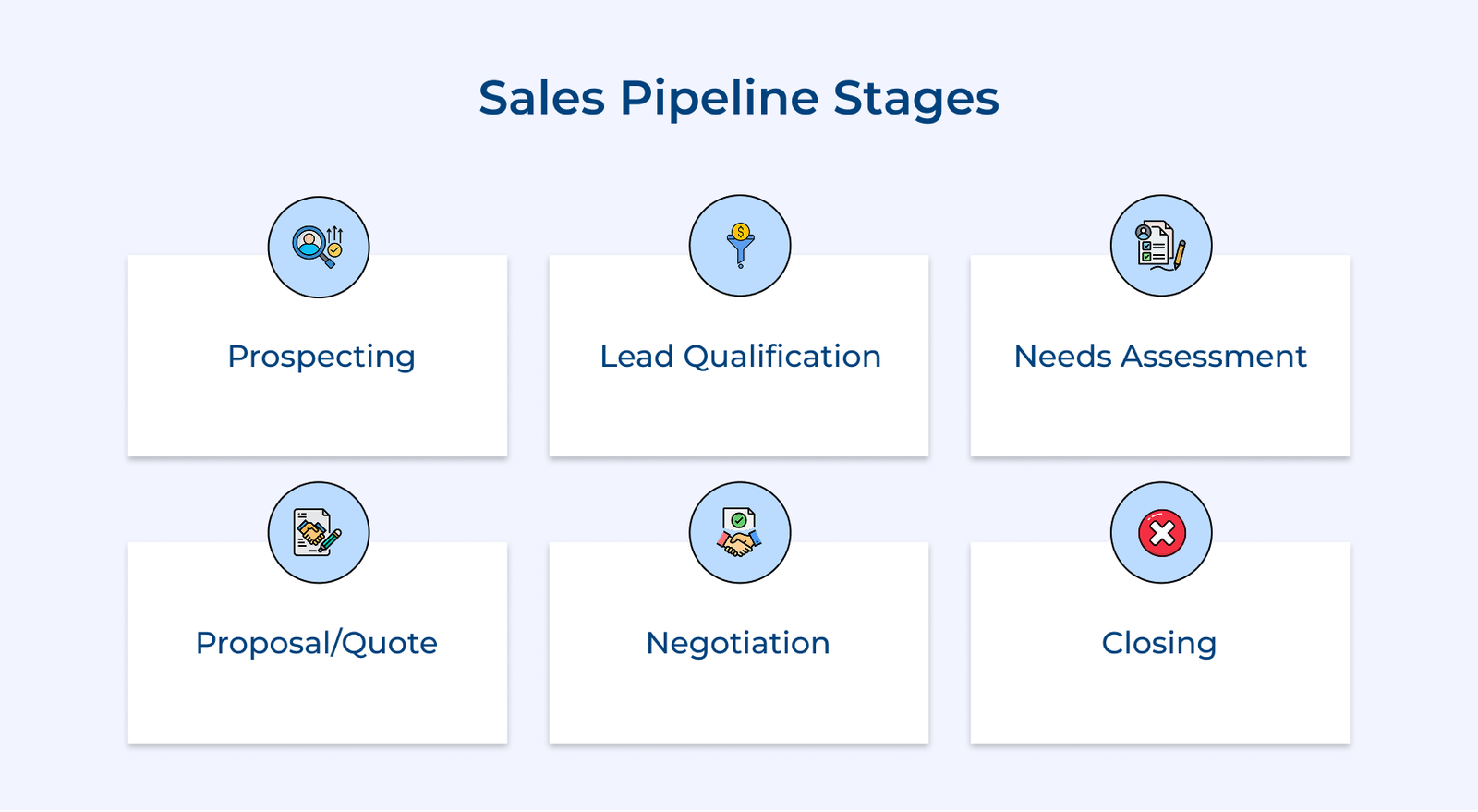
The prospecting stage is where the sales journey begins. Sales reps identify potential customers who are likely to benefit from the product or service, using methods like social media outreach, referrals, trade shows and cold calls.
The goal here is to build a list of qualified leads that match the ideal customer profile. Sales teams gather key details such as contact information, company size, industry and other relevant data to tailor future outreach.
After identifying prospects, the next step is lead qualification, where sales reps determine if the prospect has a genuine need and the potential to convert. Using frameworks like BANT (Budget, Authority, Need, Timeline), they assess key factors to evaluate each lead.
The stage often involves initial conversations to understand the prospect’s pain points, budget, decision-making process and purchase timeline. Sales teams can focus on the most promising opportunities by filtering out unqualified leads.
Sales reps dig deeper into the prospect’s unique challenges, goals and pain points in the needs assessment stage. Through detailed discovery calls or meetings, they gather valuable insights into the prospect’s business processes and specific needs.
The sales team tailors their pitch, positioning their product or service as the ideal solution with the information. Customized proposals begin to take shape, setting the stage for a more personalized and compelling sales approach.
The sales team presents a formal offer that outlines the solution, pricing, timeline and expected results. It is a critical moment when the team showcases how their product or service directly addresses the prospect’s needs.
Typically delivered through written documents and presentations, the proposal must align with the prospect’s specific pain points. It’s an opportunity to reinforce how the solution will solve their problems and deliver measurable benefits.
The negotiation stage begins once the proposal is presented, where the sales team and prospect discuss key deal terms, such as price, contract length and additional features or support.
Sales reps must be equipped to address objections, offer alternatives and find solutions that benefit both parties. The goal is to finalize the deal, ensuring both the prospect’s and the company’s needs are met.
The closing stage is where the deal is either won or lost. If successful, it involves securing signatures, finalizing the agreement and processing the order or contract.
Once closed, the focus shifts to a smooth transition for the new customer, including onboarding and product delivery. Even if the deal is lost, the stage offers valuable feedback to refine and improve future sales efforts.
The following are the best practices for how to build a sales pipeline effectively, helping you streamline your sales process, prioritize leads and turn more prospects into loyal customers.
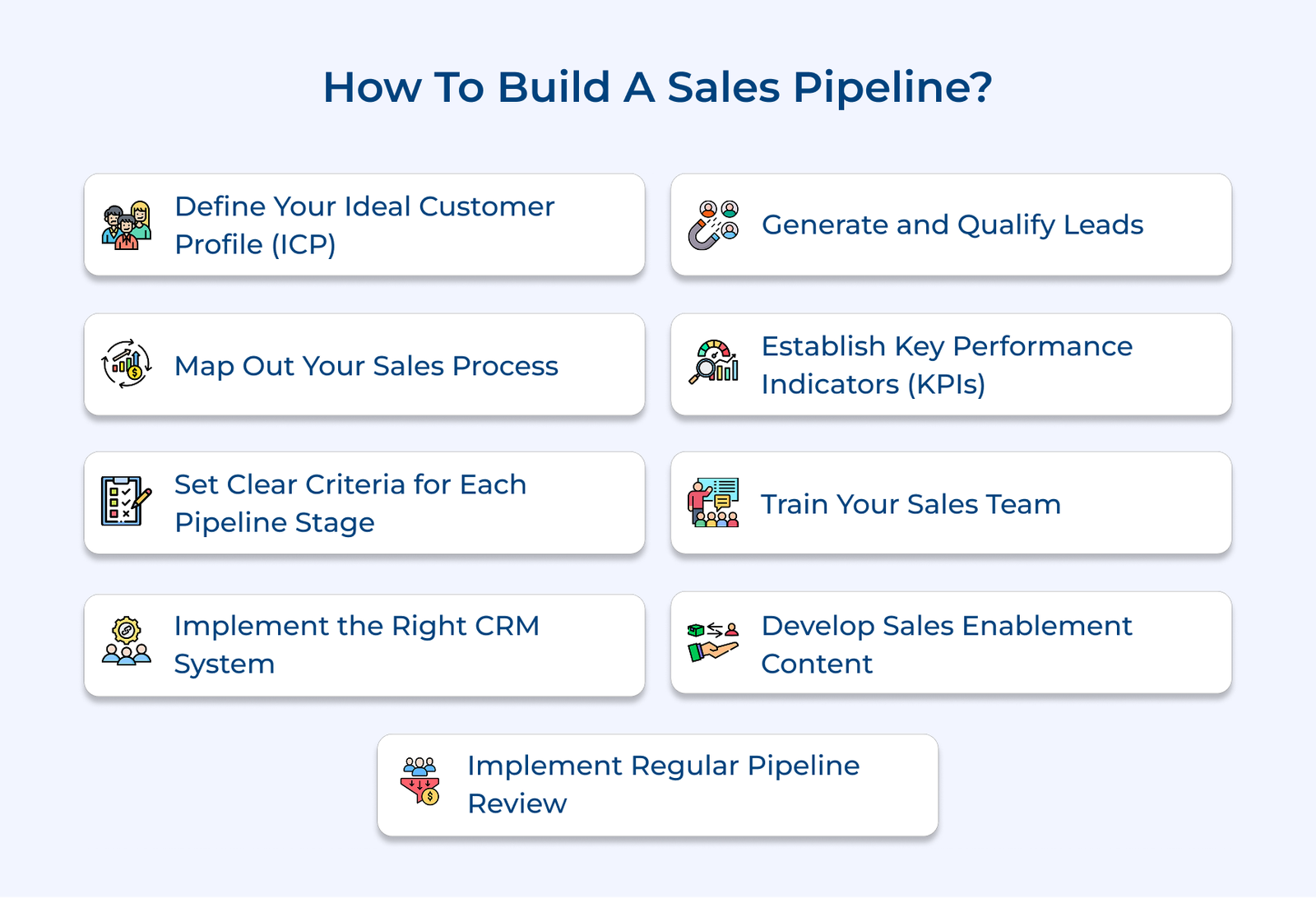
Defining your Ideal Customer Profile (ICP) is key to focusing your sales efforts on the most promising leads. You can refine your strategies to attract similar high-value prospects by understanding who your best customers are.
Once your ICP is in place, use it to guide lead generation, content creation and sales messaging. It helps prioritize high-conversion leads and ensures your campaigns resonate with the right audience, maximizing the impact of your resources.
Actionable tips:
Mapping your sales process creates a clear, structured framework for your team, ensuring consistency and efficiency at every step. It helps identify potential bottlenecks, streamline workflows and provides a standardized method for measuring performance across the entire cycle.
Your team can navigate each stage of the customer journey with confidence with a well-defined sales process. It ensures consistent handling of prospects, minimizes the risk of missed opportunities and makes tracking progress easier, helping you pinpoint areas for improvement.
Pro tips:
Establishing clear criteria for each pipeline stage is crucial for accurate forecasting and optimal resource allocation. It removes ambiguity, ensures leads are properly qualified and helps sales reps understand the specific actions needed to move prospects forward.
You can pinpoint high-priority deals, identify potential bottlenecks and determine when to allocate more resources or shift focus to other opportunities by using the criteria to assess each lead’s progress.
Best practices:
A CRM system is essential for efficiently managing your sales pipeline. It centralizes customer data, tracks interactions and offers valuable insights into your sales process, promoting seamless collaboration across your team.
Leverage your CRM to monitor lead progress, automate routine tasks and set follow-up reminders. It also provides detailed reports on sales performance, helping you make data-driven decisions and gain a comprehensive view of your sales operations.
Actionable tips:
Generating and qualifying leads is essential for keeping your sales pipeline full. A steady stream of quality leads ensures your team stays focused on high-potential prospects, improving both efficiency and conversion rates.
Leverage multiple marketing channels to generate leads, then use your Ideal Customer Profile (ICP) and qualification criteria to filter for the most promising opportunities. It helps prioritize leads, guiding your next steps including immediate sales outreach or long-term nurturing through marketing efforts.
Pro tips:
Establishing KPIs is crucial for measuring the success of your sales pipeline and pinpointing areas for improvement. The metrics provide valuable insights into your sales performance, guiding decisions on resource allocation, strategy tweaks and coaching priorities.
You can monitor progress toward sales goals, assess performance and identify trends or bottlenecks in the pipeline by tracking KPIs. Regularly reviewing the metrics allows you to make data-driven adjustments that optimize your sales process and boost results.
Pro tips:
Training your sales team is key to ensuring consistency and boosting performance. It ensures everyone follows the same process, stays current with product knowledge and sharpens their skills in handling diverse sales situations.
Use training sessions to onboard new hires, upskill your team and introduce new tools or strategies. Regular sessions enhance a culture of growth and ensure your team remains adaptable to excel.
Best practices:
Sales enablement content equips your team with the tools to engage prospects at every pipeline stage. It ensures consistent messaging, addresses key customer concerns and helps drive deals forward by providing relevant information.
Leverage the content to educate prospects, overcome objections and showcase your product’s value. When shared in conversations, follow-up emails or as part of a content strategy, it supports lead nurturing and accelerates the sales process.
Actionable tips:
The reviews help spot stagnant deals, improve forecasting accuracy and highlight areas where strategies can be optimized for better results.
Use the reviews to assess pipeline health, identify trends and make data-driven decisions about resource allocation. It’s also a great opportunity to coach your sales team, share best practices and collaboratively address challenges to keep deals moving forward.
Best practices:
Sales pipelines and sales funnels are both crucial tools in sales management, but they serve different purposes. Let’s check them out in detail.
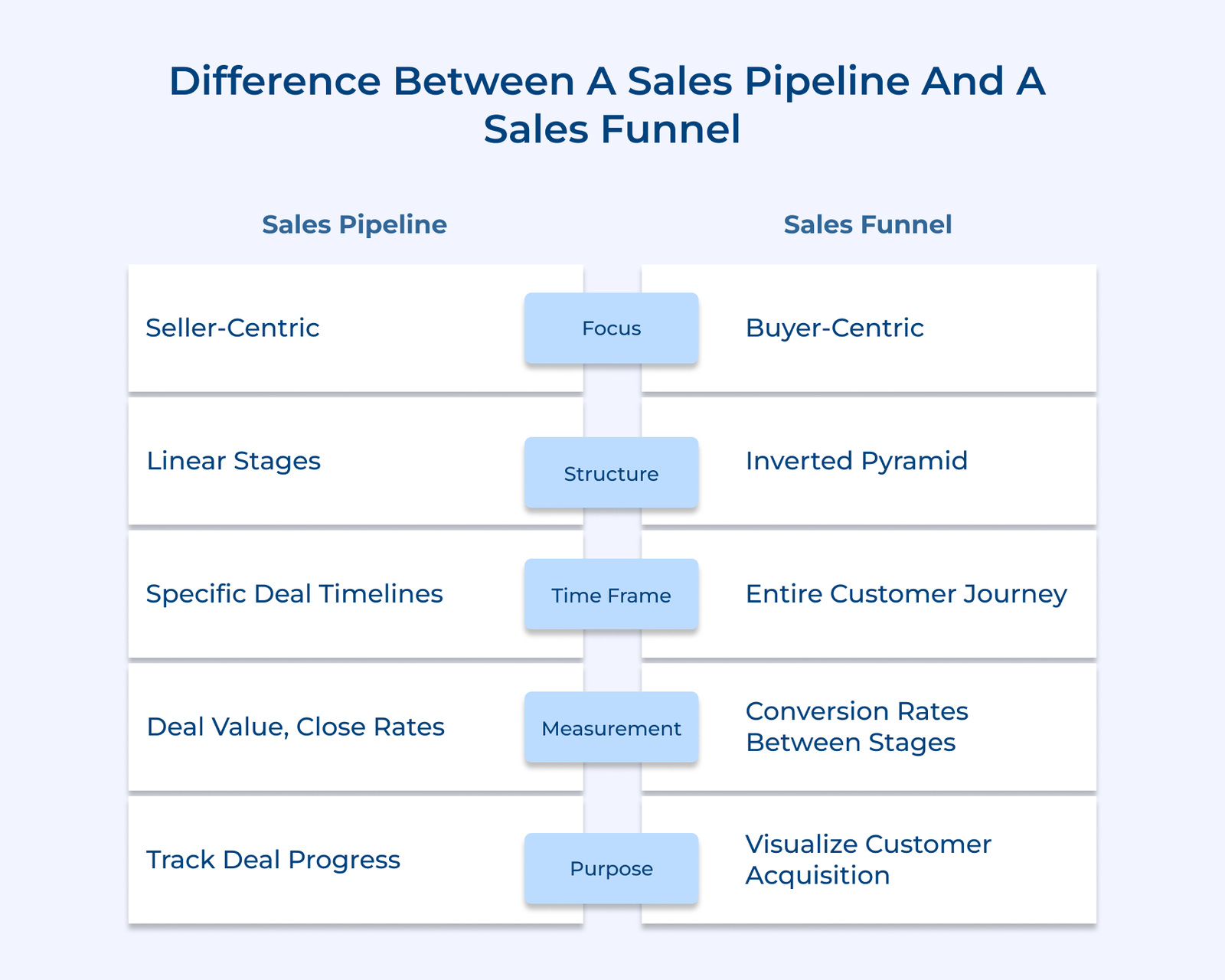
1. Perspective
A sales pipeline is seller-focused, outlining the steps and actions the sales team must take to advance each opportunity. It provides a clear view of where each deal stands, helping sales reps stay on track and move leads through the process.
A sales funnel takes a buyer-centric approach, illustrating the customer’s journey from awareness to purchase. It focuses on how leads are nurtured and guided through each stage of their decision-making process, leading to conversion.
2. Structure
Sales pipelines follow a linear structure, with distinct stages that guide a deal from start to finish. The stages such as prospecting, qualification, proposal, negotiation and closing help sales teams track progress.
Sales funnels take an inverted triangle shape, starting wide with a large pool of potential leads. As prospects move through the stages of awareness, interest, consideration and decision, the funnel narrows, leading to fewer conversions at the bottom.
3. Focus
A sales pipeline focuses on tracking individual deals as they progress through each stage, enabling sales teams to take targeted actions and make accurate forecasts based on the current status of each opportunity.
A sales funnel emphasizes lead volume and conversion rates, offering insights into how many prospects enter the funnel. It helps identify bottlenecks and areas where leads are dropping off in the customer journey.
4. Time Frame
Sales pipelines are dynamic and flexible. It allows the deals to enter and progress at varying speeds without a fixed endpoint. The fluid approach enables continuous management and adjustment of multiple opportunities at once.
Sales funnels follow a more defined timeline, starting when a lead enters and ends when a conversion occurs or the lead exits. The structured framework allows for a more precise analysis of sales and marketing effectiveness over specific periods.
5. Measurement
Sales pipelines are typically tracked using value-based metrics like deal size, potential revenue and the probability of closing. The focus is on the quality and potential worth of each opportunity as it moves through the pipeline.
Sales funnels are measured by volume-based metrics, such as lead counts at each stage and conversion rates. The metrics provide insights into how effectively leads are generated and converted, helping to assess the success of the funnel.
Explore the key metrics that you must include in every sales pipeline to boost performance and achieve stronger results.
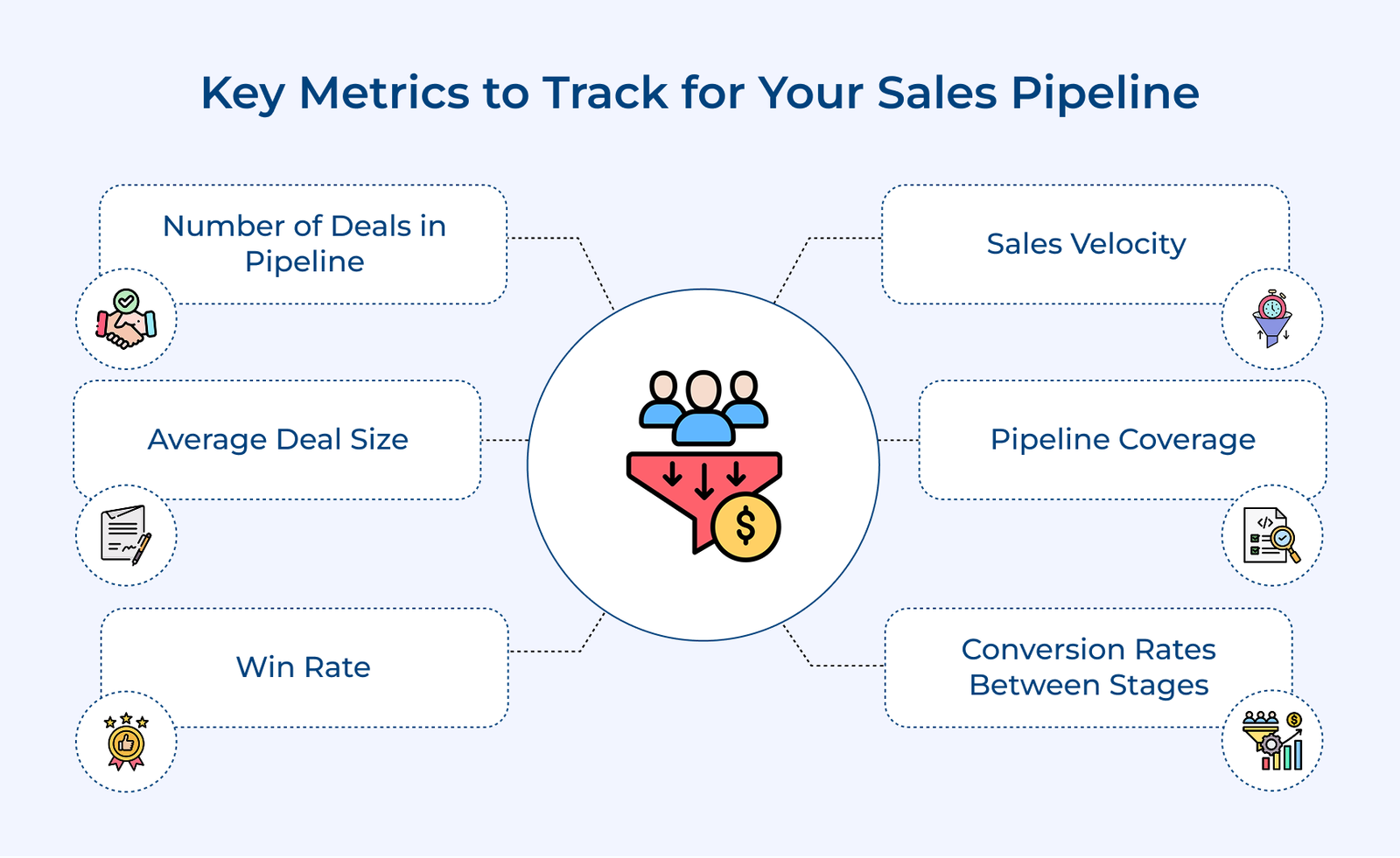
The metric gives a snapshot of your pipeline’s health by showing the number of active sales opportunities. A strong pipeline maintains a steady flow of deals, ensuring consistent revenue. Regularly tracking the number helps spot trends and uncover potential issues in lead generation or qualification.
The metric reflects the average value of deals in your pipeline, helping with revenue forecasting and prioritization. A larger average deal size suggests you’re reaching the right customers and effectively showcasing your value. It also highlights potential upsell or cross-sell opportunities.
The win rate measures the percentage of deals closed successfully, calculated by dividing won deals by all closed deals (won + lost). It reveals your sales team’s effectiveness and market competitiveness. A low win rate may signal challenges with your sales process, product-market fit or competition.
Sales velocity measures how quickly deals progress through your pipeline, calculated by multiplying the number of deals, average deal size and win rate, then dividing by the sales cycle length. It helps gauge your pipeline’s efficiency in generating revenue.
Pipeline coverage is the ratio of your pipeline’s total value to your revenue target. A healthy coverage (typically 3x to 5x your quota) ensures you have enough opportunities to meet your goals, even with some deals potentially falling through. Low coverage signals a need for stronger lead generation or better qualification.
The metrics track the percentage of deals advancing from one stage to the next, highlighting potential bottlenecks in your sales process. Let’s assume that a drop-off between the proposal and negotiation stages may signal the need for better proposal strategies or sales team training.
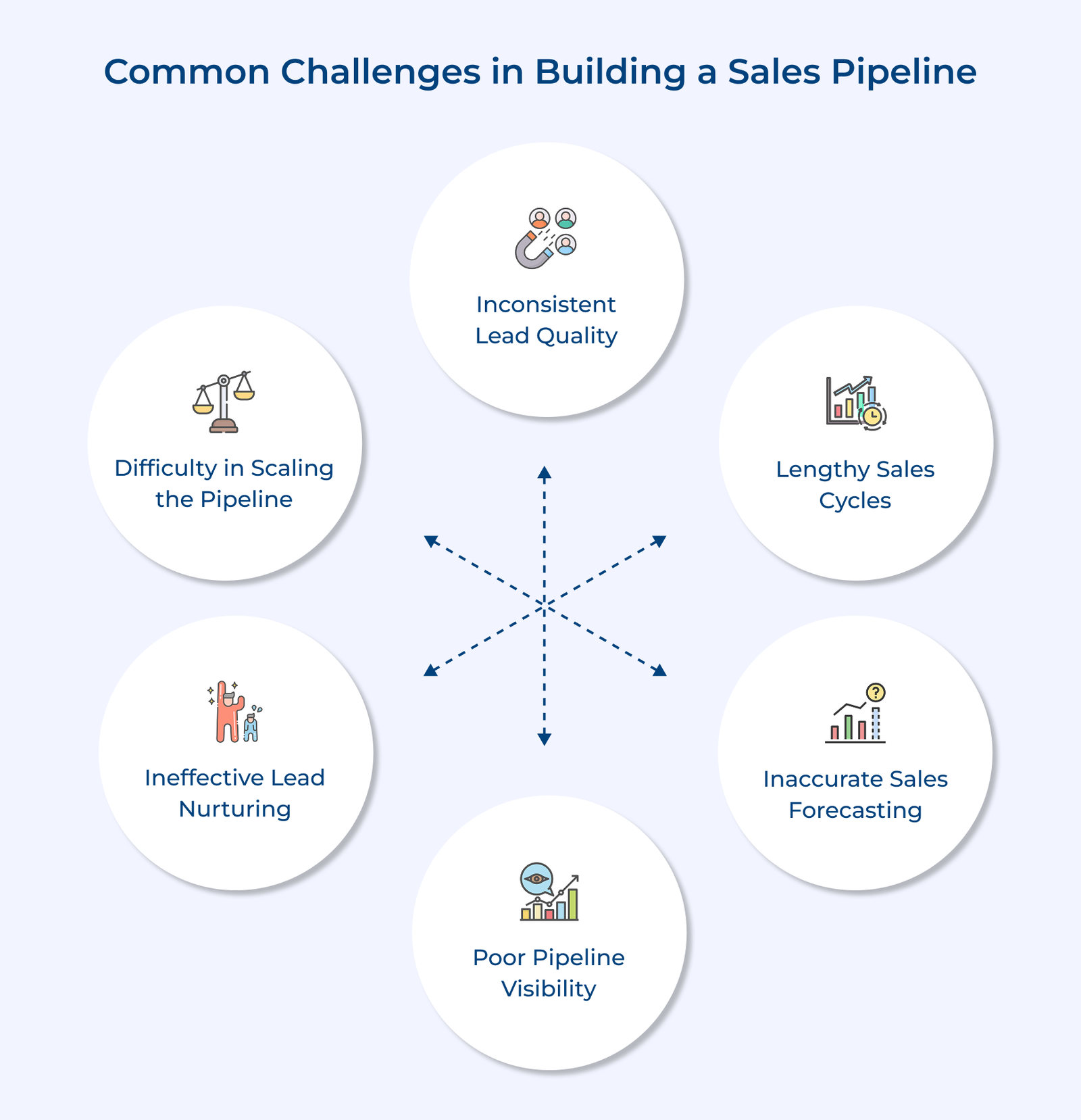
Below are the most common challenges faced when building a sales pipeline and how to overcome them to streamline your process.
1. Inconsistent lead quality
Many sales pipelines struggle with inconsistent lead quality, mixing high-potential prospects with time-wasting leads. The inconsistency can drain resources and hinder sales effectiveness, as reps waste time on unqualified opportunities.
A strong lead-scoring system based on your ideal customer profile. Regularly refine the system based on conversion data and team feedback to improve lead quality over time.
2. Lengthy sales cycles
Long sales cycles can drain resources, slow down sales velocity and increase the risk of losing deals to competitors. The delays often stem from inefficient processes, poor lead qualification or a lack of proper nurturing through the pipeline stages.
Map out the process to identify bottlenecks and eliminate unnecessary steps. Automate routine tasks, create stage-specific content to nurture prospects and set clear timelines for each stage. Train your team on time management and prioritization to keep deals moving efficiently.
3. Inaccurate sales forecasting
Inaccurate sales forecasts can result in poor decisions, wasted resources and missed revenue targets. It often arises from unreliable pipeline data, subjective deal probabilities or overlooking external factors that impact deal closures.
Leverage historical data and advanced analytics. Establish a consistent method for assessing deal probabilities at each stage and update forecasts regularly based on real-time pipeline insights.
4. Poor pipeline visibility
A lack of clear visibility into the sales pipeline can lead to missed opportunities, inefficient resource allocation and undetected bottlenecks. It often results from poor reporting tools or inconsistent data entry practices.
Invest in a powerful CRM with customizable reporting and dashboards. Set standardized data entry protocols and train your team to keep records accurate. Regular pipeline review meetings will help ensure that everyone stays aligned and informed on pipeline status.
5. Ineffective lead nurturing
Many businesses struggle to nurture leads effectively, leading to high drop-off rates and missed conversions. It often stems from generic follow-up strategies or a lack of personalized engagement throughout the sales process.
Create a structured lead nurturing program with tailored content and personalized outreach for each stage of the pipeline. Use marketing automation tools to send relevant, timely communications and equip your sales team with the training they need to nurture leads effectively.
6. Difficulty in Scaling the Pipeline
As businesses scale, maintaining a high-quality sales pipeline becomes increasingly challenging. It often involves balancing lead quality, managing a growing sales team and adapting processes to handle more volume without compromising efficiency.
Invest in scalable tools like CRM and marketing automation systems. Standardize processes with clear playbooks that can be easily replicated and implement a comprehensive onboarding for new hires to ensure consistent best practices across the team.
Structuring your sales pipeline for growth is crucial. A well-organized pipeline provides clarity, focus and direction, helping you seize opportunities. It’s the backbone of effective sales management and accurate forecasting.
A strong sales pipeline streamlines the lead nurturing, prioritizing high-value opportunities and boosting team collaboration. It also delivers valuable insights into performance, enabling data-driven decisions and continuous improvement.
Key takeaways:

Creating an effective sales pipeline takes 3-6 months, depending on your industry, sales cycle and existing processes. It includes defining stages, implementing a CRM, training your team and collecting data for optimization. Refining the pipeline is an ongoing effort beyond the initial setup.
The sales pipeline value is calculated by multiplying the Number of Deals, Average Deal Size and Win Rate. Calculate Sales Velocity: (Deals x Deal Size x Win Rate) / Sales Cycle Length for a deeper insight. It reveals how fast your pipeline is generating revenue.
Regular pipeline reviews are key to staying on track. Hold weekly team check-ins to discuss deal progress and monthly or quarterly deep dives to assess overall pipeline health. Sales reps should update their pipelines daily to maintain accuracy and spot immediate action items.
Boost conversion rates by prioritizing lead quality, personalizing outreach at every stage and offering value-driven content. Proactively address objections and analyze where deals are stalling. Train your team on stage-specific techniques and use automation to free up time for high-value tasks that drive results.

Grow Customer Relationships and stronger team collaboration with our range of products across the Conversational Engagement Suite.
Omnichannel Customer Support & Help Desk Software
AI Enabled Business Messaging and Chatbot Software
Sales Engagement & CRM Software
Call Center Software & Virtual Phone System
Product Marketing & Experience Platform
Customer Experience & Feedback Management Software

 Top 11 B2B Customer Engagement Strategies of 2026
Scroll to top
Top 11 B2B Customer Engagement Strategies of 2026
Scroll to top