A Comprehensive Guide on Sales Metrics & KPIs in 2026
Learn about the key sales metrics and KPIs every team should track to measure performance. Explore the ways to identify gaps and make informed decisions that support sustainable growth.

Learn about the key sales metrics and KPIs every team should track to measure performance. Explore the ways to identify gaps and make informed decisions that support sustainable growth.
Most sales teams collect mountains of data but struggle to make sense of it. Managers and reps often end up guessing because the numbers they track don’t reveal what actually matters. Too many metrics create noise, making it harder to spot real problems and opportunities.
The fix isn’t more data but the right data. A focused set of well-chosen KPIs can show where the team stands, what’s working and what needs attention. So we will be going through the most important sales KPIs that cut through the clutter. These metrics strike a balance between long-term goals and day-to-day performance. Instead of drowning in numbers, you’ll know which ones to trust and how to use them to drive better decisions.
Sales metrics and KPIs (key performance indicators) refer to concrete ways to measure how well your sales efforts are working. Instead of guessing or relying on hunches, they give you real numbers to track progress, spot problems early and make better decisions.
The metrics work by collecting and analyzing data from everyday sales activities, like logging calls, closing deals or updating your profile. Tools like CRM systems pull the data together in one place, turning it into dashboards and reports. Sales managers can then see what’s working, what’s not and adjust strategies as needed. Some tools can even use past data to predict future sales patterns.
Key principles:
Let’s go through the key reasons and benefits of implementing a robust sales tracking system.
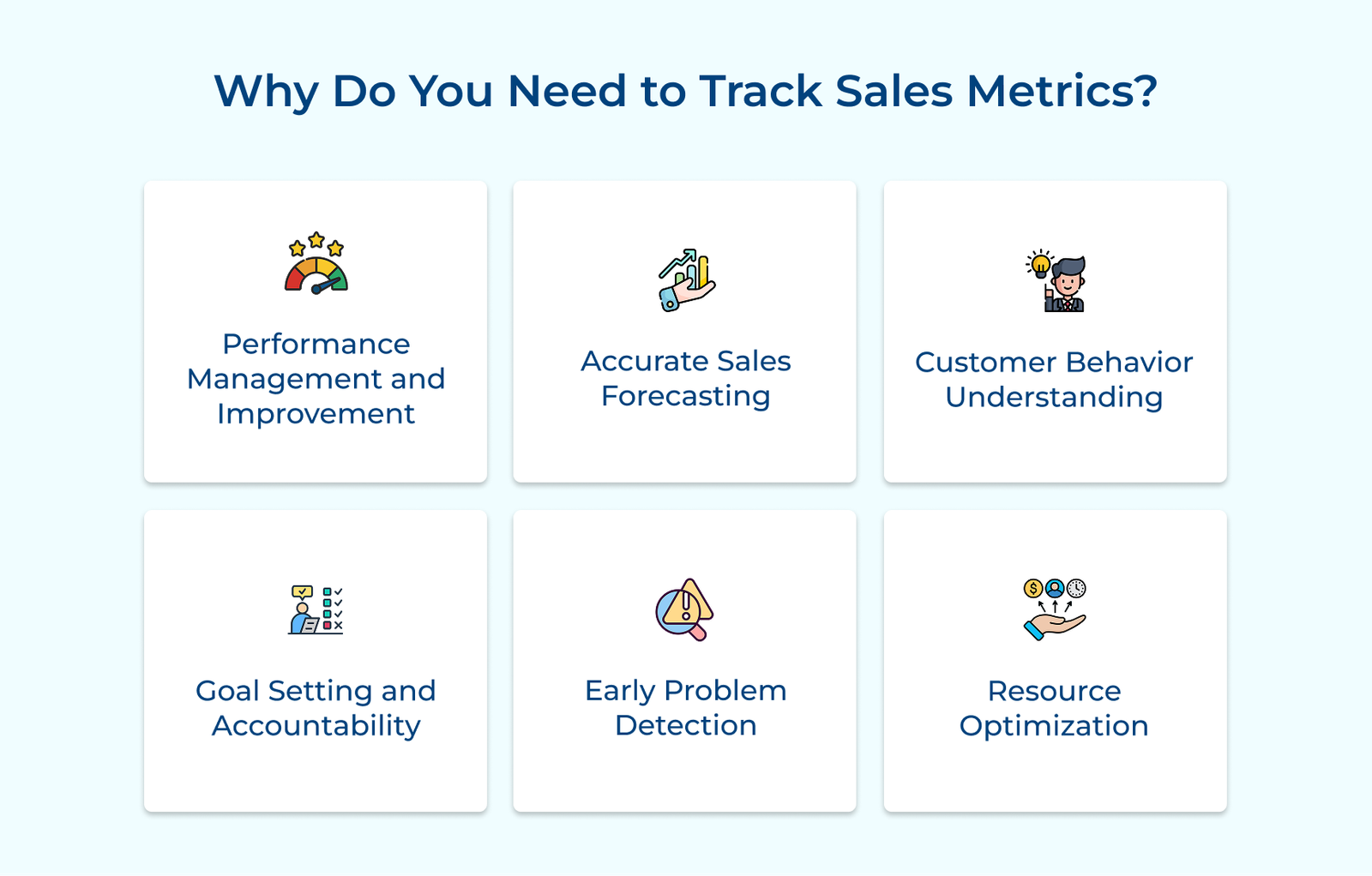
1. Performance Management and Improvement
Sales metrics let you see how both individuals and the team are doing over time. You can spot top performers and understand what they’re doing right. The knowledge helps you design better training and share proven approaches to lift everyone’s performance.
2. Accurate Sales Forecasting
Looking at past sales trends alongside current pipeline data helps you predict future results with more confidence. It means better planning for inventory, staffing and budgets – plus the ability to adjust your strategy during slow or busy seasons.
3. Customer Behavior Understanding
Metrics show patterns in how and when customers buy. You’ll learn which products are often bought together, when sales peak and what drives repeat purchases. It makes it easier to tailor your messaging and improve your approach to different types of buyers.
4. Goal Setting and Accountability
Using real data to set goals makes targets more realistic and fair. Everyone on the team knows what’s expected and how success is measured. The clarity encourages consistency, ownership and a shared focus on hitting goals.
5. Early Problem Detection
When you track metrics regularly, you can catch issues before they grow. Maybe a conversion rate starts to dip or a once-popular product slows down. The early signals give you time to investigate and fix things before results take a bigger hit.
6. Resource Optimization
Tracking which sales activities lead to the best outcomes helps you invest your time, budget and people where they’ll have the most impact. When you double down on high-performing channels and drop what’s not working, every decision about where to invest your time becomes clearer.
Check out the key differences between sales metrics and sales KPIs, understanding how each works will help your team focus on what truly drives performance.
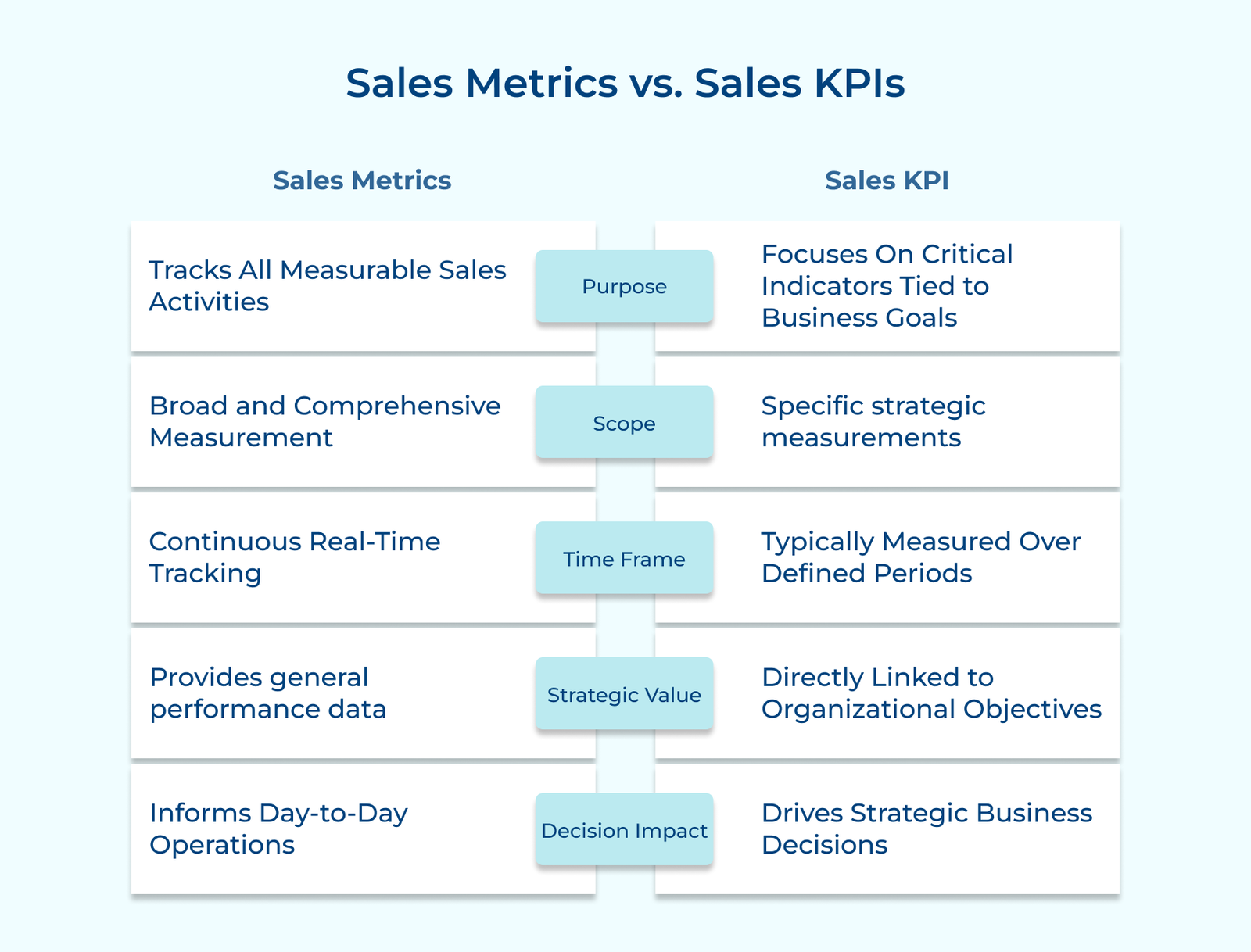
Purpose and Focus
Sales metrics cover a broad range of data points from how long reps spend on calls to how quickly emails get answered. They give you a full picture of what’s happening across your sales process.
KPIs are the critical few metrics to directly align with your business goals. Instead of tracking everything, they help you focus on what truly matters for hitting targets and moving the business forward.
Scope and Breadth
Sales metrics measure just about everything in your sales workflow. They help you see how the whole system operates, from finding leads to closing deals.
KPIs zoom in. They filter that flood of data to highlight the most useful signals, like the ones that show if you’re making real progress toward strategic outcomes.
Time Frame and Measurement
Sales metrics are often updated continuously and show what’s happening right now. They’re useful for spotting immediate trends and making quick adjustments.
KPIs usually run on longer timelines – monthly, quarterly or yearly and are checked against specific targets. They’re used to track progress on bigger goals, not just daily activity.
Strategic Significance
Sales metrics help you understand how your process is running. They highlight what’s working, what’s not and where patterns may be emerging.
KPIs are directly tied to business strategy. They give leadership a clear view of if the company is on track and help steer big-picture planning.
Impact on Decision Making
Sales metrics support front-line decisions, like refining a sales script or adjusting follow-up timing. They help managers improve how the team operates day-to-day.
KPIs shape larger decisions like setting budgets, entering new markets or shifting tactics. They provide the context needed for strategic moves.
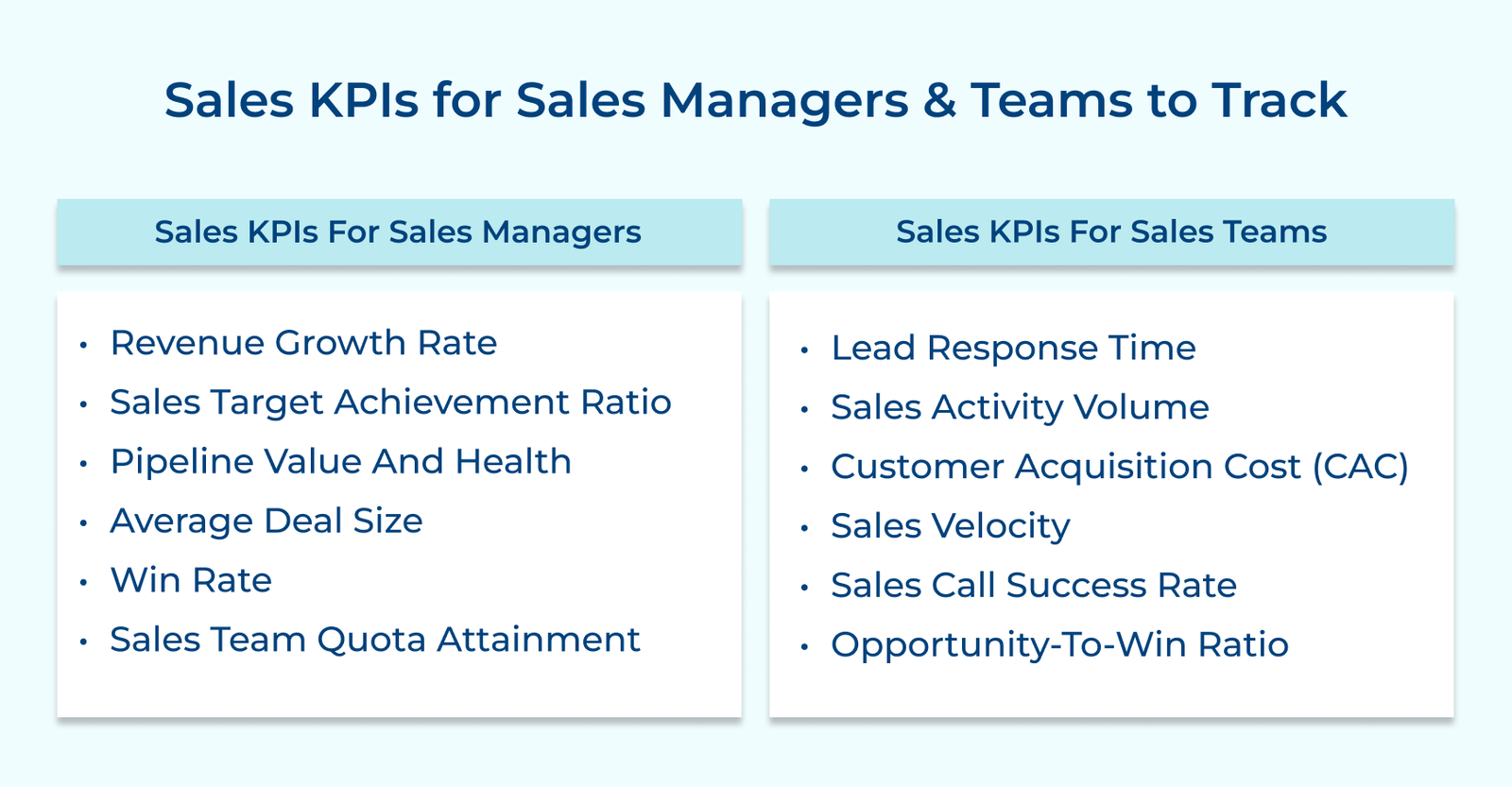
Let’s go through the 11 sales KPIs every sales manager and team should track to stay focused on what truly drives results.
Revenue growth rate measures how your company’s income is changing over time, if it’s rising, holding steady or slipping. It’s a clear signal of how well your sales efforts are contributing to overall business health and direction.
Formula:
[(Current Period Revenue – Previous Period Revenue) / Previous Period Revenue] x 100
Benchmark and usage:
The percentage shows the pace at which your revenue is growing. A steady rise means your sales strategies are working. It’s a flag to reassess. Most stable companies aim for 15–45% annual growth, while younger startups might shoot higher as they scale.
Pro tips:
Sales target achievement shows how close your team is to hitting its sales goals. It’s a direct, no-frills way to measure whether your efforts are paying off and where there’s room to improve.
Formula:
(Actual Sales Achieved / Sales Target) x 100
A score above 80% is generally seen as strong, but anything less could signal missed opportunities or unrealistic targets. It helps sales leaders understand which strategies are working and which ones need tweaking.
Actionable tips:
Pipeline value and health give you a forward-looking snapshot of your sales funnel. The KPI tells you not just how much money is in the pipeline, but also how likely that money is to materialize. It makes it one of the most practical tools for revenue forecasting and process improvement.
Formula:
Pipeline Value = Sum of (Number of Opportunities × Average Deal Size × Probability of Closing)
Pipeline Health = (Number of Qualified Opportunities / Total Opportunities) × 100
Best practices:
Average deal size tells you how much revenue, on average, each closed sale brings in. It’s a simple but powerful way to measure if your team is making the most of its selling efforts, because closing a few high-value deals can be more efficient than chasing dozens of smaller ones.
Formula:
Total Revenue / Number of Deals Closed
Larger deals often take the same effort as smaller ones, so understanding the number helps you work smarter, not just harder. It also reveals how well your team is positioning higher-value solutions and if the customers see the full value in what you offer.
Key takeaways:
Win rate shows your team turns sales opportunities into actual deals. It’s one of the clearest ways to measure how well your sales process is working and if your team is focusing on the right prospects.
Formula:
(Number of Won Opportunities / Total Number of Closed Opportunities) × 100
The metric goes beyond effort—it measures effectiveness. A healthy win rate usually falls between 20-40% in B2B sales, but what’s good depends on your industry and deal size. A declining rate may point to issues in how prospects are qualified, pitched or supported through the buying process.
Pro tips:
Sales team quota attainment shows how much of their target your sales reps hit. It’s a direct way to see if your goals are realistic, your team is on track and your compensation plans are fair and effective.
Formula:
(Actual Sales Amount / Assigned Sales Quota) × 100
Calculation Example:
Let’s say a sales rep has:
– Quarterly Quota: $250,000
– Actual Sales: $200,000
Quota Attainment = ($200,000 / $250,000) × 100 = 80%
If the same rep in another quarter has:
– Quarterly Quota: $250,000
– Actual Sales: $300,000
Quota Attainment = ($300,000 / $250,000) × 100 = 120%
Actionable tips:
Lead response time tracks how quickly your team responds to new leads after they express interest. It’s a simple number with major impact: the faster you follow up, the more likely you are to start a real conversation and eventually close a deal. Timing matters, especially when your competitors are just a few clicks away.
Formula:
(Time of First Response – Time of Lead Creation) = Lead Response Time
Research shows that contacting a lead within one hour makes them 7x more likely to engage. Delays, even short ones, can mean lost opportunities, especially in competitive markets.
Calculation Example:
If a lead comes in at 10:00 AM and receives a response at 10:45 AM:
Lead Response Time = 10:45 AM – 10:00 AM = 45 minutes
For a lead that arrives at 8:00 PM and gets a response at 9:00 AM the next day:
Lead Response Time = 9:00 AM – 8:00 PM = 13 hours
Best practices:
Sales activity volume tracks how much your team is selling by covering the calls made, emails sent, meetings held and proposals shared. It gives a clear view of daily effort and helps connect actions to results. While more activity often leads to better outcomes, what matters is making the right kind of contact, the kind that moves deals forward.
Formula:
Sum of (Calls + Emails + Meetings + Other Tracked Activities) per Time Period
Top-performing reps often hit 30-40 quality touches per day, but raw numbers aren’t everything. It’s about consistent, focused activity that leads to conversations, not just busywork.
Ways to improve:
Sales velocity shows how fast your team is turning opportunities into revenue. It tells you how efficiently deals move through your pipeline and how much money you’re generating each day. It’s a powerful metric because it blends multiple factors such as the deal size, win rate, sales cycle and opportunity count into one clear number.
Formula:
Sales Velocity = (Number of Opportunities × Average Deal Value × Win Rate) / Average Sales Cycle Length
Calculation Example:
Given:
– Number of Opportunities: 100
– Average Deal Value: $10,000
– Win Rate: 30%
– Average Sales Cycle: 60 days
Sales Velocity = (100 × $10,000 × 0.30) / 60 = $5,000 per day
Key takeaways:
Sales call success rate shows how effective your team is during phone conversations by tracking how many calls lead to a positive next step, like booking a meeting, qualifying a lead, or moving a deal forward. It gives a clear view of how well your team is communicating and if their messaging is working.
Formula:
(Number of Successful Calls / Total Number of Calls Made) × 100
Calculation Example:
Daily call performance:
– Total Calls Made: 50
– Successful Calls (meetings scheduled): 15
Success Rate = (15 / 50) × 100 = 30%
Monthly comparison:
– Week 1: 35% success rate
– Week 2: 28% success rate
– Week 3: 42% success rate
– Week 4: 38% success rate
Monthly Average Success Rate = (35 + 28 + 42 + 38) / 4 = 35.75%
Ways to improve:
Opportunity-to-win ratio measures how well your team turns qualified sales opportunities into actual deals. It highlights how efficiently your pipeline is moving and helps pinpoint where deals stall or fall apart. You can spot bottlenecks and sharpen your forecasting by tracking the KPI.
Formula:
(Number of Won Opportunities / Total Number of Created Opportunities) × 100
A solid ratio for B2B sales usually falls between 15–25%, depending on deal size, industry, and complexity.
Pro tips:
Check out how different sales KPI dashboards should be tailored to match the specific needs and responsibilities of each role in your sales organization.
For Chief Revenue Officers (CROs) and Sales Leaders
1. Revenue performance dashboard
The dashboard tracks key revenue figures like monthly recurring revenue, annual contract value and year-over-year growth. It offers a clear picture of how sales efforts are translating into actual income, helping teams spot patterns, assess performance and make informed calls about budgets and focus areas.
2. Strategic growth dashboard
Designed to show how well your business is expanding, the dashboard includes data on market reach, customer acquisition costs and lifetime value. It helps leadership see where growth is happening, what it’s costing and where adjustments might be needed to stay on track.
1. Team performance dashboard
The dashboard shows how individual reps and the team are doing against their quotas. It tracks key stats like pipeline movement and conversion rates at each sales stage. Managers use it to see who needs support, which deals are moving and how to better assign accounts and territories.
2. Pipeline health dashboard
The dashboard tracks how deals are progressing, how often they close and how accurate forecasts are. It helps managers quickly spot stalled deals, fix issues early and keep the pipeline full enough to support steady revenue.
1. Process efficiency dashboard
The dashboard tracks how long it takes to close deals, how fast reps follow up on leads and how often key sales activities happen. It’s used to find bottlenecks, fix slow spots in the process and make sure tools and systems are helping reps work faster.
2. Analytics and forecasting dashboard
The dashboard pulls together past sales data, current pipeline details and trends to help teams make better predictions. It gives sales ops a clear view of what’s likely to happen next and helps them suggest concrete ways to improve performance based on the numbers.
1. Activity and goals dashboard
The dashboard shows how each rep is doing with daily and weekly tasks, like calls, meetings and proposals, compared to their targets. It helps them stay on track, manage their workload and focus on what moves deals forward.
2. Deal progress dashboard
The deal progress dashboard tracks how deals are moving through the pipeline, how long they’ve been stuck and how much contact reps have had with each account. It helps reps spot slow-moving or neglected deals and make sure they’re building a strong pipeline.
Let’s go through the effective ways to track your sales KPIs that will help you maintain consistency and derive meaningful insights from your data.
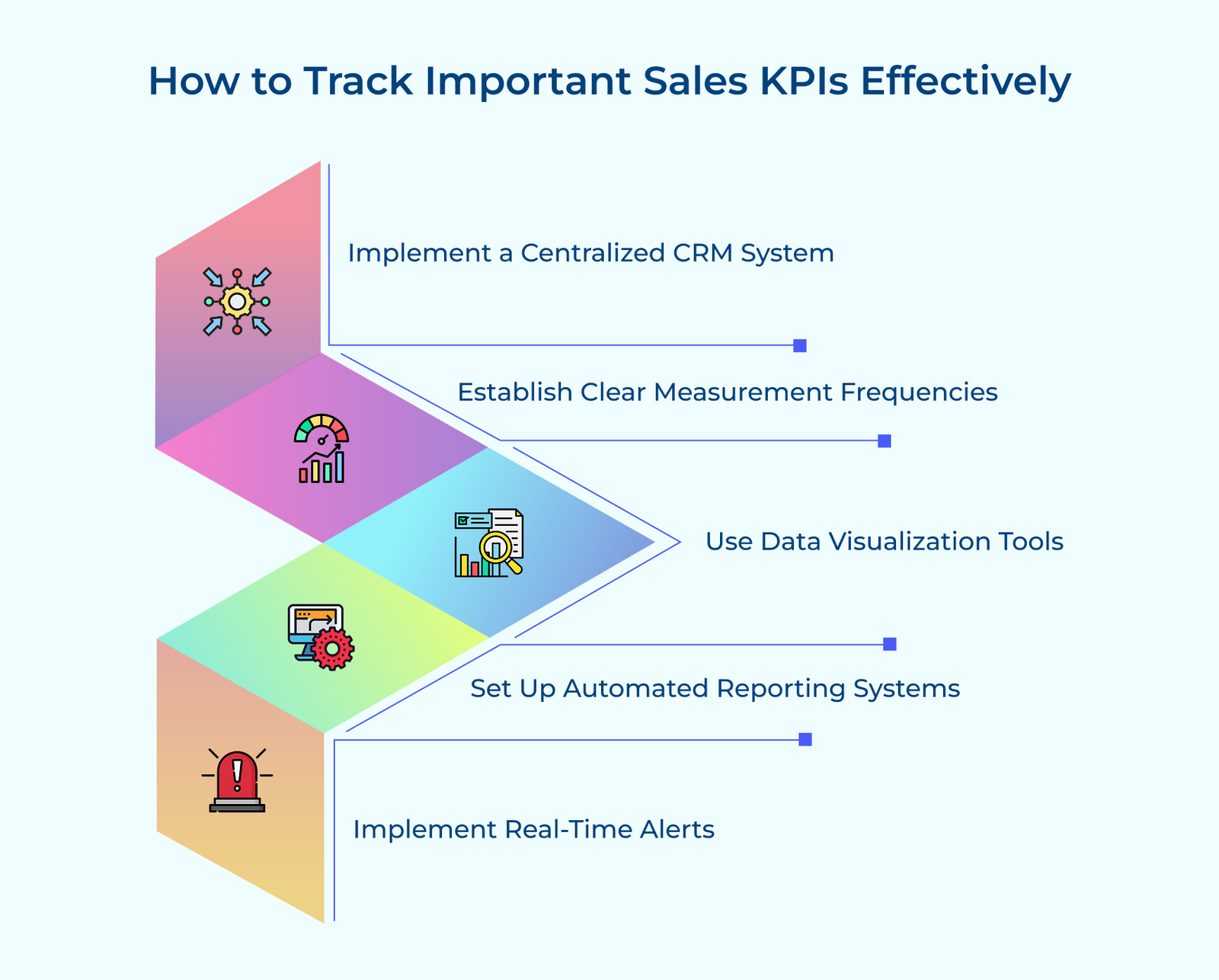
1. Implement a Centralized CRM System
A centralized CRM keeps all your sales data in one place. It automatically logs interactions, updates deal stages and generates reports. It eliminates scattered data and ensures everyone is working with the same accurate information.
2. Establish Clear Measurement Frequencies
Not all metrics need daily attention. Track fast-moving KPIs, like lead response time, daily, while others, like revenue growth, might only need monthly or quarterly reviews. Setting the right frequency keeps tracking useful without overloading the team.
3. Use Data Visualization Tools
Use charts, graphs and dashboards to make sales data easier to understand. Visuals help spot trends and outliers quickly, so teams can act without digging through spreadsheets.
4. Set Up Automated Reporting Systems
Set up automatic reports that go to the right people at regular intervals. It saves time and keeps everyone informed without manual updates. Automation also helps ensure nothing slips through the cracks.
5. Implement Real-Time Alerts
Create alerts for when metrics fall outside expected ranges, like a sudden drop in win rates or a delay in lead follow-up. The quick flags help teams catch issues early and adjust before they snowball.
Sales metrics and KPIs are more than just numbers – they’re decision-making tools. When chosen carefully and tracked consistently, they turn day-to-day activity into insights that drive your long-term growth.
Tracking alone isn’t enough. Real progress comes from building a culture where every team member understands what’s being measured, why it matters and how their work affects the bigger picture.
Key takeaways:

Sales leaders need dashboards that show overall revenue, growth and forecast accuracy. Sales reps benefit more from tracking daily activities, open opportunities and deal progress. The best dashboards are tailored to each role, showing only the metrics that help the person make better decisions.
Core metrics include revenue growth, pipeline value, win rate and customer acquisition cost. But not all metrics matter equally to every business. Focus on the ones that match your goals. Use a mix of leading indicators (like activity levels) and lagging indicators (like revenue) to get a full picture.
Start with your goals. Then choose the metrics that best measure them. Use a CRM or dashboard tool that integrates well with your existing systems. Keep the layout simple—put the most important numbers up front. Test it with users, get feedback and keep refining.
The fundamental KPIs include revenue growth, pipeline health, conversion rate, sales cycle length and customer lifetime value. The metrics provide a balanced view of both current performance and future potential. They help track both the efficiency of your sales process and its effectiveness in generating sustainable revenue.
The review frequency should match the metric’s nature and impact. Daily monitoring works best for activity metrics and lead response times. Pipeline and opportunity metrics need weekly review. Revenue and strategic metrics typically require monthly or quarterly analysis. Set a schedule that gives you insight without overwhelming your team.
Don’t guess—look at the data. Figure out where the problem starts, then narrow it down. Set focused goals and act on them. Fixing issues might mean adjusting your process, improving team skills or providing better tools. Track progress regularly and stay flexible.

Grow Customer Relationships and stronger team collaboration with our range of products across the Conversational Engagement Suite.
Omnichannel Customer Support & Help Desk Software
AI Enabled Business Messaging and Chatbot Software
Sales Engagement & CRM Software
Call Center Software & Virtual Phone System
Product Marketing & Experience Platform
Customer Experience & Feedback Management Software

 What is Nonprofit Customer Service? Strategies & Challenges
Scroll to top
What is Nonprofit Customer Service? Strategies & Challenges
Scroll to top