Top 7 CRM Challenges and Ways to Overcome Them in 2026
Uncover the most common CRM challenges businesses face. Get practical, easy-to-implement solutions to improve user adoption, data quality, customer engagement and system performance.

Uncover the most common CRM challenges businesses face. Get practical, easy-to-implement solutions to improve user adoption, data quality, customer engagement and system performance.
Do you know about 65% of companies adopt a Customer Relationship Management (CRM) system within the first five years of their business operations? CRM systems are meant to simplify customer relationships, yet many businesses still stumble. Growing expectations, mounting data, and new technologies like AI have only raised the stakes. At the same time, familiar issues like disconnected tools and unreliable data continue to block progress, draining time, revenue and customer confidence.
The problems can be fixed. We’ll go through the biggest CRM challenges companies are facing and show you how to tackle them head-on. Be it to clean up messy data, get your team on board or unlock the real value of AI, you’ll find practical tips to help you get more from your CRM and make it work the way it should.
CRM challenges refer to the complex obstacles organizations face when deploying systems to manage their customer interactions and relationships. The challenges come up because CRM is not merely a technological solution but a comprehensive business strategy that requires significant organizational changes in processes, culture and mindset.
Understanding the challenges is essential. A poorly implemented CRM can lead to frustrated users, messy data, wasted time and missed opportunities. Research shows that up to 70% of CRM projects fail to meet expectations, often because businesses underestimate what’s involved.
Key goals:
Let’s review the significant benefits that come from overcoming your CRM-related obstacles, ensuring that your investment yields real returns.
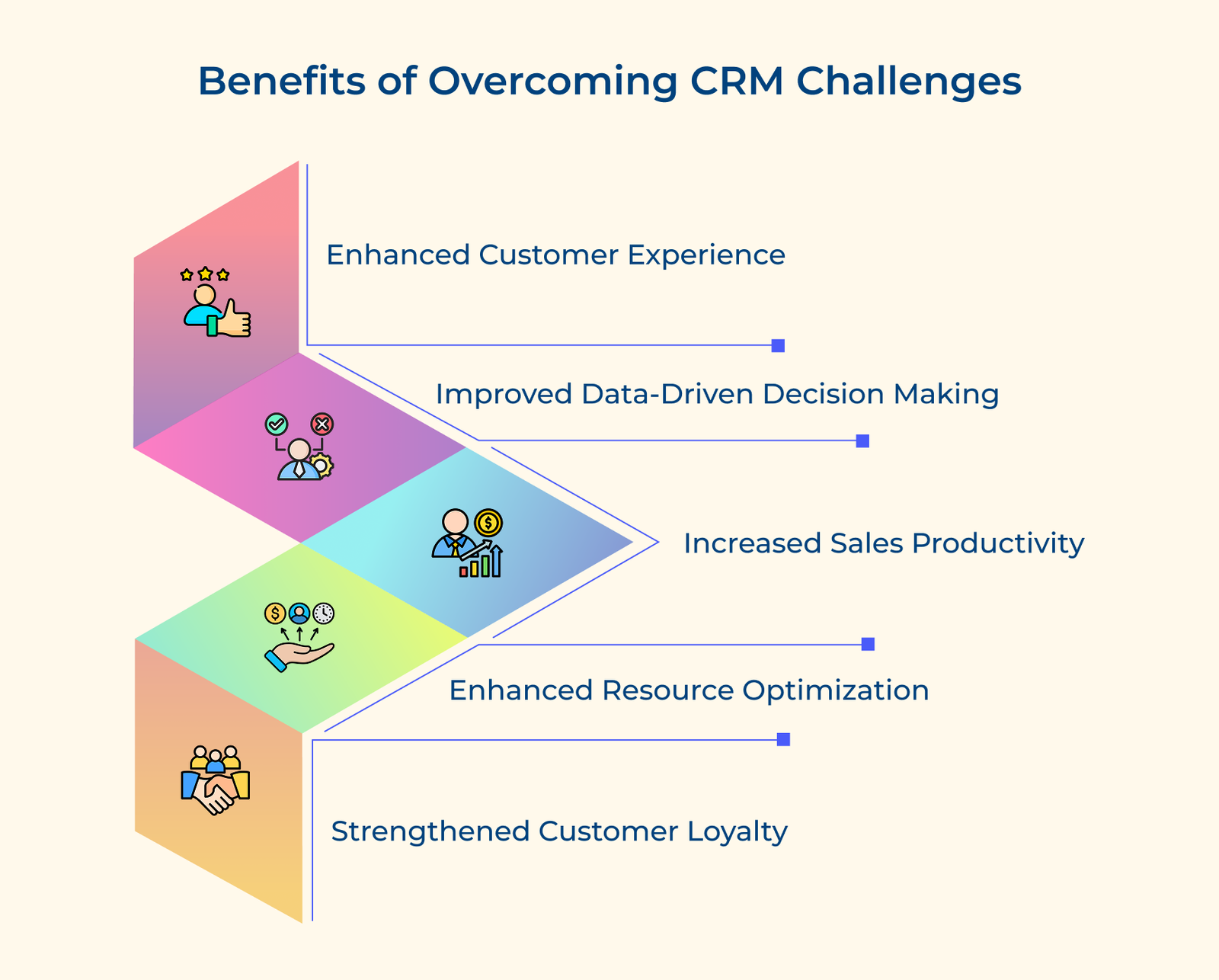
Enhanced Customer Experience
When you overcome the customer relationship management challenges and your CRM works as it should, your team has the full picture, including past interactions, preferences and needs. It makes it easier to offer help that feels personal and relevant, not generic. Customers feel heard, understood and more connected to your brand.
Improved Data-driven Decision Making
Fixing CRM data issues means your decisions don’t rely on guesswork. You get a clearer view of what your customers want, how they behave and where your opportunities lie. It helps leaders plan ahead with confidence and make choices grounded in real insight.
Increased Sales Productivity
Salespeople spend less time on repetitive tasks and more time with customers with a well-functioning CRM. Automations take care of the busywork and organized data helps reps quickly spot the most promising leads.
Enhanced Resource Optimization
Solving CRM issues helps your team work smarter. You can see which efforts are paying off and where to focus your resources. The clarity means fewer wasted hours and better results.
Strengthened Customer Loyalty
When your CRM helps you stay ahead of customer needs, you build stronger relationships. You’re able to solve problems early, offer helpful suggestions and stay relevant. Over time, the consistency builds trust and keeps people coming back.
Let us go through the top CRM challenges along with actionable strategies to overcome them, ensuring your organization stays ahead of the competitors.
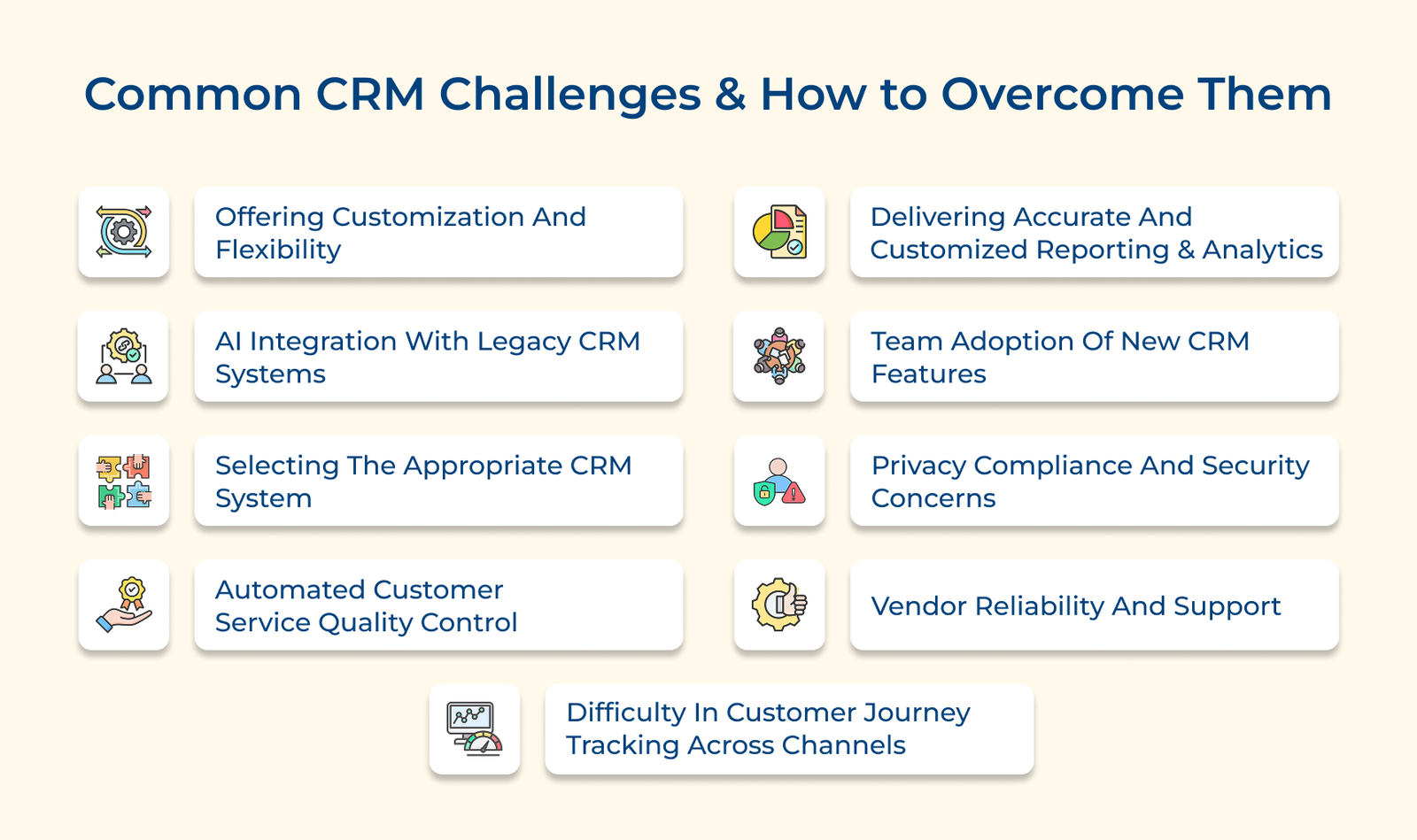
Modern businesses need CRM systems that can adapt to their unique processes and workflows. Businesses struggle to find the right balance between standardization and customization. It becomes crucial as different departments often require specific features while maintaining system consistency across the organization.
The complexity arises from diverse business needs and varying user requirements across departments. Each team wants the CRM to work their way but excessive customization can lead to system instability and maintenance issues. Finding the balance can become harder as organizations grow and evolve.
Solutions:
Businesses face significant CRM challenges when trying to incorporate modern AI capabilities into their existing CRM infrastructure. The integration is essential for staying competitive but legacy systems often lack the architectural foundation to support advanced AI features seamlessly.
Many businesses operate on older CRM platforms that weren’t designed with AI integration in mind. The technical gap between legacy architecture and modern AI requirements creates performance bottlenecks that affect system reliability.
Solutions to Overcome:
Choosing the right CRM system represents a critical decision that impacts your entire organization’s ability to manage customer relationships effectively. Businesses are often seen struggling here because the wrong choice leads to significant financial losses and operational disruptions. The system needs to align with the business goals while providing room for future growth.
Key questions:
Managing automated customer service quality in CRM systems has become increasingly challenging as businesses scale their operations. Poor quality control in automated responses can damage customer relationships and brand reputation. Businesses need to ensure their automated systems maintain high service standards while handling growing customer interactions efficiently.
The solution:
Build smart response learning models
Create an AI-powered learning system that continuously analyzes customer interactions and their outcomes. The system should track customer satisfaction metrics after automated responses and use the feedback to improve response accuracy.
Create dynamic quality checkpoints
Implement a multi-layer verification system that monitors automated responses in real time. The system should include sentiment analysis, contextual awareness and response appropriateness checks. When responses don’t meet quality thresholds, they get routed to human agents for review and correction.
Develop comprehensive performance analytics
Establish a robust monitoring system that tracks key performance indicators for automated customer service. It includes response accuracy, customer satisfaction scores and issue resolution rates. Regular analysis of these metrics helps identify areas needing improvement and guides system optimization.
The challenge lies in generating precise and actionable insights from vast amounts of CRM data. Many organizations struggle with unreliable reporting due to data inconsistencies and integration issues. It affects decision-making capabilities and prevents businesses from fully leveraging their customer data for strategic planning.
Ways to enhance CRM analytics:
Design smart data validation systems
Implement automated data validation processes that check for inconsistencies and errors before generating reports. The system should verify data completeness, standardize formats and flag anomalies. Regular data audits ensure the accuracy of input data, leading to more reliable analytics.
Create unified data integration workflows
Develop a centralized data integration framework that combines information from all customer touchpoints. It ensures there’s consistent data flow between different systems and departments. The unified approach eliminates data silos and provides a complete view of customer interactions.
Build custom analytics dashboards
Design role-specific dashboards that display relevant metrics and KPIs for different teams. The dashboards should offer real-time data visualization, customizable reports and drill-down capabilities. The targeted approach helps teams focus on metrics that matter most to their objectives.
When teams resist adopting new CRM features, your business loses significant productivity potential. Low adoption rates mean expensive features go unused and your team continues with inefficient manual processes. It creates a ripple effect where poor data input leads to unreliable reporting and ultimately affects customer service quality.
Let’s understand the ways to boost feature adoption with the team:
Failing to maintain proper compliance in your CRM system can lead to devastating consequences such as data breaches, legal penalties and loss of customer trust. As privacy regulations become stricter, businesses must constantly update their security measures while ensuring system usability isn’t compromised.
Ways to enhance security:
Check out how major brands faced and overcame their unique challenges of customer relationship management, demonstrating the importance of strategic problem-solving in customer relationship management.
Nike
Nike struggled with integrating their online and physical retail store data into a unified CRM system. Their customer interactions across digital platforms, mobile apps and physical stores created disconnected data silos. It prevented them from delivering consistent personalized experiences to their global customer base.
They overcome the issue with CRM by developing a phased integration approach, starting with their digital channels before incorporating physical store data. Implementing a cloud-based CRM solution with real-time synchronization helps them get a unified view of customer interactions. It led to more personalized product recommendations and improved customer engagement across all channels.
Starbucks
Starbucks faced CRM challenges in connecting its loyalty program data with its customer service systems. Their existing CRM was not able to handle the volume of daily transactions from millions of loyalty members while maintaining real-time personalization capabilities.
The company redesigned its CRM architecture to handle high-volume data processing and implemented AI-driven analytics. The new system enabled them to deliver personalized offers based on customer preferences and purchase history. The enhanced system strengthened customer loyalty and improved their mobile ordering experience.
Tesla
Tesla encountered problems managing customer communications across their sales service and delivery processes. Their rapid growth led to communication gaps between departments resulting in inconsistent customer experiences and delayed response times.
They implemented an integrated CRM platform that connected all customer-facing departments. They were able to streamline their customer journey by creating automated workflows and centralized communication channels. The approach help them improve their customer satisfaction and reduce service resolution times.
Spotify
Spotify struggled with analyzing vast amounts of user behavior data to provide personalized music recommendations. Their existing CRM system couldn’t effectively process and utilize the massive stream of user interaction data for real-time personalization.
They developed a custom CRM solution focusing on real-time data processing and machine learning capabilities. It allowed them to create more accurate music recommendations and personalized playlists. The enhanced system improved user engagement and subscription retention rates.
Airbnb
Airbnb faced difficulties managing relationships between hosts and guests across different regions . Their CRM system struggled to handle the complexity of two-sided marketplace interactions while maintaining consistent service quality.
They created a specialized CRM system to manage both host and guest relationships simultaneously. When they implemented automated translation features and region-specific support workflows, they improved their communication efficiency.
The following are the essential steps that ensure your CRM implementation supports your organization’s goals while minimizing disruption to daily operations.
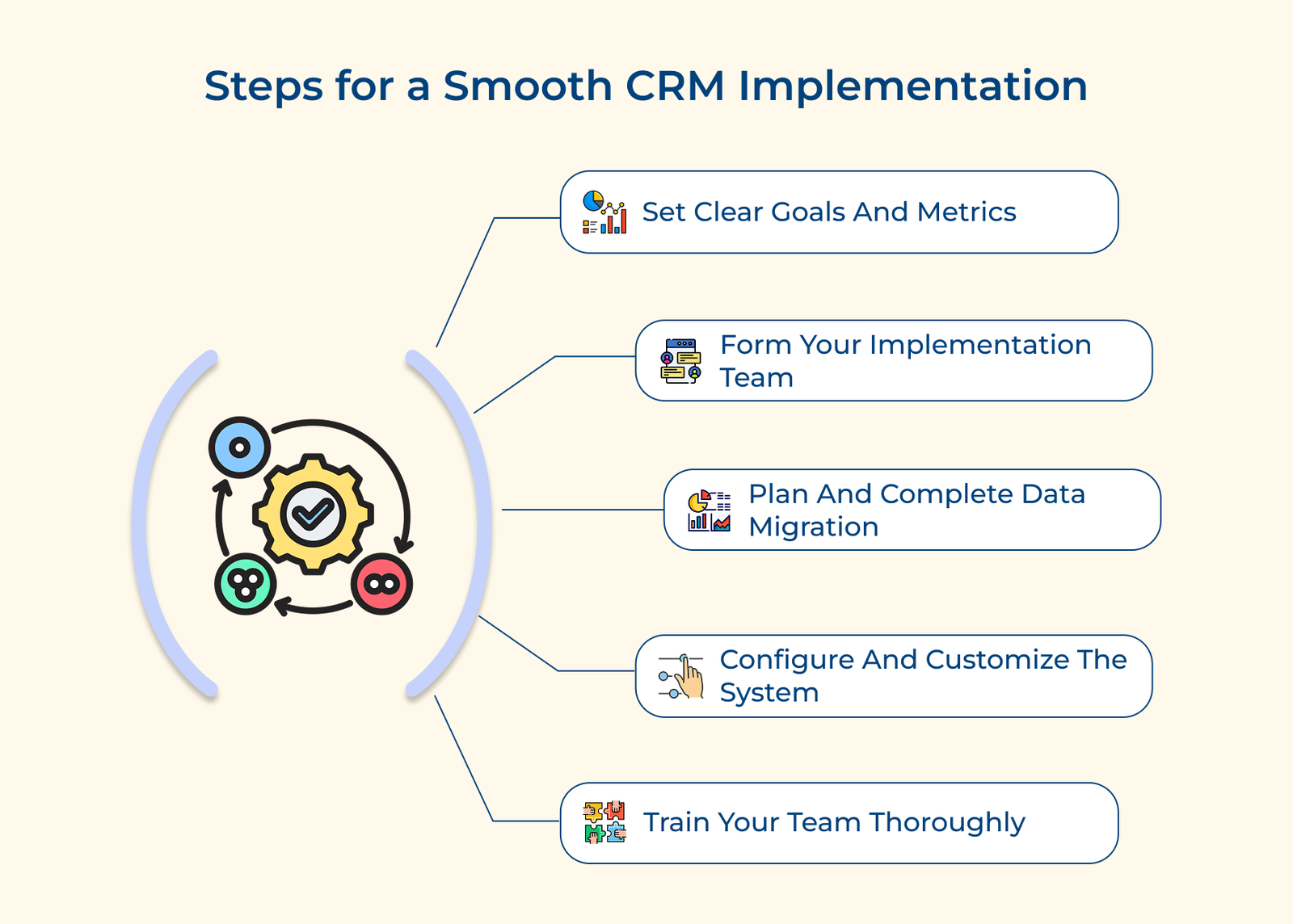
Your CRM implementation journey begins with establishing concrete goals that align with your business strategy. Start by identifying specific pain points in your current customer relationship processes and outlining how the new CRM system will address them. Consider factors like customer satisfaction metrics, sales efficiency and data accuracy requirements.
The foundational step requires input from all stakeholders to ensure the chosen success metrics reflect departmental needs. Create a detailed document outlining short-term and long-term objectives, including measurable KPIs that will help track progress throughout the implementation process.
Building the right implementation team is crucial for project success. Your team should have reps from different departments who understand their respective workflows and can advocate for their team’s needs. The cross-functional group will help ensure the CRM system meets everyone’s requirements.
Select team members who demonstrate both technical aptitude and strong communication skills. Assign clear responsibilities, including project manager’s technical leads, department representatives and end-user advocates. The diverse team composition helps balance technical capabilities with practical business needs.
Developing a comprehensive data migration strategy is essential for maintaining data integrity during the transition. Begin by auditing your existing data sources, identifying critical information that needs to be transferred and establishing data cleaning protocols to ensure accuracy.
Create a detailed migration timeline that includes multiple testing phases and validation checkpoints. The step requires careful attention to data mapping between old and new systems while maintaining compliance requirements throughout the transfer process.
Tailoring your CRM system to match your organization’s workflows requires careful planning and execution. Start with essential features that address your core business needs and gradually build additional functionality. The approach helps prevent overwhelming users while ensuring critical processes are properly supported.
Work closely with department heads to understand their specific requirements and workflow preferences. Document all customizations thoroughly and test each configuration change to ensure it doesn’t negatively impact other system functions or user experience.
Creating an effective training strategy ensures users can maximize the CRM system’s potential. Begin by developing role-specific training materials that focus on daily tasks and common scenarios users will encounter. The targeted approach helps in maintaining engagement and improving information retention.
Implement a multi-phase training program that includes hands-on practice sessions, remote learning resources and ongoing support mechanisms. Regular feedback sessions during training help identify areas where additional instruction or system adjustments might be needed.
CRM comes with its share of hurdles – system complexity, low adoption, messy data, and shifting customer expectations. Ignoring these CRM issues only slows teams down and weakens customer relationships. Tackling them head-on, though, can turn those same problems into drivers of efficiency and growth.
The real difference comes from preparation and follow-through. Teams that invest in planning, training and system fine-tuning build a setup that actually works for them instead of against them. The payoff shows up in smoother collaboration, better customer interactions and insights that help leaders make smarter calls.
Here’s the thing: there’s no finish line. Both technology and customer needs will keep evolving. Businesses that stay adaptable while keeping their goals in sight are the ones that get long-term value out of CRM. Challenges aren’t just roadblocks; they’re chances to build stronger processes and deeper relationships.

CRM implementations often fail due to a combination of poor planning and misaligned expectations. The root causes typically include inadequate user training, lack of executive support and resistance to change from team members. Businesses sometimes end up rushing into implementation without properly defining their objectives or understanding their current processes. A successful CRM implementation requires careful planning, change management strategies and continuous support throughout the transition period.
Notable CRM disasters often stem from attempting to force complex customizations without proper testing. Some organizations have lost millions by selecting systems that didn’t align with their business processes or failing to migrate their existing data properly. Other disasters include implementing systems without adequate security measures, leading to data breaches or choosing platforms that couldn’t scale with business growth, causing system-wide failures.
Businesses that want to make their CRM software truly valuable should focus on aligning it with their business processes and user needs. Start by clearly defining your objectives and ensuring the system supports your workflow rather than forcing users to adapt to the software. Regular training updates, along with continuous feedback collection, will help in keeping the system relevant.
Successful CRM challenge resolution begins with a clear understanding of your organization’s specific needs and pain points. So make sure to have a detailed implementation roadmap that includes regular checkpoints and success metrics. Focus on user adoption through comprehensive training programs and ensure proper data management practices. Build a strong support system, including internal champions, vendor relationships and technical expertise to address issues quickly.
Maintaining high-quality data requires establishing strict data entry standards and regular cleaning procedures. Implement automated validation rules to prevent incorrect data entry and schedule regular audits to identify inconsistencies. Train users on proper data entry procedures and create accountability for data quality through regular reviews along with the feedback sessions.
Modern CRM systems need robust security measures, including role-based access controls, encryption and regular security audits. It is recommended to implement multi-factor authentication for all users and maintain detailed logs of system access. Regular security training for all users helps prevent common vulnerabilities while staying compliant with data protection regulations and ensures customer information remains secure.

Grow Customer Relationships and stronger team collaboration with our range of products across the Conversational Engagement Suite.
Omnichannel Customer Support & Help Desk Software
AI Enabled Business Messaging and Chatbot Software
Sales Engagement & CRM Software
Call Center Software & Virtual Phone System
Product Marketing & Experience Platform
Customer Experience & Feedback Management Software

 Customer Service Quality Assurance: A Comprehensive Guide
Scroll to top
Customer Service Quality Assurance: A Comprehensive Guide
Scroll to top