A Comprehensive Guide on B2B Customer Churn in 2026
Explore the strategies to reduce B2B customer churn. Learn to identify causes, analyze data and implement proactive retention tactics to drive long-term growth.

Explore the strategies to reduce B2B customer churn. Learn to identify causes, analyze data and implement proactive retention tactics to drive long-term growth.
Customer retention is key to sustainable business growth. Retaining customers costs 5x less than acquiring new ones. Many businesses struggle to effectively track and reduce churn, resulting in revenue losses. The challenge isn’t just identifying at-risk customers—it’s about implementing a strategic approach to reduce B2B customer churn. Without the right metrics and systems, businesses end up reacting to customer departures rather than preventing them, missing valuable intervention opportunities.
There’s a solution that can transform how organizations approach customer retention. Businesses can build a solid framework to reduce churn by understanding churn calculation, applying proven strategies and utilizing modern technology. We’ll dive into essential churn management strategies, offering actionable insights to help protect and expand your customer base.
B2B customer churn refers to the rate at which businesses end their relationship with service providers, typically having larger financial impacts than B2C churn due to higher contract values and long-term partnerships.
The churn process in B2B follows a pattern where companies assess the value of a product or service based on factors like ROI, service quality and alternatives. Warning signs, such as decreased usage, delayed payments or reduced engagement often appear months before churn. The churn rate is calculated by dividing the number of lost customers by the total number of customers at the start of the measurement period.
Key principles:
Let’s go through the key benefits of reducing customer churn which contributes to long-term business success.
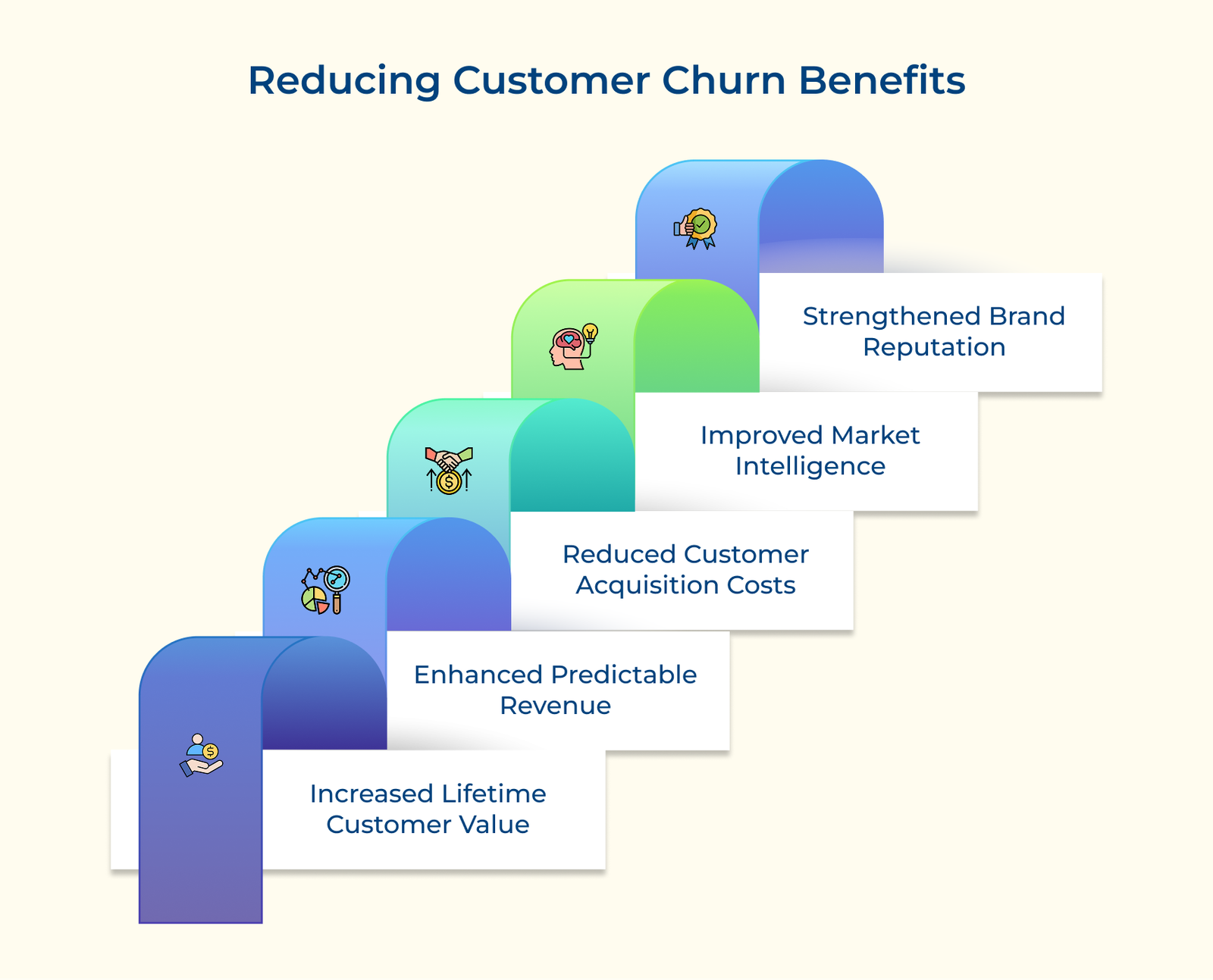
1. Increased Lifetime Customer Value
Long-term customers tend to increase their spending as they expand their use of your products or services. Their growing trust turns your company into a strategic partner, amplifying the financial value.
2. Enhanced Predictable Revenue
Lower churn rates create stable, predictable revenue allowing businesses to plan more effectively. Companies can invest in growth and attract more investors with less focus on replacing lost customers.
3. Reduced Customer Acquisition Costs
Retaining existing customers is more cost-effective than acquiring new ones. Savings from marketing and sales can be reinvested in product development or customer experience improvements, driving sustainable growth.
4. Improved Market Intelligence
Long-term customers offer valuable insights into product usage and market needs. Their feedback fuels innovation, making them partners in shaping improvements and driving a competitive edge.
5. Strengthened Brand Reputation
Satisfied long-term customers become brand advocates, driving referrals and enhancing market credibility. Their testimonials reduce marketing costs, creating a growth-driven cycle of customer advocacy.
Check out the steps to calculate the customer churn rate, a key metric for measuring retention and understanding the effectiveness of your business’s strategies.
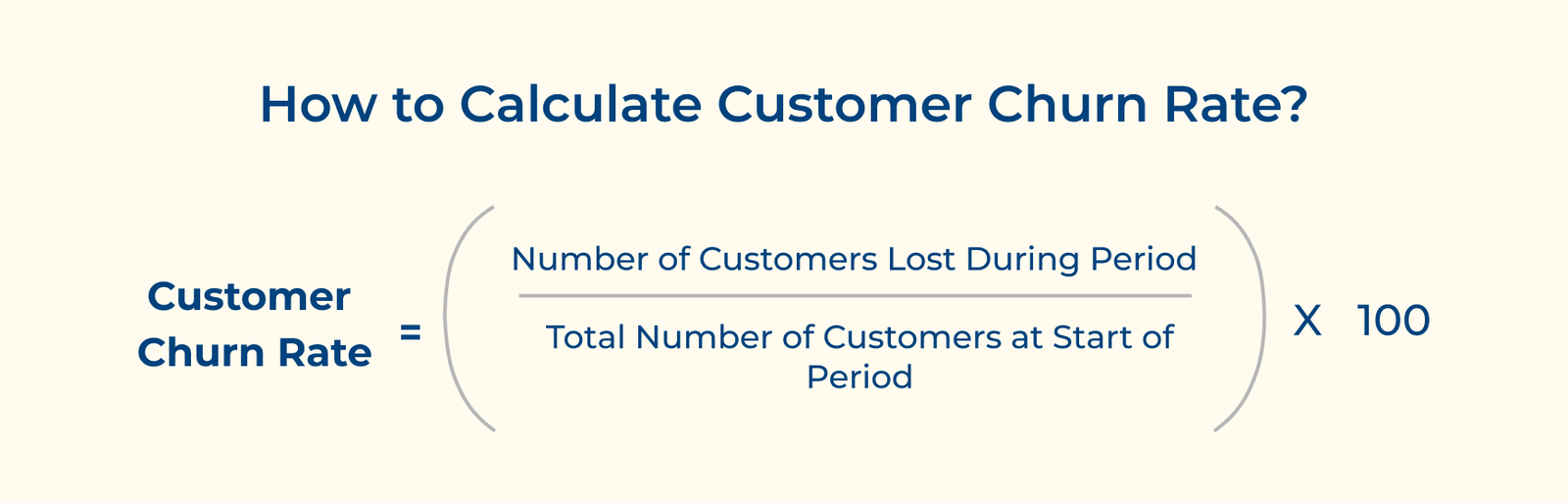
Customer Churn Rate = (Number of Customers Lost During Period / Total Number of Customers at Start of Period) × 100
Churn rates vary by industry, company size and business model. A healthy annual churn rate for B2B SaaS companies is typically 5-7% or 0.42-0.58% monthly. Enterprise-focused companies strive for lower rates (3-5% annually), while those targeting small businesses may accept higher rates (10-15% annually).
1. Define Your Period
Choose your measurement time frame based on your business cycle and contract lengths. Monthly is ideal for subscription-based models, while quarterly or annual periods suit enterprise businesses with longer contracts.
2. Determine Starting Customer Count
Capture the total active customer base at the start of your chosen period. Make sure that you’re counting only relevant customers and excluding non-qualifying accounts based on your defined criteria.
3. Track Customer Losses
Track all customer departures during the period. Include both voluntary cancellations and involuntary churn, maintaining detailed records of why customers left for future analysis.
4. Apply the Formula
Plan your numbers into the churn rate formula. Double-check your calculations and ensure you’re using consistent units for accurate results.
5. Analyze and Segment Results
Segment churn by customer type, contract value or industry to spot trends. The segmentation helps target improvement efforts effectively.
Example calculation:
Let’s say a SaaS company starts with 500 customers in January:
– Starting customers: 500
– Customers lost: 15
– Churn Rate = (15 ÷ 500) × 100 = 3% monthly churn rate
The 3% monthly churn rate equals 36% annually, highlighting the need for enhanced retention strategies.
Check out the key differences between B2B and B2C churn. Let’s go through how B2B churn involves longer decision cycles and deeper relationships compared to B2C churn.
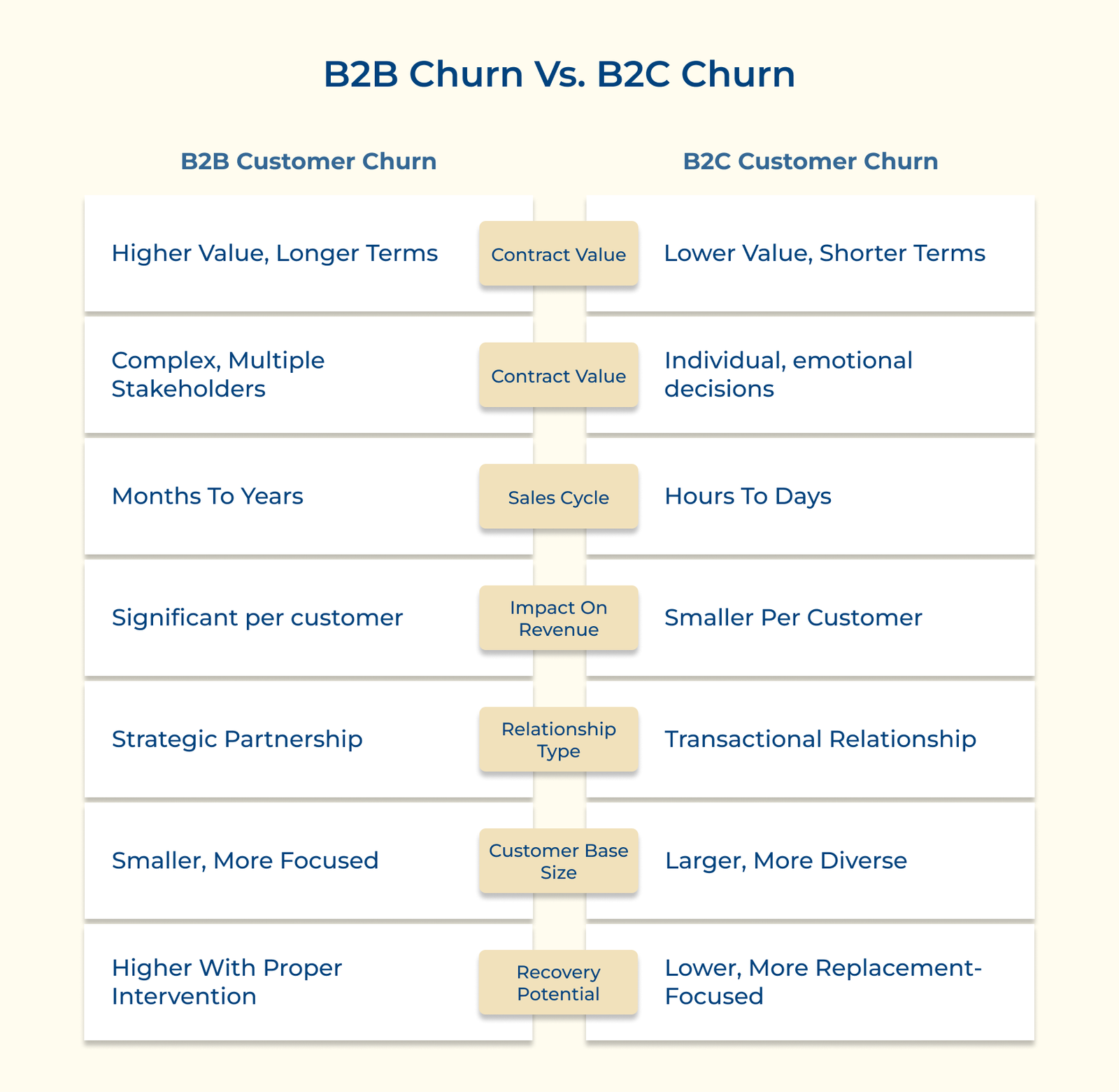
1. Contract Value and Financial Impact
Losing a single customer in B2B can result in a significant financial hit, often thousands or millions in annual recurring revenue. The relationships involve major investments in customization, implementation and support, making retention crucial.
The impact of B2B churn goes beyond revenue loss, affecting resource allocation, team structures and long-term planning. Unlike B2C, where individual customers contribute less, B2B losses can shake company valuation and investor confidence, requiring stronger retention strategies.
2. Decision-Making Process and Complexity
B2B churn involves multiple stakeholders including procurement teams, end-users, technical evaluators and executive decision-makers. The complexity means that churn prevention requires maintaining relationships and demonstrating value at every organizational level.
B2C churn is driven by individual decisions based on price, convenience or preference. While B2B churn is harder to predict, its complexity also offers more opportunities for intervention and retention.
3. Relationship Dynamics and Management
B2B relationships are deeply integrated into client’s operations, with customized solutions, dedicated support and strategic alignment. The partnerships demand ongoing engagement through account management, business reviews and service optimization.
The intensity of B2B relationships necessitates proactive management and continuous value demonstration. Unlike B2C relationships, which are often transactional, B2B partnerships involve shared objectives, making proactive relationship management and consistent value demonstration essential for preventing churn.
4. Recovery and Retention Strategies
B2B churn prevention relies on early warning systems, health checks and proactive interventions. Companies invest in customer success, technical support and relationship management to address issues before churn occurs.
Recovery in B2B often involves executive engagement, contract renegotiation and service optimization. It differs significantly from B2C, where retention typically revolves around promotions or automated win-back strategies.
5. Implementation and Onboarding Impact
B2B relationships thrive on effective implementation and onboarding, which can span months or years. Poor onboarding leads to adoption issues and churn, making the phase vital for long-term retention.
The process differs from B2C scenarios, where onboarding is simpler and more standardized. B2B implementation requires detailed planning, milestone tracking and success metrics to ensure strong foundations for lasting relationships.
Let’s go through nine actionable strategies that can help you not only reduce churn but also enhance long-term loyalty with your B2B clients.
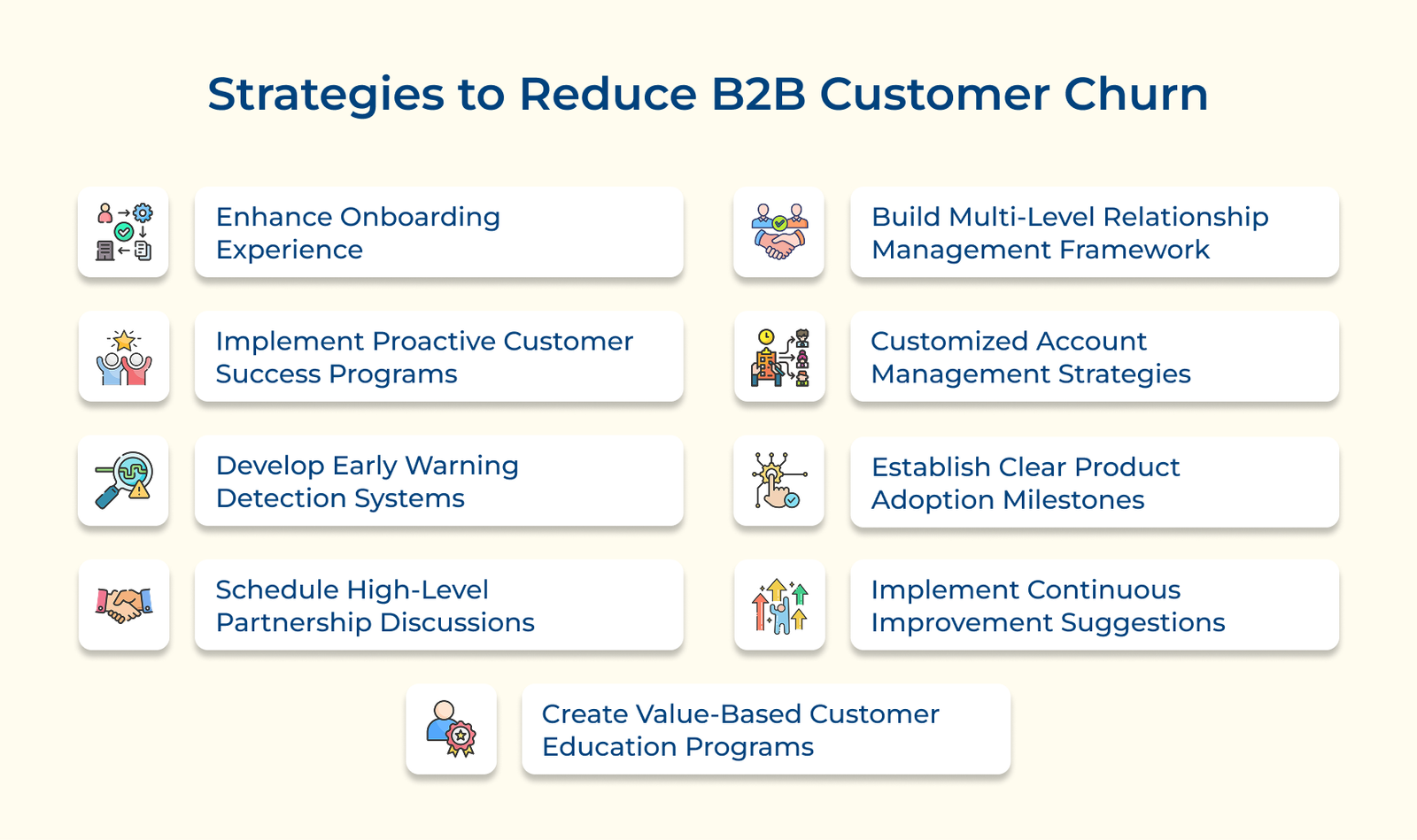
Onboarding is the foundation of a strong customer relationship, setting expectations and driving success. A well-crafted process helps customers quickly realize value and reinforces their investment confidence.
Establish a structured onboarding framework with clear milestones, dedicated specialists and regular check-ins. Begin with a kickoff meeting to align on goals, followed by a tailored implementation plan.
Pro tips:
Proactive customer success shifts from reactive support to anticipating needs and solving issues before they arise. The approach enhances a strategic partnership, helping customers achieve their business goals.
Create a dedicated success team to monitor health scores, usage patterns and outcomes. Develop success plans, conduct quarterly reviews and offer strategic guidance on product usage.
Actionable tips:
Early warning systems act as a radar, identifying at-risk customers before they churn. The systems track behavior, engagement and signals of dissatisfaction or reduced product value perception.
Identify key churn indicators specific to your business, such as usage frequency, support tickets, payment timing and feature adoption. Create a scoring model and set automated alerts for when metrics dip below thresholds, enabling timely interventions.
Best practices:
Regular executive partnership discussions are key to elevating B2B relationships. The high-level engagements ensure alignment on long-term goals, address strategic concerns and strengthen the partnership to prevent churn.
Establish a quarterly meeting schedule with a focused agenda, emphasizing value delivery, future roadmaps and business impact. Involve key stakeholders, review achieved outcomes and create action plans for areas needing attention.
Pro tips:
Value-based customer education programs bridge the gap between product features and customer success. The program helps customers achieve their business goals, maximizing their investment and building confidence in using your solution.
Start by designing role-based learning paths tailored to different user personas. Create a curriculum that blends product knowledge with industry best practices and strategic insights. Ensure each module has clear objectives along with measurable outcomes, delivering content through webinars, self-paced courses, workshops and certification.
Pro tips:
A multi-level relationship management framework strengthens connections across all customer organization tiers. It prevents churn by creating multiple advocates and ensuring value is recognized at every level.
Begin by mapping key stakeholders within each customer organization, assigning relationship owners to each level. Ensure regular engagement with tailored communications and interactions based on the specific needs of end-users to executives.
Actionable tips:
Customized account management tailors strategies to each customer’s unique needs, enhancing long-term partnerships. It enhances customer satisfaction by addressing specific business goals and challenges.
Start by segmenting customers based on industry, size, complexity and growth potential. Conduct detailed assessments to identify pain points and objectives, then create personalized communication plans. Continuously refine the strategies based on feedback and evolving needs.
Pro tips:
Product adoption milestones act as a roadmap, turning abstract concepts like “success” into tangible measurable progress. The milestones help track the customer’s journey from initial implementation to advanced product use.
Define key stages of product maturity, from basic functions to advanced features and establish specific metrics for each. Align the milestones with customer goals, offering clear value at each stage. Regular reviews help identify gaps and deepen engagement.
Best practices:
A strong feedback system turns customer insights into actionable improvements, showcasing your commitment to evolving with their needs. It builds a cycle where customers see their input directly influencing your product and services, enhancing their investment in the partnership.
Implement multiple feedback channels like surveys, focus groups and advisory boards. Prioritize and evaluate suggestions, then communicate how customer feedback drives change. Share a transparent timeline for updates.
Pro tips:
Technology-driven proactive engagement leverages AI, automation and data analytics to address customer needs before issues arise. The approach scales personalized attention while maintaining high-quality interactions.
Start by selecting the right tech tools that integrate with your systems. Set up automated alerts for key behaviors, use AI sentiment analysis for communications and create workflows for personalized interventions. Balance automation with a human touch to preserve authentic relationships.
Pro tips:
Check out the digital tools that can help manage B2B customer churn effectively. The tools offer engagement strategies to enhance retention and reduce churn risks.
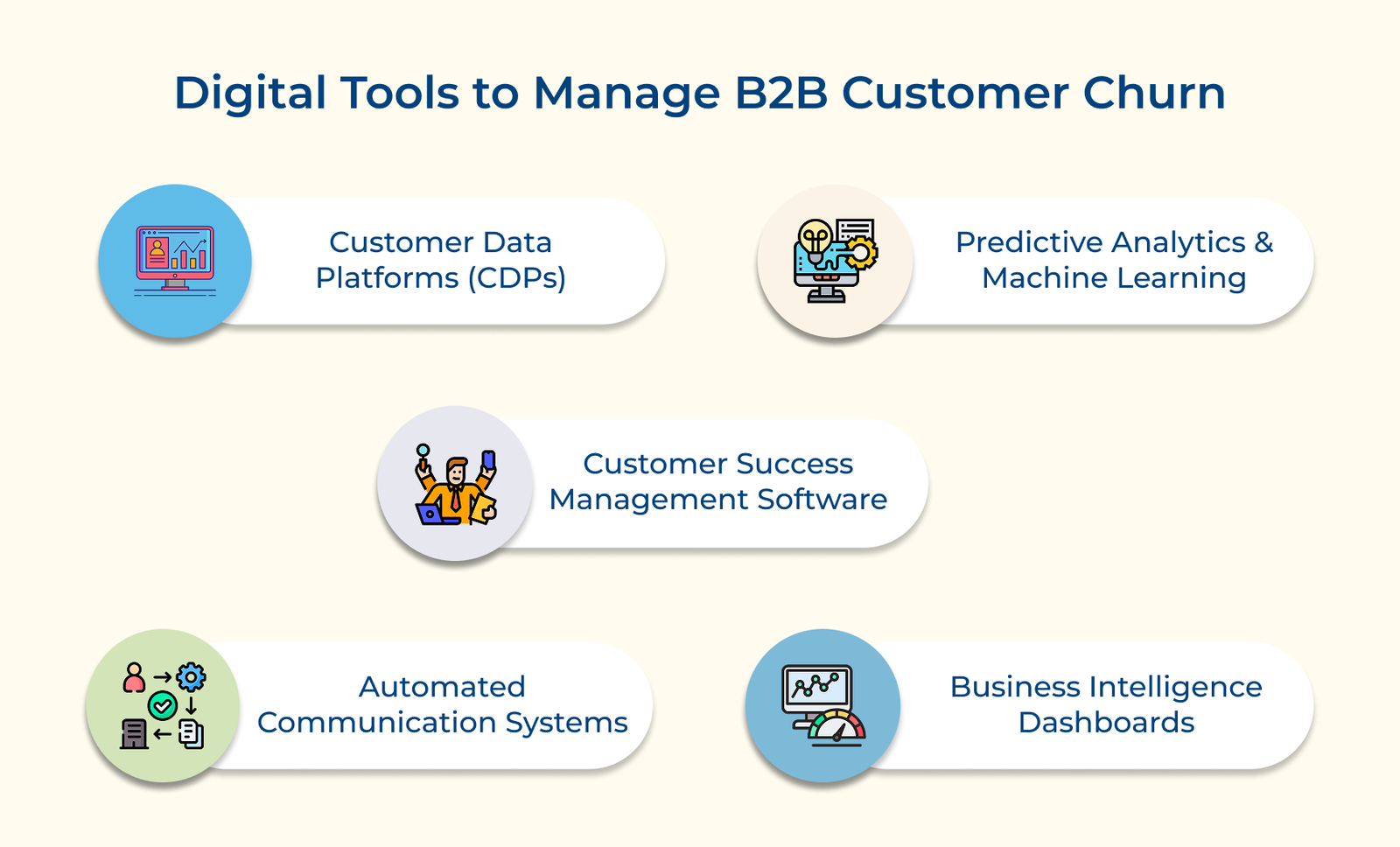
1. Customer Data Platforms (CDPs)
CDPs unify customer data from various touchpoints, combining insights from CRM, product usage, support tickets and marketing. The comprehensive view helps businesses identify churn risk and understand the full customer journey.
2. Predictive Analytics and Machine Learning
Advanced analytics platforms leverage historical data and machine learning to spot churn patterns. They generate churn probability scores that improve with time by analyzing product usage, support tickets and engagement metrics.
3. Customer Success Management Software
Specialized platforms automate customer success tasks by tracking KPIs, managing communications and monitoring product adoption. They help teams prioritize at-risk accounts and recommend intervention strategies using proven playbooks.
4. Automated Communication Systems
AI-powered communication platforms enable personalized outreach at scale. Using natural language processing, they analyze sentiment in emails, chats and support tickets, triggering targeted messages when signs of dissatisfaction arise.
5. Business Intelligence Dashboards
Interactive visualization tools turn complex customer data into actionable insights. Real-time dashboards track health scores, usage and engagement, helping teams spot trends.
Below are the key challenges businesses face in B2B customer retention, from understanding customer needs to navigating complex relationships.
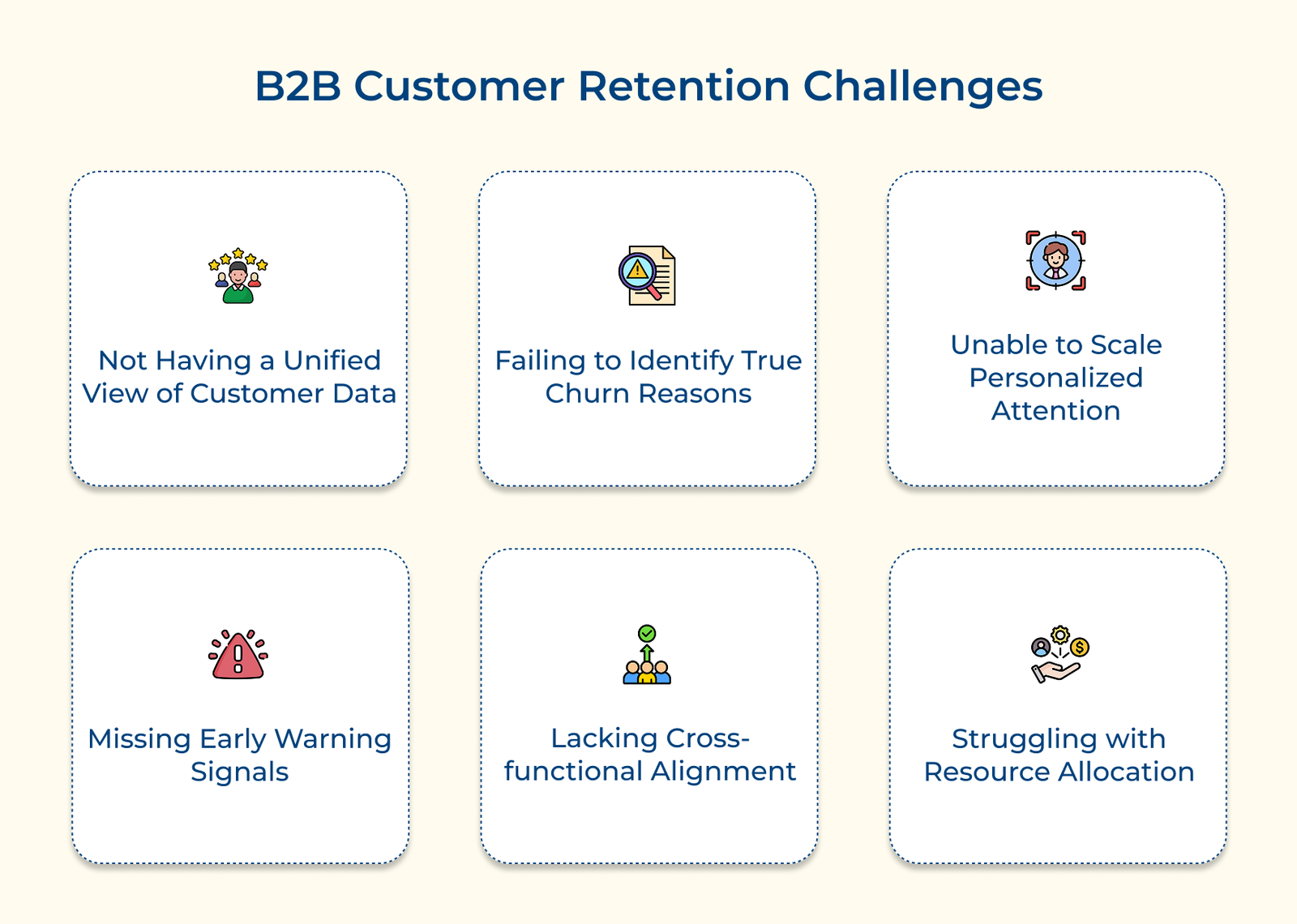
When departments store customer data separately, it creates gaps in understanding customer health. The misalignment leads to critical insights falling through the cracks between sales, support and success teams.
Customers often give surface-level reasons for leaving, making deeper issues. Without thorough exit interviews and data analysis, companies overlook systemic problems, leaving the true causes of churn unresolved.
As customer bases expand, maintaining personalized relationships becomes harder. Success teams struggle to provide consistent service, leading to diminished quality when stretched too thin across accounts.
Companies often miss subtle signs of customer dissatisfaction, overlooking usage trends and engagement metrics in daily operations. The customer has usually already left by the time warning signs are clear.
Departments often pursue conflicting goals without a unified retention strategy. Sales, success and product teams work in silos, creating disjointed experiences that result in service gaps and unmet expectations.
Balancing resources between high-value and smaller accounts is a challenge. Poor prioritization leads to neglecting key customers while wasting effort on accounts already poised to leave.
Ways to overcome:
Managing B2B customer churn requires a strategic, multifaceted approach that blends proactive monitoring, value demonstration and relationship building. Businesses can address churn risks before they escalate by using retention strategies from early warning systems to executive engagement.
Success depends on leveraging both technology and human elements. Tools like predictive analytics and customer success platforms, combined with personalized relationship management, form a strong retention framework that adapts to evolving customer needs.
Key takeaways:

Reducing B2B churn requires a layered approach, starting with understanding why customers leave. Implement strong onboarding and proactive customer success programs. Continuously demonstrate value with regular business reviews and success metrics. Set up early warning systems to spot at-risk customers and tailor intervention strategies. Above all, build strong relationships at all levels within the customer organization.
B2B customer experience encompasses all interactions between a business customer and a vendor throughout their relationship. It includes product usage, support interactions, onboarding and ongoing communication. Poor experiences directly increase churn risk, as business clients evaluate ROI rigorously. Companies delivering exceptional experiences create loyalty and stickiness, making switching costs appear higher than renewal costs, ultimately reducing churn rates significantly.
B2B churn rates vary widely by industry, company size and business model. Annual churn typically ranges from 5-7% for enterprise clients and 10-15% for small businesses in SaaS companies. Professional services aim for around 10%. The benchmarks serve as guidelines, with acceptable rates varying based on specific business conditions.
Effective B2B churn measurement goes beyond tracking customer count. Focus on both logo churn ( lost customers) and revenue churn (lost value). Consider customer lifetime value, account expansion and partial churn due to downgrades. Use cohort analysis to identify churn patterns across segments and periods.
Key warning signs of churn include reduced product usage, disengagement with customer success teams, delayed payments and less participation in business reviews. Watch for changes in stakeholders, lower feature adoption and more support tickets. Monitor sentiment in customer communications and engagement with training or educational resources. Changes in the indicators often signal churn months in advance.
Customer success teams proactively ensure clients achieve desired outcomes with purchased solutions. They build relationships, monitor product usage, identify risk signals and intervene before dissatisfaction escalates. Regular business reviews and value reinforcement, help businesses transform clients from mere users to invested partners. The strategic function transforms traditional reactive support into a proactive discipline that addresses churn triggers before they manifest as cancellation decisions.

Grow Customer Relationships and stronger team collaboration with our range of products across the Conversational Engagement Suite.
Omnichannel Customer Support & Help Desk Software
AI Enabled Business Messaging and Chatbot Software
Sales Engagement & CRM Software
Call Center Software & Virtual Phone System
Product Marketing & Experience Platform
Customer Experience & Feedback Management Software

 What is Sales Optimization? Strategies & Best Practices
Scroll to top
What is Sales Optimization? Strategies & Best Practices
Scroll to top