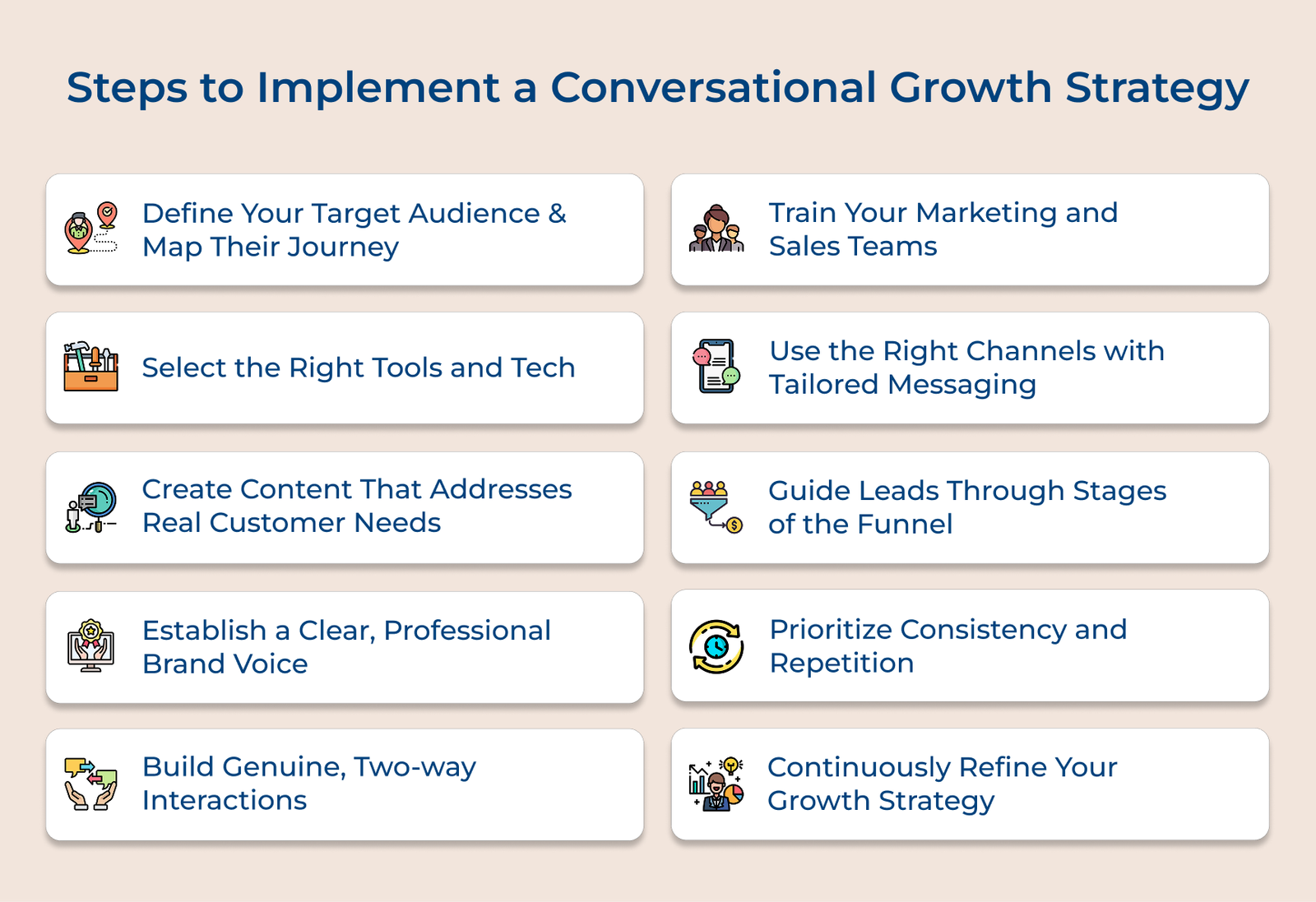
1. Identify the Target Audience and Examine Their Customer Journey
Without proper insight, businesses risk creating irrelevant content and interactions that miss the mark. You can pinpoint key touchpoints, pain points and opportunities to engage meaningfully by mapping the customer journey. It involves building detailed buyer personas, analyzing customer behaviors and mapping every interaction.
Assume there’s a B2B software company that discovers that enterprise customers spend three months researching solutions before reaching out. They create targeted conversation triggers: early-stage prospects interact with chatbots for basic information. The later-stage prospects are connected with product specialists by mapping common questions at each stage.
Actionable tips:
- Conduct quarterly customer interviews to refresh your audience insights and journey maps, keeping your strategy aligned with their evolving needs.
- Tailor conversation flows for each buyer persona, adjusting tone, content and timing to match their unique characteristics.
2. Choose the Right Technology
Selecting the right technology is key to a successful conversational growth strategy. The right tools enable scalable, efficient and personalized interactions, while poor choices can lead to frustrated customers. Technology impacts everything from customer experience to team productivity and data insights, so choosing wisely is crucial for long-term success.
The process involves evaluating conversational tools such as chatbots, messaging platforms and CRM systems based on business needs, budget or customer preferences. The chosen platform should integrate seamlessly with existing systems, offer strong analytics and scale with growth.
Pro Tips:
- Launch a pilot program with your chosen technology on a small scale to identify and address potential issues before full implementation.
- Continuously monitor performance metrics to ensure the technology consistently meets both customer and business needs.
3. Create Relevant Content Based on Customer Needs
Without relevant, customer-centric content, interactions lose value, leading to lower engagement and trust. You naturally enhance deeper, more impactful conversations by understanding customer pain points and positioning your brand as a solution.
The strategy involves analyzing customer feedback, search patterns and questions to create targeted content that speaks directly to their concerns at every stage of their journey. Imagine there’s a healthcare tech company that creates interactive blog posts addressing common implementation challenges with embedded conversation triggers.
Best practices:
- Maintain a dynamic content calendar based on customer service interactions and frequently asked questions, updating it monthly with new insights.
- Build content clusters around key topics, linking each piece to interactive opportunities like live chat, webinars or consultation calls to drive engagement.
4. Setup Your Brand Voice (Be Professional)
A consistent, professional brand voice builds trust and recognition at every customer touchpoint. Without a clear voice, communications can feel disjointed or unreliable. Well-defined brand voice guidelines ensure that customers experience the same level of professionalism whether they’re interacting with chatbots or human representatives.
The step involves creating comprehensive voice guidelines that outline tone, language and style across all channels. Assume there’s a financial services company that uses a brand voice matrix to guide responses. They should use a friendly yet formal tone for basic inquiries and a more empathetic, consultative tone for sensitive financial discussions.
Actionable tips:
- Develop a comprehensive brand voice guide with clear dos and don’ts for common conversation scenarios across all channels.
- Hold regular team training sessions using real conversation examples to reinforce the proper application of brand voice guidelines.
5. Create Interpersonal Interactions
Genuine interpersonal interactions humanize your brand and enhance customer relationships. Personal touches set your brand apart in a world dominated by automation, creating emotional connections that lead to higher satisfaction, loyalty and word-of-mouth referrals. The strategy emphasizes providing meaningful human-to-human interactions within your broader conversational framework.
Take the example of a subscription box service that offers video chat consultations for customers struggling with product selection. Customer service reps conduct personalized “discovery calls,” blending prepared questions with natural conversation to understand preferences and offer tailored recommendations.
Pro tips:
- Set up a system to identify high-value conversation opportunities that require personal interaction instead of automated responses.
- Develop guidelines to personalize interactions based on customer history and preferences while ensuring efficiency.
6. Train Your Inbound Marketing and Sales Team
Well-trained teams are crucial for executing conversational growth strategies successfully. Without proper training, teams risk missing opportunities, delivering inconsistent experiences or failing to turn conversations into meaningful outcomes.
Training ensures everyone is aligned on strategy, equipped with the right tools and understands best practices for engaging customers. Imagine there’s a SaaS company that holds monthly training sessions where teams practice handling different conversation scenarios, record successful interactions for future learning and conduct peer reviews to share insights across the team.
How to implement:
- Launch a mentorship program pairing experienced team members with newcomers to offer continuous support and practical guidance.
- Conduct quarterly skill assessments and create personalized training plans tailored to individual performance metrics.
7. Engage More Leads and Use the Right Messaging Channels
Choosing the right channels for different customer segments maximizes engagement and ensures your messages reach the right audience. Without optimizing channels, messages may miss their mark or be delivered through ineffective mediums. The strategy involves understanding where your target customers spend their time and how they prefer to communicate.
Let’s assume that a retail brand learns that young professionals prefer using Instagram DMs for quick questions but turn to email for detailed product info. They implement an omnichannel strategy that allows conversations to start on Instagram and smoothly transition to email for more in-depth discussions.
Actionable Tips:
- Conduct quarterly reviews of channel performance to identify which platforms drive the most meaningful conversations and adjust resource allocation.
- Create platform-specific conversation templates that align with your brand voice while optimizing for each channel’s unique features.
8. Guide Customers Across the Funnel
Strategic guidance through the sales funnel ensures customers get the right support at every stage, preventing them from getting stuck, losing interest or missing out on opportunities. It involves designing conversation triggers and content tailored to each stage of the funnel. Teams identify key decision points and potential roadblocks, then develop proactive strategies to help customers navigate them.
Consider a real estate company that creates stage-specific conversation flows. The top-funnel leads receive automated property recommendations, middle-funnel prospects receive personalized agent follow-ups and bottom-funnel clients receive dedicated agent support through closing.
Pro tips:
- Design clear conversation paths for moving customers between funnel stages, with specific triggers for scaling up personal interaction.
- Develop a scoring system to assess when customers are ready to progress to the next funnel stage and adjust conversation strategies accordingly.
9. Make Consistency and Repetition a Growth Priority
Consistency in messaging builds trust and strengthens brand identity. Without it, customers may receive conflicting messages, leading to confusion and diminished confidence. The strategy involves creating clear protocols for all customer interactions, ensuring consistency across channels and teams. Regular audits ensure that high standards are maintained while enhancing continuous improvement.
Consider a technology consulting firm that uses a message matrix to ensure core value propositions are consistently communicated across touchpoints. Whether through chatbots, email sequences, or the sales rep, the same key benefits are highlighted, using varied language but consistent messaging.
Actionable Tips:
- Conduct monthly audits across all communication channels to ensure consistent messaging and address any discrepancies.
- Build a central knowledge base of approved messages and responses, updated quarterly, so all teams have access to the latest, consistent information.
10. Focus on Optimizing Your Growth Strategy
Continuous optimization keeps your conversational marketing strategy effective as customer needs and market conditions evolve. Without regular updates, strategies risk becoming outdated and less impactful. Data-driven improvements ensure maximum ROI and maintain a competitive edge. Teams use A/B testing, customer feedback and analytics to identify opportunities for improvement.
Think there’s an online education platform that tracks metrics like response times, conversion rates and satisfaction scores. They adjust chatbot responses and live chat staffing by noticing lower engagement during certain hours, resulting in improved response rates.
Best practices:
- Conduct monthly optimization reviews where teams analyze key metrics and suggest targeted improvements based on data insights.
- Develop an experimentation calendar to test new conversation strategies with defined success criteria and clear implementation timelines.
Examples of Conversational Growth Strategy
Below are five detailed examples of conversational growth strategies, showcasing how businesses can leverage customer interactions to drive engagement.