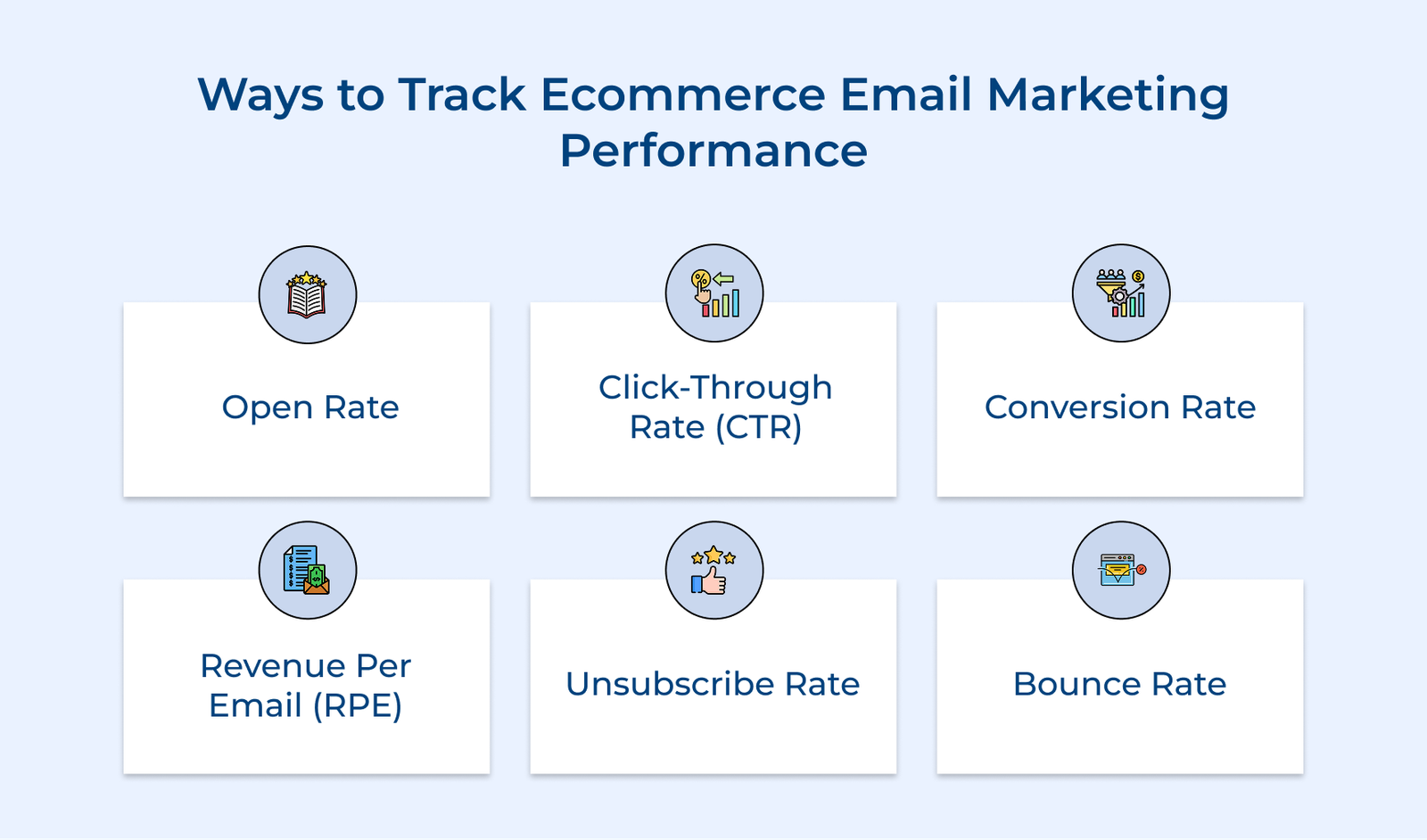
1. Open Rate
The open rate measures the percentage of recipients who open your email, reflecting the effectiveness of your subject lines and sender name. A low open rate may indicate your emails aren’t grabbing attention or are being marked as spam. An open rate of 15-25% is generally considered solid for ecommerce.
2. Click-Through Rate (CTR)
CTR shows the percentage of recipients who clicked on links in your email, measuring how engaging and relevant your content is. A high CTR means your content and CTAs are resonating well. A CTR of 2-5% is typically considered strong for ecommerce.
3. Conversion Rate
Conversion rate measures the percentage of recipients who took a desired action, like making a purchase or signing up for an offer. It’s a key indicator of your email’s ability to drive business results. A conversion rate of 1-5% is typically seen as successful for ecommerce.
4. Revenue Per Email (RPE)
RPE measures the average revenue generated per email sent. It’s calculated by dividing total campaign revenue by the number of emails sent, giving you insight into the direct financial impact of your email marketing efforts.
5. Unsubscribe Rate
The unsubscribe rate tracks the percentage of recipients who opt out after receiving an email. A high rate may suggest your content isn’t resonating or you’re emailing too often. An unsubscribe rate under 0.5% is typically considered solid.
6. Bounce Rate
The bounce rate measures the percentage of emails that couldn’t be delivered. It includes soft bounces (temporary issues) and hard bounces (permanent failures, like invalid addresses). A high bounce rate can hurt your sender reputation, so aim to keep it below 2%.
Examples of Ecommerce Email Marketing
Following are some inspiring examples of successful e-commerce email marketing strategies that can elevate your business and turn click-throughs into loyal customers.
1. Amazon
Campaign Type: Personalized Product Recommendations
Amazon leverages extensive customer data to deliver tailored product recommendations via email, analyzing past purchases, browsing behavior and abandoned carts.
The approach has been a major driver of Amazon’s success, with reports showing that product recommendations account for 35% of its revenue. Their email campaigns boast impressive open rates of 35% and click-through rates of 15%, far exceeding industry averages.
2. Sephora
Campaign Type: VIP Program & Birthday Rewards
Sephora’s Beauty Insider program uses email to engage customers with exclusive offers, early access and personalized beauty tips, along with birthday emails featuring special gifts or discounts.
The strategy has built strong customer loyalty, with Beauty Insider members driving up to 80% of Sephora’s annual sales. Birthday emails, in particular, see open rates of 34%, far surpassing regular campaign performance.
3. Warby Parker
Campaign Type: Abandoned Cart Emails
Warby Parker uses a series of timely, engaging emails to re-capture customers who leave items in their cart. The emails feature product reminders, customer reviews and occasional incentives to encourage completion.
Their abandoned cart strategy has successfully recovered a significant portion of lost sales. While exact figures are not disclosed, industry data shows that effective abandoned cart emails can recover 10-15% of sales, with Warby Parker likely reaching the higher end of that range.
4. Dollar Shave Club
Campaign Type: Welcome Series & Humor-Infused Newsletters
Dollar Shave Club is famous for its witty, engaging emails. They kick off with a welcome series that introduces their brand voice and products, followed by humorous newsletters that mix product updates with grooming tips.
The strategy has helped Dollar Shave Club establish a strong brand identity and loyal customer base. Their email open rates, around 50%, far exceed industry norms. The high engagement fueled their rapid growth, leading to a $1 billion acquisition by Unilever in 2016.
5. Adidas
Campaign Type: Re-engagement & Personalized Fitness Content
Adidas leverages data from its Runtastic app to send personalized emails featuring fitness achievements, challenges and tailored product recommendations. They also run re-engagement campaigns for inactive subscribers with exclusive offers and new product launches.
The approach has driven high engagement, with re-engagement emails boasting open rates up to 40%. The personalized fitness content not only boosts sales but also increases app usage, fueling a cycle of engagement and data collection. The strategy has played a key role in Adidas’s digital transformation, contributing to a 50% year-over-year growth in e-commerce sales.
Unlock Sales Potential with Ecommerce Email Marketing!
Email marketing is a powerful tool for e-commerce businesses to maximize sales. It creates a direct connection with customers, enabling personalized messaging and targeted promotions.
Email marketing drives revenue by nurturing relationships, encouraging repeat purchases, and recovering abandoned carts. It’s a cost-effective way to reach a wide audience, showcase products and create urgency with limited-time offers.