A. Emails
Email for Delayed Shipping Complaint
The response acknowledges the delay, offers a sincere apology, explains the cause if possible and provides a solution or compensation. It reassures the customer of the company’s commitment to timely delivery and includes updated tracking details. Addressing delays quickly helps prevent cancellations, builds trust and shows reliability, even in challenging situations.
Complaint: “My order is several days late and I haven’t received any updates.”
Example:
Subject: Update on Your Delayed Order #12345 – Our Sincere Apologies
Dear [Customer Name],
We sincerely apologize for the delay in shipping your order #12345 and understand your frustration.
The delay was caused by [brief explanation], but we’ve expedited your shipment and it will now arrive by [date]. As a gesture of goodwill, we’re offering [e.g., 20% off your next order].
Your updated tracking number is [number]. We value your business and are working hard to prevent future delays.
If you have any questions, feel free to reach out to us.
Best regards,
[Your Name]
Customer Service Representative
Email for Wrong Product Shipped Complaint
The response expresses regret for the error, provides clear instructions for returning the incorrect item and explains the process for receiving the correct product. It might provide reimbursement for the inconvenience. Resolving shipping problems effectively keeps customers happy, avoids bad reviews and shows the company’s dedication to precision.
Complaint: “I received the wrong item in my order.”
Example:
Subject: Resolution for Incorrect Item Shipped – Order #67890
Dear [Customer Name],
We’re sorry for the mix-up with your order #67890 and understand your frustration. We’re addressing the issue right away.
Please follow the following steps to return the incorrect item:
1. [Return instructions]
Once we receive your return, we’ll ship the correct [product name] immediately. As a token of appreciation for your patience, we’re including [e.g., a $20 gift card] with your replacement order.
Thank you for your understanding and we’ll resolve this as quickly as possible.
Sincerely,
[Your Name]
Customer Service Representative
Poor Customer Service Experience
The response details the precise actions being taken to resolve the matter. It might provide pay and a direct route to management for more conversation. Quickly resolving negative client experiences can increase customer retention, enhance the company’s brand and yield insightful input for employee development.
Complaint: “I had a terrible experience with your customer service representative yesterday.”
Example:
Subject: Our Apologies for Your Recent Customer Service Experience
Dear [Customer Name],
We’re truly sorry to hear about your negative experience with our customer service on [date]. It is not the level of service we strive for and we’re taking immediate action to make things right.
Here’s what we’re doing:
1. Investigating the incident thoroughly
2. Providing additional team training
3. Strengthening our quality assurance processes
We’d like to offer [compensation, e.g., a full refund] to make it right. Our Customer Experience Manager, [Name], would also like to speak with you personally. You can reach them at [phone/email].
We value your feedback and are committed to regaining your trust.
Sincerely,
[Your Name]
Customer Service Manager
B. Phone Scripts
Billing Complaint
The representative is guided by the script as they acknowledge the billing issue, look into the disparity, clearly explain the results and provide a remedy. Efficiently addressing billing complaints preserves client confidence, averts possible legal problems and guarantees correct financial records for the client.
Complaint: “There’s an unexpected charge on my bill.”
Example:
Agent: “Thank you for calling [Company Name]. This is [Your Name]. How may I assist you today?”
Customer: “I’m calling about an unexpected charge on my bill. I don’t understand where it came from.”
Agent: “I apologize for the confusion with your bill. I’d be happy to look into this for you. May I have your account number, please?”
Customer: [Provides account number]
Agent: “Thank you. I see the charge you’re referring to. Let me investigate it for a moment… [After investigation] I understand your concern. The charge is for [explanation]. I see that [reason for adjustment if applicable]. I’ll be happy to remove this charge from your bill immediately. Is there anything else I can help you with regarding your bill?”
Customer: “No, that’s all. Thank you for your help.”
Agent: “You’re welcome. I’m glad I could assist you. Is there anything else I can help you with today?”
Defective Products
The script walks the agent through understanding the customer’s annoyance, obtaining the information required to identify the flaw and providing a straightforward resolution (repair, replacement or refund). Managing complaints about defective products effectively can stop bad press from spreading, preserve brand reputation and offer insightful input for future product development.
Complaint: “The product I bought is not working properly.”
Example:
Agent: “Thank you for calling [Company Name]. This is [Your Name]. How can I assist you today?”
Customer: “I bought a [product] last week, and it’s not working right. I’m really frustrated.”
Agent: “I’m so sorry to hear that your [product] isn’t working properly. I understand how frustrating that can be. Can you please provide me with your order number and describe the issue you’re experiencing?”
Customer: [Provides order number and describes the problem]
Agent: “Thank you for that information. Based on what you’ve described, I’d like to offer you a replacement [product] at no cost. We’ll also cover the shipping for returning the defective item. Does the solution work for you?”
Customer: “Yes, that would be fine.”
Agent: “Excellent. I’ll process that replacement right away. You’ll receive an email with return instructions and tracking information for your new [product]. Is there anything else I can help you with today?”
Customer Wait Time Complaint
The main points of the script are to acknowledge the customer’s time, offer an instant solution to their first question and provide payment for the delay. Resolving concerns about wait times can increase customer satisfaction, offer suggestions for streamlining customer support procedures and show that the business values its customers’ time.
Complaint: “I’ve been on hold for over an hour trying to get help!”
Example::
Agent: “Thank you for your patience. This is [Your Name] with [Company Name]. How may I assist you today?”
Customer: “Finally! I’ve been on hold for over an hour. This is ridiculous!”
Agent: “I sincerely apologize for the long wait time you’ve experienced. That’s completely unacceptable and I understand your frustration. I’m here now and ready to give you my full attention. How can I help you today?”
Customer: [Explains their original reason for calling]
Agent: “I understand. Let me take care of that for you right away… [Resolves the original issue] I’d like to offer you [compensation, e.g., a $20 credit on your account] to apologize for your wait. Can I do anything else for you today?”
Customer: “No, that’s all. Thank you.”
Agent: “You’re welcome. Again, I apologize for the wait. We value your time and I’ll be sure to report it to our management team to improve our service. Thank you for your patience and for being a valued customer.”
C. Live Chat
Website technical glitch
The response promptly identifies the problem, offers fast troubleshooting instructions and, if the malfunction continues, suggests alternate methods for the customer to finish their assignment. Resolving website issues quickly preserves user experience, avoids missed sales and shows the company’s technological proficiency.
Complaint: “I can’t complete my purchase because the checkout page keeps freezing.”
Example:
Customer: Hi, I’m trying to make a purchase but the checkout page keeps freezing. Can you help?
Agent: Hello! I’m sorry you’re experiencing difficulties with our checkout page. Let’s try to resolve it quickly for you.
Agent: Could you please try clearing your browser cache and cookies, then attempt the purchase again? If the issue persists, please let me know and I’ll provide alternative options to complete your order.
Customer: Okay, I’ll try that and let you know.
[A few minutes later]
Customer: I’ve cleared my cache, but it’s still not working.
Agent: I apologize for the continued inconvenience. I’d be happy to process your order manually over chat. Could you please provide me with the items you wish to purchase and your shipping information?
Product Quality Complaint
The reaction shows empathy for the customer’s displeasure. Restoring client relationships, offering insightful product feedback and maintaining the company’s dedication to quality are all possible with an efficient response to quality concerns.
Complaint: “The product I received is of much lower quality than advertised.”
Example:
Customer: The [product] I received is nothing like what was advertised. The quality is really poor.
Agent: I’m truly sorry to hear that the [product] didn’t meet your expectations. Quality is very important to us and we want to make this right. Could you please provide more details about the quality issues you’ve noticed?
Customer: [Describes quality issues]
Agent: Thank you for those details. I completely understand your disappointment. I’d like to offer you a full refund or a replacement with our premium version of the product at no extra cost. Which would you prefer?
Customer: I’d like to try the premium version, please.
Agent: Excellent choice. I’ll arrange for the premium [product] to be shipped to you right away. You’ll receive a prepaid return label for the original item by email. Is there anything else I can assist you with today?
Complaints About Product Availability
The response acknowledges the customer’s dissatisfaction, provides an explanation of the circumstances, suggests potential substitutes and offers ways to be notified when the goods are ready. Resolving availability issues effectively helps keep customers interested, save missed purchases and yield insightful information for inventory management.
Complaint: “The item I want is always out of stock. When will it be available?”
Example:
Customer: I’ve been trying to buy [product] for weeks, but it’s always out of stock. When will you have it?
Agent: I apologize for the inconvenience this has caused. I understand how frustrating it can be when a desired item is unavailable. Let me check our inventory system for the most up-to-date information on [product].
Agent: I see that we’re expecting a new shipment of [product] on [date]. Would you like me to set up an email notification for you when it’s back in stock?
Customer: Yes, please. But why is it always unavailable?
Agent: The [product] has been more popular than anticipated, which has led to stock shortages. We’re working on increasing our inventory to meet demand. We have a similar product, [alternative], which is currently in stock. Would you like more information about the alternative?
Customer: No thanks, I’ll wait for the email notification.
Agent: Understood. I’ve set up the notification for you. You’ll receive an email as soon as [product] is back in stock. Is there anything else I can help you with today?
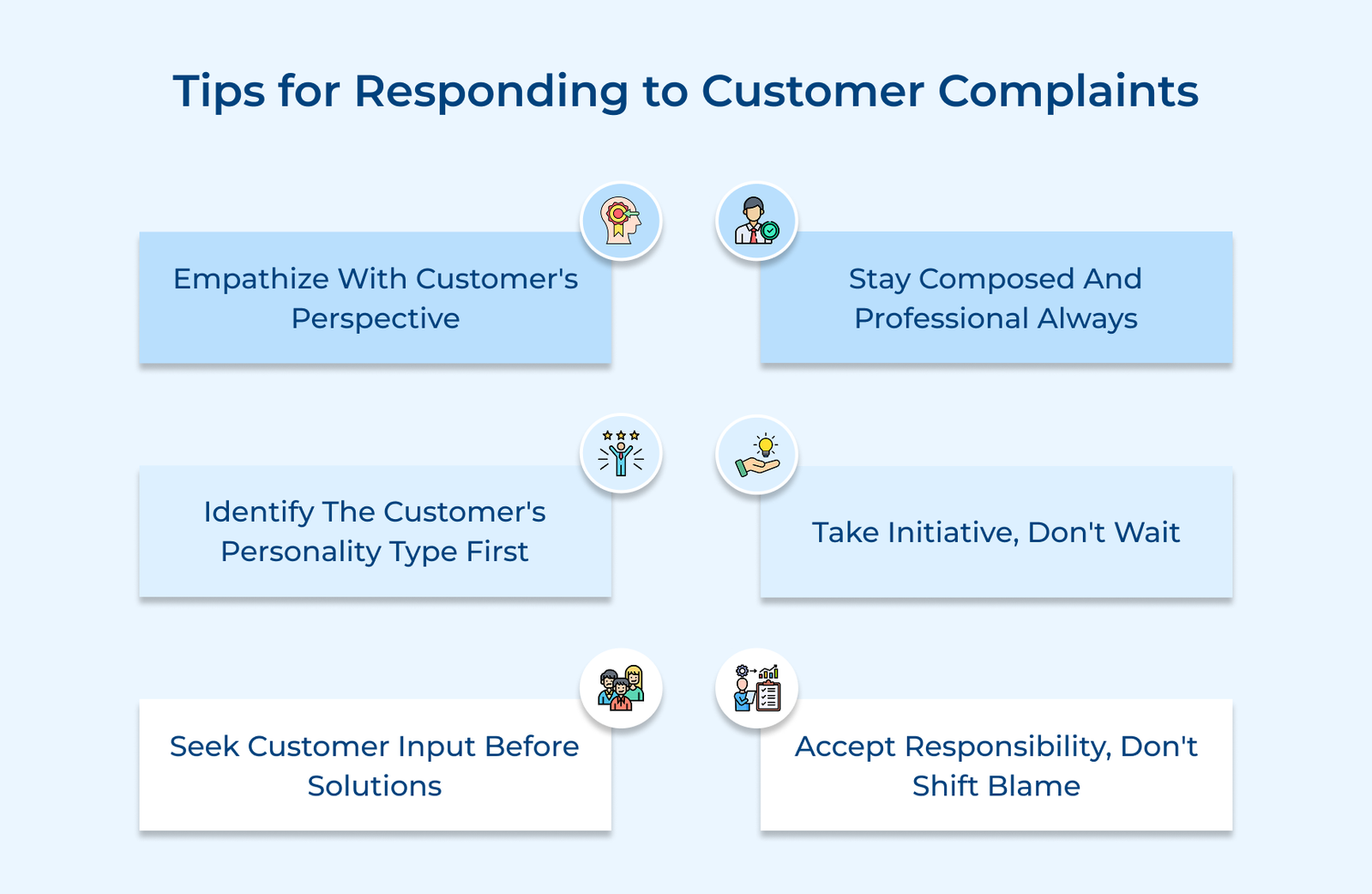
6 Tips for Responding to Customer Complaints
Check out the essential tips to help you respond to customer complaints in a way that enhances goodwill and strengthens your brand.