Top 18 Call Center KPIs and Metrics to Monitor in 2026
Explore essential call center KPIs and metrics to measure performance, enhance customer satisfaction, optimize operations and drive continuous improvement in your contact center's efficiency.

Explore essential call center KPIs and metrics to measure performance, enhance customer satisfaction, optimize operations and drive continuous improvement in your contact center's efficiency.
Call centers often face the dual challenge of meeting rising customer expectations while maintaining efficiency. Despite heavy investments in technology and training, many struggle to optimize performance, leading to customer dissatisfaction. Organizations can turn these challenges into opportunities for growth by embracing a data-driven approach to performance measurement. The key lies in tracking the right metrics and KPIs, which offer valuable insights into both customer experience and operational efficiency.
We will be going through the most essential call center KPIs and metrics used by top industry players to drive success. The metrics help businesses measure, analyze and improve call center performance. Mastering them will lay the groundwork for long-term growth, exceptional customer service and a competitive edge.
Call center metrics refer to indicators that measure the efficiency, quality and overall performance of customer service operations. The metrics offer valuable insights into agent productivity, customer satisfaction and service quality. Businesses can pinpoint areas for improvement, optimize resources and elevate the customer experience by analyzing them.
KPIs are gathered from various channels, including phone systems, CRM) software and quality monitoring tools. Advanced analytics platforms consolidate the data into real-time dashboards, enabling managers to make data-driven decisions and track performance at a glance. The systems automatically capture key aspects of interactions, from call duration to resolution rates, offering a comprehensive view of operational effectiveness.
Key principles:
The following are the reasons why measuring call center metrics and KPIs is essential for success in any organization.
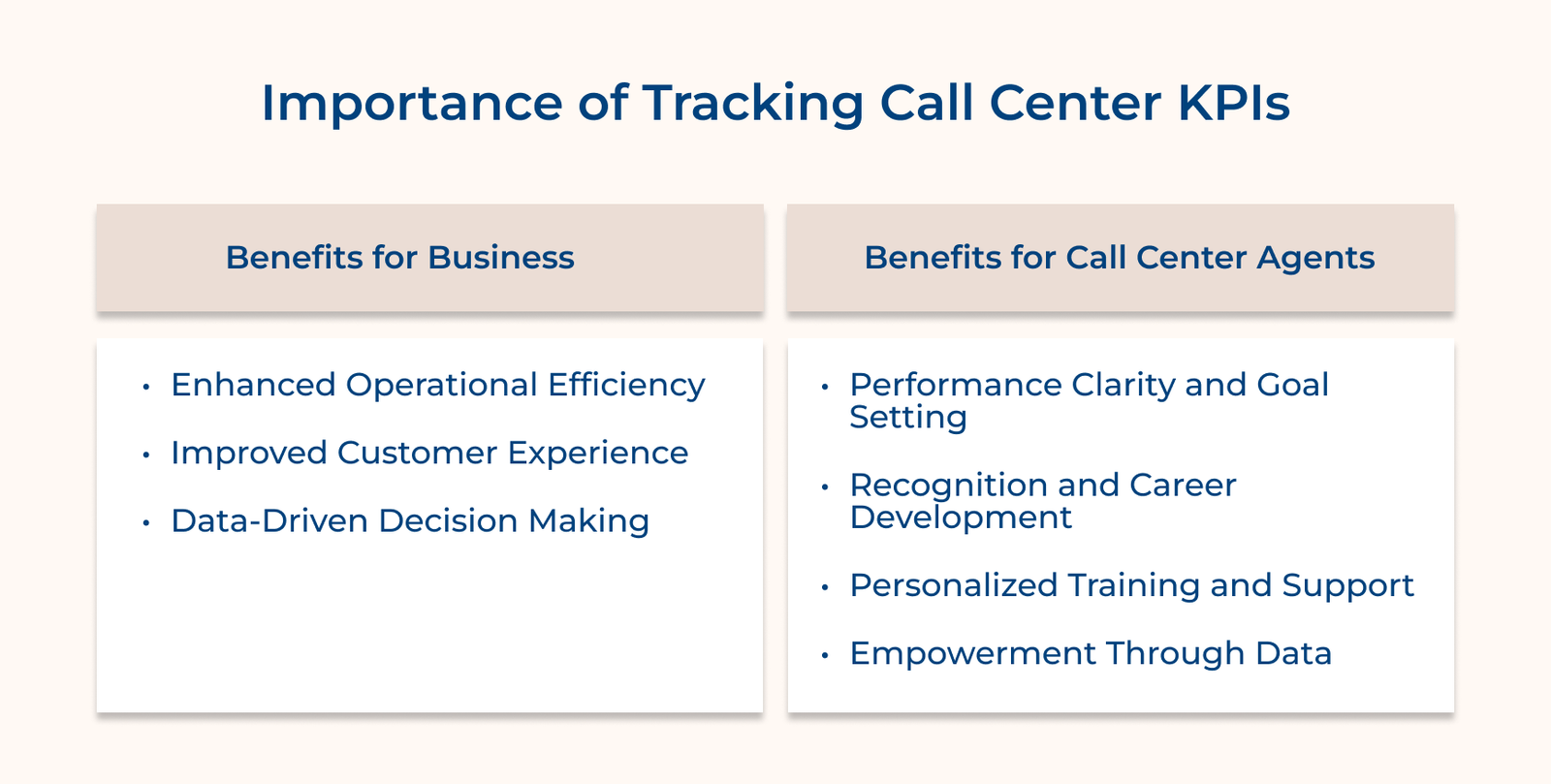
Enhanced operational efficiency: Tracking metrics like First Contact Resolution helps organizations pinpoint bottlenecks, streamline workflows and optimize resource use. It not only reduces operational costs but also maintains or enhances service quality, driving stronger financial performance.
Improved customer experience: Metrics offer a clear view of customer satisfaction, highlighting pain points and areas for improvement. The data empowers companies to craft targeted strategies that enhance service, reduce customer effort and strengthen relationships.
Data-driven decision-making: A thorough analysis of metrics empowers organizations to make data-driven decisions on staffing, training and technology investments. The strategic approach aligns call center operations with business goals and ensures optimal resource allocation.
Performance clarity and goal setting: Metrics give agents clear performance benchmarks, helping them understand expectations and track progress. Transparency enhances self-awareness, guiding agents to identify improvement areas and set meaningful development goals.
Recognition and career development: Objective performance metrics ensure fair evaluations and recognition of top performers. The data-driven approach highlights agents’ achievements, supporting career growth and showcasing their value to the organization.
Personalized training and support: Analyzing individual agent metrics allows supervisors to pinpoint areas for support or training. The targeted approach accelerates skill development and drives continuous performance improvement.
Empowerment through data: Access to performance metrics empowers agents to take charge of their growth and adjust their service in real-time. The autonomy boosts job satisfaction and enhances customer interactions.
Let’s go through the key call center KPIs and metrics you should be monitoring to ensure not only operational excellence but also an enhanced customer experience.
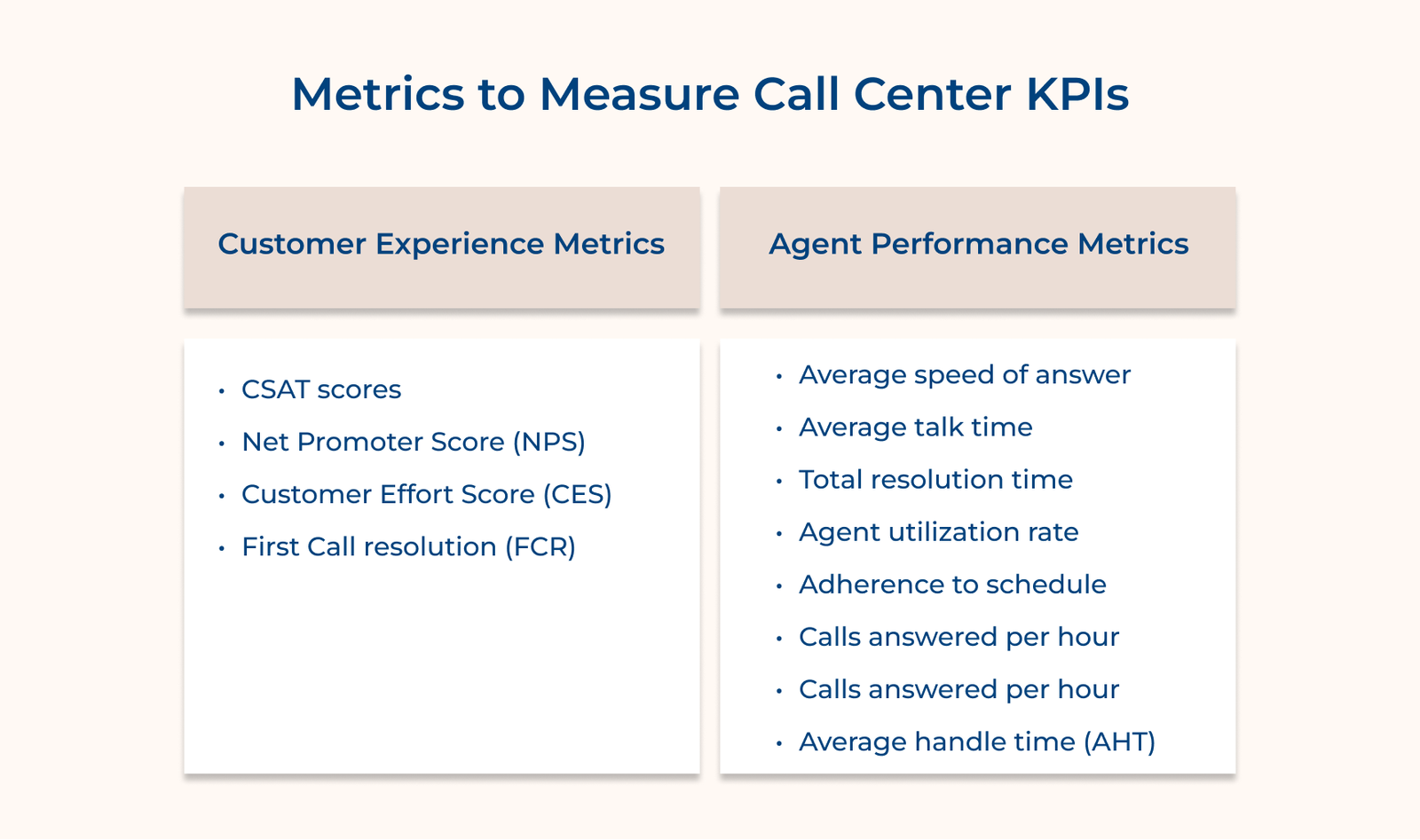
CSAT measures customer satisfaction with specific interactions or overall service through post-interaction surveys. It directly reflects service quality and customer perceptions of a brand’s support capabilities.
Tracking CSAT helps businesses spot service gaps, boost agent performance and strengthen customer loyalty. High CSAT scores lead to better retention, making it a key metric for business success and customer experience.
Formula:
CSAT = (Number of satisfied customers / Total number of survey responses) x 100
Industry-standard CSAT scores range from 75-85%, calculated from a 1-5 scale, where 4 or 5 is “satisfied.” Tracking monthly with at least a 30% survey response rate ensures accuracy.
Improvement tips:
NPS gauges customer loyalty and their likelihood to recommend a company’s services. It offers valuable insights into long-term customer relationships and brand advocacy.
NPS helps predict growth by identifying promoters who generate positive word-of-mouth and detractors who could damage the brand’s reputation. Understanding the segments enables businesses to refine service and enhance customer relationships.
Formula:
NPS = % Promoters (9-10 scores) – % Detractors (0-6 scores)
Good NPS scores vary by industry but generally: Above 30 is considered good, above 50 excellent, and 70 world-class. Calculate quarterly through surveys, ensuring a minimum sample size of 100 responses per segment.
Actionable tips:
CES measures how easy it is for customers to interact with your service team and resolve their issues. The metric reflects the effort customers need to expend during service interactions, highlighting the efficiency of the problem-resolution process.
Tracking CES is crucial because it directly impacts customer loyalty and repeat business. A smoother experience leads to higher retention rates and lower operational costs, making it an essential metric for optimizing service.
Formula:
CES = Sum of all customer effort scores / Total number of survey responses
A CES score below 3 on a 7-point scale is excellent, while scores between 5-7 indicate high effort. Calculate through post-interaction surveys, ensuring a 25% response rate for accuracy. Track monthly to spot trends.
Improvement tips:
FCR measures the percentage of customer inquiries resolved during the first interaction, without the need for follow-ups. It’s a critical indicator of service efficiency and effectiveness.
High FCR rates boost customer satisfaction and reduce operational costs. Organizations with strong FCRs see fewer repeat calls, increased customer loyalty and lower service delivery expenses.
Formula:
FCR = (Total number of resolved cases on first contact / Total number of cases) x 100
Benchmark Standards:
Industry FCR benchmarks range from 70-75%, with top performers achieving 80% or higher. Calculate daily via call tracking systems and verify through customer feedback. Use a rolling 30-day average to track trends.
Pro tips:
The average speed of answer measures how long customers wait in the queue before speaking with an agent. It reflects the call center’s responsiveness and efficiency, directly influencing customer satisfaction from the start.
Monitoring ASA is crucial for managing customer expectations and minimizing abandonment rates. Short wait times show respect for customer’s time and create positive first impressions, while long waits can lead to higher abandonment.
Formula:
ASA = Total wait time for answered calls / Total number of answered calls
Benchmark Standards:
Industry standards recommend an ASA of 20-30 seconds, though it varies by sector. Track hourly during peak times and daily for overall performance. Segment by call type and time of day to identify improvement areas.
Improvement tips:
Average Talk Time measures the duration of actual conversations between agents and customers, excluding hold time and after-call work. It reveals insights into interaction efficiency and the complexity of customer inquiries.
Tracking ATT helps optimize resource allocation, identify training gaps and improve workforce planning. Analyzing talk time patterns also uncovers opportunities for process improvements and knowledge base enhancements.
Formula:
ATT = Total talk time / Total number of calls handled
Benchmark Standards:
Optimal ATT varies by industry and call type, typically ranging from 3-6 minutes for standard service calls. Track daily and analyze weekly, segmenting by call types and customer groups for more accurate benchmarks.
Improvement tips:
Total Resolution Time measures the entire duration from a customer’s initial contact to the complete resolution of their issue, including any follow-up interactions. The metric offers a holistic view of the problem-resolution process and service efficiency.
Monitoring Total Resolution Time is vital for understanding the full customer journey and identifying bottlenecks. It helps organizations optimize service delivery, reduce customer effort and allocate resources effectively across different stages of issue resolution.
Formula:
Total Resolution Time = Initial Handle Time + Follow-up Time + Time Between Interactions
Benchmark Standards:
Industry standards vary but typically aim for same-day resolution (under 8 hours) for standard inquiries and 24-48 hours for complex issues. Track time from initial contact to final resolution, maintaining separate benchmarks for different issue categories.
Improvement tips:
Schedule adherence measures how closely agents stick to their assigned schedules, including start times, breaks and end times. It reflects workforce management effectiveness and individual agent reliability, impacting operational efficiency.
Tracking schedule adherence is crucial for maintaining consistent service levels and controlling operational costs. High adherence rates ensure optimal staffing during peak times, improving service availability and customer satisfaction.
Formula:
Schedule Adherence = (Time in Adherence / Total Scheduled Time) x 100
Benchmark Standards:
Industry standards for schedule adherence typically range from 90-95%. Track daily by comparing actual agent activity to scheduled times and consider real-time monitoring for immediate adjustments.
Actionable tips:
Calls Answered Per Hour measures how many incoming calls an agent handles in one hour, providing key insights into agent productivity and workload management.
Tracking the metrics helps optimize staffing, identify high performers and set realistic performance goals. It also supports data-driven decisions for workforce planning and training, ensuring a balanced workload across teams.
Formula:
Calls Answered Per Hour = Total Number of Calls Handled / Total Number of Working Hours
Benchmark Standards:
Industry standards typically range from 8-12 calls per hour for complex support and 15-20 for basic inquiries. Track hourly during peak periods and calculate daily averages, adjusting for call complexity.
Improvement tips:
Average Handle Time measures the total time spent on customer interactions, including talk time, hold time and after-call work. The comprehensive metric reflects service efficiency and resource utilization.
Tracking AHT is key for effective capacity planning, cost management and optimizing service quality. It helps identify inefficiencies, training needs and automation opportunities while maintaining a balance between speed and service quality.
Formula:
AHT = (Total Talk Time + Total Hold Time + Total After-Call Work Time) / Total Number of Calls Handled
Benchmark Standards:
Industry benchmarks typically range from 4-8 minutes, depending on call complexity. Calculate daily averages and analyze trends weekly, while ensuring quality scores of at least 85%.
Improvement tips:
Average First Response Time measures the time between when a customer reaches out and receives their first meaningful reply. The key metric influences customer satisfaction and shapes service experience.
Tracking the metric is essential for keeping customers engaged and reducing abandonment. Quick responses demonstrate a commitment to service build trust early, leading to better customer experiences.
Formula:
Average First Response Time = Sum of all first response times / Total number of customer contacts
Benchmark Standards:
Industry standards suggest response times under 30 seconds for phone calls and within 4 hours for email/digital channels. Track separately by channel, monitor hourly during peak periods and calculate daily averages. Aim for 90% of responses within target times.
Improvement tips:
The call Abandonment Rate tracks the percentage of inbound calls where customers hang up before speaking with an agent. The metric reveals customer patience and the effectiveness of queue management strategies.
Monitoring abandonment rates is crucial for optimizing staffing and identifying high-demand periods when service capacity falls short. High abandonment rates signal customer frustration and lost opportunities, making the metric essential for operational planning.
Formula:
Call Abandonment Rate = (Total Abandoned Calls / Total Incoming Calls) x 100
Benchmark Standards:
The industry standard is under 5%, with top-performing centers maintaining rates below 3%. Track hourly during peak periods and daily for overall performance. Exclude wrong numbers and accidental calls by calculating after 5 seconds of wait time.
Pro tips:
Service Level Rate measures the percentage of calls answered within a set time threshold, often expressed as “X% of calls answered in Y seconds.” The key metric shows how well a call center meets its target response times and service commitments.
Tracking service levels is essential for ensuring a consistent customer experience and meeting contractual obligations. It directly impacts customer satisfaction and operational efficiency while balancing staffing costs with service expectations.
Formula:
Service Level Rate = (Calls Answered Within Threshold Time / Total Calls Received) x 100
Benchmark Standards:
Industry standards often aim for 80/20 (80% of calls within 20 seconds) or 90/15 (90% within 15 seconds). Monitor in real-time for immediate adjustments and analyze daily trends, segmenting peak periods for more accurate insights.
Improvement tips:
Types of Calls Handled categorizes incoming calls by nature, complexity and resolution needs, offering valuable insights into customer demands.
Understanding call types helps optimize agent training, knowledge base development and staffing. It enables more efficient workforce planning, improves first-call resolution and uncovers opportunities for self-service options.
Formula:
Call Type Distribution = (Number of Calls per Category / Total Calls) x 100
Benchmark Standards:
Set benchmarks based on your business type and customer needs. Track weekly distributions and monitor monthly trends. Aim for 80% of calls handled by appropriately skilled agents on first contact.
Improvement tips:
Calls Handled tracks the total number of customer interactions successfully completed by the call center within a given period. The metric provides a clear view of operational throughput and agent productivity.
Monitoring the total calls handled is crucial for capacity planning, resource allocation and performance evaluation. It helps identify peak periods, optimize staffing levels and guide decisions on technology investments to meet customer demand.
Formula:
Calls Handled = Total Inbound Calls Completed + Total Outbound Calls Completed
Benchmark Standards:
Industry standards typically target handling 90-95% of incoming calls. Track hourly for real-time adjustments and compile daily, weekly or monthly reports for trend analysis. Segment by call type and time for deeper insights.
Improvement Tips:
Cost Per Call (CPC) calculates the average cost of handling each customer interaction, factoring in labor, technology, telecommunications and overhead expenses.
Monitoring CPC is crucial for managing budgets and optimizing operations. It helps assess financial efficiency, guide resource allocation and uncover opportunities for cost reduction without sacrificing service quality.
Formula:
Cost Per Call = Total Operating Costs / Total Number of Calls Handled
Benchmark Standards:
Industry averages range from $2-$6 for basic calls and $8-$15 for complex support. Calculate monthly using full cost data, including both fixed and variable expenses. Review quarterly trends to identify cost-saving opportunities.
Improvement tips:
Call Arrival Rate tracks the volume of incoming calls over specific time intervals, offering valuable insights into customer contact patterns and peak periods. The metric helps optimize resource planning and workforce management.
Understanding call arrival patterns is essential for efficient staffing and capacity planning. It enables organizations to adjust schedules to prevent understaffing during busy periods and minimize idle time during slower times, enhancing operational efficiency.
Formula:
Call Arrival Rate = Number of Calls Received / Time Interval (typically per hour or half-hour)
Benchmark standards:
Benchmarks vary by industry, but tracking call arrivals in 15-minute intervals provides the most accurate planning. Use Erlang forecasts for staffing needs, ensuring no more than a 10% deviation from predicted volumes. Review weekly and monthly for seasonal trends.
Actionable tips:
Peak-hour traffic measures call volumes during the busiest operational hours, helping organizations understand demand patterns and plan resource needs for optimal service during high-volume periods.
Monitoring peak-hour traffic is vital for ensuring service quality during times of maximum demand. The metric guides staffing decisions, technology planning, and resource allocation, helping maintain consistent service levels even under peak stress.
Formula:
Peak-Hour Traffic = Total Calls During Highest Volume Hour / Total Daily Calls × 100
Benchmark standards:
Industry standards suggest peak hours account for 12-15% of daily call volume. Track daily peak-hour traffic and review weekly trends. Ensure service levels stay within 5% of target during busy periods with strategic resource planning.
Improvement tips:
Check out the best practices that will transform your call center metrics from mere numbers into actionable insights that propel your success.
Key questions:
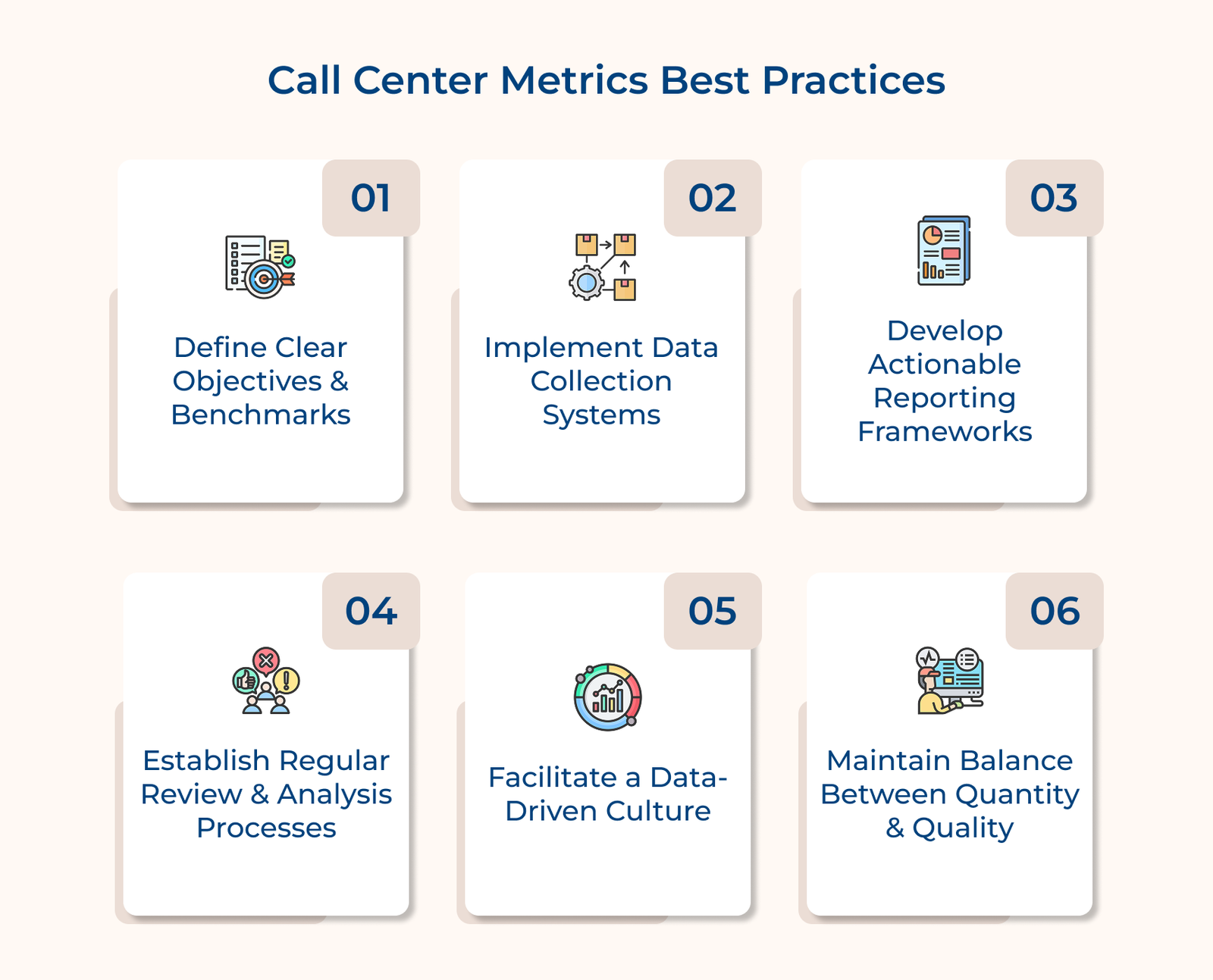
Define Clear Objectives and Benchmarks
Set clear, measurable goals for each metric, tailored to industry standards and your organization’s capacity. Develop realistic benchmarks that reflect your business context, customer expectations and operational limitations. Regularly review and adjust the goals to keep them relevant.
Implement Comprehensive Data Collection Systems
Implement integrated systems to capture data seamlessly across all customer touchpoints. Automate data collection to reduce manual errors and ensure real-time tracking. Regularly validate data to maintain accuracy and reliability.
Develop Actionable Reporting Frameworks
Develop standardized reporting templates that present metrics clearly and actionably. Include trend analysis, comparisons and context to aid decision-making. Set regular reporting schedules to ensure timely delivery to key stakeholders.
Establish Regular Review and Analysis Processes
Regularly review metric performance against targets. Hold monthly analysis sessions to uncover trends, patterns and improvement opportunities. Leverage data insights to proactively adjust strategies and optimize resource allocation.
Enhance a Data-Driven Culture
Enhance organizational awareness of metrics through ongoing training and communication. Empower agents and managers to use data for daily decisions. Create feedback loops showing how metric improvements drive customer satisfaction and business success.
Maintain a Balance Between Quantity and Quality
Maintain a balance between efficiency and service quality by tracking both types of metrics. Regular calibration sessions ensure that performance targets align with high service standards without compromising customer experience.
Call center metrics are essential tools for driving operational excellence and superior customer experience. Businesses can make informed decisions that optimize resources, improve service delivery and fuel continuous growth by consistently tracking key performance indicators. Monitoring customer experience, agent performance and operational metrics empowers companies to design targeted strategies that align with both customer expectations as well as business goals.
Thriving in call center operations requires transforming metrics into actionable insights. Companies that excel in the area deliver reliable, high-quality service while maintaining efficiency and cost-effectiveness, leading to higher customer satisfaction.

Effective call center metrics collection relies on integrated technologies like Automatic Call Distributors (ACD), CRM systems and Quality Management platforms. Organizations can streamline the process and consolidate data from multiple channels by automating data capture. Regular validation ensures the accuracy and reliability of the metrics, enabling actionable insights.
The ideal solution varies based on your organization’s size, complexity and needs. Enterprise platforms like Genesys, NICE inContact and Five9 provide robust metrics tracking. When selecting a platform, focus on scalability, integration options, real-time reporting and analytics features to ensure it meets both operational demands as well as budget constraints.
Call center efficiency is measured through key metrics like Average Handle Time (AHT), First Call Resolution (FCR), Agent Utilization Rate and Cost per Call. Analyzing the metrics together offers a holistic view of performance. Regular benchmarking against industry standards and internal targets highlights areas for improvement.
Industry benchmarks typically include Customer Satisfaction (CSAT) above 85%, First Call Resolution (FCR) over 75%, Average Speed of Answer (ASA) under 30 seconds and Abandonment Rate below 5%. The metrics should be tailored to your business context and customer expectations for optimal relevance.
Review frequency should align with metric type and organizational needs. Real-time metrics need constant monitoring, operational metrics should be checked daily and strategic KPIs are best analyzed weekly or monthly. Establish a clear review schedule that includes daily operational reviews, weekly performance analyses and monthly strategic assessments.

Grow Customer Relationships and stronger team collaboration with our range of products across the Conversational Engagement Suite.
Omnichannel Customer Support & Help Desk Software
AI Enabled Business Messaging and Chatbot Software
Sales Engagement & CRM Software
Call Center Software & Virtual Phone System
Product Marketing & Experience Platform
Customer Experience & Feedback Management Software

 12 Effective Ways to Overcome Ecommerce Challenges
Scroll to top
12 Effective Ways to Overcome Ecommerce Challenges
Scroll to top