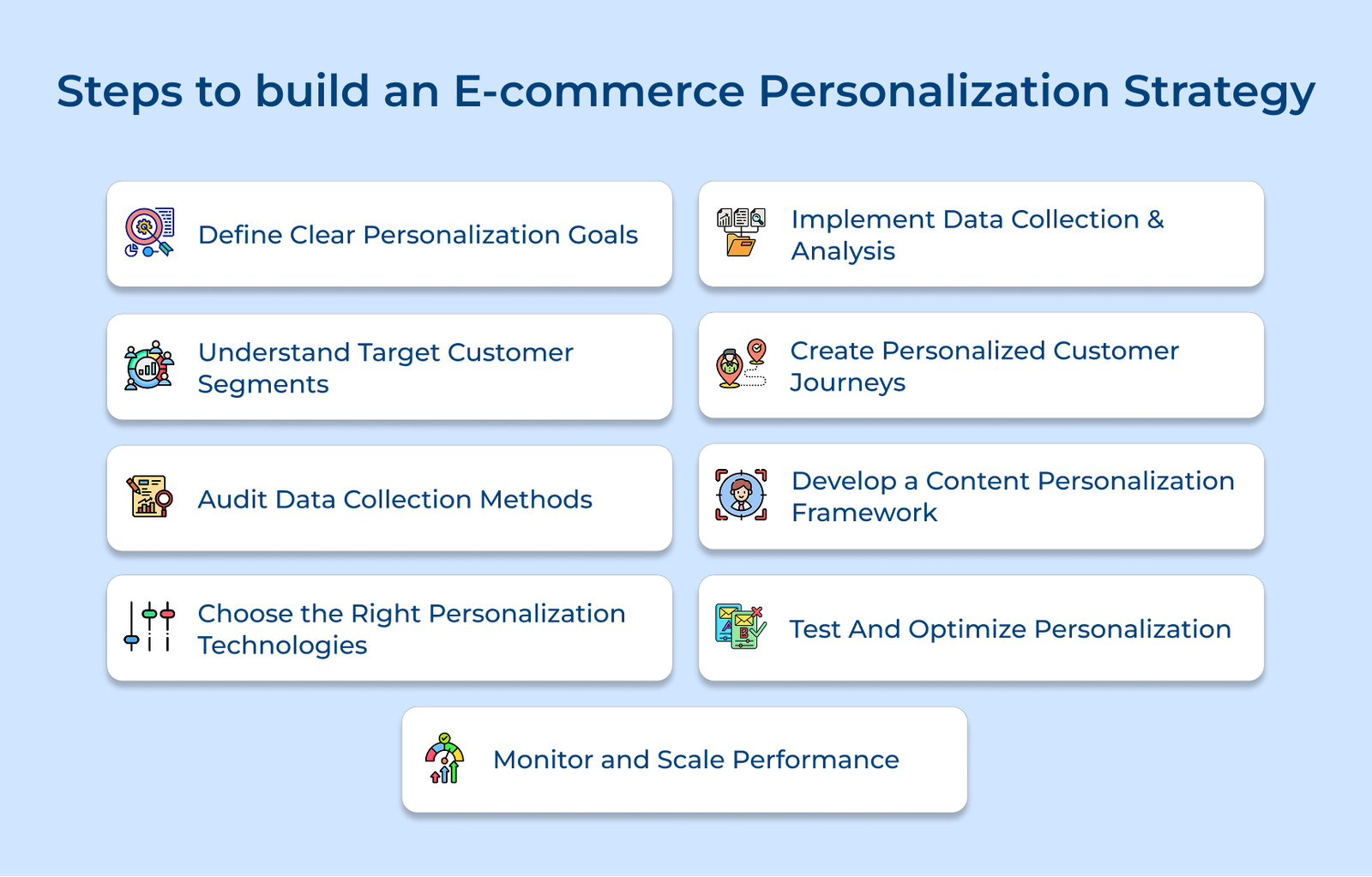
1. Define Clear Personalization Goals and Objectives
Establishing clear personalization goals is crucial for a successful strategy. Without defined objectives, efforts can become unfocused and ineffective. Align your goals with business priorities, targeting areas where personalization drives the most impact.
Start by identifying key metrics like conversion rates or average order value, then set specific goals to support them. Let’s assume that to boost customer lifetime value, focus on strategies that encourage repeat purchases through tailored recommendations.
Pro tips:
- Use the SMART framework (Specific Measurable Achievable Relevant Time-bound) for clear, actionable goals.
- Prioritize initiatives based on potential impact and implementation effort.
2. Understand Your Target Customer Segments
Effective personalization goes beyond basic demographics by focusing on customer segments, enabling more relevant and engaging experiences. Understanding the segments is key to tailoring your strategy.
Start by analyzing customer data to uncover patterns in behavior, purchasing and engagement. Create detailed personas that capture motivations, pain points and preferred communication channels, then use the insight to craft personalized strategies.
Actionable tips:
- Conduct regular customer interviews or surveys to validate assumptions and gain qualitative insights.
- Prioritize behavioral segments over demographic for more actionable personalization opportunities.
3. Audit Current Data Collection Methods
A data audit uncovers gaps and opportunities in your data collection practices, ensuring you gather the right insights for personalization while adhering to privacy standards.
Begin by mapping your data touchpoints, such as website analytics, customer feedback and transaction records. Evaluate the quality, completeness and accessibility of your data. Create a data inventory that categorizes different types of customer information and assess how each data point contributes to your personalization goals.
Best practices:
- Use a data quality scorecard to assess accuracy, timeliness and relevance regularly..
- Document all data processes to ensure compliance with privacy laws like GDPR and CCPA.
4. Select Appropriate Personalization Technologies
Selecting the right technology stack is crucial for successful personalization, enabling effective data collection, analysis and execution. Without the proper tools, scaling personalization can become inefficient and costly.
Start by assessing your business needs, technical capacity and budget. Compare personalization platforms based on AI features, integration options and scalability. Consider ease of implementation, vendor support and total cost of ownership.
Pro tips:
- Draft a requirements document that outlines both current and future needs before evaluating solutions.
- Begin with a pilot program to test one technology before full-scale implementation.
5. Implement Data Collection and Analysis
Effective data collection and analysis are key to successful personalization. Without strong data systems, you’ll miss crucial valuable insights and behavior patterns needed to create tailored experiences.
Start by tracking interactions across all touchpoints, including website visits, emails and purchases. Use analytics tools that can handle both structured and unstructured data. Create a centralized database that consolidates the information into a centralized database for easy access.
Pro tips:
- Implement data validation processes to ensure the accuracy and reliability of your insights.
- Automate data collection workflows to reduce manual errors and improve efficiency.
6. Create Personalized Customer Journey Maps
Customer journey mapping helps visualize how various customer segments interact with your brand, highlighting key moments for impactful personalization. The approach uncovers opportunities to enhance the customer experience with targeted actions.
Start by documenting all touchpoints, from initial awareness to post-purchase. Create separate journey maps for each segment, focusing on their unique preferences and pain points. Use the insights to personalize interventions at critical moments.
Actionable tips:
- Include emotional factors to understand customer sentiments at each touchpoint.
- Regularly update maps with fresh data to reflect evolving customer behaviors.
7. Develop Content Personalization Framework
A content personalization framework ensures consistency and alignment across all channels, tailoring your strategy to customer preferences. Without it, personalization can become ineffective, leading to inconsistent experiences.
Start by developing content templates and rules for different segments. Create a content matrix that links content types to customer needs and build automated workflows to deliver timely, relevant content.
Pro tips:
- Implement a content scoring system to assess effectiveness for each segment.
- Use version control to track and maintain consistency across personalized content.
8. Test and Optimize Personalization Efforts
Testing and optimization ensure your personalization strategies achieve the desired outcomes. The iterative process helps fine-tune tactics for different segments, avoiding ineffective approaches that could harm the customer experience.
Implement a structured testing program with A/B testing, multivariate testing and user feedback. Start with small-scale tests on targeted segments, using insights to refine your strategies and boost engagement.
Pro tips:
- Prioritizes high-impact elements in your testing calendar for regular optimization.
- Document all test results, including failures to inform future improvements.
9. Monitor and Scale Success Metrics
Continuous monitoring of personalization metrics helps measure the impact on business goals, ensuring strategies are effective and scalable. Regular assessment identifies growth opportunities and highlights underperforming tactics.
Set up a comprehensive dashboard to track key performance indicators, from micro-metrics like click-through rates to macro-metrics like customer lifetime value. Regularly review them with stakeholders to make informed decisions on scaling successful strategies and optimizing weaker ones.
Actionable tips:
- Use a tiered metrics system to differentiate between leading and lagging indicators.
- Benchmark performance across segments, channels and periods for actionable insights.
5 Real-Life Ecommerce Personalization Examples
Below are five inspiring examples of companies that have revolutionized their ecommerce presence through effective personalization strategies.
1. Nike: Crafting Personal Athletic Journeys
Nike’s digital strategy focuses on delivering personalized experiences via the Nike App and website. Nike tailors gear recommendations by analyzing workout data, purchase history and browsing patterns.
2. Sephora: Beauty Matched to Individual Preferences
Sephora’s Beauty Insider program collects customer data to deliver personalized recommendations. Sephora customizes the shopping experience based on skin types with features like Virtual Artist for virtual product trials and in-app messaging offering tailored beauty tips.
3. Amazon: Pioneering Predictive Personalization
Amazon’s personalization engine uses browsing patterns, purchase history and real-time behavior to offer dynamic product recommendations. Features like “Frequently Bought Together” and “Customers Who Bought This Also Bought” enhance the product discovery experience for each shopper.
4. Spotify: Harmonizing Music with Personal Taste
Spotify’s merchandise store uses listening data to offer personalized product recommendations, based on user playlists, favorite artists and listening habits. The data-driven approach has boosted merchandise sales and deepened artist-fan connections, expanding revenue beyond streaming.
5. Stitch Fix: Tailoring Fashion to Individual Style
Stitch Fix blends AI-driven recommendations with human stylists to offer personalized clothing selections. Their approach creates a unique shopping experience by analyzing style quizzes, feedback and purchase history. It resulted in high customer satisfaction and repeat purchases.
What Are The Challenges Of Implementing Ecommerce Personalization?
Let’s go through the key challenges organizations face in ecommerce personalization and uncover potential solutions to overcome them.