Customer Emotion: Types, Best Practices & Examples
Learn about the impact of customer emotions on buying decisions. It highlights key emotional triggers, best customer engagement practices and examples to strengthen relationships.

Learn about the impact of customer emotions on buying decisions. It highlights key emotional triggers, best customer engagement practices and examples to strengthen relationships.
Understanding how customers feel isn’t easy and most businesses get it wrong. Customer emotions often go unspoken, yet they shape how people perceive your product, respond to your service and decide whether to return. When companies overlook this, they miss chances to improve, connect and build lasting trust.
A more structured approach – one that tracks emotional responses, analyzes feedback and acts on what matters can change that. Businesses can only build stronger, more honest relationships when they are paying attention to how customers feel at key touchpoints. More than 50% of consumers are willing to pay more for brands that create positive emotional experiences.
Let us break down how leading brands use emotional intelligence, learn how to measure emotional cues and pick up strategies you can use to create experiences that keep customers coming back.
Customer emotion refers to the psychological responses customers have during their interactions with a brand, product or service. It includes both conscious and subconscious feelings that influence behavior, decision-making or satisfaction throughout their journey with a company.
Customer feelings work through interconnected processes. When customers engage with a brand, their experiences trigger emotional reactions based on factors like product quality, service and messaging. The emotions form lasting memories that influence future decisions. Companies can analyze emotions through tools like sentiment analysis, feedback surveys and even facial recognition, allowing them to improve the customer experience.
Key use case:
Check out the importance of understanding customer emotion to understand how it helps businesses connect more deeply with their audience.
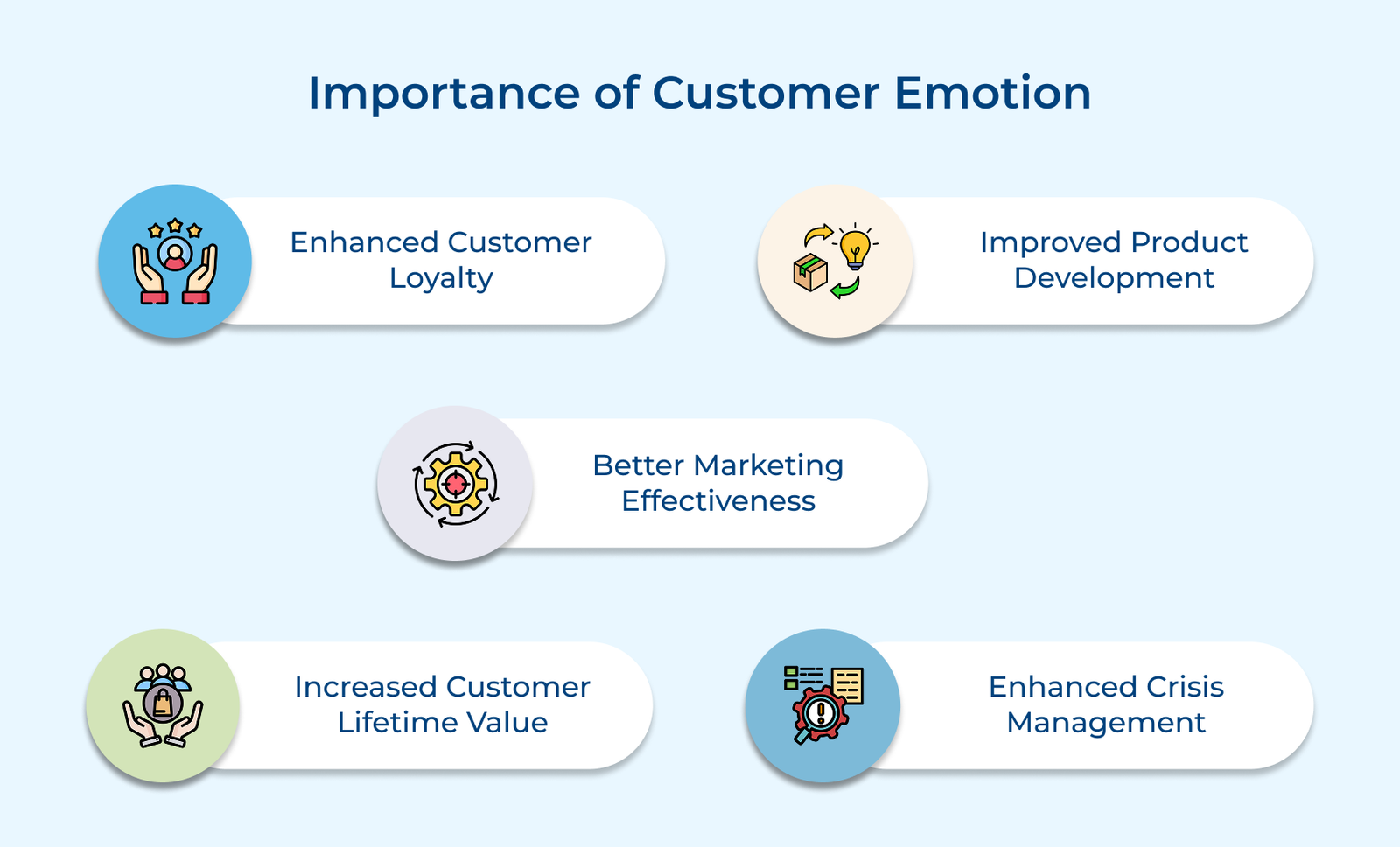
Enhanced Customer Loyalty
When businesses understand and respond to customer emotions, they build stronger, more lasting relationships. The emotional connection encourages customers to stay loyal to the brand, leading to higher retention and more repeat purchases.
Improved Product Development
Understanding customer feelings helps businesses design products that truly connect with users. Companies can create solutions that meet both practical needs and emotional desires by identifying pain points.
Better Marketing Effectiveness
Marketing campaigns that connect with customer emotions drive stronger responses. Businesses can craft messages that resonate deeply by understanding what motivates customers emotionally, leading to higher engagement and better use of marketing resources.
Increased Customer Lifetime Value
When customers feel a strong emotional connection to a brand, they’re more likely to spend more over time. They become less focused on price and more willing to try new products, resulting in higher average purchase values.
Enhanced Crisis Management
Understanding customer feelings helps companies handle difficult situations more effectively. Businesses can address concerns before they escalate by anticipating emotional reactions, maintaining trust and recovering quickly from setbacks.
Let’s go through the fundamental types of emotions that customers commonly experience during their interactions with products and services.
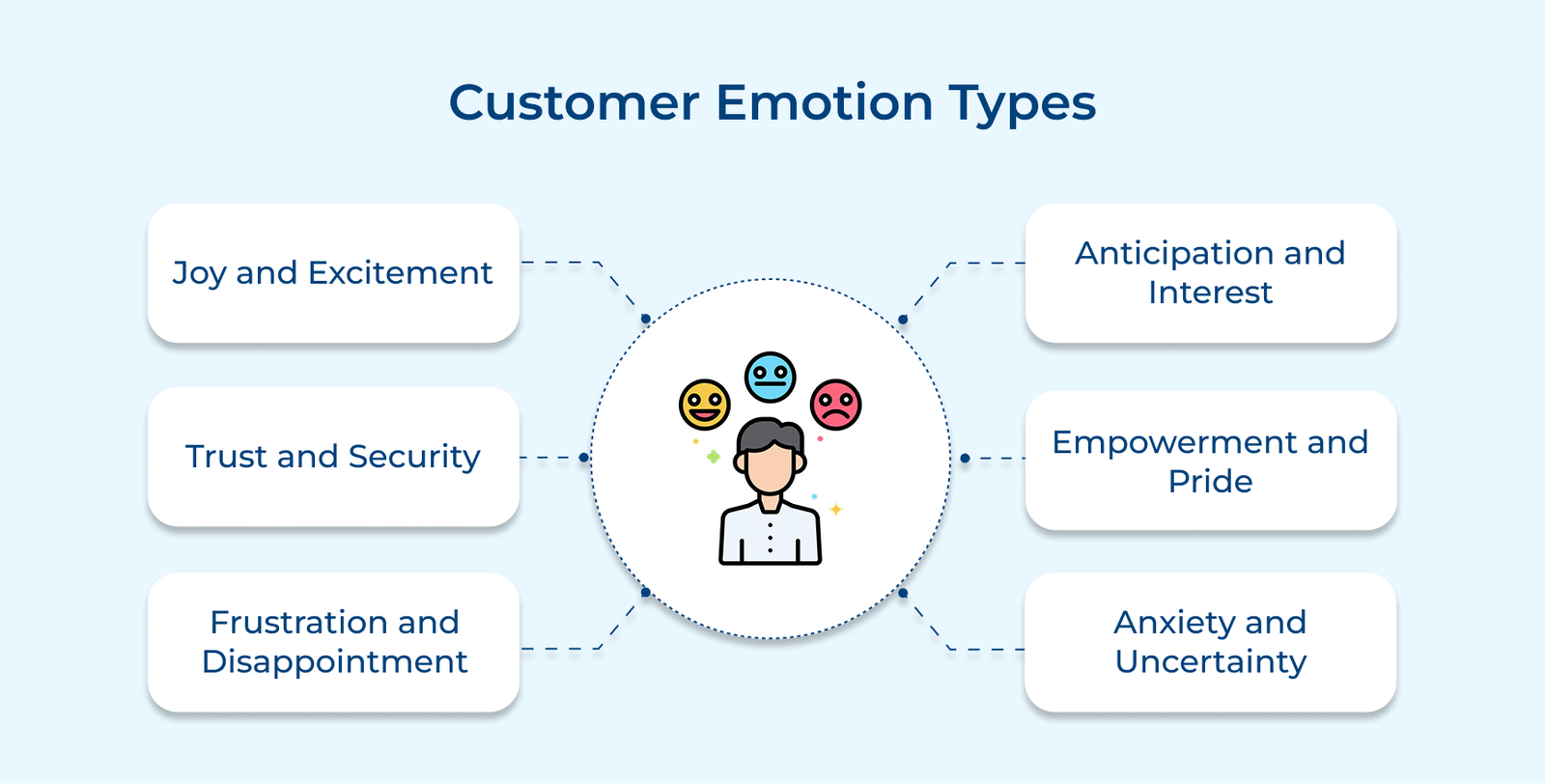
Joy and Excitement
Customers feel joy when a product or service goes beyond their expectations and creates moments of surprise. The positive emotion often arises when a product solves problems effortlessly. It builds a foundation for loyalty and positive word-of-mouth.
Assume there’s a customer who experiences joy when they unbox their new smartphone and easily transfer all their data from the old device. The smooth process sparks excitement to explore the other features of their new purchase.
Trust and Security
Trust is built when customers consistently receive reliable service and feel their needs are genuinely cared for. It grows through positive interactions and honest communication, becoming the foundation of lasting relationships.
Let’s consider that a customer feels secure when their bank promptly notifies them of suspicious activity on their credit card and swiftly resolves the issue. The reassurance enhances trust in the bank’s dedication to safeguarding their financial security.
Frustration and Disappointment
Negative emotions surface when products or services fall short of expectations or when customers encounter obstacles during their journey. Recognizing the pain points allows businesses to pinpoint areas for improvement and create better solutions.
Take the scenario where a customer feels frustrated when they can’t easily find the customer service number on a website. As a result, they have to navigate through multiple pages just to handle a simple return.
Anticipation and Interest
Emotions arise when customers eagerly await new products or interactions with a brand. They fuel engagement and give businesses a chance to build excitement around their offerings. It often leads to greater satisfaction when the product is finally delivered.
Take the example of a customer following updates from their favorite tech company about an upcoming product launch. They track the development, join early discussions and look forward to trying it out – all driven by genuine interest.
Empowerment and Pride
Customers feel empowered when products or services help them reach their goals or enhance their lives. The emotion strengthens their connection with the brand and often turns them into advocates who share their positive experiences.
Let’s assume that a customer feels proud after mastering a new skill on an online learning platform. They proudly share their achievement on social media and recommend the platform to others.
Anxiety and Uncertainty
The emotions arise when customers encounter confusion or uncertainty during their purchase journey. Recognizing the concerns allows businesses to improve support systems and provide clearer communication to guide customers confidently.
Imagine there’s a customer who feels anxious while deciding between various insurance plans. Clear explanations and supportive guidance from the provider here can ease their worries and help them make a confident, informed choice.
Check out the various techniques to measure customer emotion and identify the KPIs that matter.
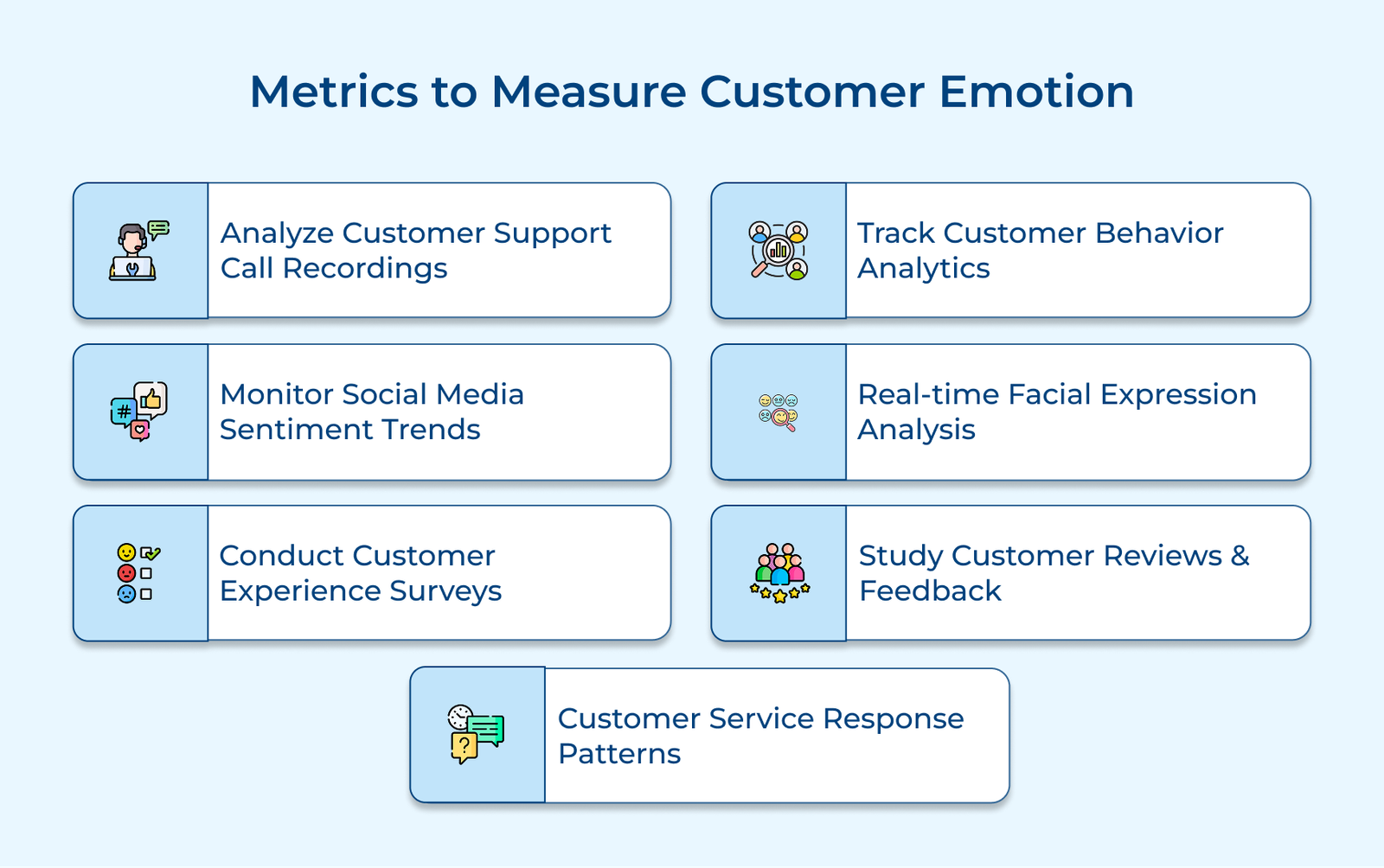
Analyzing call recordings helps businesses uncover the emotions behind customer interactions, offering deeper insights into satisfaction levels and service quality. Teams can refine their response strategies and improve customer experiences in real time by evaluating tone, pitch along with the language.
Voice pattern detection uses AI to analyze subtle shifts in pitch or tone, identifying stress and frustration even when customers don’t say it outright. Emotional keyword tracking highlights phrases that signal dissatisfaction or delight, helping support teams respond appropriately. Conversation flow assessment maps how emotions shift throughout a call, revealing patterns that can guide more effective interactions.
Pro tips:
Social media monitoring provides a window into real-time customer emotions, offering businesses a chance to engage, resolve issues and amplify positive experiences instantly. Companies can react swiftly to emerging concerns and capitalize on moments of praise by tracking brand mentions across platforms.
Real-time brand mentions tracking highlights immediate reactions to product updates, service experiences or marketing campaigns, allowing teams to address issues before they escalate. Trending topic analysis uncovers broader industry conversations, helping businesses understand emotional patterns and refine their messaging accordingly.
Actionable tips:
Customer experience surveys offer a clear window into how people feel at different touchpoints, helping businesses track emotional trends over time. Companies can spot patterns in sentiment shifts and refine their approach to customer engagement by consistently gathering structured feedback.
Instant feedback collection captures emotions in the moment, giving teams immediate insights into how specific interactions impact customers. Long-term satisfaction tracking reveals how emotional connections influence loyalty and advocacy, helping businesses strengthen relationships over time.
Key takeaways:
Behavior analytics uncovers how emotions shape customer actions across digital platforms, linking feelings to real-world decisions. Businesses gain insight into how emotional responses drive engagement, conversions and drop-offs by analyzing browsing patterns.
Website engagement metrics highlight which elements spark positive emotional connections, guiding teams to refine content and design a more resonant user experience. Purchase pattern analysis pinpoints emotional roadblocks, like cart abandonment rates, helping businesses smooth out the buying journey to align with both logic and emotion.
Pro tips:
Facial expression analysis helps businesses measure real-time customer emotions, allowing them to adapt their service approach instantly. Companies can identify frustration, confusion or satisfaction by analyzing facial cues, making interactions more responsive and personalized.
Let’s assume that a retail store uses AI-powered cameras to detect when customers appear confused while navigating aisles. The system alerts floor staff who can then approach and offer assistance. Similarly, video call emotion detection helps support teams adjust their tone and approach based on customer reactions, leading to more empathetic interactions.
Best practices:
Review analysis uncovers how customers truly feel about a product and service by examining their own words. The approach helps businesses identify emotional highs as well as lows in customer experiences, offering a clearer picture of what resonates and what needs improvement.
Teams can pinpoint recurring emotional triggers and common themes across different customer groups by tracking sentiment patterns. Monitoring trends over time reveals shifts in sentiment while comparing categories highlights which products or services enhance the strongest emotional connections. The insights help businesses refine their offerings to better meet customer needs.
Key takeaways:
Customer service response patterns reveal how interactions shape customer emotions over time. Businesses can pinpoint what aspects of service delivery create frustration or reassurance by analyzing the patterns. It leads to better training and process improvements.
The approach is not just about how fast you solve a problem but it’s also about how fast it feels to the customer. Tracking both the actual time and the customer’s perception helps you close the gap between service delivery as well as expectation.
Pro tips:
Check out the key differences between customer emotion and customer satisfaction to understand why paying attention to both gives you a more complete view of the customer experience.
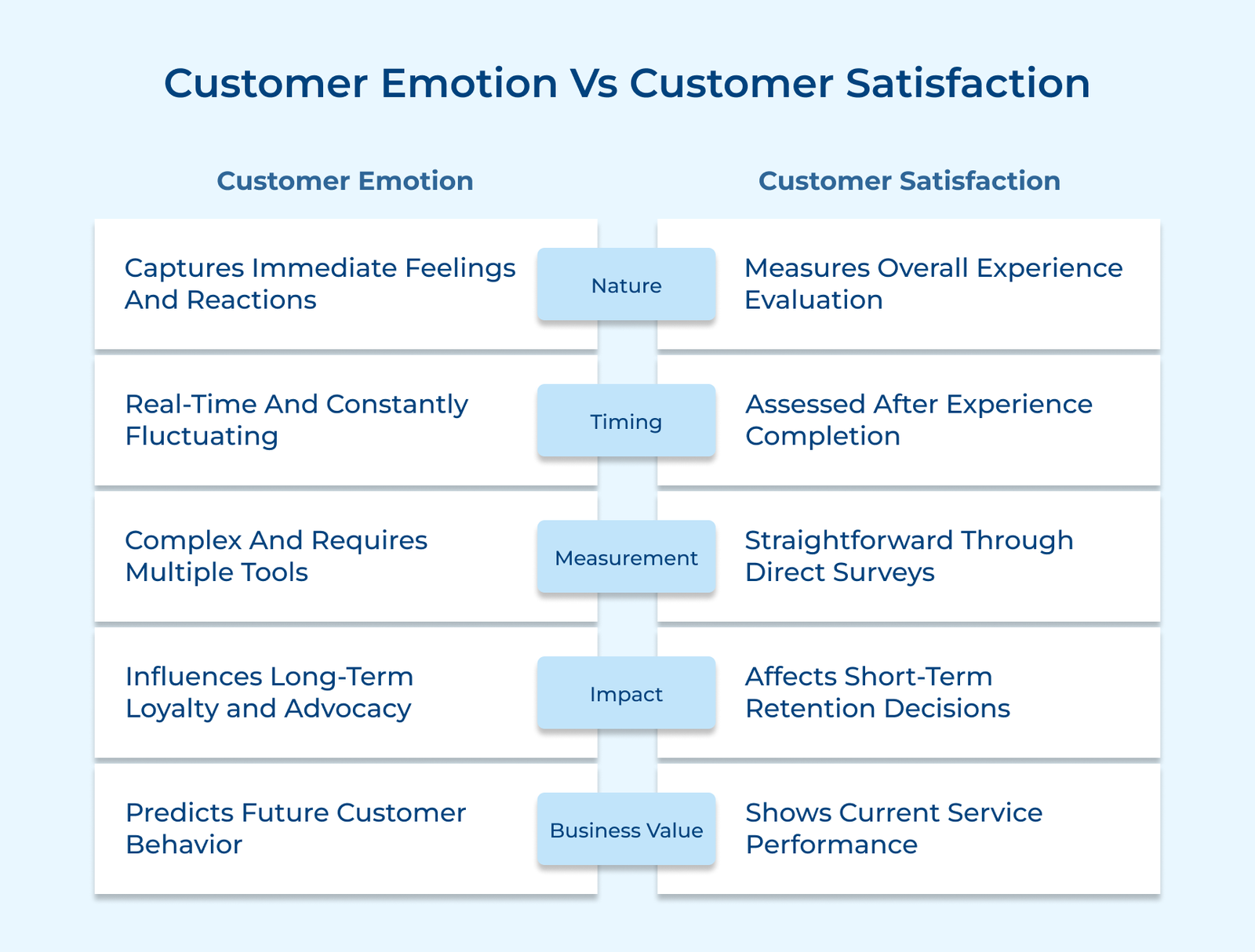
Nature of Assessment
Customer emotion reflects how people often feel instinctively throughout their experience with a brand. The emotional cues, whether it’s trust, irritation or delight reveal the personal side of customer interactions.
Customer satisfaction is more analytical. It answers whether a product or service met expectations, usually based on specific outcomes or promised features.
Timing of Measurement
Emotions shift in real time. One moment of friction, like a long wait or an unhelpful reply, can instantly change how a customer feels, making immediate feedback essential.
Satisfaction is typically assessed after an interaction or at set points in the journey. It offers a snapshot of how things went, but it may miss the feelings that surfaced during the process.
Measurement Methods
Tracking emotions requires more nuanced tools, such as sentiment analysis or tone detection. It uncovers what people might not say outright.
Satisfaction is often measured through standard surveys or ratings. It is easier to administer but may overlook emotional context.
Impact on Business
Emotion drives connection. Customers who feel understood or valued are more likely to stay loyal, even if things don’t always go perfectly.
Satisfaction points to functional success. It tells you what worked or didn’t, but doesn’t always capture whether the customer felt good about the experience.
Business Value
Understanding emotion helps you anticipate future behavior, like churn or advocacy. It builds experiences that connect on a human level.
Satisfaction data gives clear benchmarks for improvement. It helps you optimize processes, but it may not reveal why customers stay or leave.
Below are the key strategies to effectively tap into the emotional landscape of your audience, helping you create meaningful interactions that go beyond mere transactions.
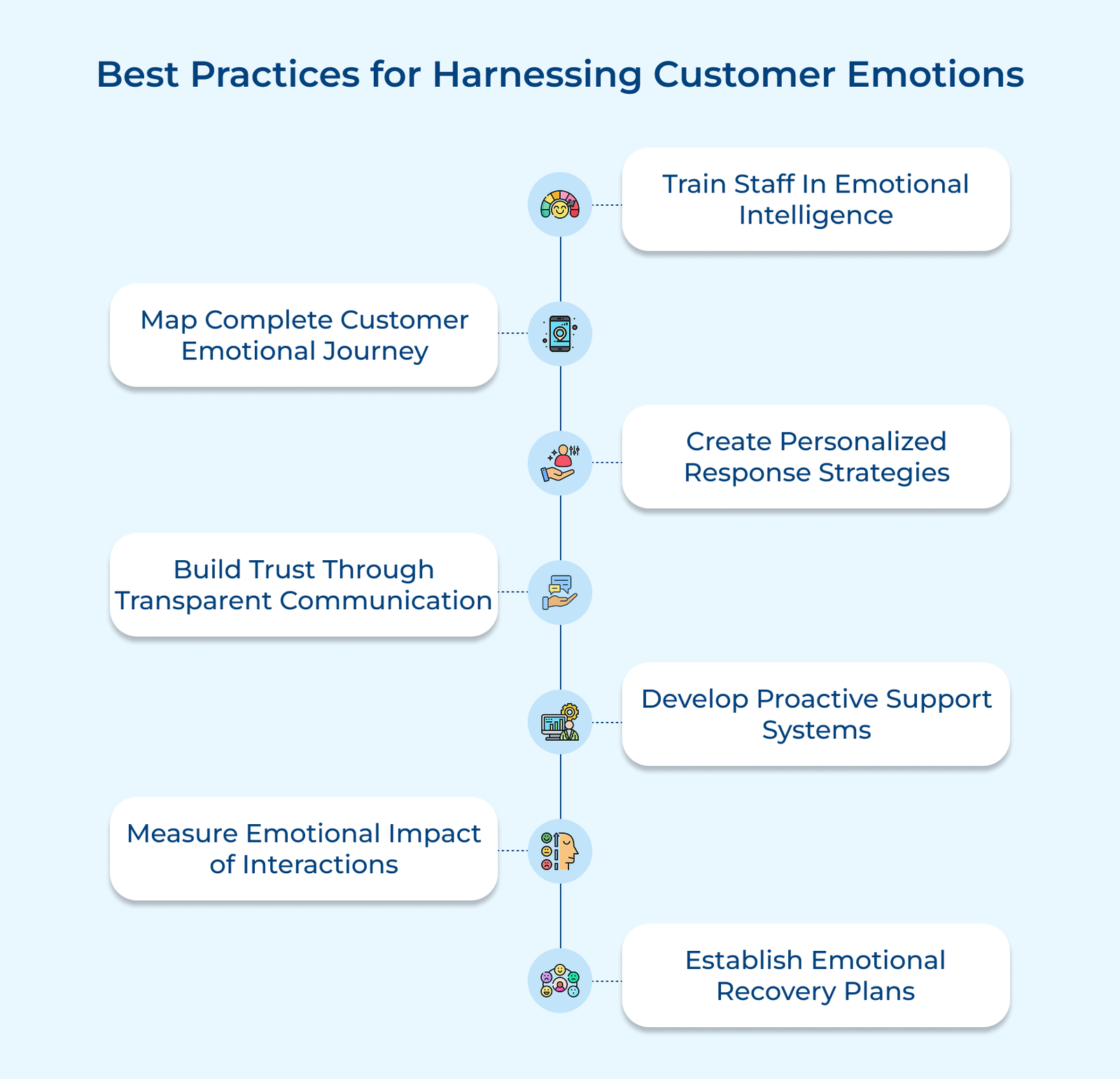
Teaching emotional intelligence helps customer service teams handle tough conversations with more clarity and care. When staff can recognize how a customer is feeling, whether it’s frustration, confusion or relief, they are better prepared to respond in ways that calm tensions.
The awareness makes every interaction smoother and more human, especially when things don’t go as planned. It’s not about scripted empathy, it’s about knowing how to read the moment and react with patience. Emotional intelligence also means knowing how to manage your reactions.
Pro tips:
Journey mapping gives a clear picture of how customers feel at each step of their interaction with your brand. Instead of just focusing on what they do, it explores how they feel from the first impression to long-term engagement. The emotional lens helps teams understand where experiences fall short or where they genuinely connect.
Spotting emotional shifts between touchpoints helps teams address frustrations before they snowball. Whether it’s confusion during sign-up or relief after a support call, recognizing the transitions shows where customers need more clarity or reassurance. Documenting the moments not only highlights problems, it points directly to fixes that improve how customers feel, not just what they do.
Actionable tips:
When responding to customers, a one-size-fits-all approach often misses the mark. People want to feel understood, not handled. That’s why personalized response strategies matter. Businesses can respond in ways that feel more human and less scripted by paying attention to the emotional tone of each interaction.
Adapting how you communicate also plays a big role. Some customers want clear step-by-step instructions, while others prefer quick, to-the-point answers. Being able to shift your tone and level of detail shows that you’re really listening. The more your team understands a customer’s preferences and past experiences, the better they can respond in a way that feels genuinely supportive.
Best practices:
Building trust with customers isn’t about grand gestures—is often the small, clear actions that matter most. When businesses keep communication honest and processes transparent, customers are more likely to feel comfortable expressing their concerns. The openness lays the groundwork for emotional connection.
Consistency also plays a big part in building that trust. Clear updates across every touchpoint help reduce confusion and ease customer anxiety. When your message doesn’t shift from channel to channel, customers feel grounded. Acknowledging emotions, especially when things go wrong, shows you’re not just checking boxes.
Key takeaways:
Proactive support isn’t just about solving problems—it’s about preventing them from happening in the first place. When businesses take the time to understand common emotional triggers in customer interactions, they can build systems that offer help before frustration sets in. The thoughtful support creates smoother experiences and shows customers they’re genuinely cared for, not just managed.
Having emotional safety nets in place means customers never feel stranded when things get tough. Whether it’s a real person checking in or a well-timed message that acknowledges a possible concern, being ready with support builds emotional trust. When people know help is close by, even when they don’t ask, it reassures them that the business is paying attention and ready to act.
Pro tips:
Understanding how your service makes people feel is just as important as resolving their issues. Measuring the emotional impact of each interaction helps you go beyond checking whether a problem was solved. It shows whether your approach actually made the customer feel better. Teams can adjust their tone, timing and tactics to improve how customers experience support at every step by spotting patterns in emotional reactions.
Looking at resolution effectiveness through an emotional lens gives a clearer picture of what’s working and what’s not. Two customers might receive the same technical fix, but one leaves frustrated and the other reassured, because the emotional experience was different. Tracking how solutions influence emotions helps teams refine their process to ensure that resolutions are not just functional, but also emotionally satisfying.
Actionable tips:
Handling emotionally charged situations isn’t just about solving a problem but it’s about rebuilding trust. A thoughtful recovery plan helps teams respond quickly and calmly when emotions run high. Staff know how to recognize distress, de-escalate tension and provide reassurance with clear steps in place.
Recovery frameworks offer a reliable way to guide customers back to a positive experience. Rather than improvising under pressure, teams follow a clear path to resolution that still leaves room for personal touches. The approach shows customers that your business doesn’t just care when things are going well, you care enough to make things right when they go wrong.
Pro tips:
Below are some leading brands that have successfully incorporated customer emotion into their business strategies.
1. Apple
Apple puts a lot of thought into how its products make people feel. Every step is meant to build excitement from its sleek design of the devices to the simple yet elegant unboxing. Customers get one-on-one help and access to workshops in their stores that make the experience feel more personal.
Over time, it has turned Apple into more than a tech brand—it’s something people feel proud to be part of. Many customers see Apple as a reflection of their identity and loyalty runs so deep, they’ll often defend the brand like a friend.
2. Disney
Disney doesn’t just create theme parks—it builds emotional memories. Staff are trained to spot chances to make someone’s day better, whether that’s comforting a crying child or adding a surprise to a routine ride. Every part of the park experience is designed to keep visitors smiling.
Because of the attention to emotional detail, families return generation after generation. People don’t just remember the rides, they remember how they felt and that feeling keeps them coming back.
3. Southwest Airlines
Southwest uses humour and warmth to stand out in an industry not known for either. Flight attendants are encouraged to be themselves and bring some lightness to the flight, turning a routine trip into something more human.
The down-to-earth approach has helped Southwest earn long-term loyalty. Customers appreciate the genuine effort to make flying a little less stressful and often share those positive moments with others.
4. Starbucks
Starbucks aims to be more than just a coffee shop—it wants to be your “third place,” somewhere between home and work where you feel comfortable. Baristas often learn customers’ names and usual orders, making visits feel familiar.
The personal touch keeps people coming back. Many customers don’t just like Starbucks for the drinks—they like the sense of routine and recognition it brings to their day.
5. Nike
Nike connects with people by telling real, motivating stories about athletes, about setbacks, about pushing through. It’s not just about the gear—it’s about what the gear represents.
The focus on personal achievement helps customers see Nike as more than a brand. It feels like a partner for many people in their journey, whether they’re running marathons or just starting out.
Understanding customer emotions gives businesses more than just numbers—it reveals the why behind people’s actions. Teams can move past surface-level responses and start building experiences that feel personal by spotting emotional patterns in feedback, behavior and interactions. Instead of guessing what customers want, businesses can respond with empathy and real insight.
The real value of tapping emotions is that it connects data to real people. When companies read between the lines and recognize how their actions make customers feel, they’re better equipped to prevent problems. It’s about replacing assumptions with understanding and building relationships, not just transactions.
Key takeaways:

Customers go through a range of emotions as they interact with your brand. They might feel curious or excited when exploring something new, anxious before a big purchase, frustrated when something goes wrong and relieved or happy when it gets fixed. Paying attention to the emotional shifts helps you see things from their point of view and design experiences that feel more thoughtful.
Emotions often steer the wheel when it comes to making decisions. If a customer feels calm, confident or excited, they’re more likely to follow through with a purchase. But if they’re unsure or uneasy, they’ll hesitate and might even walk away entirely. It’s not logic that tips the scale, but how something feels in the moment.
Emotional intelligence helps service teams notice how customers are feeling and respond in a way that makes sense. It’s about picking up on tone, body language or word choice, then adjusting how they talk or solve a problem. When teams do it well, customers feel heard, respected and more likely to walk away with a positive experience.
When sales teams understand how customers feel, they can build real connections. They learn what excites or worries someone, which helps them respond in ways that feel thoughtful and personal. The emotional awareness often makes the difference between a one-time conversation and a lasting customer relationship.
Businesses can learn a lot about how customers feel by combining simple tools like surveys with more advanced ones like sentiment analysis, voice tone tracking or even facial expression reading. Used together, these methods give a fuller picture of what customers are really feeling, not just what they say.
Handling negative emotions starts with noticing them early. A sincere response that shows you’re listening, followed by a clear path to fix the issue can go a long way. When teams respond with real empathy and focus on solutions, tough moments become chances to earn trust.
Grow Customer Relationships and stronger team collaboration with our range of products across the Conversational Engagement Suite.
Omnichannel Customer Support & Help Desk Software
AI Enabled Business Messaging and Chatbot Software
Sales Engagement & CRM Software
Call Center Software & Virtual Phone System
Product Marketing & Experience Platform
Customer Experience & Feedback Management Software

 Customer Experience Benchmarking: 9 Effective Steps
Scroll to top
Customer Experience Benchmarking: 9 Effective Steps
Scroll to top