Customer Success vs Customer Experience: The Key Differences
Learn about the key differences between customer success vs customer experience. Understand their distinct roles, strategies and impact on overall business growth.

Learn about the key differences between customer success vs customer experience. Understand their distinct roles, strategies and impact on overall business growth.
Many businesses blur the line between customer success and customer experience, using the terms as if they mean the same thing. The mix-up often leads to confused priorities, wasted effort and uneven service that weakens customer trust. Without clarity, companies risk creating disjointed customer journeys. Teams may overlap or miss key touchpoints, leaving customers frustrated and underserved.
Let’s explore the fundamental differences between customer success vs customer experience. You’ll develop more effective strategies to guide customers toward lasting value and satisfaction by understanding how the complementary approaches work together.
Customer experience refers to the overall impression a customer has when interacting with a brand. It encompasses every touchpoint, from the first interaction to post-purchase support. A good experience builds loyalty, while a bad one drives customers away and harms reputation.
The impact is directly reflected in business performance through measurable outcomes. Companies with great customer experience see higher growth, better retention and easier customer acquisition through word-of-mouth.
Key factors:
Customer success is a term used to describe the process of ensuring customers achieve their desired outcomes by effectively using a product or service. It involves not only ensuring satisfaction but also actively working to help customers get the most value from their purchase. The goal is to promote long-term relationships and maximize customer retention.
Unlike reactive support, customer success proactively anticipates and prevents challenges. The proactive methodology transforms the vendor-client relationship into a true partnership focused on mutual growth and value creation.
Key factors:
Let’s go through the differences between customer experience vs customer success that can help businesses effectively implement both practices to achieve their desired outcomes:
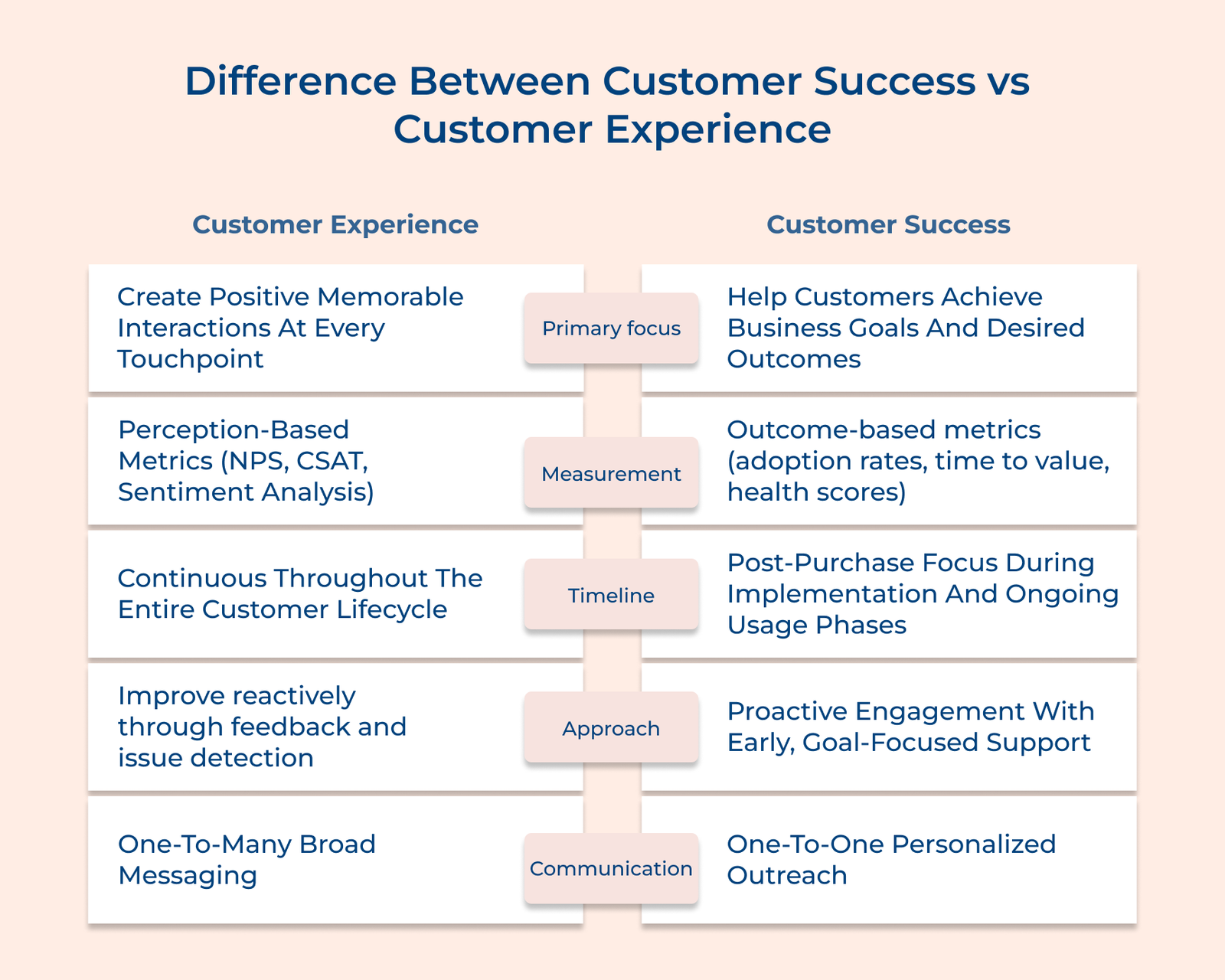
Customer experience focuses on creating positive emotional connections and smooth interactions at every touchpoint. It’s about how customers feel during their interactions with your brand.
Customer success focuses on helping customers achieve their specific goals and desired outcomes using your product or service. It’s about if the customers get the results they expect.
Pro tips:
Customer experience relies on perception-based metrics that capture emotional responses and satisfaction levels throughout the customer journey. The measurements focus on sentiment and feelings rather than concrete business outcomes.
Customer success uses objective business metrics that demonstrate actual value delivery and goal achievement. The measurements focus on tangible outcomes and performance indicators that directly tie to business results.
Key metrics:
Key metrics:
The fundamental difference lies in what the metrics reveal about your customer relationships. Experience metrics show customer feelings; success metrics show goal achievement.
Customer experience operates continuously throughout the entire customer lifecycle from initial awareness through post-purchase interactions. It never truly ends as long as the relationship exists.
Customer success typically begins after the purchase decision and focuses on the implementation and ongoing usage phases. It has defined milestones and success markers along the way.
Actionable tips:
Customer experience teams are typically cross-functional and distributed across multiple departments, including marketing, sales, support or product development. They work collaboratively to ensure consistent brand interactions throughout the customer journey.
Key differences:
Customer success teams operate as dedicated specialists who are assigned to specific customer accounts or segments. They build strong relationships and understand customers’ unique needs and goals.
Customer experience teams focus on optimizing touchpoints and removing friction points before customers encounter problems. They use predictive analytics and customer feedback to identify potential pain points across the entire customer journey.
Key questions:
Customer success teams intervene when they detect early warning signs that customers might not achieve their desired outcomes. They monitor usage patterns, engagement levels and progress toward goals to provide proactive support when customers need guidance.
Customer experience communication uses broad channels like newsletters and surveys to reach large segments. The messaging focuses on brand values, product updates and general satisfaction improvement initiatives across the customer base.
Key functions:
Customer success communication is highly personalized and follows structured cadences with individual customers or small groups. The conversations focus on each customer’s challenges, progress and goals.
Customer experience teams tackle systemic issues affecting multiple customers. They identify patterns in customer feedback and work to redesign processes or eliminate friction points that create negative experiences.
Customer success teams address individual customer challenges and context. They offer tailored solutions and guidance to help customers achieve their goals.
Best practices:
Customer experience investments focus on infrastructure, technology and processes that benefit all customers. The investments aim to lift the overall quality of interactions and reduce operational costs through efficiency gains.
Key questions:
Customer success invests in teams, tools and programs for specific accounts or segments. The investments prioritize relationship depth over breadth and focus on maximizing lifetime value from existing customers.
Check out how aligning customer experience with customer success can transform your customer relationships and contribute significantly to your business’s success.
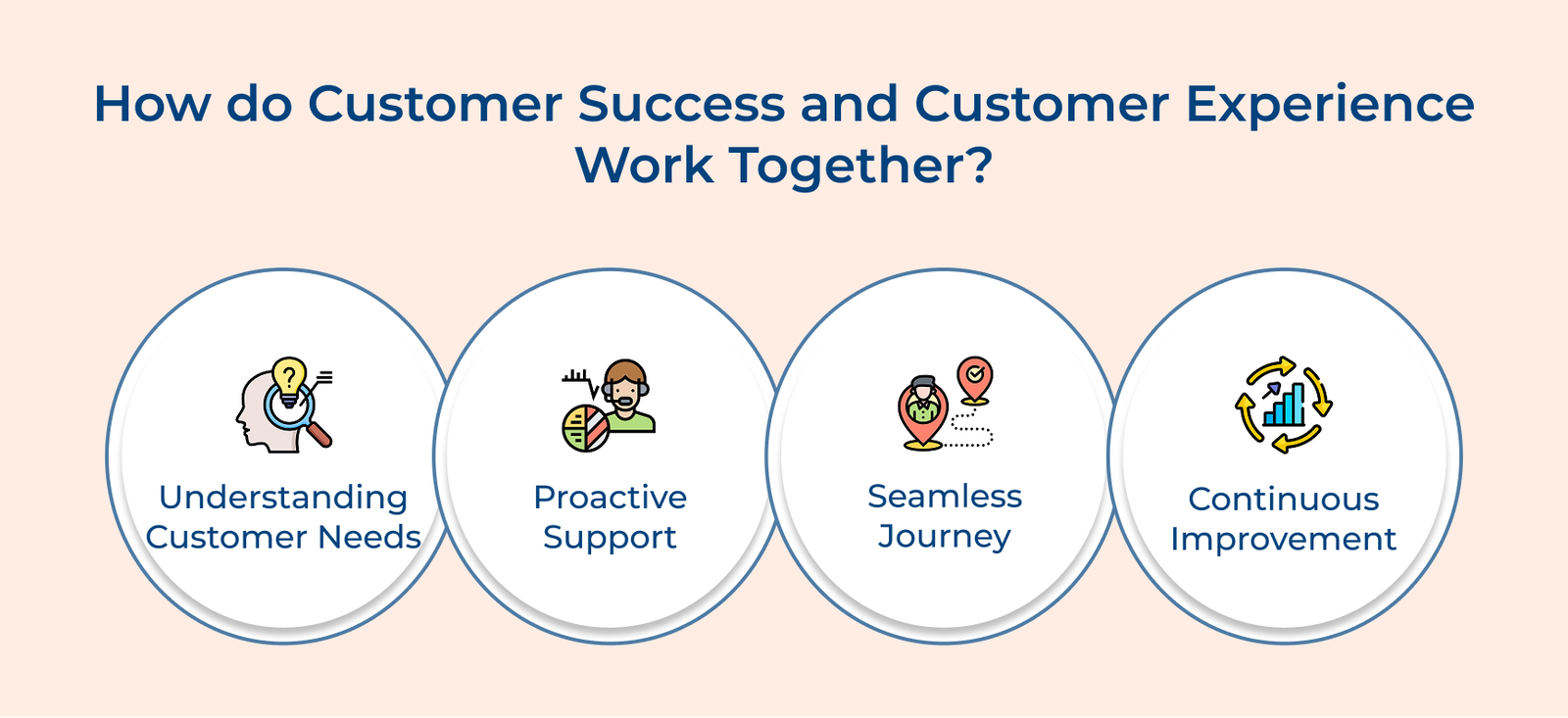
1. Understanding customer needs: Both customer success and customer experience start with knowing what customers expect. Understanding their needs helps businesses tailor products, services, and interactions, laying the foundation for a smooth experience.
2. Proactive support: Customer success teams play a vital role in providing proactive support to customers. They anticipate potential issues that customers may face and offer solutions in advance. Such a proactive approach prevents problems, enhances the customer experience and promotes customer success.
3. Seamless journey: A smooth, consistent journey is key to a positive experience. Customer success teams work with sales, marketing or support to make each touchpoint straightforward, reducing friction and keeping customers on track
4. Continuous improvement: Both functions rely on ongoing refinement. Customer success teams gather feedback, analyze patterns and share insights with relevant departments to improve processes over time.
Check out how customer success and customer experience shape the customer journey, influencing interactions at every stage of their relationship with your brand.
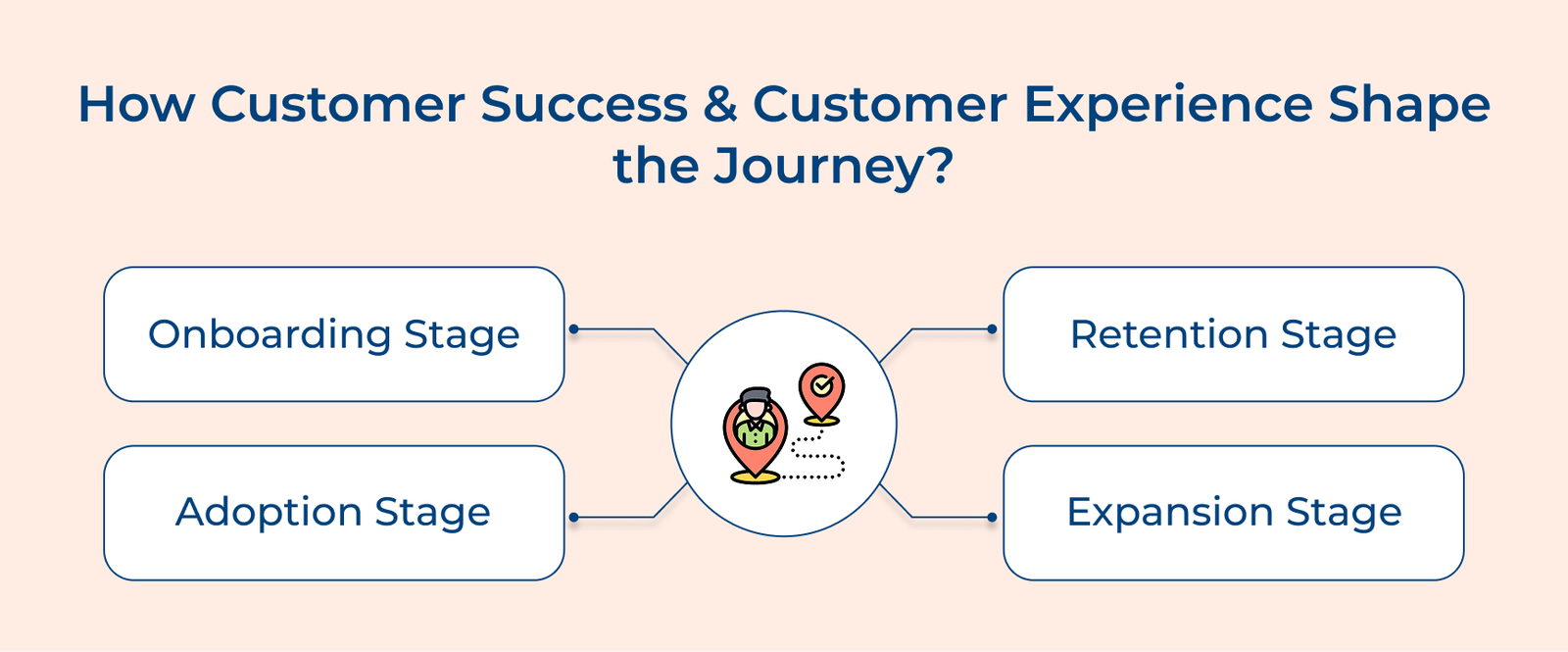
The onboarding stage is where the customer first interacts with the company’s products. Customer success teams ensure a smooth onboarding process by providing
The company helps customers understand how to use the product, answer their questions and address initial challenges. New customers are also provided with personalized treatment in the form of video calls. The stage sets the foundation for a positive CX and influences the customer’s perception of the company’s commitment to their success.
A positive customer experience during the onboarding stage improves customer satisfaction, reduces churn and increases the likelihood of successful adoption.
Customers actively use and integrate the product into their daily operations. Here, the customer success team needs to provide ongoing support, monitor usage and offer proactive assistance.
The team has to ensure that customers are maximizing the value they get from the product. It can be done through continuous education, feature updates and regular check-ins. A customer experience during the adoption stage increases customer engagement and enables them to achieve their desired outcomes.
Retention is critical to any business’s long-term success. Customer success teams closely
They provide assistance, guidance or resources to customers to overcome challenges and achieve their goals. A positive customer experience throughout the retention stage strengthens customer loyalty and reduces churn. Satisfied customers are more likely to renew their subscriptions or repurchase, significantly impacting a company’s revenue and growth.
Once customers achieve their initial goals, the expansion stage presents an opportunity to grow the customer relationship further. Customer success teams actively identify and suggest
They collaborate with the sales team to ensure a smooth transition and upselling or cross-selling. Customers who have had a successful journey with the company are more likely to explore and adopt new offerings, increasing their lifetime value.
The following are the industries that typically provide customer experience and customer success. Let’s check them in detail below.
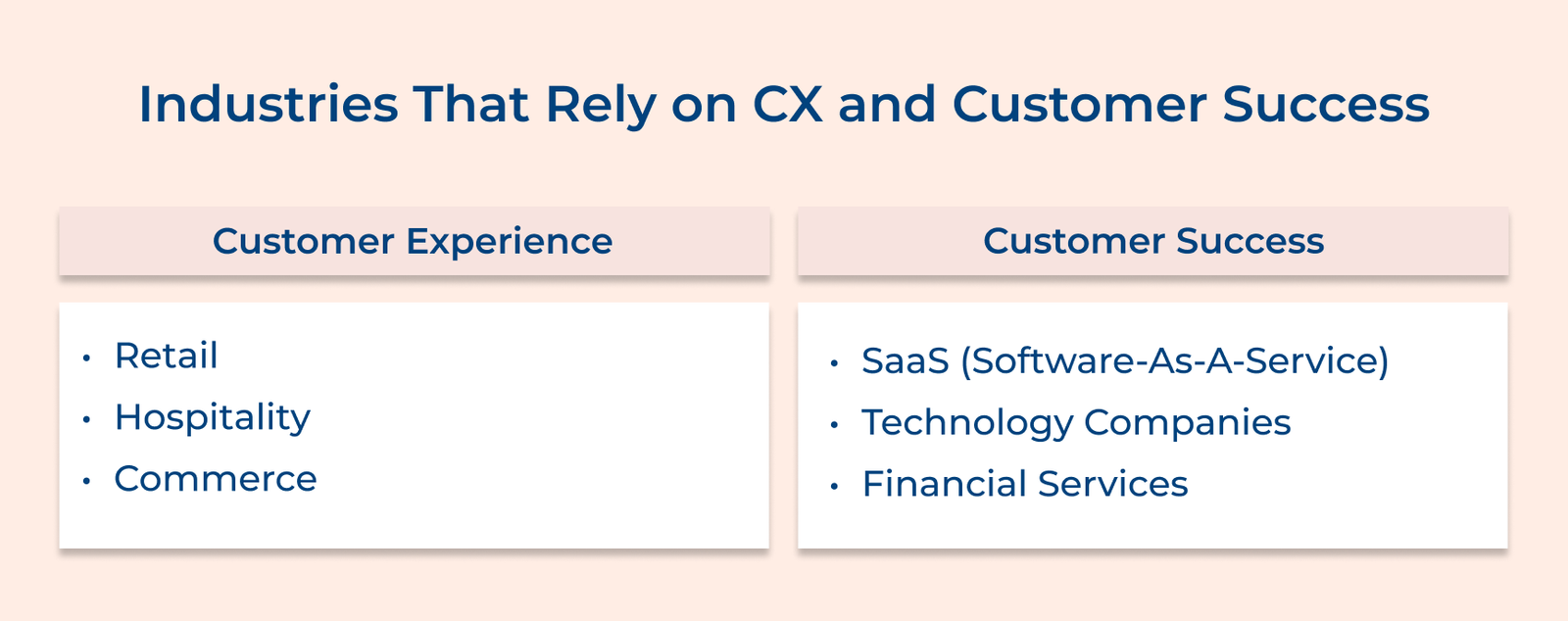
1. Retail: Retailers understand the importance of providing an enjoyable shopping experience to their customers. They focus on factors like
2. Hospitality: The hospitality industry, including hotels, resorts and restaurants, relies heavily on positive customer experiences to retain guests. Hospitality businesses heavily invest in delivering a superior customer experience, from friendly to luxurious accommodations and memorable dining experiences.
3. E-commerce: E-commerce companies have made customer experience a top priority due to the rise of online shopping. They work to
1. SaaS (Software-as-a-Service): SaaS companies offer subscription-based software solutions to businesses. The companies prioritize customer success through onboarding, training and ongoing support to help users get the most from their software.
2. Technology companies: Companies that develop and sell complex products often have dedicated customer success teams. The teams work closely with customers to understand their unique needs, provide technical support and offer guidance to maximize their usage.
3. Financial services: Banks, insurance companies and other financial service providers also prioritize customer success. They help customers meet financial goals with personalized advice, planning tools and ongoing support for a better banking or insurance experience.
Combining customer experience and customer success is a winning combination for any business. Companies can build strong relationships and drive sustainable growth by focusing on providing exceptional experiences to customers.
Customer experience encompasses every interaction a customer has with a brand, while customer success focuses proactively on helping customers achieve their goals. When the two elements are integrated, businesses can create a seamless journey for their customers, leading to increased satisfaction, retention and success. Companies can truly differentiate themselves by prioritizing the preferences of the customer.

Both customer experience and customer success are critical for a business’s long-term success. They complement each other. A positive customer experience lays the foundation for customer success by creating a strong relationship based on trust and satisfaction. Customer success contributes to an enhanced customer experience by ensuring that customers achieve their desired outcomes.
Businesses can focus on activities such as personalization, timely customer support, omnichannel experiences and continuous improvement based on feedback. Businesses should provide proactive onboarding, ongoing training, regular check-ins and access to resources that help customers achieve their goals.
Businesses can measure customer experience through metrics, such as net promoter score (NPS), customer satisfaction (CSAT) score and customer effort score (CES). The metrics provide insights into customer perceptions and satisfaction levels. Metrics like customer churn rate, customer lifetime value and adoption rates can help measure the effectiveness of customer success efforts.
No, they go hand in hand. Great experiences make success possible and success deepens the experience. Customer success builds on a strong experience foundation, while a positive experience encourages product adoption and continued engagement. Together, they create a complete, consistent customer journey.
Customer experience is the responsibility of the entire organization, from top-level executives to front-line employees. Every employee has a role to play in delivering outstanding customer experiences and driving customer satisfaction. Customer success is commonly owned by a dedicated team within an organization, often referred to as the customer success team. The team is responsible for ensuring that customers achieve their desired outcomes and are successful throughout their journey.

Grow Customer Relationships and stronger team collaboration with our range of products across the Conversational Engagement Suite.
Omnichannel Customer Support & Help Desk Software
AI Enabled Business Messaging and Chatbot Software
Sales Engagement & CRM Software
Call Center Software & Virtual Phone System
Product Marketing & Experience Platform
Customer Experience & Feedback Management Software

 Chatbot Analytics: The Most Essential Metrics to Track in 2026
Scroll to top
Chatbot Analytics: The Most Essential Metrics to Track in 2026
Scroll to top