E-commerce KPIs to Measure Sales
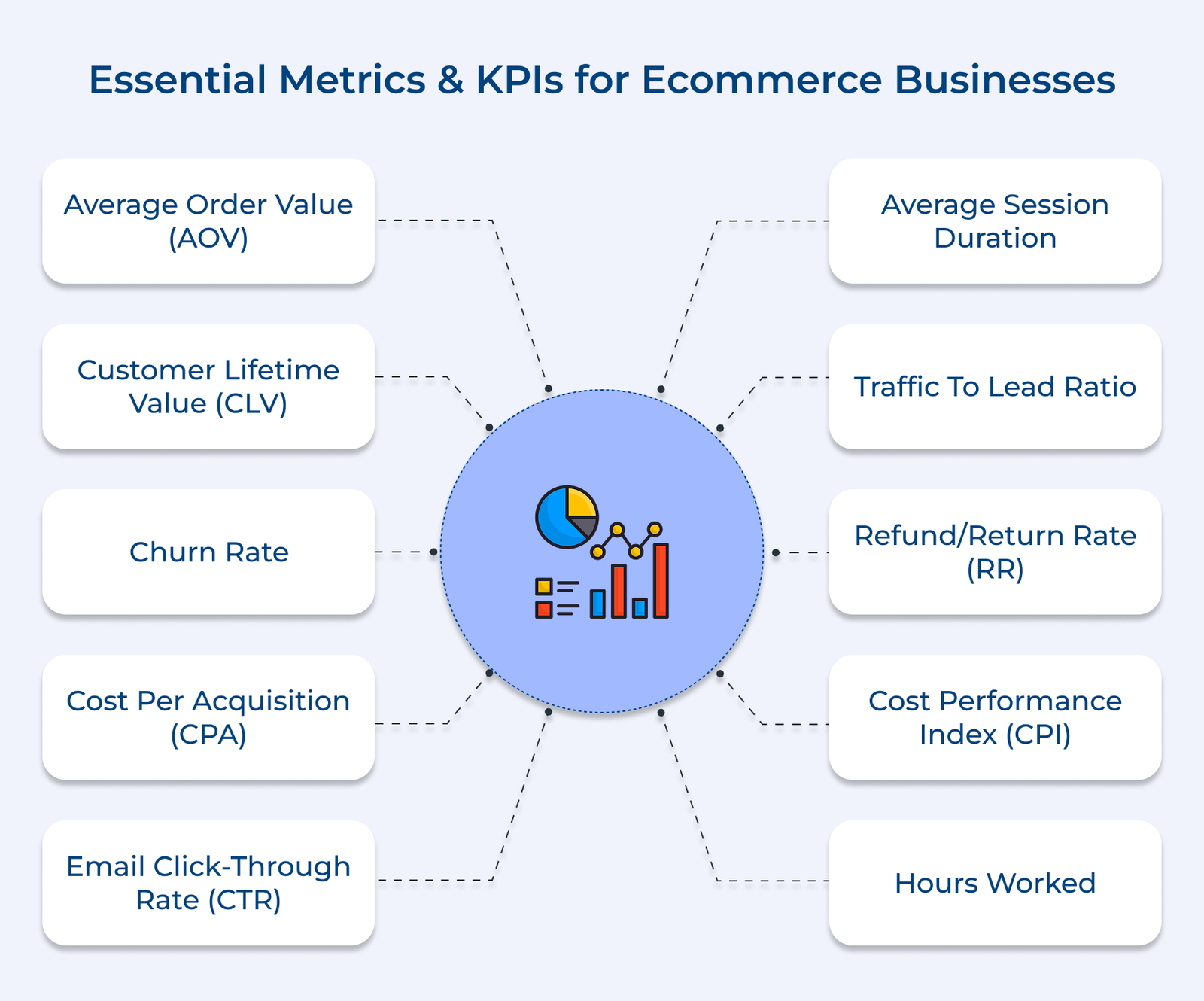
1. Average Order Value (AOV)
Average order value tells you how much customers spend per transaction. A higher AOV boosts revenue and offsets acquisition costs, making each sale more profitable.
Formula: Total Revenue / Number of Orders
Retail ecommerce typically sees an AOV between $50–$100, but it varies. Track it monthly by dividing your total monthly revenue by the number of orders.
Ways to improve:
- Bundle products: Suggest complementary items to encourage larger purchases.
- Loyalty rewards: Offer bonus points for bigger orders to motivate customers to spend more.
2. Shopping Cart Abandonment Rate (CAR)
Cart abandonment happens when shoppers add items to their cart but leave without completing the purchase. It could indicate issues like a complicated checkout process or a pricing concern.
Formula: (Number of Abandoned Carts / Total Number of Shopping Carts Created) x 100
A good target is keeping the number under 70%. Compare the abandoned carts to the total carts created daily.
Pro tips:
- Reminder emails: Send simple emails reminding customers about their abandoned items and offering them a discount to encourage the final purchase.
- Simplified checkout: Reduce unnecessary form fields, offer guest checkout and provide multiple payment options to make the buying process smoother.
3. Conversion Rate (CR)
Your conversion rate measures the percentage of website visitors who complete a purchase. It tells you how well your site turns interest into sales.
Formula: (Number of Conversions / Total Number of Visitors) x 100
Most e-commerce stores aim for a 2-3% conversion rate. Track the metric weekly by dividing total sales by total visitors and multiplying by 100.
Ways to improve:
- Build trust at checkout: Place customer reviews and high-quality product images near the buy button to give shoppers confidence.
- Create urgency: Show real-time inventory levels on product pages so customers know when stock is running low.
4. Customer Lifetime Value (CLV)
Customer lifetime value estimates how much revenue a single customer generates throughout their relationship with your business. It helps determine how much you should invest in acquiring and retaining customers.
Formula: Average Order Value x Average Purchase Frequency x Average Customer Lifespan
A strong CLV should be at least 3 times your customer acquisition cost. Track it quarterly to ensure you’re spending efficiently on marketing and retention.
Actionable tips:
- Reward loyalty: Surprise long-term customers with early access to new products or invite-only sales.
- Create a VIP program: Offer perks that improve over time, encouraging repeat purchases and long-term engagement.
5. Churn Rate
The churn rate measures the percentage of customers who stop buying from your store within a specific period. It helps you gauge customer retention, if the shoppers keep coming back or move on.
Formula: (Number of Customers Lost in Period / Total Number of Customers at Start of Period) x 100
Subscription-based ecommerce aims for a 5-7% churn rate while retail ecommerce targets 20-25% annual churn. If you start January with 1000 customers and lose 50 by month’s end, your churn rate would be: (50/1000) x 100 = 5% monthly churn rate.
Key takeaways:
- Find out why customers leave: Survey those who haven’t purchased in 60 days to understand their reasons and offer personalized incentives to bring them back.
- Encourage repeat purchases: Set up a loyalty program where rewards grow as customers buy more frequently.
E-commerce KPIs to Measure Marketing
6. Website Traffic
Website traffic measures how many visitors come to your online store, helping you evaluate the impact of your marketing efforts. High traffic suggests effective promotion, while low traffic may indicate that your brand isn’t reaching enough potential customers.
Formula: Sum of Users (New + Returning) Who Visit Your Site in a Given Period
Aim for 10-20% monthly traffic growth if you’re scaling up. Established eCommerce sites should see steady growth with noticeable spikes during peak shopping seasons.
Pro tips:
- Focus on one social media platform first: Master a single platform before expanding. Share behind-the-scenes content that gives customers a deeper connection to your brand.
- Make your products part of a story: Create engaging content around your best-sellers, showing how they fit into real-life scenarios your audience relates to.
7. Bounce Rate
Bounce rate shows the percentage of visitors who leave your site after viewing only one page. It helps reveal if your content matches what visitors expected to find. A high bounce rate usually signals a gap between what you promised and what the page delivers.
Formula: (Single-Page Sessions / Total Sessions) x 100
A healthy ecommerce bounce rate falls between 20-45% with content-heavy pages typically seeing slightly higher rates compared to product pages.
Key takeaways:
- Highlight your strongest product benefits at the top of the page with clear, engaging visuals.
- Make sure landing page headlines match your ad copy so visitors immediately see what they came for.
8. Social Media Engagement
Social media engagement shows how much your audience interacts with your posts. High engagement means your content connects with followers, while low engagement signals it may not match their interests.
Formula: (Total Engagements / Total Followers) x 100
Standard benchmark:
Aim for an engagement rate of 1-5% on Instagram and 0.5-1% on Facebook, with video content typically generating higher engagement than static posts.
Best practices:
- Share real customer stories or behind-the-scenes moments through short videos.
- Joint relevant trending discussions and add thoughtful insights instead of generic comments.
9. Average Session Duration
The metric shows how long visitors stay on your site. Longer sessions suggest they find your store useful, while short ones may point to confusing navigation or unhelpful content.
Formula: Total Duration of All Sessions / Number of Sessions
Standard benchmark:
A healthy average session duration ranges from 2-3 minutes for ecommerce sites. Product-focused pages should aim for longer durations, especially for high-value items. Track the total time spent by all users and divide by session count. Include only complete sessions and exclude bounced sessions for accurate measurement.
Actionable tips:
- Add interactive filters that make it easy to browse multiple products.
- Provide clear size guides and comparison tools to help shoppers make decisions without leaving your site.
10. Email Click-Through Rate (CTR)
CTR shows the percentage of email recipients who click a link in your email. It reveals how effective your content is at getting readers to take the next step..
Formula: (Number of Clicks / Number of Emails Delivered) x 100
Standard benchmark:
Ecommerce campaigns typically see 2-5%. Promotional emails are often at the lower end, while transactional emails perform higher.
Calculation method:
Monitor clicks through your email marketing platform and divide by successfully delivered emails. Exclude bounced or undelivered emails from calculations.
How to improve:
- Segment subscribers by past purchases and send tailored product suggestions.
- Add countdown timers for limited-time deals to encourage quicker clicks.
E-commerce KPIs to Measure Customer Service
11. Customer Satisfaction (CSAT) Score
CSAT measures how happy customers are with a recent interaction. High scores show you’re meeting expectations, while low scores reveal areas needing quick fixes.
Formula: (Number of Satisfied Customers / Total Number of Survey Responses) x 100
(Satisfied customers typically rate 4 or 5 on a 5-point scale)
Standard benchmark:
Ecommerce businesses should aim for 80%. Leaders often hit 85%, while anything below 75% signals urgent service issues.
Ways to improve:
- Route queries to agents who specialize in the customer’s issue.
- Track common pain points and build quick, standardized solutions.
12. Net Promoter Score (NPS)
NPS tracks loyalty by asking how likely they are to recommend your brand. Promoters boost growth through advocacy, while detractors highlight risks of churn.
Formula: % of Promoters (score 9-10) – % of Detractors (score 0-6)
(Based on “How likely are you to recommend us?” on a 0-10 scale)
Standard benchmark:
A score of 30–50 is good, 50+ is excellent. Anything below 0 means serious experience issues that need attention.
Pro tips:
- Reach out directly to detractors to understand and fix their concerns.
- Highlight customer success stories and testimonials to reinforce trust.
13. First Response Time
The metric tracks how quickly your team replies to a customer’s first inquiry. Fast responses show respect for the customer’s time, while delays risk frustration and lost sales.
Formula: Total Time to First Response / Total Number of Customer Inquiries
Standard benchmark:
Aim to respond within 1 hour during business hours for email and 15 minutes for chat. Social media responses should happen within 2 hours.
Calculation method:
Track time between ticket creation and first agent response. Calculate the average across all tickets excluding non-business hours.
Ways to improve:
- Send automated acknowledgment messages with useful resources.
- Use chatbots to handle simple questions when agents are offline.
14. Average Resolution Time
The metric measures how long it takes to fully resolve customer issues. Shorter times signal efficiency and good processes; longer times often mean bottlenecks.
Formula: Total Time to Resolve All Tickets / Total Number of Resolved Tickets
Standard benchmark:
Most ecommerce issues should be resolved within 24 hours. Technical issues may take up to 48 hours, while simple queries should be resolved within 4 hours. Measure the time between ticket creation and final resolution. Calculate the average across all resolved tickets in your chosen period.
Key takeaways:
- Build a knowledge base with ready-made answers for recurring issues.
- Review resolution data to find where agents need extra training.
E-commerce KPIs to Measure Store Performance Management
15. Cost Performance Index (CPI)
CPI shows how efficiently you’re using your budget. A score above 1.0 means you’re spending less than planned for the work completed, while below 1.0 signals overspending.
Formula: Earned Value / Actual Costs
(Earned Value = Budgeted Cost of Work Performed)
Maintain a CPI between 0.95 and 1.1. Values above 1.2 might indicate quality compromises, while values below 0.9 signal serious cost control issues. Calculate monthly by dividing the budgeted cost of completed work by actual costs incurred. Track trends across quarters to identify seasonal patterns.
Ways to improve:
- Monitor spending in real time and adjust before overruns build up.
- Revisit vendor contracts regularly to secure better rates.
16. Budget
The metric compares your planned spending to actual spending across store operations. Staying close to budget helps maintain profitability and avoid financial surprises.
Formula: (Actual Spending / Planned Budget) x 100
Standard benchmark:
Actual spending should stay within 5-10% of the planned budget. Essential categories should remain within 3% variance, while marketing budgets may allow 15% flexibility.
Ways to improve:
- Break annual budgets into weekly or monthly checkpoints.
- Use past data to adjust for seasonal spikes.
17. Hours Worked
The metric shows how effectively your team’s time is used in relation to order volume. It helps control labor costs while keeping service levels consistent.
Formula: Total Hours Worked / Number of Orders Processed
Standard benchmark:
Labor hours should process 4-6 orders per hour for small operations and 8-12 orders per hour for larger operations with automation.
Calculation method:
Track total staff hours, including overtime. Divide by orders processed to calculate labor efficiency ratio on a daily, weekly and monthly basis.
Best practices:
- Schedule shifts around peak demand using order history data.
- Cross-train staff to cover multiple roles when workloads shift.
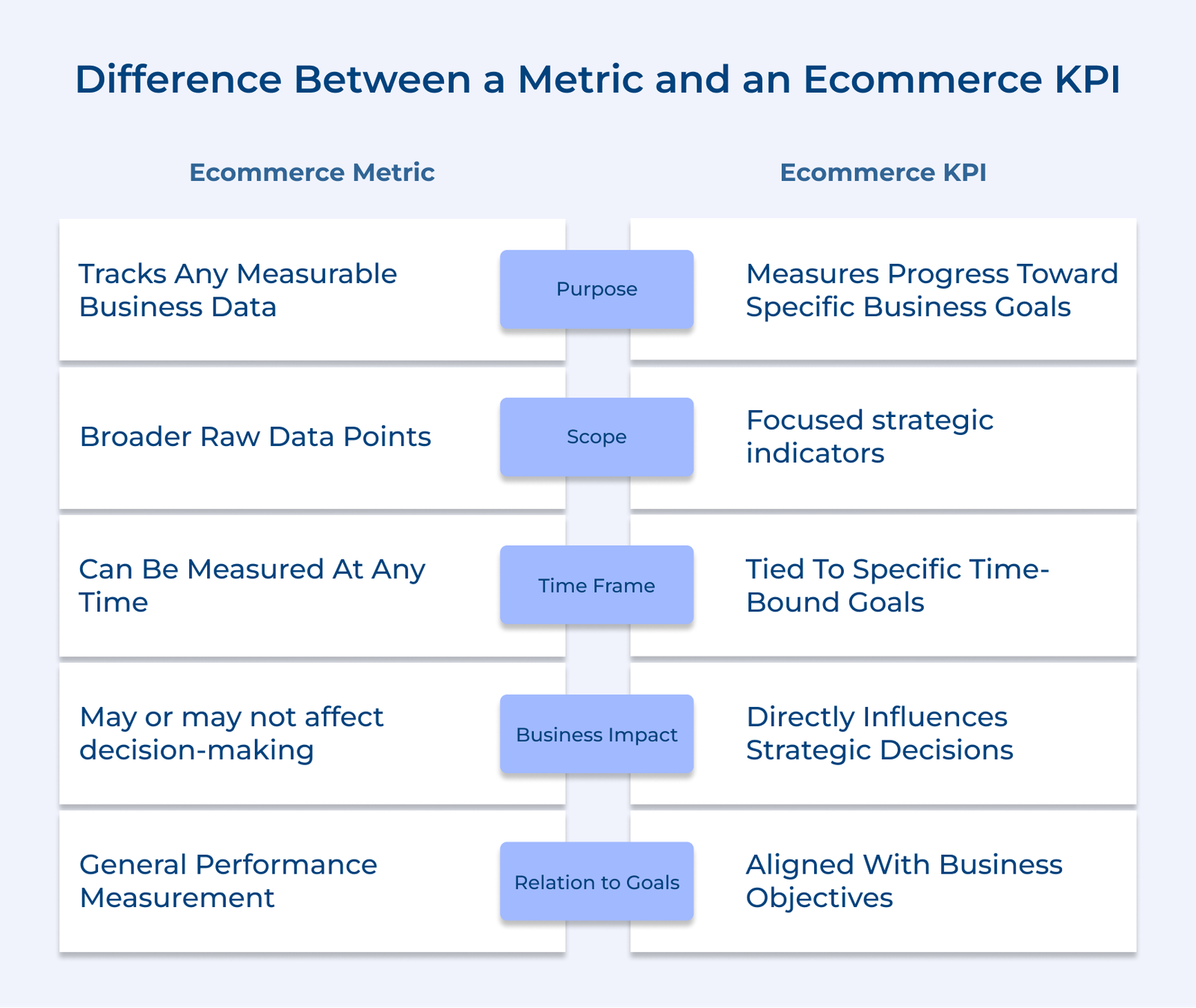
Difference Between a Metric and an Ecommerce KPI
Below are the differences between a metric and an ecommerce KPI. Understanding the distinction between e-commerce metrics and KPIs is crucial for effective performance.