The Evolution of Customer Service
Explore the evolution of customer service, from traditional methods to modern innovations. Learn about the key factors shaping the future of support, including technology and personalization.

Explore the evolution of customer service, from traditional methods to modern innovations. Learn about the key factors shaping the future of support, including technology and personalization.
Modern customers expect instant, seamless support across multiple channels. The outdated model of limited hours and single-channel communication no longer meets expectations, leaving businesses struggling to keep up. The gap between what customers want and what businesses deliver leads to higher churn, negative reviews or a damaged reputation. Companies that prioritize improving their customer experience are reaping the rewards—boosting customer retention by 42% and increasing satisfaction by 33%.
The good news? The customer service evolution is accelerating, transforming how businesses engage, support and build lasting relationships with their customers. Companies can now deliver personalized, proactive support, meeting customers where they are with AI, automation and data analytics. The shift isn’t just about new tools – it’s about rethinking how businesses build lasting customer relationships.
Customer service evolution refers to the transformation from simple face-to-face interactions to a complex, multi-channel approach that shapes the entire customer experience. Modern-day businesses engage with customers across various touchpoints, from traditional phone support to digital channels like social media, chat and email.
The seamless experience blends human agents and AI-driven automation, ensuring quick solutions while reserving personal interactions for more complex issues requiring empathy.
Key objectives:
Let’s go through the key factors driving the evolution of customer service, from technological advancements to shifting customer expectations.

1. Technological Advancement
The rise of digital technologies has transformed service delivery. The AI-powered chatbots and virtual assistants now provide instant, seamless support enhancing customer interactions like never before. The advanced CRM systems track interactions across touchpoints to personalize customer experiences.
2. Shifting Consumer Behavior
Modern customers demand instant responses and round-the-clock solutions, effortlessly switching between communication channels. The shift has driven businesses to adopt omnichannel support, ensuring a seamless experience across all platforms.
3. Data-Driven Insights
Advanced analytics enable companies to analyze vast customer data, predicting needs and spotting issues before they arise. The deeper insight allows businesses to tailor their services based on individual preferences and past interactions.
4. Economic Pressures
Rising competition and cost pressure push businesses to find efficient service solutions. Striking the right balance between automation and human interaction is key to maintaining quality while controlling costs, driving innovation in service delivery models.
5. Globalization Effects
The growth of international markets has introduced new service challenges. Businesses must support across time zones and cultures, requiring flexible strategies that meet diverse customer expectations.
Check out the benefits for businesses in adapting to the evolving customer service landscape, from enhanced customer satisfaction to improved efficiency.
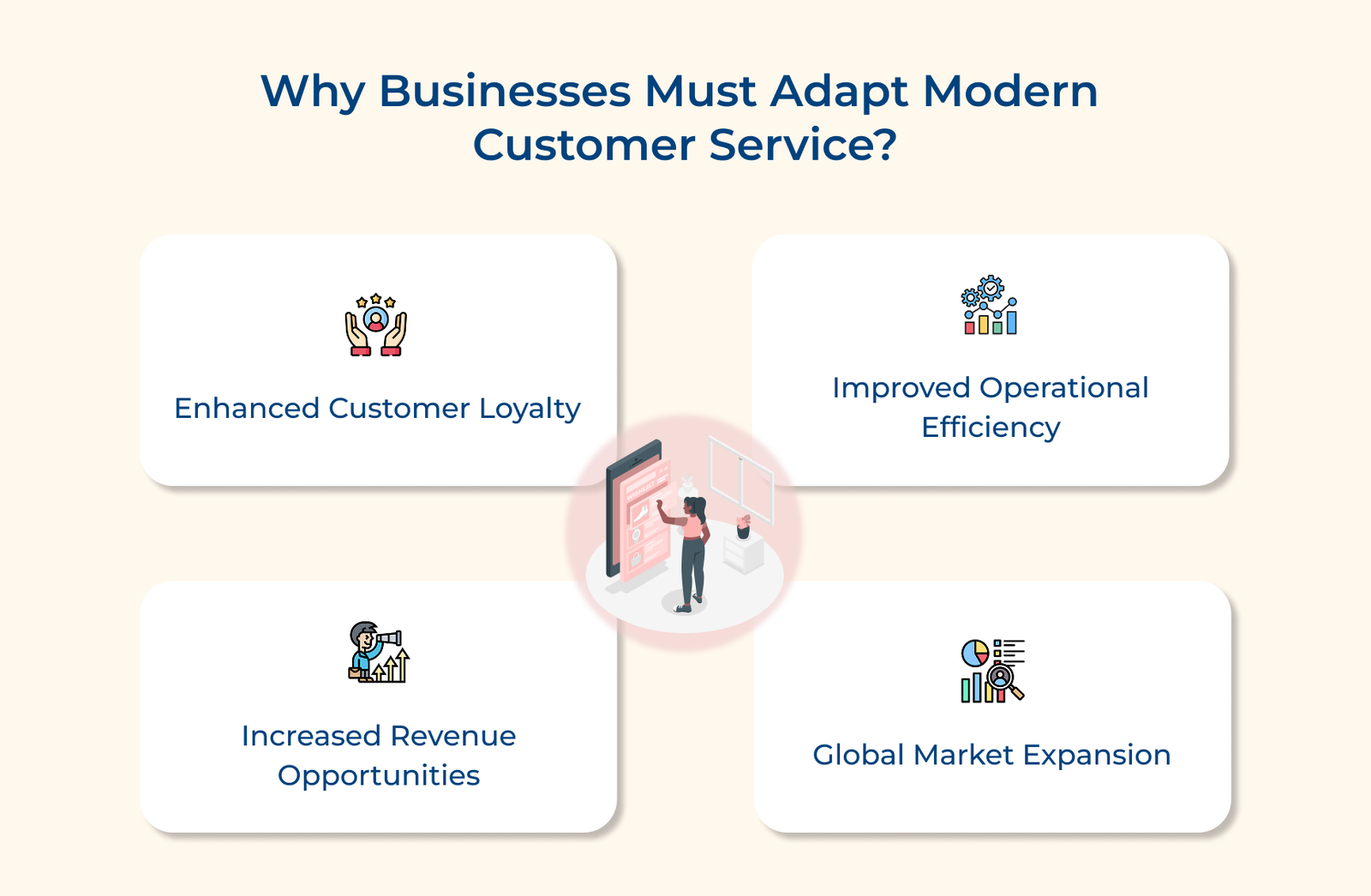
Modern customer service builds stronger emotional bonds by personalizing interactions. Advanced CRM systems track preferences and history, enhancing meaningful engagements that turn casual customers into loyal brand advocates.
Modern customer service technologies optimize support by automating routine inquiries with AI, freeing up human agents for complex issues. According to Gartner, 80% of companies are leveraging AI to enhance customer experience, transforming the way they engage, support, and delight their customers.
Exceptional customer service uncovers opportunities for upselling and cross-selling by better understanding customer needs. Satisfied customers are more likely to spend on additional products, driven by the trust and positive relationship built.
Modern customer service technologies allow businesses to effectively serve customers across time zones and languages. Automated translations and localized support open doors to new markets, driving growth without operational costs.
Below are the key milestones in the evolution of customer service, highlighting how it has transformed year by year to meet changing customer expectations.
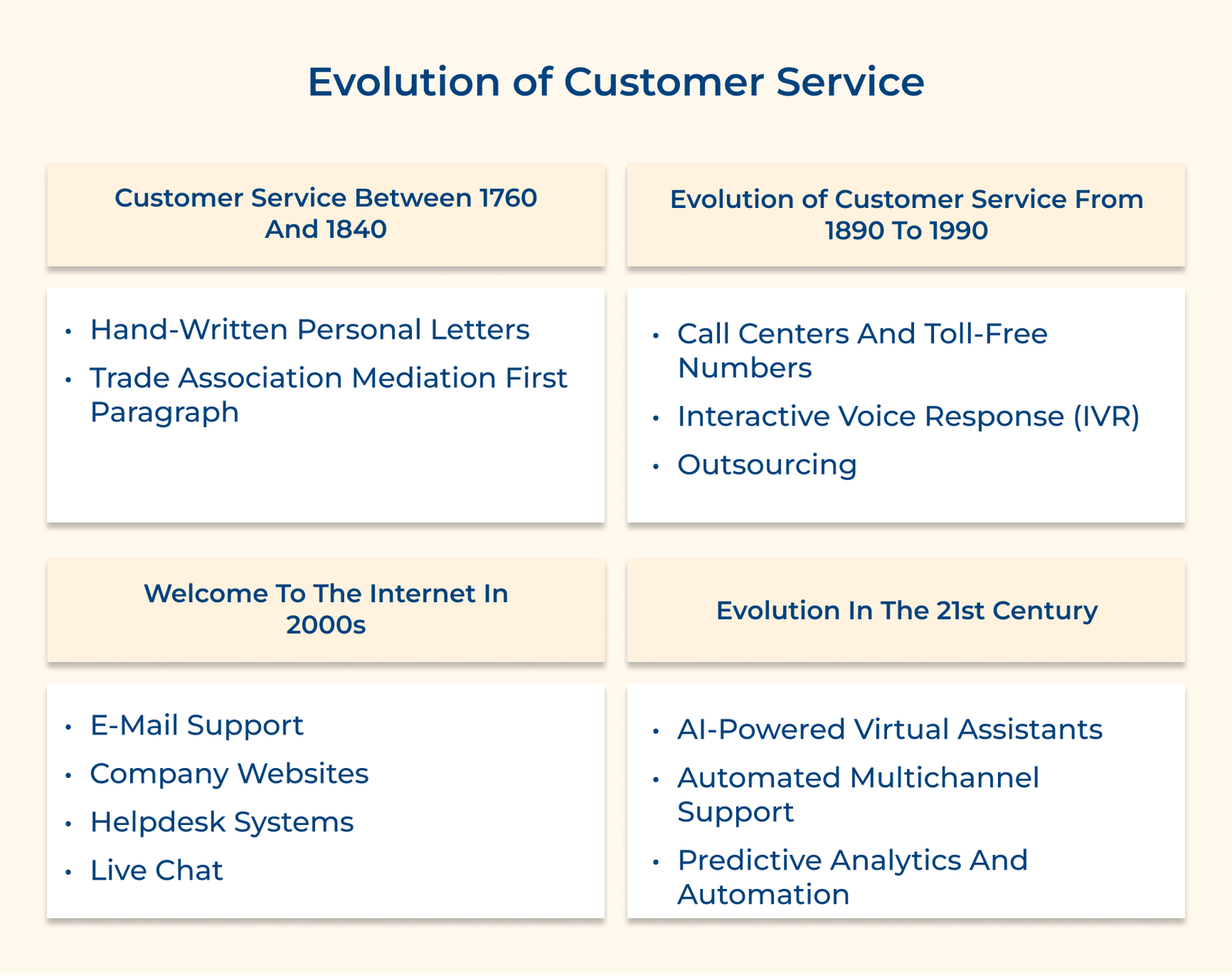
Between 1760-1840, the Industrial Revolution marked the start of formal customer communication. The period saw businesses relying on three key methods to address customer complaints, shaped by the era’s social and technological advances.
During the late 18th century, customers wrote detailed hand-written letters to business owners to express concerns or dissatisfaction, often following formal conventions. Businesses could take weeks or even months due to slow postal times, with business owners replying personally.
Key takeaways:
Trade associations acted as intermediaries in the late 18th and early 19th centuries, handling customer complaints. They investigated issues, recorded resolutions and set early standards for fair business practices. All of it paved the way for modern customer service and consumer protection.
Pro tips:
Between 1880 and 1980, groundbreaking advancements in customer service technology reshaped how businesses interacted with customers, laying the foundation for modern-day support systems. Key developments include:
The 1960s saw the rise of call centers, revolutionizing customer service by centralizing support and allowing businesses to manage multiple calls with trained agents using advanced telephone systems. The introduction of toll-free 800 numbers in 1967, made customer support more accessible, eliminating long-distance charges and encouraging more customers to reach out.
Actionable tips:
IVR systems introduced automated phone interactions in the 1970s, guiding customers through service options using pre-recorded messages and touch-tone technology. The innovation allowed businesses to handle routine inquiries without human intervention. As IVR evolved, it improved call routing and pre-screened customers, gathering essential information before connecting to agents, boosting call center efficiency.
Pro tips:
Early outsourcing focused on domestic partnerships, enabling businesses to maintain cultural and language compatibility while reducing costs. The initial successes paved the way for international outsourcing in the future.
Key takeaways:
The 2000s sparked a digital revolution in customer service, reshaping business-customer interactions. The internet introduced new channels, making support more accessible, efficient and personalized. Key developments include:
Email became a game-changer in customer service in the early 2000s, offering customers a written record of interactions. Businesses implemented email management systems to prioritize and route messages to the right support teams, ensuring no inquiry was overlooked.
The asynchronous nature of email allowed support teams to handle multiple inquiries simultaneously, providing detailed responses. Email has now become a customer favorite for support, with 67% preferring it as their go-to communication channel for customer service.
Pro tips:
Corporate websites transformed from basic digital brochures to full-service platforms, customer support hubs, featuring contact forms, FAQs and product documentation, offering 24/7 access to essential resources.
Companies began personalizing websites based on user behavior, using advanced tracking systems to understand customer navigation and frequently sought information.
Key takeaways:
Helpdesk software revolutionized how businesses manage customer inquiries by centralizing communications across emails, phone calls and website submissions. The unified platform allowed support teams to track, prioritize and resolve issues more efficiently.
Advanced ticketing systems introduced automated workflows and performance analytics. Support teams could now track resolution times, spot bottlenecks and measure customer satisfaction. The data-driven approach drove continuous improvements in service quality.
Pro tips:
Live chat introduced real-time text-based support on company websites, offering a perfect balance between the detail of email and the immediacy of phone support. Businesses could manage multiple chats at once, improving efficiency without sacrificing personal interaction.
Simple inquiries were handled automatically, while complex issues were seamlessly escalated to human agents. The blend of automation and human support optimized resources while maintaining high service quality.
Key takeaways:
The 21st century has brought a groundbreaking shift in customer service automation, driven by AI and advanced technologies. Let’s explore how automation has evolved across three key dimensions in modern support.
AI-powered virtual assistants, fueled by natural language processing, have transformed front-line customer support. The assistants learn from each interaction, improving their accuracy and problem-solving skills.
Machine learning enables them to predict customer needs based on past patterns, shifting customer service from a reactive to a proactive approach, boosting overall satisfaction.
Key takeaways:
Modern automation systems integrate communication channels like social media, messaging apps, email and voice support, maintaining context across platforms so customers can switch without losing conversation history. The unified approach ensures consistent service, no matter the channel.
Actionable tips:
Modern customer service platforms use predictive analytics to forecast customer behavior and potential issues. The systems analyze vast amounts of customer data including purchase history, service interactions and website activity. It enables businesses to resolve problems before they escalate into complaints.
Automation has advanced to include real-time sentiment analysis and customer feedback processing. The systems can automatically detect trends, spot emerging issues and respond proactively, ensuring high service quality.
Key takeaways:
Check out the future evolution of customer service, where emerging technologies will redefine how businesses engage in the years ahead.
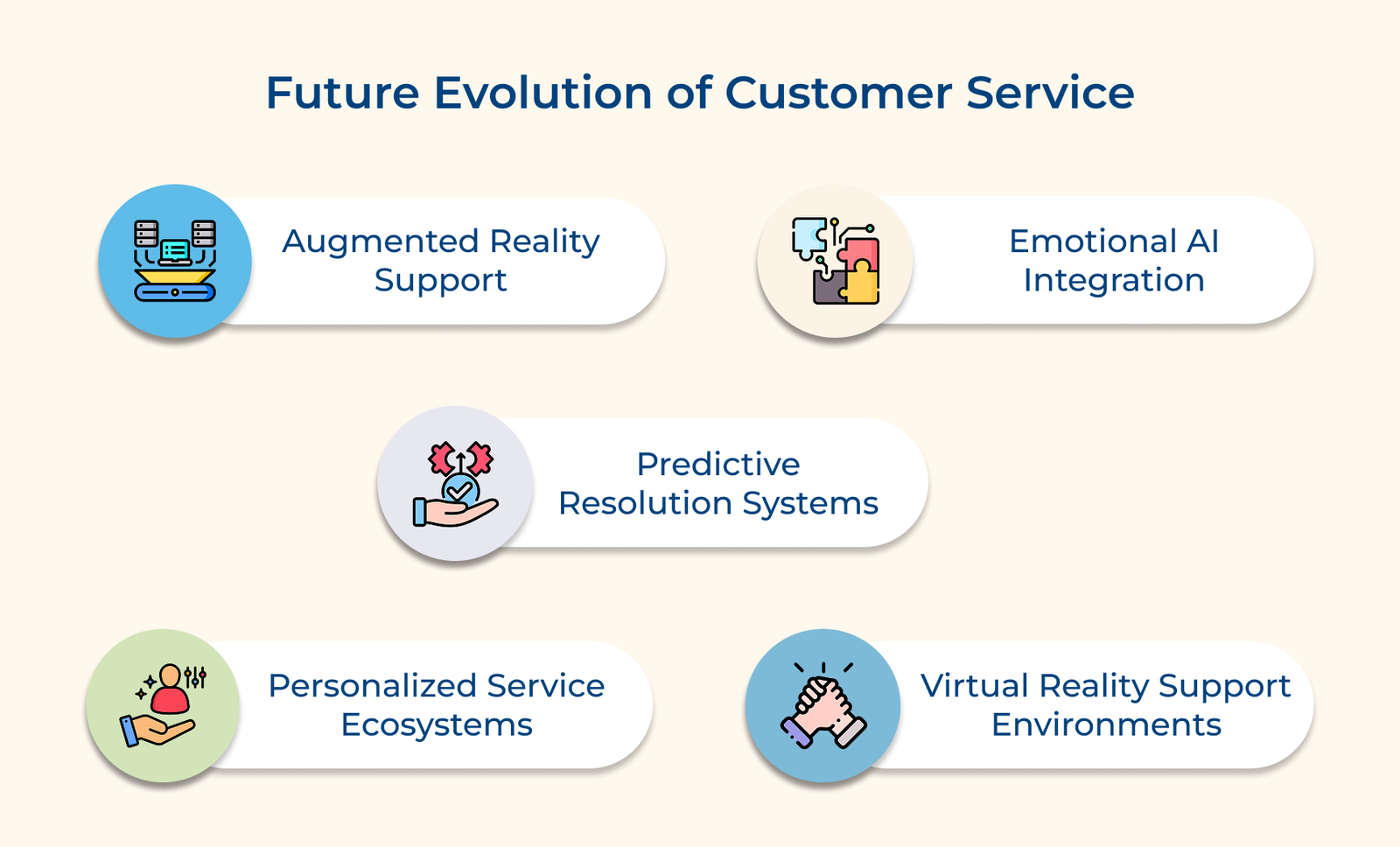
Customer service will embrace AR technology, offering immersive troubleshooting with virtual overlays that guide customers through complex procedures. The visual support will make technical assistance more intuitive and efficient.
AR will also allow customers to scan products for instant access to information and personalized support guides, adapting to different skill levels. AR will bridge the knowledge gap between experts and customers by providing real-time visual guidance.
Advanced AI will use voice analysis, facial recognition and text sentiment to respond to customer emotions, adapting communication for more empathetic interactions.
Emotional intelligence will flag emotionally challenging situations and escalate them to specialized agents, creating deeper connections. Emotional AI will help businesses better meet customers’ emotional needs and enhance service quality by enabling genuinely empathetic automated responses.
Future customer service systems will proactively resolve issues before customers before customers even notice them. Advanced algorithms will detect potential problems by analyzing product performance, behavior patterns and usage data.
Leveraging IoT sensors and real-time data analysis, the systems will ensure optimal product performance, reducing complaints. Predictive systems will shift customer service from reactive to preventive, enhancing the overall experience and minimizing the need for customer-initiated support requests.
Customer service will become a personalized ecosystem, adapting to individual preferences and behaviors. The systems will create detailed profiles to enhance future support and product recommendations by learning from each interaction.
The technology will enable businesses to offer tailored solutions based on customer history, preferences and expertise, ensuring a consistent, customized experience across all service channels.
VR technology will create immersive support environments, allowing customers to interact with products, test solutions and troubleshoot in realistic virtual settings.
Support agents will join customers in the virtual spaces, offering hands-on assistance and demonstrations. It will make product training and support more engaging, reducing the need for in-person service visits.
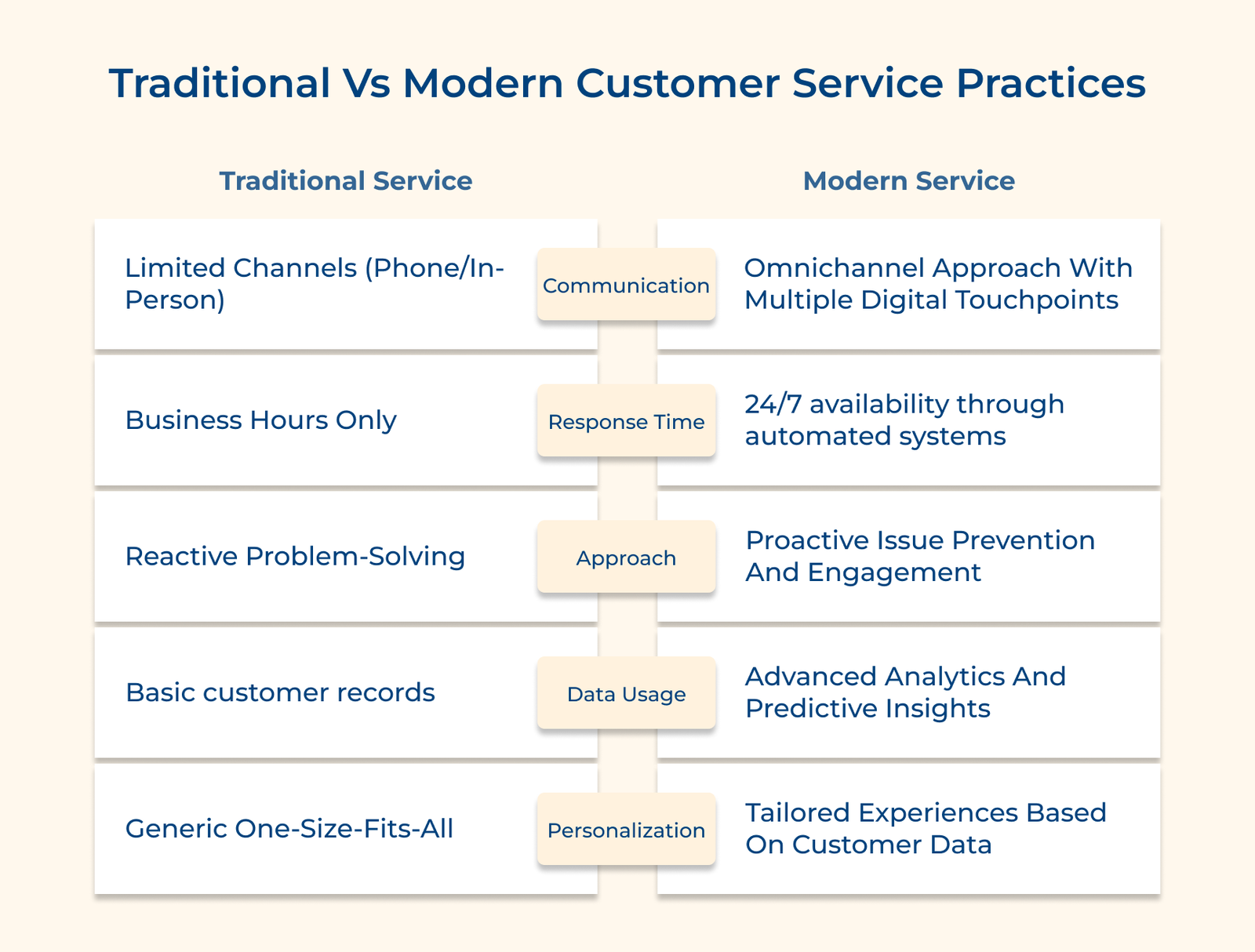
Following are the key differences between traditional and modern customer service practices, exploring how evolving technologies have reshaped the way businesses engage.
1. Communication Channels
Traditional customer service depended on face-to-face interactions and phone calls, causing delays during peak hours. The limitations often resulted in long wait times and customer frustration, especially outside business hours.
Modern service adopts an omnichannel approach, integrating social media, email, chat and self-service portals. The multi-channel strategy offers customers flexibility in communication while maintaining consistent service quality across all platforms.
2. Response Time
Traditional service was limited to business hours, requiring customers to adjust their schedules, often resulting in backlogs and delayed responses, especially for those in different time zones.
Modern systems offer 24/7 support through AI-powered chatbots and automation. The technologies ensure instant responses to simple inquiries and routing of complex issues to human agents during business hours.
3. Service Approach
Traditional customer service was reactive, waiting for customers to report issues which often led to escalated problems and higher dissatisfaction.
Modern service uses predictive analytics to spot potential issues before they arise, enabling businesses to address concerns proactively, reducing support tickets and enhancing customer satisfaction.
4. Data Utilization
Traditional service relied on basic records and manual tracking, making it hard to understand customer behavior patterns. Support agents often lacked comprehensive customer history leading to repetitive information gathering.
Modern service uses advanced analytics to build detailed customer profiles and predict future needs. The data-driven approach enables personalized support experiences and efficient problem resolution with intelligent recommendations.
5. Personalization Level
Traditional service offered standardized solutions, often failing to address individual customer needs and preferences effectively.
Modern service tailors experiences by analyzing customer data, behavior and past interactions. The personalized approach ensures more relevant solutions and stronger relationships through personalized support strategies.
Check out the role of social media in the evolution of customer service, where platforms have become key channels for building stronger relationships with customers.
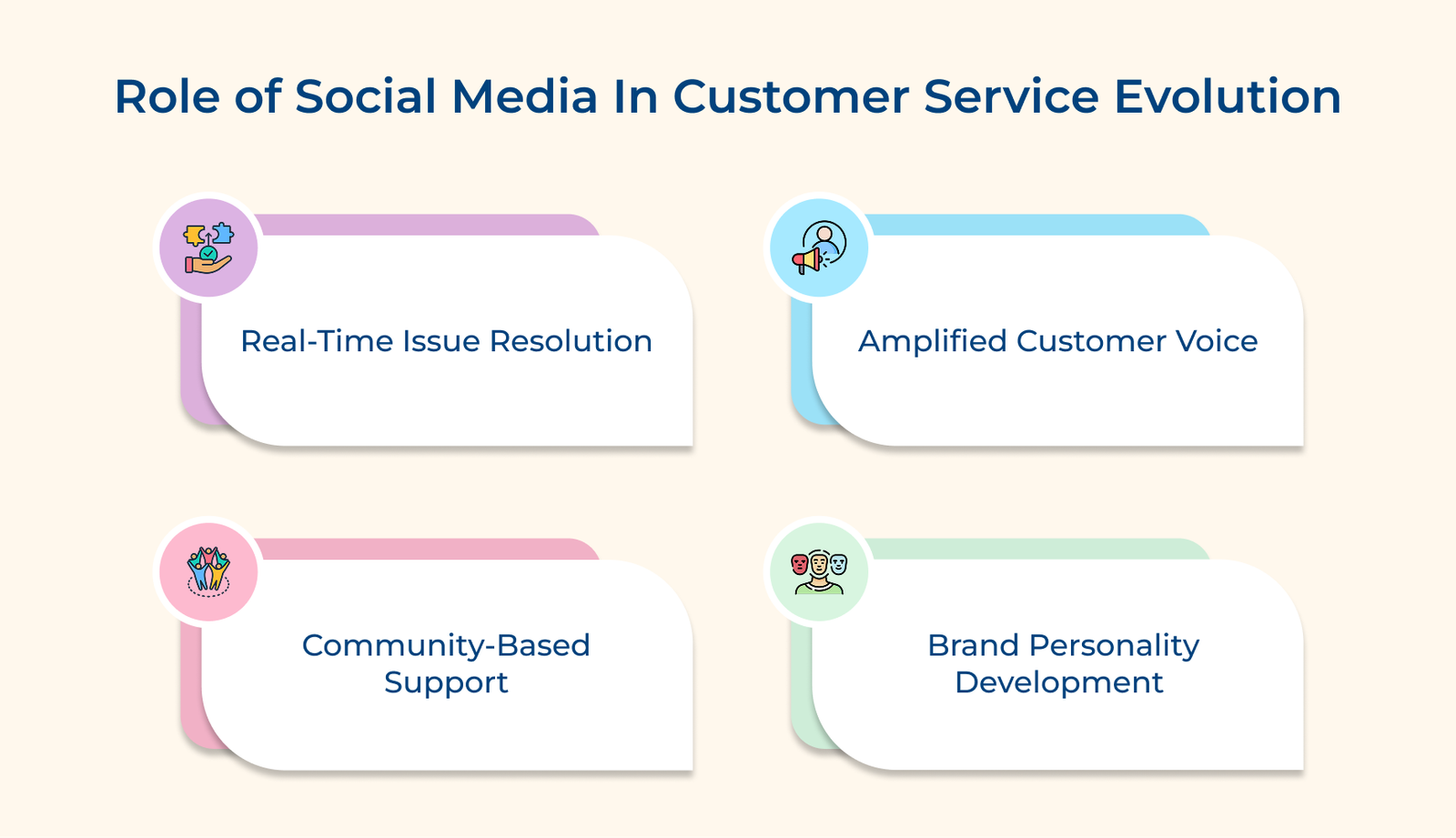
Social media has created an expectation for instant responses to customer concerns. Businesses now monitor their channels around the clock, developing fast-resolution strategies and dedicated teams to manage real-time interactions effectively.
Social platforms give customers the power to share their experiences with a wide audience, making a single complaint potentially reach thousands. The amplification has pushed businesses to prioritize service quality and transparency to protect their reputation.
Social media has sparked the rise of customer communities where users help each other resolve issues. The peer-to-peer networks complement traditional customer channels, offering authentic solutions and strengthening customer relationships. Companies now actively encourage and moderate the communities to enhance their support ecosystem.
Social media has shifted customer service from transactional to brand-building opportunities. Companies now use service interactions to showcase their personality and values, turning responses into positive brand experiences that boost loyalty.
Customer service has evolved from simple face-to-face interactions to advanced digital experiences, driven by technological progress, shifting consumer expectations and the need for businesses to stay competitive. AI, automation and data analytics have revolutionized how companies meet customer needs.
Looking ahead, emerging technologies like augmented reality, emotional AI and quantum computing promise hyper-personalized experiences, while still preserving the human touch essential for lasting relationships. Success will come from balancing technological efficiency with genuine human connection.
Key takeaways:

Customer service is transforming from a reactive, single-channel approach to a proactive, omnichannel experience. Modern service integrates AI-powered automation with human expertise, enabling personalized interactions at scale. Self-service options are becoming more sophisticated, while data analytics helps predict and prevent issues before they arise. The evolution emphasizes customer empowerment while maintaining the human touch for complex issues.
The fundamental concepts are accessibility, personalization, efficiency and empathy. Accessibility ensures customers can reach support through their preferred channels at any time. Personalization tailors interactions based on customer history and preferences. Efficiency delivers quick, effective solutions without compromising quality. Empathy requires understanding and addressing both stated and unstated customer needs, creating emotional connections that build loyalty.
Technology has revolutionized customer service through AI chatbots, predictive analytics and automated workflow systems. Machine learning enables more intelligent self-service options and helps agents make data-driven decisions. Cloud computing facilitates seamless integration across channels, while social media and messaging platforms have created new touch points. The advances have raised customer expectations for immediate, personalized service.
The future of customer service will blend advanced AI capabilities with enhanced human interactions. Predictive analytics will enable hyper-personalized experiences, while augmented reality might facilitate remote troubleshooting. Voice-based AI assistants will become more sophisticated and emotional AI could help better understand customer sentiment. The focus will shift from problem-solving to proactive experience enhancement.
Measurement requires a combination of traditional and emerging metrics. Beyond standard KPIs like response time, businesses should track channel effectiveness, predictive success rates and customer effort scores. Journey analytics help understand the complete customer experience, while sentiment analysis provides deeper insights into emotional responses. Regular voice-of-customer feedback ensures evolution aligns with actual needs.

Grow Customer Relationships and stronger team collaboration with our range of products across the Conversational Engagement Suite.
Omnichannel Customer Support & Help Desk Software
AI Enabled Business Messaging and Chatbot Software
Sales Engagement & CRM Software
Call Center Software & Virtual Phone System
Product Marketing & Experience Platform
Customer Experience & Feedback Management Software

 How to Build a Lead Generation Funnel: 10 Effective Steps
Scroll to top
How to Build a Lead Generation Funnel: 10 Effective Steps
Scroll to top