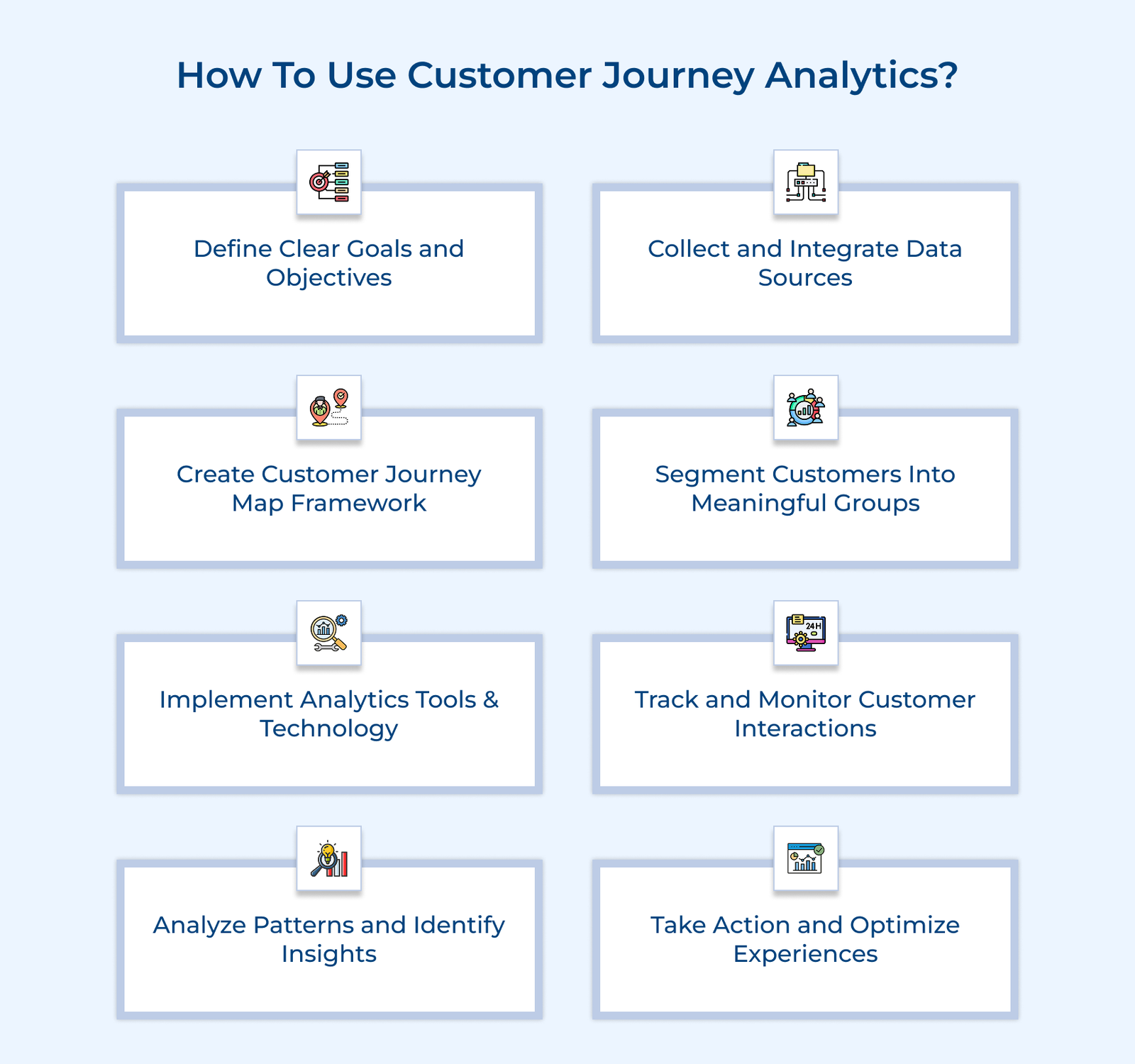
1. Define Clear Goals and Objectives
Clear clear goals and objectives are essential for successful customer journey analytics. A well-defined roadmap aligns analytics efforts with business outcomes, ensuring teams focus on impactful metrics. KPIs should reflect revenue goals, customer satisfaction and loyalty at every stage, from awareness to advocacy.
Aligning business objectives with analytics strategy ensures measurable value through improved customer experiences and business performance. Success metrics must be SMART (Specific, Measurable, Achievable, Relevant, Time-bound) to track progress and ROI effectively.
Actionable tips:
- Hold quarterly goal reviews to ensure analytics objectives align with evolving business needs.
- Use a balanced scorecard combining quantitative metrics (conversion rates) and qualitative measures (satisfaction scores).
2. Collect and Integrate Data Sources
Effective data collection and integration are crucial for accurate analysis of the entire customer journey. Without consistent and reliable data, organizations cannot uncover valuable insights into customer behavior or improve experience.
Start by mapping data sources across all touchpoints, including websites, mobile apps, CRM systems, social media and customer service interactions. Establish standardized collection methods to ensure consistency. Integration protocols unify disparate data into a single, accessible view. Implement robust data governance and quality checks to preserve integrity.
Pro tips:
- Audit existing data sources to identify gaps for complete journey visibility.
- Set up automated validation checks to maintain quality and flag anomalies for review.
3. Create a Customer Journey Map Framework
A customer journey mapping framework offers a structured way to visualize and understand the customer experience. Organizations can identify opportunities to enhance engagement across various touchpoints and channels by viewing interactions from the customer’s perspective.
Conduct a comprehensive audit of all customer interactions across both the digital and physical platforms. Documenting customer interactions and defining journey stages creates a clear picture of the entire customer lifecycle. Teams should outline major stages like awareness, consideration, purchase and post-purchase support.
Best practices:
- Create distinct journey maps for different customer segments to understand unique paths and preferences.
- Update journey maps regularly based on customer feedback and evolving behavior patterns.
4. Segment Customers Into Meaningful Groups
Customer segmentation allows businesses to deliver personalized experiences and target their efforts more effectively. Organizations gain deeper insights into needs and preferences by grouping customers based on shared traits, leading to optimized engagement strategies. Analyzing behavioral patterns such as purchase history, browsing habits and feature usage reveals how different segments interact with products or services.
Incorporating demographic data and persona profiles enriches segmentation. Creating detailed personas with specific needs, goals and pain points helps craft tailored solutions. Effective personas combine quantitative data with qualitative insights from customer research.
Actionable tips:
- Develop dynamic segmentation models that update automatically based on evolving customer behavior.
- Leverage predictive analytics to uncover emerging segments and anticipate future needs.
5. Implement Analytics Tools and Technology
Robust analytics tools and technology are crucial for effective customer journey analysis. Organizations need the right infrastructure to collect, process and analyze customer data, turning it into actionable insights for improvement. Choosing the right analytics platforms involves evaluating business needs such as data integration capabilities, scalability, reporting features and ease of use.
The platform should support both basic tracking and advanced analytics for deeper insights into customer behavior. Setting up accurate tracking and intuitive dashboards is essential. Well-configured reporting tools enable stakeholders to easily access key metrics and make informed decisions.
Pro tips:
- Conduct regular platform audits to ensure tools align with evolving business needs.
- Develop tailored dashboard templates for different user groups based on their information needs and access levels.
6. Track and Monitor Customer Interactions
Continuous monitoring of customer interactions provides real-time insights into experience quality. It enables organizations to identify issues and respond proactively, ensuring high satisfaction across all touchpoints.
Real-time engagement tracking helps spot immediate customer behavior patterns, such as page views, click-through rates, session duration and conversions. Monitoring live interactions also allows teams to address technical problems or experience gaps promptly. Collecting both explicit customer feedback (through surveys) and implicit feedback (via behavior data) deepens understanding.
Actionable tips:
- Set up automated alerts for significant shifts in engagement or conversion drops.
- Establish a systematic process for collecting and analyzing feedback across all touchpoints.
7. Analyze Patterns and Identify Insights
Pattern analysis turns raw data into actionable insights, helping businesses uncover a deeper understanding of customer behaviors and identify opportunities to improve experiences. Teams should use advanced analytics to track navigation paths, feature usage and purchase behaviors to detect behavioral trends.
Recognizing the patterns allows for better predictions of future customer needs and helps spot churn risks early. Identifying pain points focuses on areas of friction such as drop-off points, complaints and negative feedback. Analyzing the patterns helps pinpoint specific touchpoints or processes that need optimization.
Actionable tips:
- Conduct monthly deep-dive sessions to analyze key journey stages or customer segments for targeted improvements.
- Create a prioritization framework to address pain points based on customer impact and ease of implementation effort.
8. Take Action and Optimize Experiences
Action and optimization convert insights into measurable improvements. The success of customer journey analytics hinges on an organization’s ability to act on data-driven insights and continually assess their impact on customer satisfaction. Implementing changes requires careful prioritization, with a focus on potential impact and resource requirements. New solutions should be tested thoroughly before full deployment to ensure they enhance the customer experience.
Impact measurement validates optimization efforts. Organizations can quantify improvements, justify investments and inform future strategies by tracking key metrics before as well as after changes. Regular measurement helps justify investments in customer experience enhancements and guides future optimization efforts.
Best practices:
- Use A/B testing to validate new solutions before full implementation.
- Set quarterly reviews to assess the impact of changes and refine optimization strategies.
Customer Journey Analytics vs. Customer Journey Mapping
Understanding the differences between customer journey analytics and customer journey mapping is crucial for organizations aiming to improve their customer experience.