1. Excellent Communication Skills
Strong communication skills are essential for customer service managers, enabling them to convey information clearly across various channels and adapt to different audiences. Mastery of both verbal and written communication ensures clarity in team interactions, directly influencing team performance.
Let’s assume that a customer service manager introduces new service protocols for peak seasons. Clear communication ensures all team members are aligned with updated procedures and customer handling guidelines, supported by team briefings.
Learning tips:
- Practice active listening by focusing on understanding before responding and asking clarifying questions.
- Improve written communication through regular documentation and peer feedback to enhance clarity.
2. Strong Leadership Abilities
Strong leadership skills are key to guiding teams toward shared goals while ensuring operational excellence. Effective leaders make decisions, inspire their teams through challenges and promote professional growth. Leadership drives team performance, ensures consistent service and creates positive work environments that reduce turnover.
Let’s consider that during a system outage, a manager exemplifies leadership by maintaining team morale, implementing contingency plans and guiding the team through crisis procedures to ensure service continuity.
Actionable tips:
- Build mentorship relationships with seasoned leaders to learn best practices.
- Lead small projects or team initiatives to gain hands-on leadership experience.
3. Technical Proficiency and Digital Adaptation
Technical proficiency is crucial for customer service managers, enabling them to effectively use software platforms and adapt to evolving technologies. Managers must be skilled in service management systems and data platforms that support customer operations.
Assume there’s a customer service manager overseeing the implementation of a new CRM system. Their technical expertise ensures smooth configuration, team training and minimal service disruption during the transition.
Best practices:
- Stay updated on new technologies by exploring demos and industry innovations.
- Practice hands-on with various service management platforms to gain practical experience.
4. Empathy and Emotional Intelligence
Fewer than one in every ten agents report empathy, quality and listening as their greatest strengths. The skill helps managers recognize emotional cues, stay composed and show genuine understanding in tough situations. Emotional intelligence strengthens relationships with team members and effectively manages sensitive customer interactions.
Let’s consider that when a team member faces repeated difficult customer interactions, the manager uses emotional intelligence to recognize stress and offer support. Empathy helps the team members build resilience while maintaining service quality.
Actionable tips:
- Practice observing emotional cues in daily interactions and reflect on how different responses affect outcomes.
- Ask for feedback on your leadership style and emotional support to identify areas for improvement.
5. Strategic Planning and Goal Setting
Strategic planning and goal setting involve crafting actionable service strategies that align with organizational objectives. The skill includes defining clear, measurable targets and performance metrics to optimize customer service operations. Effective strategic planning allows managers to align service delivery with business goals and customer expectations.
Let’s assume that a customer service manager designs a quarterly service improvement plan, setting specific targets for response times and customer satisfaction scores. Strategic planning ensures resource allocation and team efforts remain focused on achieving defined service excellence goals.
Pro tips:
- Enhance strategic planning skills by participating in formal training and practical application in your current role.
- Start by setting SMART goals for small projects to connect planning with execution effectively.
6. Advanced Problem-Solving and Decision-Making Skills
Advanced problem-solving involves analyzing complex service challenges and crafting effective solutions under pressure while considering long-term impacts on service quality. The skill helps reduce response times, improve outcomes and drive continuous service improvement.
Let’s consider that a manager faces a surge in customer complaints about delivery delays. The manager identifies bottlenecks and quickly implements solutions by analyzing the situation systematically.
Learning tips:
- Explore different problem-solving frameworks and apply them to real-world customer service scenarios.
- Keep a decision-making journal to reflect on past choices and their outcomes, driving continued improvement.
7. Analytical Skills
Analytical skills involve collecting, interpreting and extracting actionable insights from customer service data. It includes spotting patterns in service interactions and using data to drive improvements in service delivery. Strong analytical abilities empower managers to make informed decisions based on measurable metrics.
Let’s assume that a manager reviews monthly service data to optimize staffing schedules. The manager adjusts team schedules by analyzing peak service hours and response times, ensuring efficient resource allocation without compromising service quality.
Pro tips:
- Master data analysis tools and reporting platforms commonly used in customer service.
- Regularly review performance metrics to extract meaningful insights and identify areas for improvement.
8. Conflict Resolution
Conflict resolution is the ability to mediate disagreements among customers, team members and other stakeholders, addressing issues while preserving professional relationships. It involves identifying the source of conflict and applying effective strategies to resolve it. Strong resolution skills prevent complex issues from escalating, protect customer relationships and enhance team harmony.
Let’s consider that a manager mediates a dispute between a customer and a service rep over policy interpretation. Using active listening and mediation techniques, the manager resolves the issue to everyone’s satisfaction, ensuring positive outcomes for all parties.
Actionable tips:
- Learn different conflict resolution techniques and practice in low-stakes situations to build confidence.
- Seek mentorship from experienced managers to refine your approach to complex customer service conflicts.
9. Patience
Patience is the ability to stay composed and professional during challenging or extended customer service situations. It involves maintaining calm under pressure, handling repetitive tasks efficiently and staying focused in high-stress environments. Patient leadership enhances a stable work atmosphere, helping teams manage stress during busy service periods.
Let’s assume that a manager navigates a complex service issue that requires multiple interactions over several days. The manager ensures the team maintains high service standards and resolves the issue thoroughly, despite time pressure by staying patient.
Learning tips:
- Practice mindfulness to improve emotional regulation in difficult situations.
- Develop personal stress management routines to maintain composure during high-pressure moments.
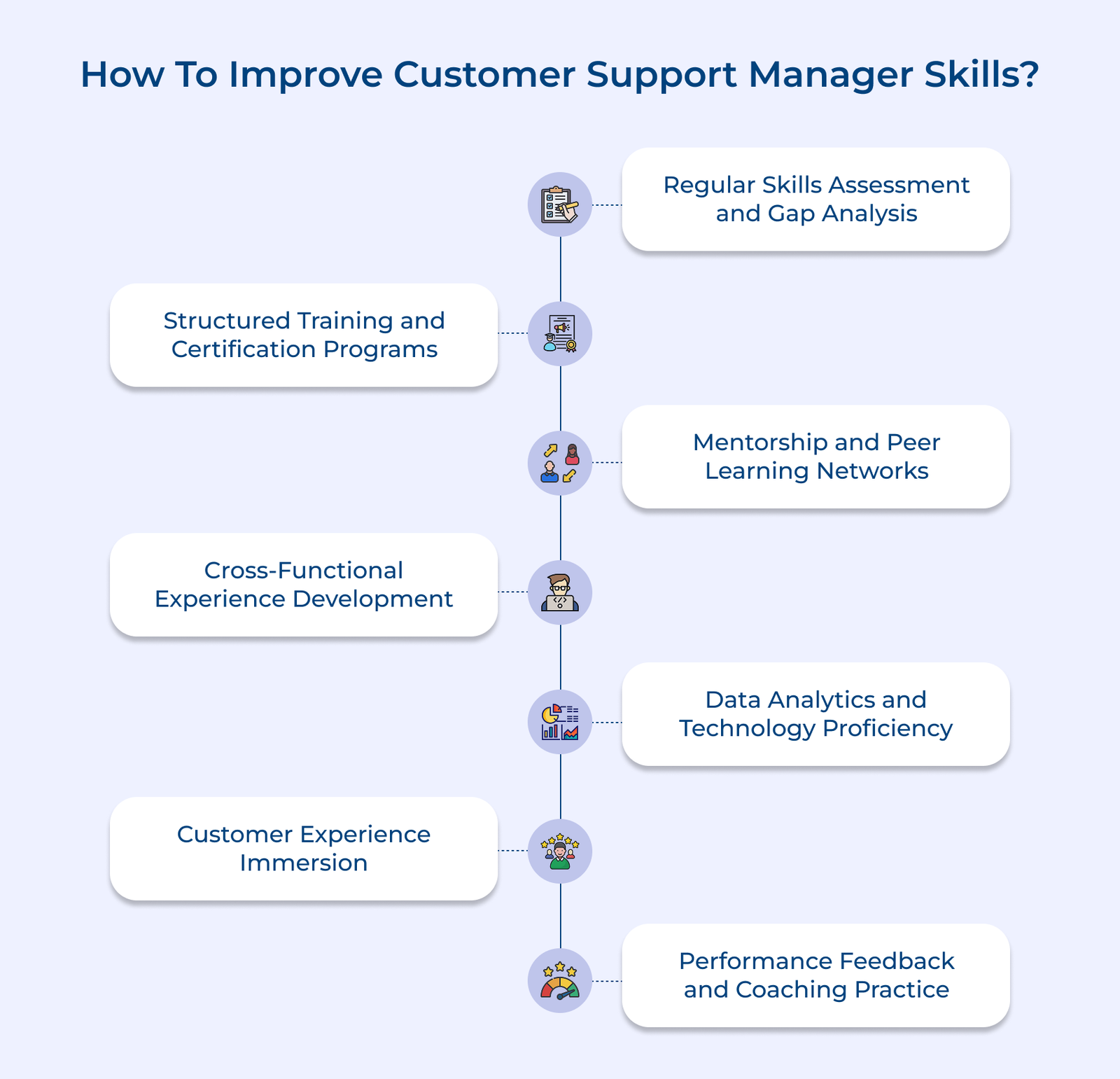
How To Improve Customer Support Manager Skills: 7 Best Practices
Enhancing customer support manager skills is essential for leading teams effectively and delivering outstanding customer experiences. Let us take a look at certain best practices to refine these skills and excel in the role.