What is Customer Intent & How to Use it?
Understanding customer intent helps businesses tailor marketing strategies, improve engagement and increase conversions by addressing customers' needs at the right time with relevant content.

Understanding customer intent helps businesses tailor marketing strategies, improve engagement and increase conversions by addressing customers' needs at the right time with relevant content.
Modern businesses often face the challenge of understanding what customers truly want. Over 25% of businesses are using buyer intent data to deliver ads and campaigns to companies with a high engagement potential. Despite access to vast amounts of customer data, many companies struggle to turn the information into insights that drive sales and satisfaction. It often leads to misaligned marketing, wasted ad spending and frustrated customers. The root cause?
A lack of understanding of customer intent – the driving force behind every interaction with your brand. Enter consumer intent analysis: a game-changing approach that helps decode customer behavior and predict future actions. Businesses can create targeted solutions, deliver personalized experiences and significantly boost conversion rates by uncovering the “why” behind customer actions. We’ll explore how mastering client intent can transform your business strategy.
Customer intent refers to the deeper motivation, needs or goals behind a customer’s actions and purchasing decisions. It reveals what customers truly want to achieve, beyond surface-level behaviors.
Businesses analyze data from various touchpoints like website interactions, search queries, purchase history and feedback. The data uncovers patterns that signal customer motivations.
Key principles:
Let’s go through the importance of customer intent, exploring how understanding it can enhance personalized experiences and drive higher conversion rates.
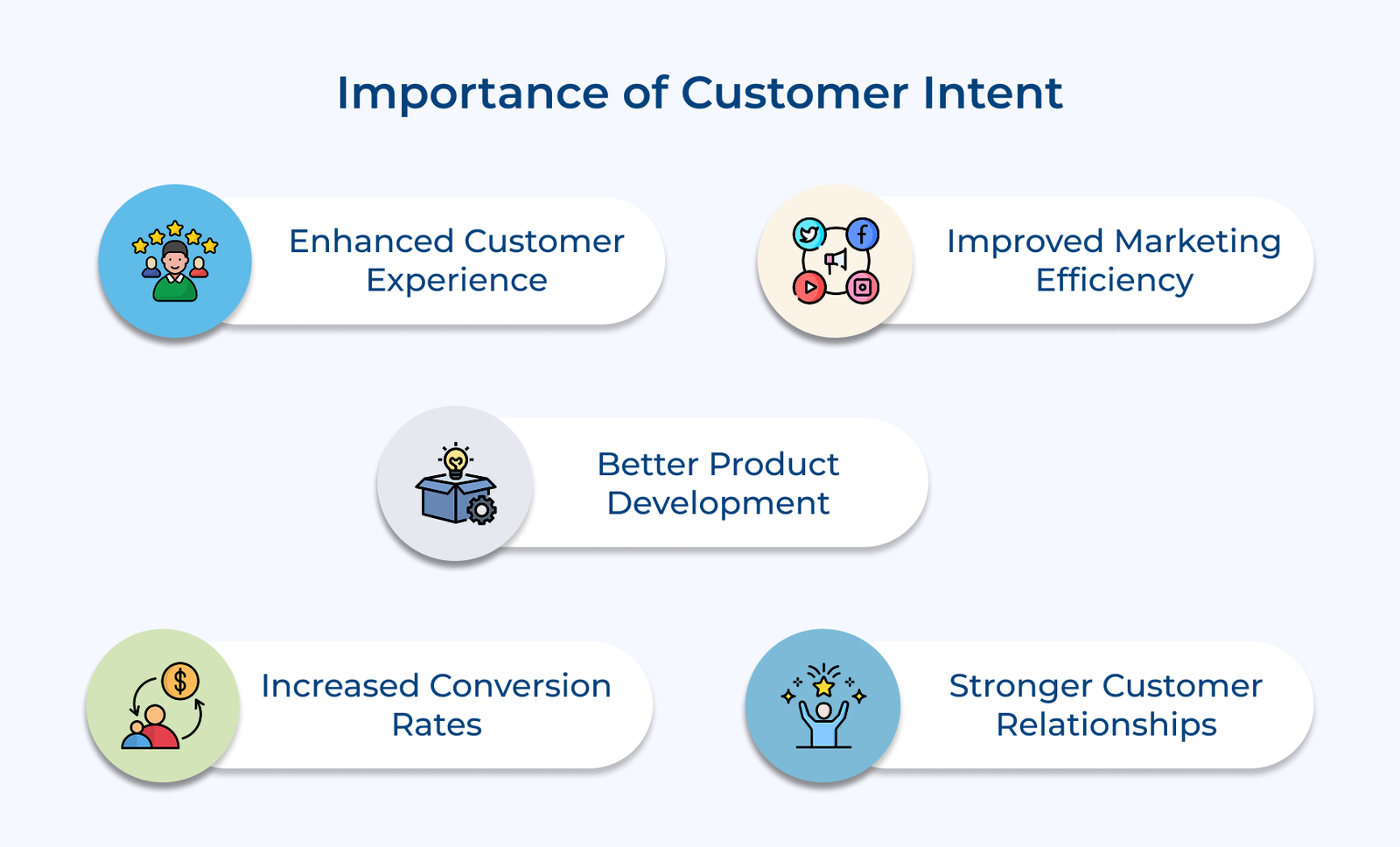
1. Enhanced Customer Experience
Customer intent insights enable businesses to craft seamless, personalized experiences by anticipating needs and eliminating friction. Understanding why customers take certain actions allows companies to design intuitive, natural journeys that boost satisfaction and loyalty.
2. Improved Marketing Efficiency
Aligning marketing strategies with consumer intent allows businesses to optimize spend and create targeted campaigns. Companies can craft messages that resonate with customer needs by understanding intent, driving higher engagement and better ROI.
3. Better Product Development
A deep understanding of client intent drives product development by uncovering what customers truly value. The insight enables companies to create solutions that address pain points and better meet market needs.
4. Increased Conversion Rates
Understanding customer intention allows businesses to predict where customers are in their journey and identify conversion barriers. The insight helps deliver the right information and support at key decision points, boosting conversion rates.
5. Stronger Customer Relationships
Recognizing and responding to consumer intent enables businesses to build stronger, more meaningful relationships. It enhances authentic interactions, showing customers that the company truly understands and values their needs.
Following are four distinct types of intent that reflect different phases of the customer’s decision-making process and interaction with a brand.
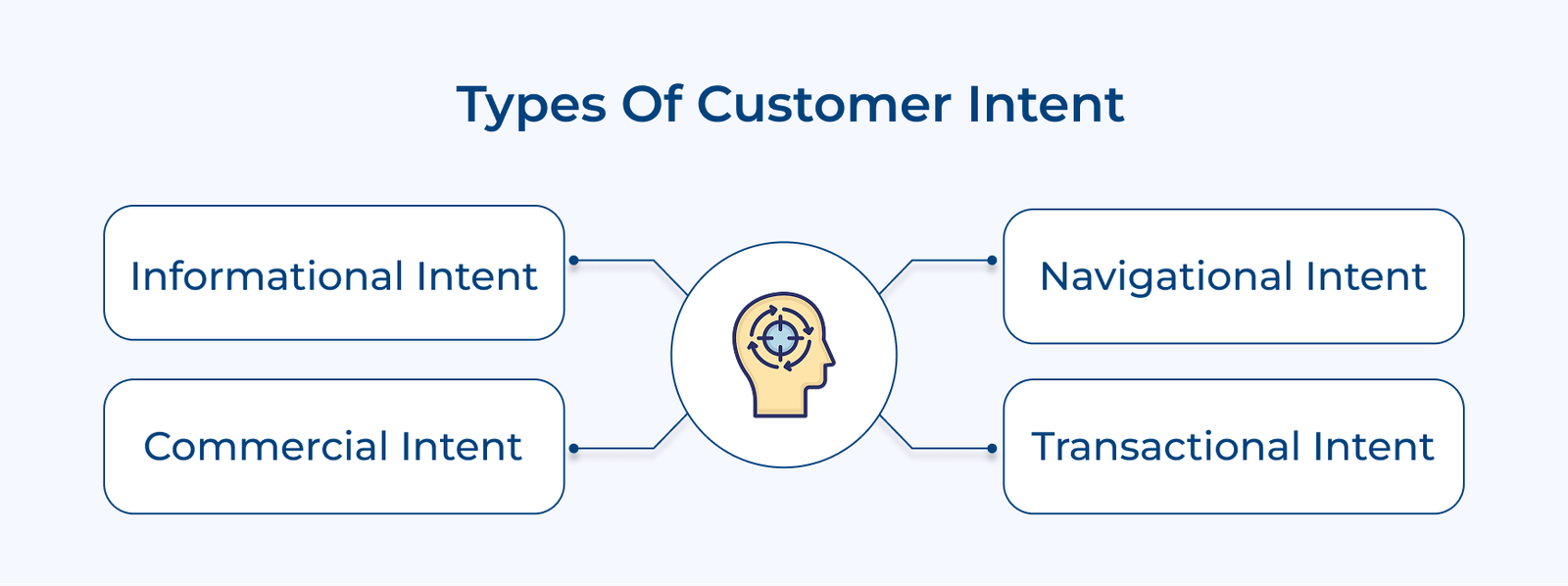
When customers show informational intent, they’re in the early stages of awareness, seeking to learn more about a product, service or solution. They’re gathering insights to better understand their options and make informed decisions.
The stage involves broad research, with customers often using educational search terms and engaging with content like blog posts, how-to guides or videos. Their behavior typically includes longer time spent on informational content and multiple visits to various sources to deepen their understanding.
Navigational intent occurs when customers already know what brand or company they want to engage with and are looking for specific destinations or touchpoints. They have a clear goal but need help finding the exact resource or page.
The customers typically use brand-specific search terms and direct navigation paths. Their behavior shows focused browsing, quick navigation between familiar pages and precise searches for brand-related content or features.
Commercial intent emerges when customers are comparing options and evaluating solutions. They’re past the information-gathering stage but haven’t committed to a purchase yet, focusing on finding the best fit for their needs.
Customers engage with comparison pages, reviews, pricing details and product specifications. Their behavior often includes multiple product views, feature comparisons and reading customer testimonials to help make a final decision.
Transactional intent marks the final stage where potential customers are ready to make a purchase or take a specific action. After completing research and comparison, their focus shifts to completing a transaction or taking definitive steps.
Customers engage heavily with shopping carts, checkout processes and conversion-focused pages. Their behavior includes direct navigation to purchase pages, reviewing pricing as well as shipping information and interacting with buy buttons or conversion forms.
Check out the benefits of understanding buyer intent for SaaS businesses, including improved targeting and higher conversion, leading to better satisfaction.
Customers are looking for educational content to better understand their challenges at the TOFU stage. They might search broad terms like “how to improve team productivity” or “best project management practices” without yet focusing on specific solutions.
SaaS businesses can create valuable content, such as blog posts and guides that address early-stage questions. A project management tool for example, might offer tips on remote team coordination or meeting management. It helps build brand awareness, establish authority and capture leads through newsletter signups or downloadable resources.
Middle-funnel prospects have pinpointed their problems and are actively exploring solutions. They engage with detailed content like product comparisons, webinars and case studies that highlight how various solutions address their needs.
The stage is a great opportunity for SaaS companies to showcase their product’s unique value proposition. Offering free trials, demos or consultation calls can help prospects assess if your solution is the right fit.
Bottom-funnel prospects are ready to make a purchase decision, seeking specific details about costs, technical requirements and ROI to justify their choice. Businesses should focus on providing in-depth product documentation, customer success stories and ROI calculators.
Sales engagement becomes crucial here as the buyer intent signals help sales teams prioritize high-potential leads such as those requesting enterprise pricing, viewing multiple case studies or attending demos. The actions indicate strong purchase intent, allowing sales teams to focus their efforts on prospects most likely to convert.
Check out eight powerful ways to identify customer intent and use it strategically to refine your marketing approach.
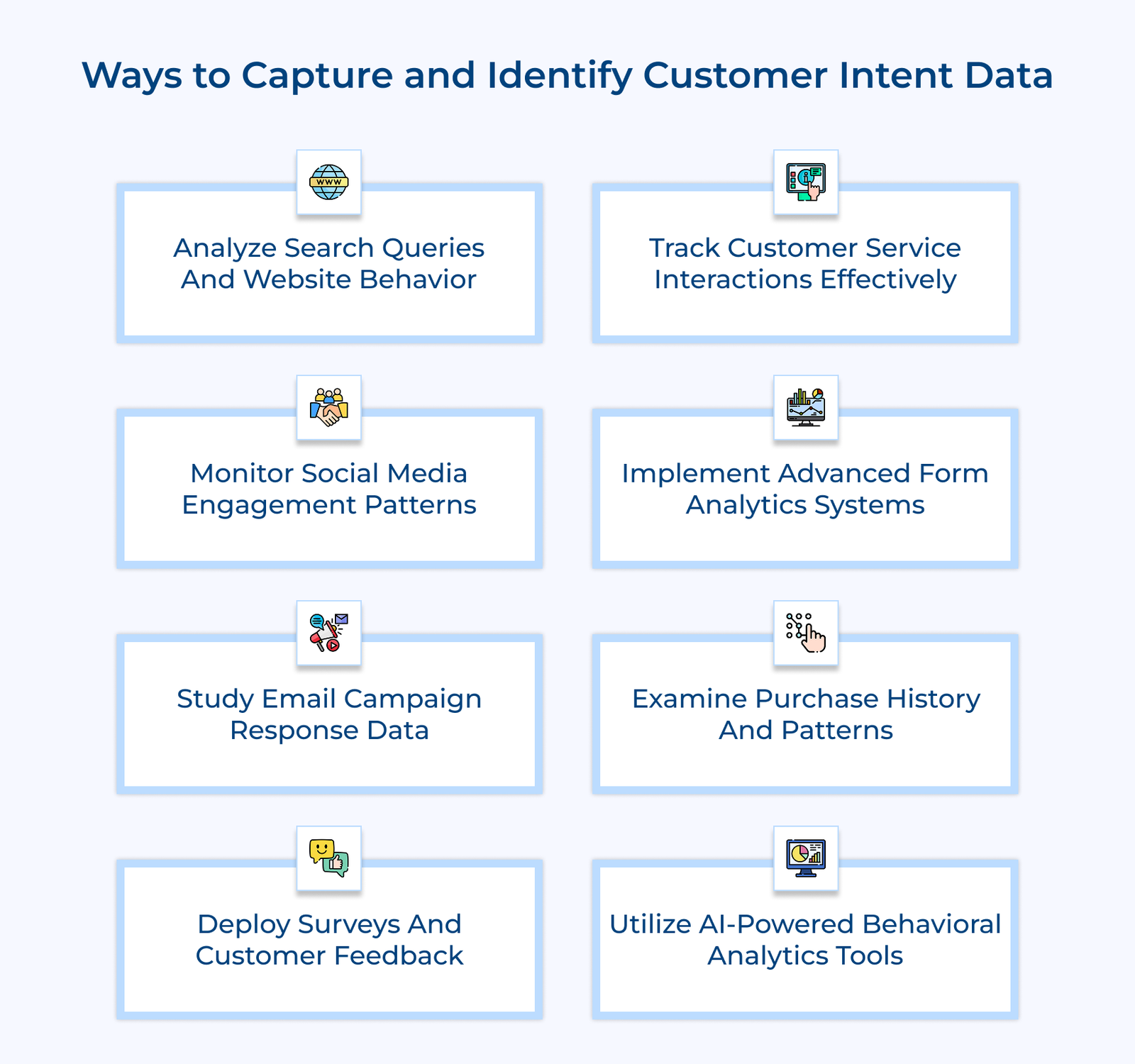
Understanding how users interact with your website through search patterns and browsing behavior offers valuable insights into their needs. The data helps businesses determine what customers are looking for and how easily they can find it on your site. Tracking on-site search terms reveals customer needs and vocabulary preferences.
Analyzing page navigation and click paths helps identify user journey obstacles. A customer spending a lot of time on product comparison pages before leaving might signal a need for clearer differentiation or additional comparison tools.
Pro tips:
Customer service interactions offer valuable voice-of-customer data, revealing immediate needs and pain points. The conversations provide unfiltered insights that can guide product development and marketing strategies. Recording common questions helps pinpoint gaps in your content and messaging.
Analyzing support tickets and chat transcripts also uncovers recurring themes. Imagine if a huge amount of customers ask for integration with a specific tool, it suggests you should prioritize that development and highlight it in marketing campaigns when it’s launched.
Actionable tips:
Social media interactions offer valuable insights into customer sentiment and brand perception across various platforms. The direct feedback helps businesses understand how customers view their brand and what sparks engagement in different contexts.
Brand mentions and sentiment analysis uncover customers’ emotional connection with your brand. You can adjust your marketing to align with customer emotions and address negative perceptions through targeted campaigns by understanding the tone of conversations.
Best practices:
Form analytics provide deep insights into how users interact with conversion points and identify obstacles in the submission process. The data is essential for optimizing conversion rates and enhancing the user experience.
Measuring completion rates and analyzing hesitation patterns helps pinpoint which form elements cause friction. Understanding correction patterns and drop-off points reveals which fields confuse or frustrate users. You can optimize form design, improve field placement and implement better validation methods to guide users toward successful form completion.
Key takeaways:
Email campaign analytics offer valuable insights into audience preferences and engagement patterns, helping businesses refine their email marketing strategy for better engagement. Open and click patterns highlight optimal sending times as well as content types.
Assume there’s a B2B software company that gets higher engagement when they send out their product update emails on Tuesday mornings rather than Friday afternoons. So now they need to adjust their schedule to ensure they get the most engagement out of their emails.
Pro tips:
Analyzing purchase history reveals customer buying decisions and preferences. It helps businesses in helping businesses forecast demand and manage inventory more efficiently. Analyzing seasonal buying trends enables businesses to prepare targeted campaigns ahead of peak periods.
You can adjust your marketing budget and messaging to make the most of the buying cycles by identifying high-demand products during specific times. Product combination analysis uncovers cross-selling opportunities, allowing businesses to create effective bundles and personalized recommendations based on actual customer behavior.
Best practices:
Customer surveys and feedback mechanisms provide valuable, structured insights directly from your target audience. The approach helps businesses make data-driven decisions for product development and marketing strategies while staying attuned to evolving customer needs.
Post-purchase satisfaction surveys reveal key drivers and pain points. Let’s assume that if customers consistently rate your onboarding process poorly, you can create targeted content or video tutorials to address common challenges. Net promoter score tracking and feature feedback further illuminate satisfaction trends, helping businesses align marketing messages with customer expectations.
Best practices:
Advanced AI analytics tools turn raw data into actionable insights by uncovering patterns that may go unnoticed. The tools empower businesses to predict customer behavior and personalize marketing efforts at scale, ensuring consistency across all touchpoints.
Predictive customer modeling identifies high-value prospects and potential churners by analyzing behavior patterns. AI segments users based on their likelihood to convert or churn, enabling targeted campaigns with tailored messaging and timing.
Pro tips:
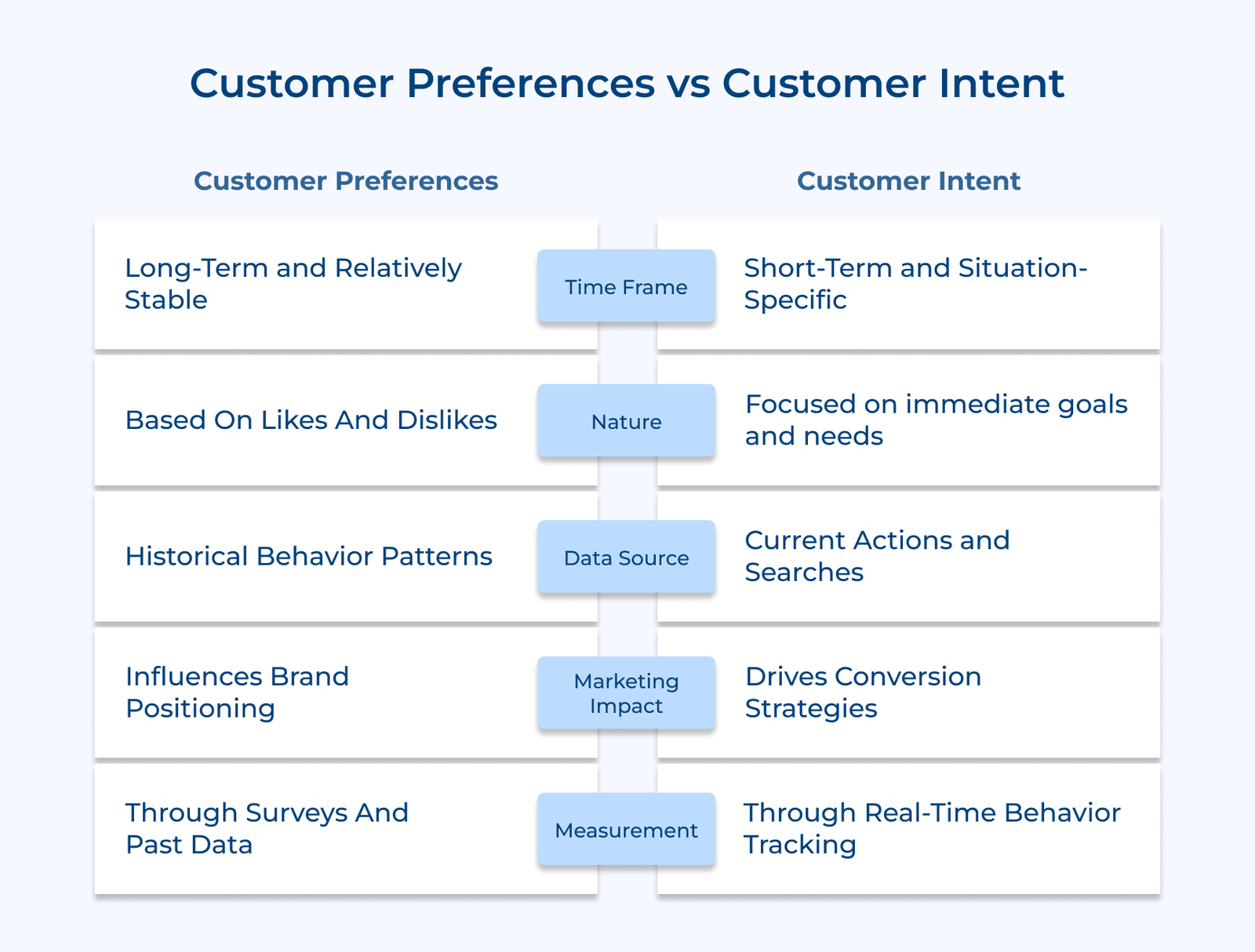
Following are the key differences between customer preferences and customer intent, highlighting how each influences purchasing behavior.
1. Time Frame and Stability
Customer preferences are established over time through experiences and personal tastes, remaining relatively stable. They play a key role in long-term brand loyalty and product selection.
Customer intent reflects the immediate goal behind a specific interaction. It can change quickly due to factors like urgency, seasonal needs or special occasions, influencing current shopping behavior.
2. Nature of Information
Preferences represent general likes and dislikes that shape brand perceptions or product choices, forming the foundation of customer relationships as well as guiding businesses in targeting broader market segments.
Intent reveals the specific goals or problems customers aim to address at the moment. It offers actionable insights into immediate needs, enabling businesses to provide relevant solutions when it matters most.
3. Data Collection Methods
Customer preferences are gathered through historical data, loyalty programs and feedback like surveys, building over time to form detailed customer profiles.
Intent data comes from real-time interactions such as search queries, website behavior and engagement patterns. It requires prompt analysis and response to seize opportunities while they are relevant.
4. Impact on Marketing Strategy
Preference data guides brand positioning, product development and long-term marketing strategies, influencing decisions on product features, pricing or brand messaging.
Intent data fuels tactical marketing efforts like real-time personalization, content recommendations and conversion optimization, enabling businesses to capitalize on immediate opportunities with relevant offers.
5. Measurement and Analysis
Preferences are measured through structured feedback, purchase history and stated customer choices, offering stable insights that guide strategic planning.
Intent is tracked using behavioral analytics, real-time interaction and engagement metrics. It requires advanced tracking systems and swift responses to capitalize on immediate opportunities.
Let’s go through the role of AI in understanding customer intent and exploring how the technologies help businesses respond to customer needs in real-time.
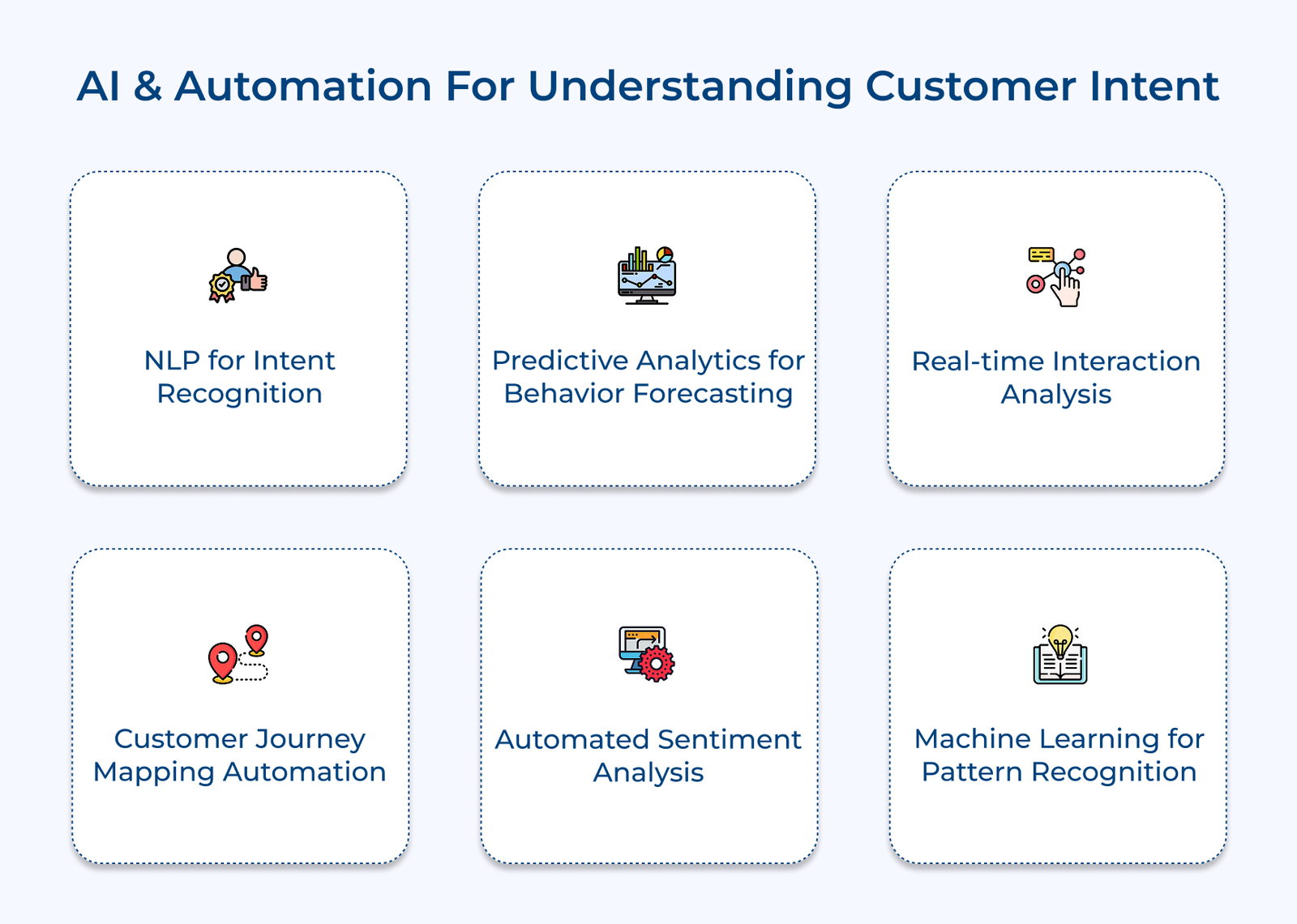
AI-powered NLP systems analyze customer communications across multiple channels to uncover underlying meanings and goals. The systems go beyond keyword matching, understanding context and emotional tones in emails, social media or chat conversations.
AI systems leverage historical data and current behavior patterns to predict future customer needs. Businesses can proactively deliver personalized offers by analyzing past purchases, browsing habits and interactions.
Automated systems track and analyze customer interactions in real time across multiple touchpoints. The tools track website navigation, form submissions and chat engagements. It enables businesses to provide timely support and relevant content exactly when it’s needed.
AI tools automatically analyze complex customer journeys across various channels, identifying common paths, bottlenecks and decision points. It helps businesses understand how customer intent evolves during brand interactions.
AI-powered sentiment analysis tools assess customer feedback across reviews, social media and support tickets, gauging emotional responses. The analysis uncovers how customers feel about products, features or experiences, helping to reveal their true intent.
Advanced machine learning algorithms continuously refine intent recognition by identifying subtle patterns and correlations in customer behavior. The ongoing learning process ensures businesses stay in tune with evolving customer needs and preferences.
Check out the following customer intent examples to better understand how different behaviors and actions reveal what customers are truly looking for.
1. Amazon’s Predictive Shopping Model
Amazon uses advanced algorithms to analyze browsing patterns, search history and purchase behaviors. The company tracks micro-interactions like product views, wish list additions and cart abandonments to measure customer intent at various stages.
The in-depth understanding allows Amazon to deliver personalized shopping experiences and targeted recommendations. Their ability to predict customer needs has led to increased customer loyalty, higher average order values and enhanced satisfaction through relevant product suggestions.
2. Netflix’s Content Recommendation Engine
Netflix analyzes viewer behavior including watching patterns, pause points, show completion rates and content ratings to understand entertainment intent. They also track viewing times, device usage, and navigation across genres.
Netflix has reshaped its content creation and recommendation strategy by focusing on viewer intent. They now produce shows based on identified preferences, while their recommendation engine helps users quickly find content, reducing search time and boosting engagement.
3. Spotify’s Discover Weekly Feature
Spotify tracks listening patterns, playlist creation, song skips and saves to understand music discovery intent. They analyze interactions with genres, time-of-day listening and social sharing to capture individual preferences.
The intent-driven approach transformed music discovery, boosting engagement, platform loyalty and subscription retention. Personalized playlists and recommendations also help artists reach their target audience more effectively.
4. Starbucks’ Mobile Order System
Starbucks analyzed customer purchase timing, store visit patterns and mobile app usage to understand convenience intent. They identified peak hours, customer flow and drink preferences to optimize ordering.
The mobile order system that emerged from the analysis streamlined the experience, reducing wait times, improving order accuracy and enhancing customer satisfaction. It also helped stores manage capacity more efficiently during peak hours.
5. Nike’s Personal Shopping Experience
Nike analyzed customer workout data, purchase history and browsing behavior through their apps and website to understand athletic wear shopping intent. They studied how customers research, review and engage with products across categories.
The deep insight enabled personalized recommendations and tailored shopping experiences. Nike’s intent-focused approach has strengthened customer relationships, improved product development and created more effective marketing campaigns that resonate with specific segments.
Understanding customer intent is now a vital element of successful business strategies. Businesses can uncover the true motivations driving customer decisions by harnessing advanced analytics, behavioral data and direct feedback. It goes beyond demographics or historical data, revealing what truly shapes customer interactions with your brand.
Identifying and acting on consumer intent transforms everything from product development to marketing strategies. Companies that master intent analysis can create personalized experiences, eliminate friction in the customer journey and build stronger, more profitable relationships. The proactive approach not only keeps businesses ahead of market trends but also enhances customer loyalty.
Key takeaways:

Purchase intent represents a consumer’s planned or predicted future buying behavior based on their current needs, desires and interactions with a brand. It encompasses both the immediate readiness to make a purchase and the longer-term consideration process. Understanding purchase intent helps businesses predict customer behavior and tailor their marketing strategies accordingly, moving customers smoothly through the buying journey.
Businesses can uncover customer intent through multiple data points and analysis methods. It includes studying search intents, analyzing website behavior patterns like page views and time spent, monitoring social media interactions and examining past purchase history. Surveys, customer interviews and heat mapping tools provide additional insights. The key is combining these various signals to create a comprehensive picture of what customers truly want to accomplish.
Customer intent fundamentally shapes modern SEO strategy by influencing content creation, keyword targeting and page structure. When people search online, they typically have one of four intents: informational (wanting to learn), navigational (looking for a specific site), commercial (researching products) or transactional (ready to buy). Understanding and aligning content with these intent types helps websites appear in the most relevant searches.
Businesses can enhance conversions by aligning their entire customer journey with identified intent signals. It means creating targeted content that matches where customers are in their decision process, personalizing website experiences based on behavior patterns and adjusting marketing messages to address specific customer needs. Proper intent mapping helps deliver the right message at the right time.
Customer intent varies significantly across different channels based on how people typically use each platform. Social media users might be in discovery mode, while search engine users often have specific goals. Email engagement suggests different intent than direct website visits. Understanding these channel-specific patterns helps businesses tailor their approach and messaging to match the typical user mindset in each space.

Grow Customer Relationships and stronger team collaboration with our range of products across the Conversational Engagement Suite.
Omnichannel Customer Support & Help Desk Software
AI Enabled Business Messaging and Chatbot Software
Sales Engagement & CRM Software
Call Center Software & Virtual Phone System
Product Marketing & Experience Platform
Customer Experience & Feedback Management Software

 How To Design a Customer Experience Survey: 8 Steps
Scroll to top
How To Design a Customer Experience Survey: 8 Steps
Scroll to top