1. Tokenization
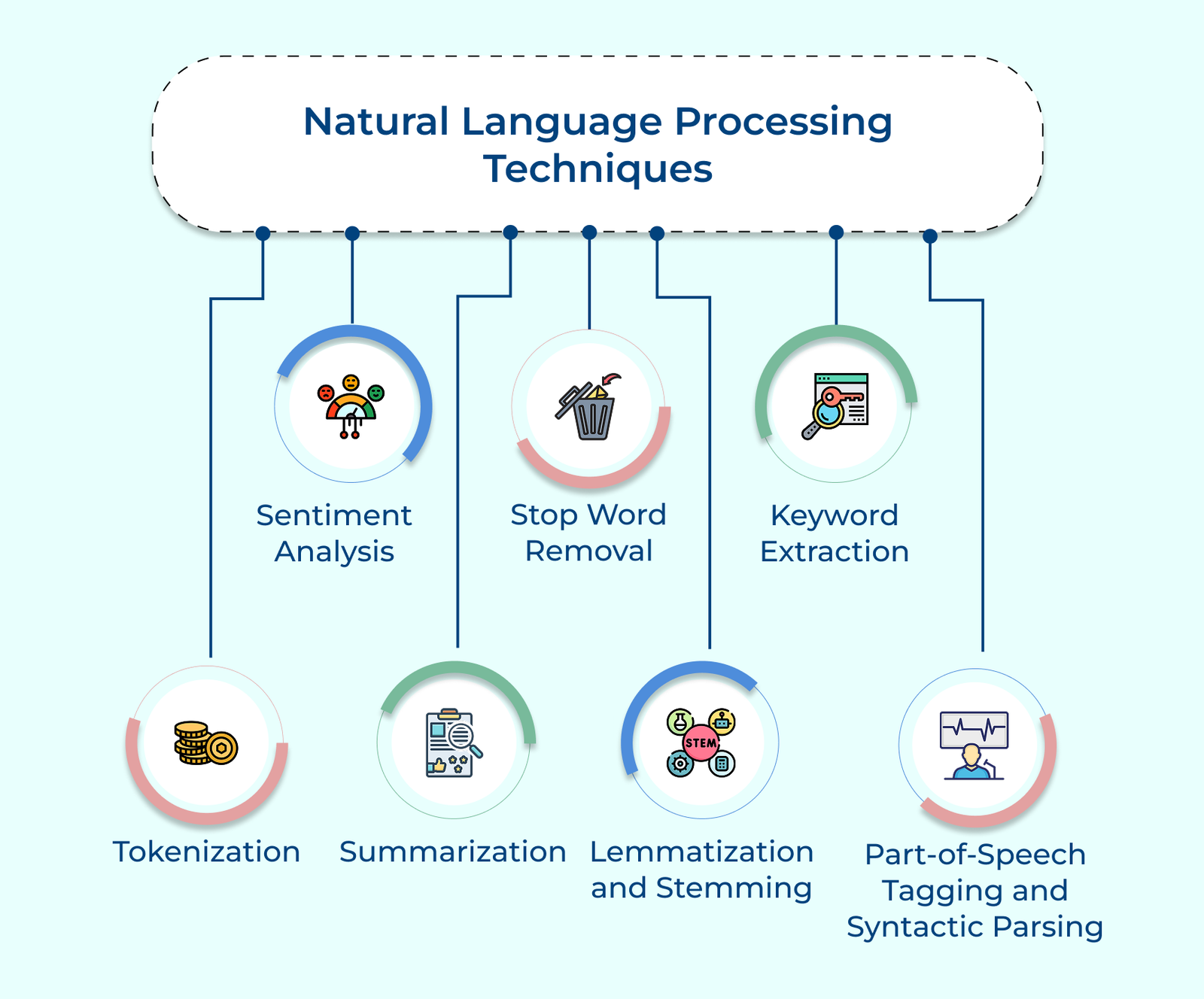
Tokenization is a key step in NLP that breaks text into smaller, meaningful units called tokens. The process splits text into words, sentences or subwords, allowing computers to analyze each unit independently or in context. Tokenization can vary from character level to word level, with advanced methods like Byte-Pair Encoding (BPE) or WordPiece handling out-of-vocabulary words and reducing vocabulary size.
Example:
Input text: “She loves reading books!”
Tokens: [“She”, “loves”, “reading”, “books”, “!”]
2. Stop Word Removal
Stop word removal filters out common, meaningless words like “the,” “is,” “at,” and “which” that appear frequently but don’t add much value to the text’s meaning. We reduce noise and focus on the key content that carries the main message by eliminating the words. The process involves using a predefined list of stop words for each language, improving efficiency and reducing text data complexity for NLP tasks.
Example:
Input: “The cat is sitting on the mat”
After stop word removal: “cat sitting mat”
3. Lemmatization and Stemming
The techniques reduce words to their root form, enhancing text analysis by standardizing language. Stemming removes word endings based on a set of rules, often leading to truncated, sometimes inaccurate words. While faster, it may produce meaningless stems but is useful for quick normalization. Lemmatization is more accurate, using vocabulary and context to return the correct base form, ensuring proper words but requiring more computational power.
Example:
Original words: “running”, “runs”, “ran”
Stemming: “run”, “run”, “ran”
Lemmatization: “run”, “run”, “run”
4. Part-of-speech Tagging and Syntactic Parsing
The techniques focus on understanding the grammatical structure of text and word relationships. Part-of-speech (POS) tagging assigns categories (noun, verb, adjective, etc.) to each word, clarifying ist role in a sentence. The analysis is essential for more advanced NLP tasks. Syntactic parsing takes it a step further, analyzing sentence structure and creating parse trees to illustrate word relationships, helping computers grasp sentence construction.
Example:
Sentence: “The black cat chases mice”
POS tags: [(“The”, DET), (“black”, ADJ), (“cat”, NOUN), (“chases”, VERB), (“mice”, NOUN)]
5. Keyword Extraction
Keyword extraction identifies the most relevant words or phrases in a text using statistical methods and linguistic rules. Techniques like TF-IDF, TextRank or RAKE analyze word frequency and relationships to determine importance. The process helps pinpoint key topics for tasks like indexing, summarization or topic modeling by combining frequency analysis, position and word context.
Example:
Text: “Artificial intelligence is revolutionizing healthcare through improved diagnosis and treatment planning.”
Keywords: [“artificial intelligence”, “healthcare”, “diagnosis”, “treatment planning”]
6. Sentiment Analysis
Sentiment analysis gauges the emotional tone of the text, classifying it as positive, negative or neutral. It accounts for context and linguistic nuances, from words to full documents. Advanced models can detect sarcasm and multiple emotions within one text, leveraging deep learning to understand complex language patterns.
Example:
Text: “The product exceeded my expectations and made my life easier!”
Sentiment: Positive (confidence: 0.92)
7. Summarization
Text summarization condenses longer content while retaining key details. Extractive summarization pulls important sentences directly from the text, ensuring accuracy and simplicity. Abstractive summarization rephrases the content, generating more natural, concise summaries by capturing the essence of the original text.
Example:
Original text: “The company reported strong Q4 earnings, with revenue up 15% year-over-year. Operating expenses decreased by 5%, while customer satisfaction scores improved by 10 points.”
Summary: “Company showed strong performance with increased revenue and improved efficiency.”
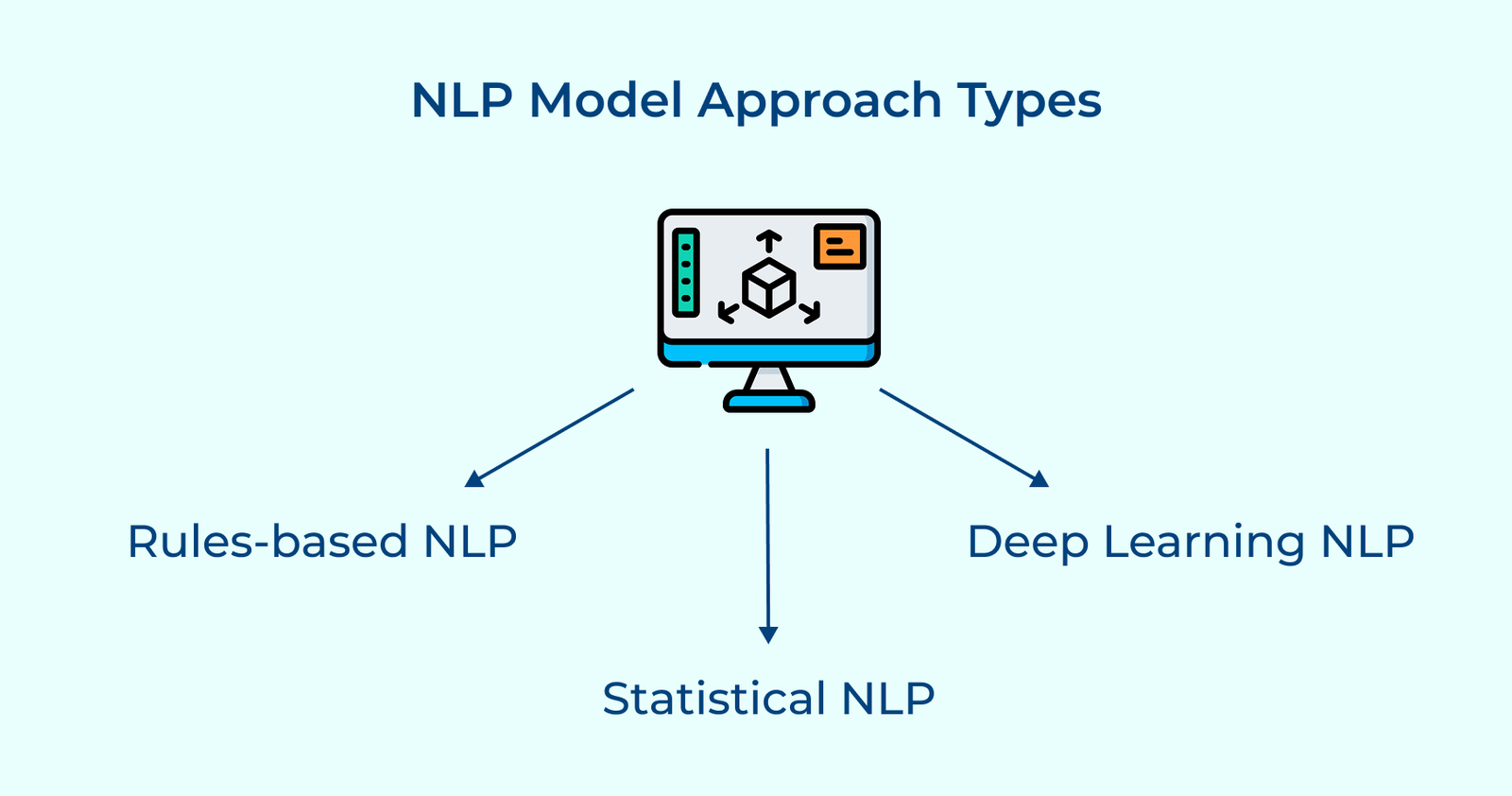
Types of NLP Model Approach
Following are the main approaches that have evolved, representing the progression of NLP technology from simple rule-based systems to sophisticated deep learning models.