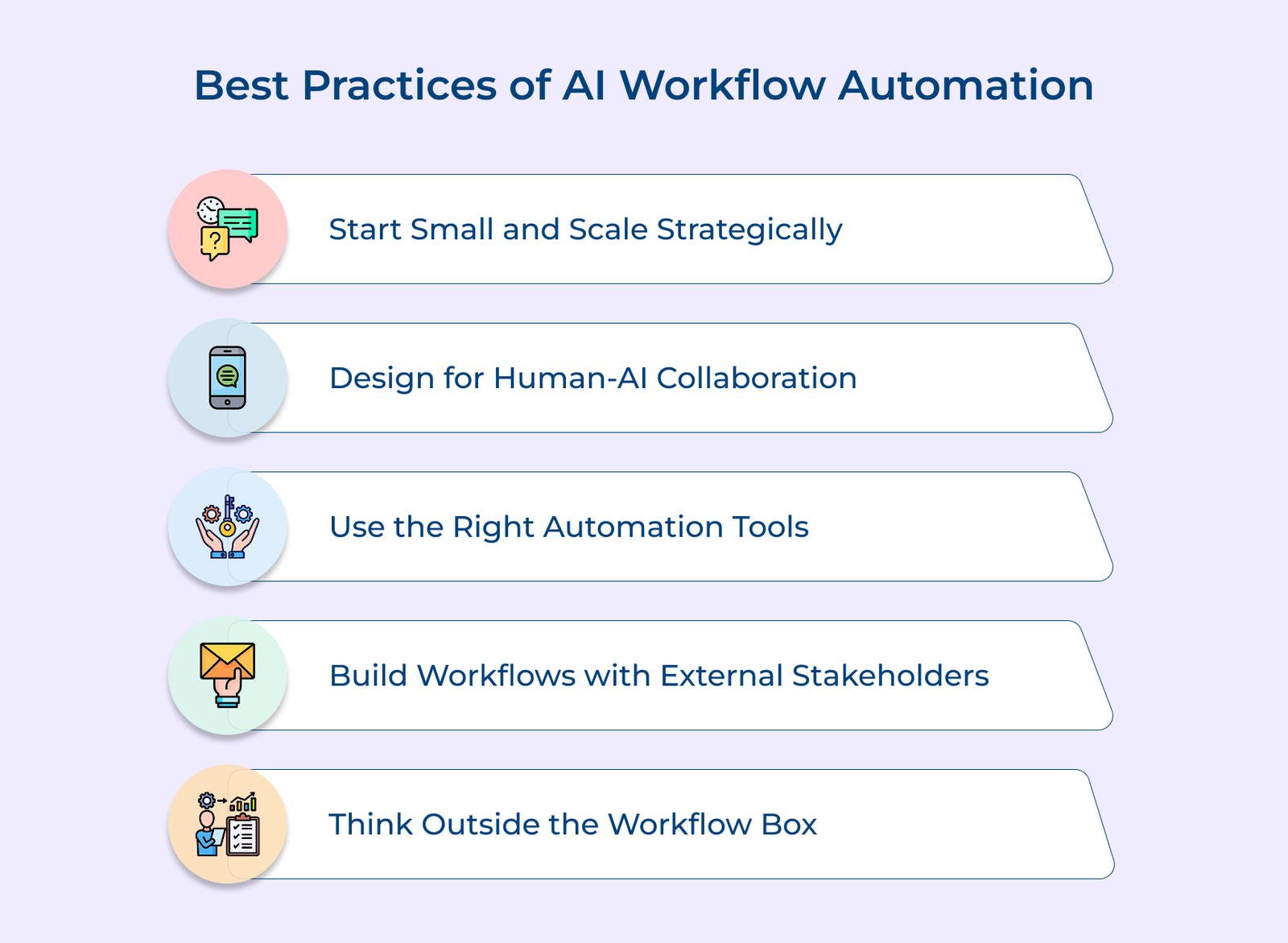
1. Start Small and Scale Strategically
Start by automating straightforward processes with clear success metrics. Tackle one workflow at a time to build expertise and confidence. Document key learnings after each implementation phase to refine your approach. Create a scalable framework that can be replicated across other processes.
2. Design for Human-AI Collaboration
Create workflows that leverage the strengths of both humans and AI. Set clear handoff points between automated and manual tasks, ensuring smooth transitions. Create user-friendly interfaces for human intervention when necessary. Enhance trust by maintaining transparency in AI decision-making processes.
3. Use the Right Automation Tools in the Right Places
Tailor automation tools to meet the specific needs of each process. Avoid over-automating simple tasks that are better suited for human intervention to maximize efficiency. Implement AI only where it adds significant value. Regularly evaluate tool effectiveness against process goals.
4. Build Workflows with External Stakeholders in Mind
Consider the impact on customers, suppliers and partners. Craft workflows that are intuitive for external stakeholders to engage with. Establish clear communication channels for real-time updates, ensuring automation enhances both efficiency and professional relationships.
5. Think Outside the Workflow Box
Look beyond traditional process boundaries for automation opportunities. Focus on optimizing entire workflows, not just individual tasks. Look for creative ways to integrate and connect various processes for seamless, end-to-end automation. Identify opportunities for cross-functional automation that can create new value.
AI Workflow Automation Examples
Let’s explore five real-life examples of organizations that embraced AI workflow automation and reaped the rewards, illustrating how the innovative approach can propel your business toward greater success.
1. Amazon’s Supply Chain Management
Amazon leverages AI workflow automation throughout its expansive supply chain, predicting demand trends, dynamically adjusting inventory levels and streamlining warehouse operations for maximum efficiency. AI algorithms manage routing optimization for deliveries while automating supplier communications and order processing workflows.
The automated system has slashed order fulfillment times and boosted inventory accuracy, leading to a substantial increase in warehouse efficiency. Customer satisfaction has improved due to faster deliveries and more accurate delivery time predictions.
2. JPMorgan Chase’s COIN (Contract Intelligence) Platform
JPMorgan implemented an AI workflow to review commercial loan agreements. The system seamlessly analyzes legal documents, extracting key terms and ensuring compliance with regulations. It streamlines document routing and approval processes while flagging exceptions for human review when necessary.
The bank has drastically cut down the time spent on document review and contract analysis. Error rates in contract processing have decreased substantially while compliance accuracy has improved. Legal teams can focus on complex cases requiring human expertise.
3. Netflix’s Content Management System
Netflix leverages AI workflows to streamline content tagging categorization and metadata management. The system effortlessly processes new content, generates relevant tags and manages content distribution workflows. It also automates quality control processes for various streaming formats, ensuring a seamless viewing experience for users.
Content processing efficiency has improved dramatically with reduced manual intervention. The platform now offers highly precise content recommendations, ensuring consistent quality across all devices. Content management resources are allocated more efficiently, optimizing both performance and operational efficiency.
4. UPS’s Delivery Optimization System
UPS has harnessed AI-driven workflow automation to streamline route optimization and delivery planning. The system effortlessly processes delivery requests, dynamically adjusts routes based on real-time factors and ensures seamless coordination for every delivery. It coordinates between drivers warehouse operations and customer communications.
Delivery efficiency has soared, with notable reductions in both fuel consumption and delivery times. The customer base now enjoy more accurate delivery predictions, leading to higher satisfaction. Operational costs have dropped at the same time, while delivery capacity has grown, driving greater efficiency.
5. Mayo Clinic’s Patient Care Management
Mayo Clinic leverages AI workflows to streamline patient scheduling, diagnostic test ordering and medical record management. The system seamlessly coordinates between departments, efficiently schedules appointments and automatically directs test results to the relevant healthcare providers, ensuring smoother operations.
Patient wait times have been drastically reduced, while resource utilization has been optimized. Healthcare providers now have more time to dedicate to patient care, as administrative burdens are significantly minimized. The quality of patient care has improved through better coordination and faster processing.
Transform Chaos into Clarity with AI Workflow Automation
Organizations today are grappling with growing complexity in managing processes and data. AI workflow automation stands out as a game changing solution, turning chaotic operations into streamlined, high-efficiency workflows, minimizing human error and boosting productivity.
AI-powered workflows are transforming industries across the board, from revolutionizing patient management in healthcare to optimizing inventory control in retail and enhancing risk assessment in financial services. It enables businesses to handle complex tasks with greater accuracy, provide better customer experiences and make data-driven decisions while maintaining security standards.
Key takeaways:
- AI-powered workflow management can cut operational costs by as much as 60%, transforming the way businesses operate.
- Successful implementation requires a strategic approach focusing on clear objectives, proper tool selection, and continuous optimization.
- Organizations must prioritize data quality while striking the right balance between automation and human oversight to maximize ROI.