1. 40% of Consumers Now Prefer Self-Service Over Human Contact for Future Interactions with Companies
The statistic highlights a major shift in customer behavior, with a growing number of people preferring automated solutions over human assistance. The trend spans multiple industries, signaling a wider cultural shift toward digital independence in customer service.
Businesses must invest in advanced self-service tools such as chatbots, interactive guides and automated processes. The solutions must be both sophisticated enough to handle complex queries and user-friendly to meet customers’ increasing preference for digital, on-demand support.
2. By Implementing Self-Service Knowledge Bases, Companies Can Reduce their Cost Per Contact by Up to 95%
The statistic highlights the powerful cost-saving potential of implementing a knowledge base. Businesses can handle more inquiries efficiently by reducing the need for support staff and operational expenses, leading to significant savings.
The savings generated can be reinvested into enhancing other customer service areas or expanding self-service tools, creating a continuous cycle of improvement and greater customer satisfaction.
3. 67% of Customers Prefer Self-Service Over Speaking to a Company Representative
The statistic reveals that two-thirds of customers prefer self-service options, driven by a desire for quick, autonomous solutions without the hassle of waiting or repeating issues to a representative.
The statistic highlights the importance of investing in a variety of self-service tools, such as automated phone systems, online portals and mobile apps. Meeting the customer demand can boost satisfaction while easing the burden on customer service teams.
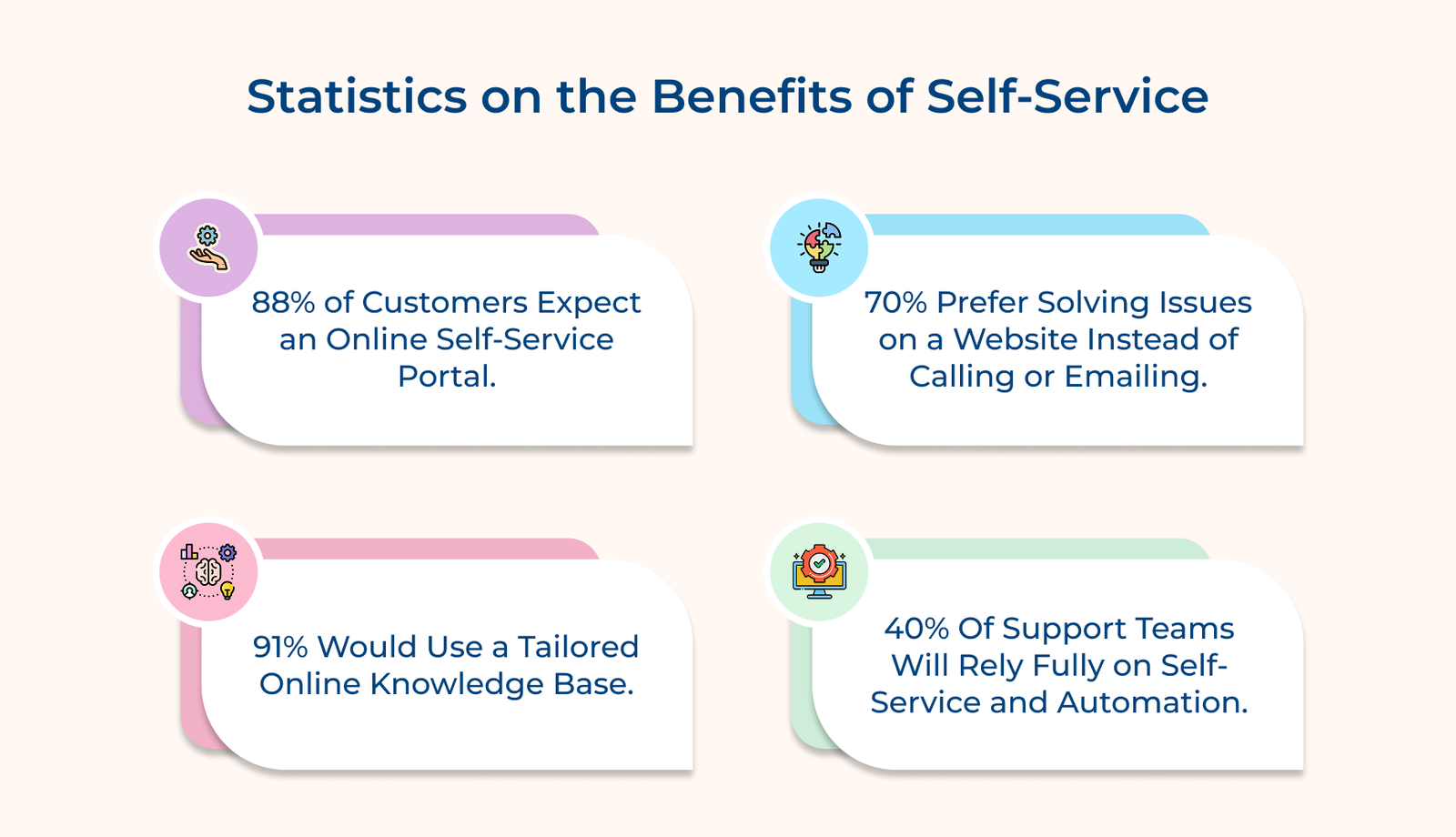
4. 90% of Consumers Expect Companies to Offer an Online Self-Service Customer Support Portal
The statistic highlights how self-service has shifted from a luxury to a basic expectation. Customers now consider self-service portals essential for interacting with a company, much like having a website or phone number.
The stat means that offering self-service options is no longer optional. Companies that fail to implement the capabilities risk falling behind and losing customers to competitors who meet the growing expectations.
5. 70% of Customers Use Company Chatbots Regularly for Simple Inquiries
The statistic underscores the increasing comfort customers have with AI-powered chatbots for basic support. The high usage rate shows that automated systems are becoming a trusted resource for handling straightforward questions and tasks.
The stat highlights the value of investing in advanced chatbot technology. Developing intelligent chatbots that can efficiently resolve common issues while seamlessly escalating complex queries to human agents will enhance the self-service experience.
The statistic highlights the strong link between quality self-service options and higher customer satisfaction. The notable increase in satisfaction demonstrates that customers not only prefer but truly value effective, easy-to-use self-service solutions.
Companies should prioritize building intuitive, accessible or well-designed self-service tools to ensure they meet customer expectations and drive satisfaction.
7. 85% of Customer Interactions are Expected to be Handled Without a Human Agent by 2026
The statistic signals a major shift toward automation and self-service shortly, with most customer service interactions set to be handled through self-service channels rather than by human agents.
Businesses must proactively invest in AI, machine learning and automated support systems. Building strong self-service infrastructure now will help companies meet the growing demand for efficient, digital-first customer support.
8. 45% of Organizations that Offer Web or Mobile Self-Service Reported an Increase in Site Traffic and Reduced Phone Inquiries
The statistic highlights the dual advantages of self-service: boosting digital engagement while lowering support costs. The decrease in phone inquiries as self-service options increases shows that customers prefer digital solutions when available.
Businesses should invest in both web and mobile self-service options, ensuring they are optimized for easy access across platforms. The approach will enhance user experience and drive greater adoption of self-service tools.
9. 60% of Customers Expect Real-Time Assistance through Self-Service Tools
The statistic underscores the growing demand for instant support through self-service channels. Over half of customers expect immediate answers and solutions at any time, making real-time support a critical need.
Businesses must prioritize 24/7 self-service options. Investing in online chatbots, instant knowledge bases and automated solutions will ensure customers can find quick resolutions, anytime they need them.
10. 75% of Customers Say Self-Service is a Convenient Way to Address Customer Service Issues
The statistic highlights how much customers value convenience in service. Three-quarters of them prefer resolving issues on their schedule, emphasizing the importance of self-service options.
Organizations should create easy-to-use, accessible self-service solutions that cover a broad range of common issues. Prioritizing user convenience will enhance satisfaction and reduce reliance on customer service teams.
11. Companies with Strong Omnichannel Customer Engagement Retain an Average 89% of their Customers
The statistic highlights the significant role self-service plays in customer retention. When integrated with other support channels, self-service can drive customer loyalty by providing seamless and efficient solutions.
Businesses must ensure their self-service options are well-integrated with human support channels. It creates a consistent, high-quality experience that boosts satisfaction and encourages long-term customer loyalty.
12. Organizations Can See an 85% Reduction in Customer Service Costs after Implementing Self-Service Solutions
The cost-saving statistic underscores the financial benefits of self-service solutions. Companies can handle a higher volume of inquiries while cutting operational costs by reducing reliance on live support staff and streamlining operations.
The savings make self-service a smart investment for businesses aiming to scale efficiently. The reduced costs can be reinvested into enhancing customer service or expanding self-service capabilities, creating a cycle of continuous improvement.
Key Stats Customer Self-Service Challenges
Check out the following self-service stats that reveal the common challenges customers face with such solutions.