1. Purpose and Function
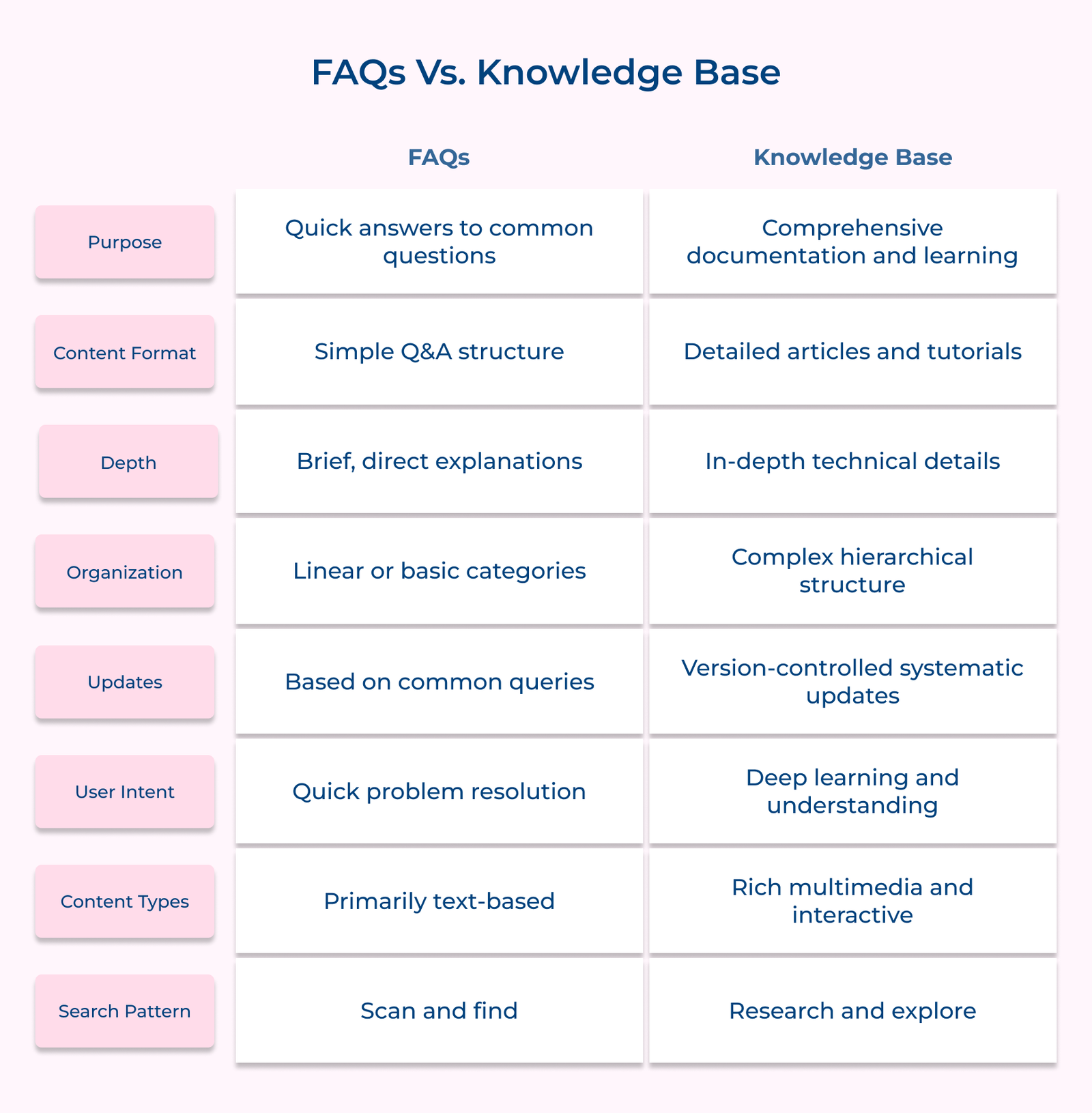
FAQs act as a first line of defense by providing quick, standardized answers to common, repetitive questions. They help filter out predictable queries before they turn into support tickets, making them ideal for handling routine inquiries that require minimal explanation.
Knowledge bases serve as comprehensive repositories of detailed information, offering in-depth education on every aspect of a product or service. They go beyond simple problem-solving to include technical documentation, user education and advanced troubleshooting, providing users with a thorough understanding of features.
Key takeaways:
- FAQs resolve common issues quickly with minimal effort.
- Knowledge bases provide comprehensive education and deeper understanding.
2. Content Structure and Organization
FAQs feature a simple, linear structure, organizing questions either alphabetically or by frequency for easy, quick access. The straightforward format enables users to rapidly find answers without navigating complex paths.
Knowledge bases use a more sophisticated, multi-level hierarchy, categorizing information in a tree-like structure with main sections, subsections and detailed articles. The organization allows for both broad exploration and deep dives into specific topics, helping users build a comprehensive understanding.
Key Uses:
- FAQs prioritize simplicity for fast scanning.
- Knowledge bases offer detailed, hierarchical structures for thorough topic exploration.
3. Content Depth and Detail
FAQs are designed for quick, direct answers to common questions, offering minimal context and avoiding complex details. Their focus is on immediate problem resolution, with clear, simple steps for users to follow.
Knowledge-based articles provide in-depth information, covering everything from basic explanations to advanced technical details. They offer context, background, use cases and potential implications, ensuring users not only know “how” to solve a problem but also “why” the solution works.
Key takeaways:
- FAQs offer concise, actionable steps for quick fixes.
- Knowledge bases provide comprehensive guides for deeper understanding.
4. Maintenance and Updates
FAQ maintenance is reactive, driven by customer queries and support ticket trends. Updates typically involve adding, removing or adjusting answers to address common, current issues. The process is straightforward and aimed at keeping content aligned with evolving customer needs.
Knowledge base maintenance is proactive and systematic. It requires regular technical reviews, version control and updates across interconnected articles. It involves ensuring content accuracy, refreshing examples and maintaining consistency across related resources.
Use cases:
- FAQ updates respond to current customer issues.
- Knowledge-based maintenance involves detailed, structured content management.
5. User Journey and Experience
The FAQ user journey is quick and task-focused. Users arrive with a specific problem, scan for relevant questions and expect an immediate, actionable solution. Success is measured by how fast they find and apply the answer.
Knowledge base users take an exploratory journey, navigating through multiple articles to deepen their understanding. They move between related topics, bookmark resources and build expertise over time, often discovering more than they initially sought.
Best practices:
- FAQ journeys are focused on fast, single-issue solutions.
- Knowledge-based experiences enhance in-depth learning and exploration.
6. Search Patterns and Behavior
FAQ search behavior is simple and direct, with users looking for specific answers to their immediate questions. They rely on keyword matching and quick scans to find precise solutions, often using natural language queries.
Knowledge-based searches are more dynamic, involving both specific inquiries and broader exploration. Users may begin with a focused search but then dive deeper into related topics, using filters, advanced search tools and cross-references to broaden their understanding.
Key takeaways:
- FAQ searches are focused on immediate, specific answers.
- Knowledge-based searches enhance deeper exploration and learning.
7. Update Frequency and Triggers
FAQ updates are driven by user behavior and support ticket trends. When new common questions arise, existing answers become outdated or gaps are identified, FAQs are quickly adjusted. The update cycle is reactive, addressing immediate needs and product changes that affect user queries.
Knowledge base updates are planned and systematic. They are triggered by product releases, technical changes, user feedback and industry updates. The process includes regular reviews, technical accuracy checks and comprehensive updates to keep content up to date.
Key takeaways:
- FAQs update based on user queries and immediate needs.
- Knowledge bases follow a structured, ongoing review process for comprehensive updates.
Effective Strategies for Implementing a Knowledge Base
Let’s explore key strategies to set up and maintain a highly effective knowledge base that serves as a reliable, user-friendly, and scalable resource.