How to Build a Sales Enablement Framework? 7 Key Steps
A sales enablement framework equips teams with the tools and processes needed to boost sales effectiveness. Learn about the key steps to implement an impactful framework for driving revenue.

A sales enablement framework equips teams with the tools and processes needed to boost sales effectiveness. Learn about the key steps to implement an impactful framework for driving revenue.
Sales teams often face immense challenges— information overload, complex buying cycles and shifting customer expectations. Even experienced reps struggle to meet their targets without proper support. As organizations grow, inefficiencies escalate, with sales teams wasting time searching for content, recreating materials and staying updated on product knowledge. It leads to longer sales cycles, missed opportunities and frustrated teams.
A well-structured sales enablement framework solves the issues – Organizations with a sales enablement strategy achieve a 49% higher win rate on forecasted deals. It streamlines operations, ensures consistent messaging, reduces onboarding time and boosts revenue through improved sales efficiency by providing the right tools.
A sales enablement framework refers to a strategic system that equips sales teams with the resources, tools, training and content needed to engage prospects effectively. It aligns sales and marketing efforts to streamline the selling process.
The framework ensures consistent messaging, accelerates onboarding, boosts productivity and enables data-driven decisions. It helps organizations scale their sales operations while maintaining quality and efficiency across customer interactions by standardizing processes.
Use cases:
A successful sales enablement framework relies on four interconnected elements. Let’s explore them in more detail.
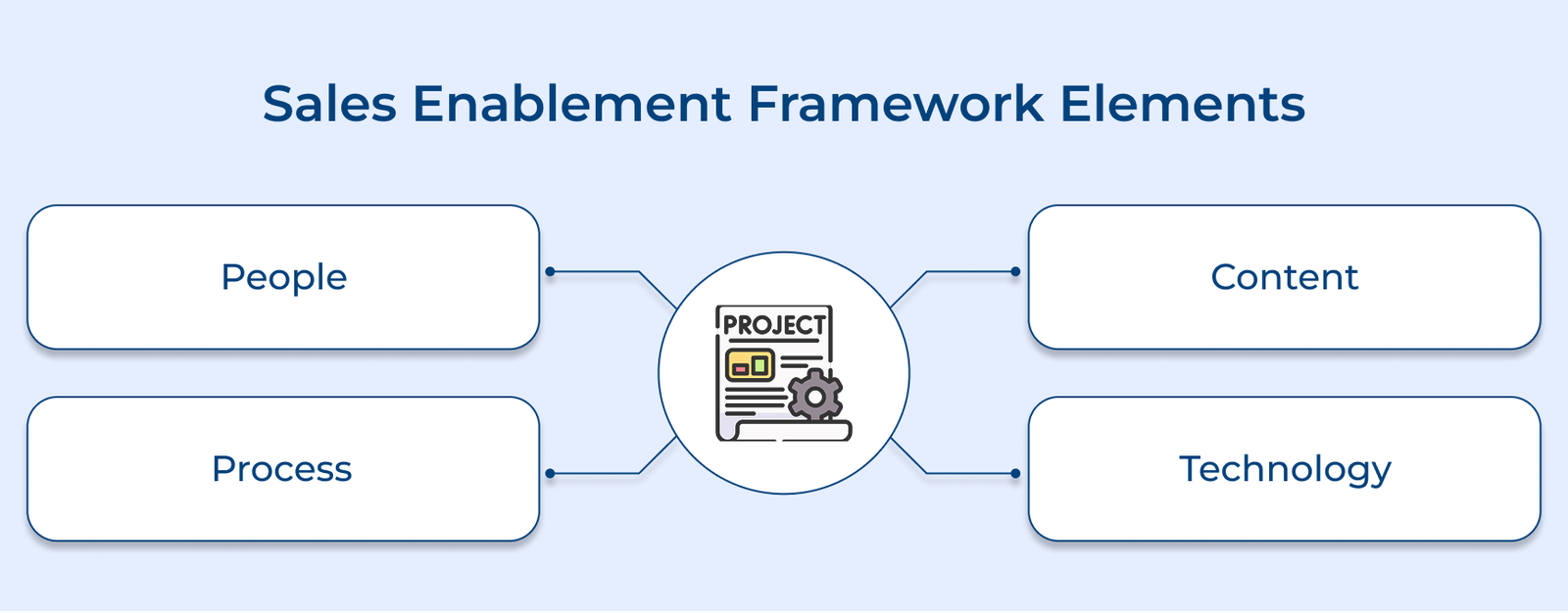
The human element emphasizes developing skilled sales professionals through targeted training and coaching. It involves creating a well-defined team structure with clear roles while enhancing continuous growth through mentorship.
Sales enablement processes define clear workflows for the entire sales cycle, from lead qualification to opportunity management. They ensure consistent customer engagement at every stage of the buying journey with standardized procedures.
Sales content includes all materials that empower reps to engage prospects effectively, such as personalized presentations and product guides for different buyer personas. A strong content strategy ensures easy access to relevant, up-to-date resources for every sales scenario.
The tech foundation equips sales teams with digital tools that boost efficiency, including CRM systems and automation platforms. Modern sales tech stacks also integrate analytics and AI-driven insights to enhance performance.
A sales enablement framework delivers strategic advantages to both organizations and their sales teams. Let’s explore each benefit:
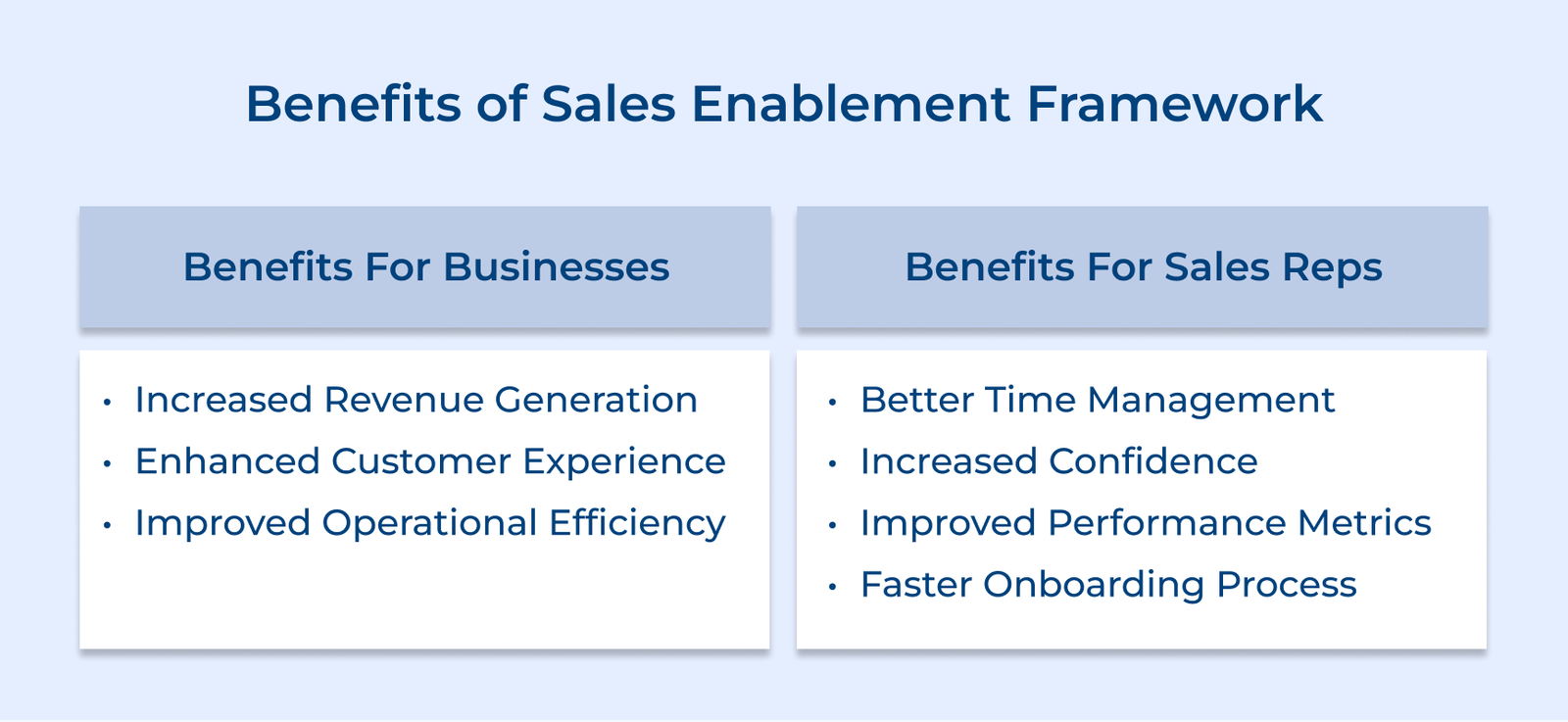
1. Increased Revenue Generation
A strong sales enablement framework drives higher conversion rates and larger deals by focusing on standardizing successful strategies. As the approach shortens sales cycles and boosts win rates, Sales enablement strategies lead to an 8% increase in quarterly revenue.
2. Enhanced Customer Experience
Sales reps can better understand customer needs and offer tailored solutions with the right tools. It results in stronger relationships and increased customer satisfaction throughout the buying journey.
3. Improved Operational Efficiency
The framework streamlines sales by automating tasks, eliminating redundancies and providing clear guidelines, resulting in improved resource allocation.
1. Better Time Management
The framework gives sales reps instant access to the right content and tools, eliminating time spent searching or creating custom materials, so they can focus on more valuable customer interactions.
2. Increased Confidence
Sales reps feel prepared for any customer interaction with comprehensive training and on-demand resources. They can access best practices and expert knowledge whenever needed. It builds confidence in their ability to handle various sales situations.
3. Improved Performance Metrics
Sales reps track their performance with clear metrics and receive regular data-driven feedback. It empowers them to pinpoint growth areas and celebrate achievements.
4. Faster Onboarding Process
Structured onboarding programs help new sales reps ramp up quickly, giving them access to proven methodologies and resources, reducing the time to full productivity.
Following are the essential steps to develop a successful sales enablement framework that drives growth and enhances your bottom line.
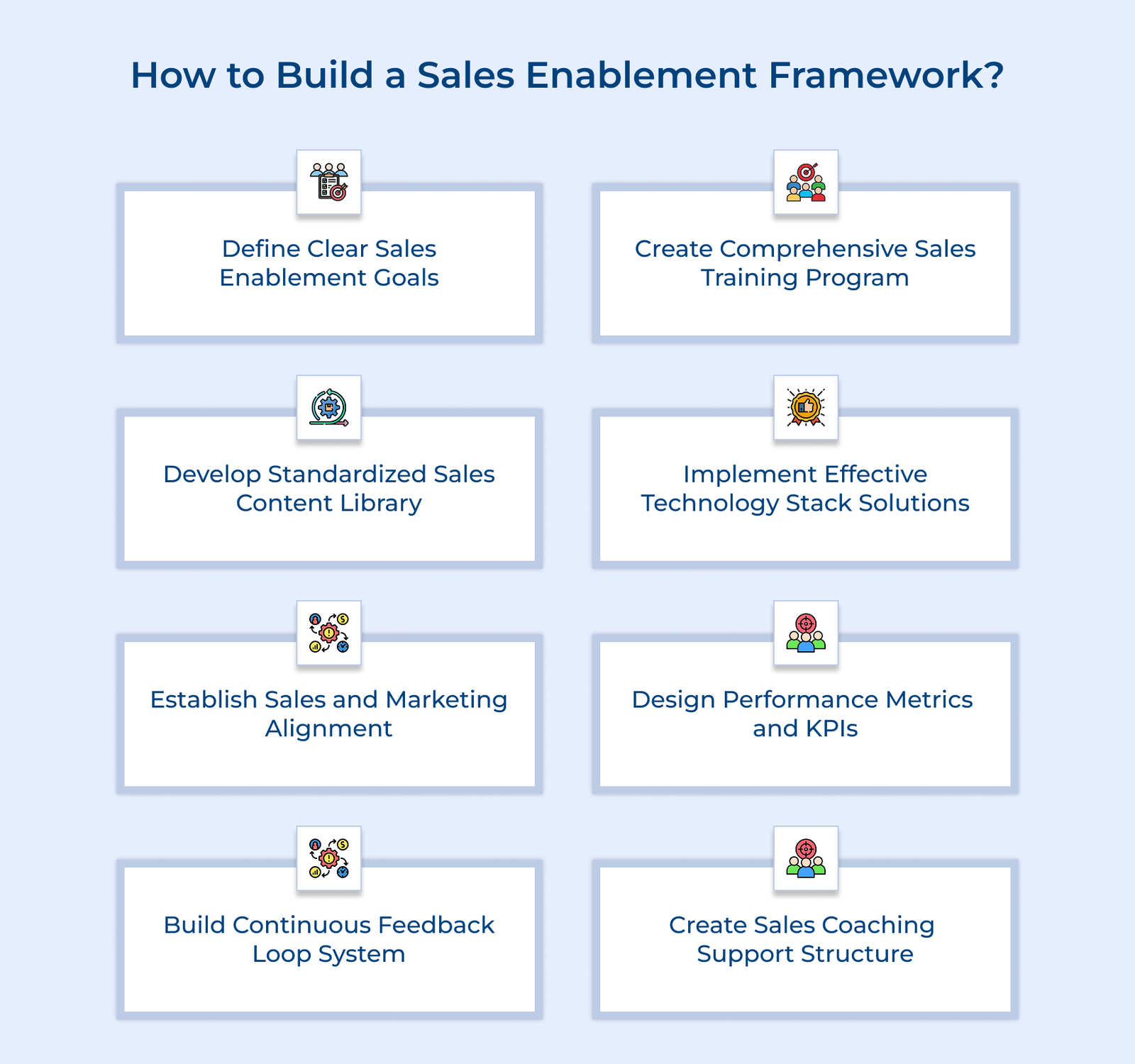
Clear goals are essential to a successful sales enablement framework. Without defined objectives, teams lack focus and struggle to measure progress. Well-set goals align efforts, track performance and serve as benchmarks to evaluate the effectiveness of sales enablement strategies.
Sales teams need specific, SMART (Specific, Measurable, Achievable, Relevant, Time-bound) revenue targets aligned with broader company objectives. The targets help drive efforts, track progress and pinpoint areas for improvement. A realistic timeline with defined milestones enhances accountability and keeps the team on track, while regular reviews ensure flexibility to adjust strategies as needed.
Best practices:
A strong training program equips sales teams with the essential knowledge and skills to thrive. It streamlines onboarding for new hires while keeping experienced reps up-to-date with the latest techniques and product insights.
Role-specific learning paths provide targeted training, tailored to different sales roles such as account executives, sales development reps and managers. It includes specialized content on product knowledge, sales methodologies and techniques for effective prospecting, relationship building or closing deals.
Pro tips:
A standardized content library ensures consistency and efficiency in sales communications, eliminating time spent recreating materials. It provides sales teams with quick access to up-to-date, relevant resources, ensuring all customer interactions align with brand messaging.
Customer-focused content, such as case studies, product guides and industry solutions, supports sales at every stage of the buyer’s journey. Organized by the buyer’s progression from awareness to decision-making, the materials build credibility and drive value. Proposal templates streamline presentations while regular content audits keep resources fresh and effective.
Actionable tips:
An integrated technology stack simplifies sales processes by automating routine tasks and providing key insights through data analytics. Sales teams gain seamless access to essential resources and can make data-driven decisions to drive performance with the right tools.
Start with a solid CRM platform to track customer interactions and monitor sales progress. Integrate with content management systems for easy access to updated materials and use communication tools to enhance collaboration across teams. The unified tech ecosystem streamlines operations and supports sales success.
How to implement:
Strong alignment between sales and marketing is essential for delivering consistent value and a seamless customer experience. When the teams collaborate effectively, they enhance each other’s efforts, reduce friction and optimize resources, driving better results.
Unified messaging ensures both teams communicate the same value propositions, with marketing crafting content tailored to sales team needs and sales providing feedback on its effectiveness. Regular joint meetings and content collaboration further strengthen alignment, enabling both teams to work toward common goals.
Best practices:
A continuous feedback system keeps the sales enablement framework agile and aligned with world needs. Sales representatives provide invaluable input on what’s working and what needs adjustment, based on their direct customer interactions.
Customer feedback further refines sales strategies by revealing trends in buying behaviors and preferences, helping teams adjust their approaches. Best practices are documented, ensuring successful strategies are shared across the organization and remain relevant to evolving sales demands.
Actionable tips:
A strong coaching structure is essential for turning sales enablement initiatives into tangible performance gains. It offers tailored guidance that helps reps enhance their skills, tackle specific challenges and meet high performance standards.
Regular coaching sessions features role-plays, strategy discussions and performance reviews provide focused skill development. Managers collaborate with reps to create personalized growth plans aligned with both individual and company goals. Peer learning programs enable reps to learn from top performers, enhancing a culture of mentoring and knowledge-sharing.
Pro tips:
Implementing a sales enablement framework often encounters various obstacles that can hinder its effectiveness. Understanding the challenges and having solutions ready can help organizations navigate the implementation process more successfully.
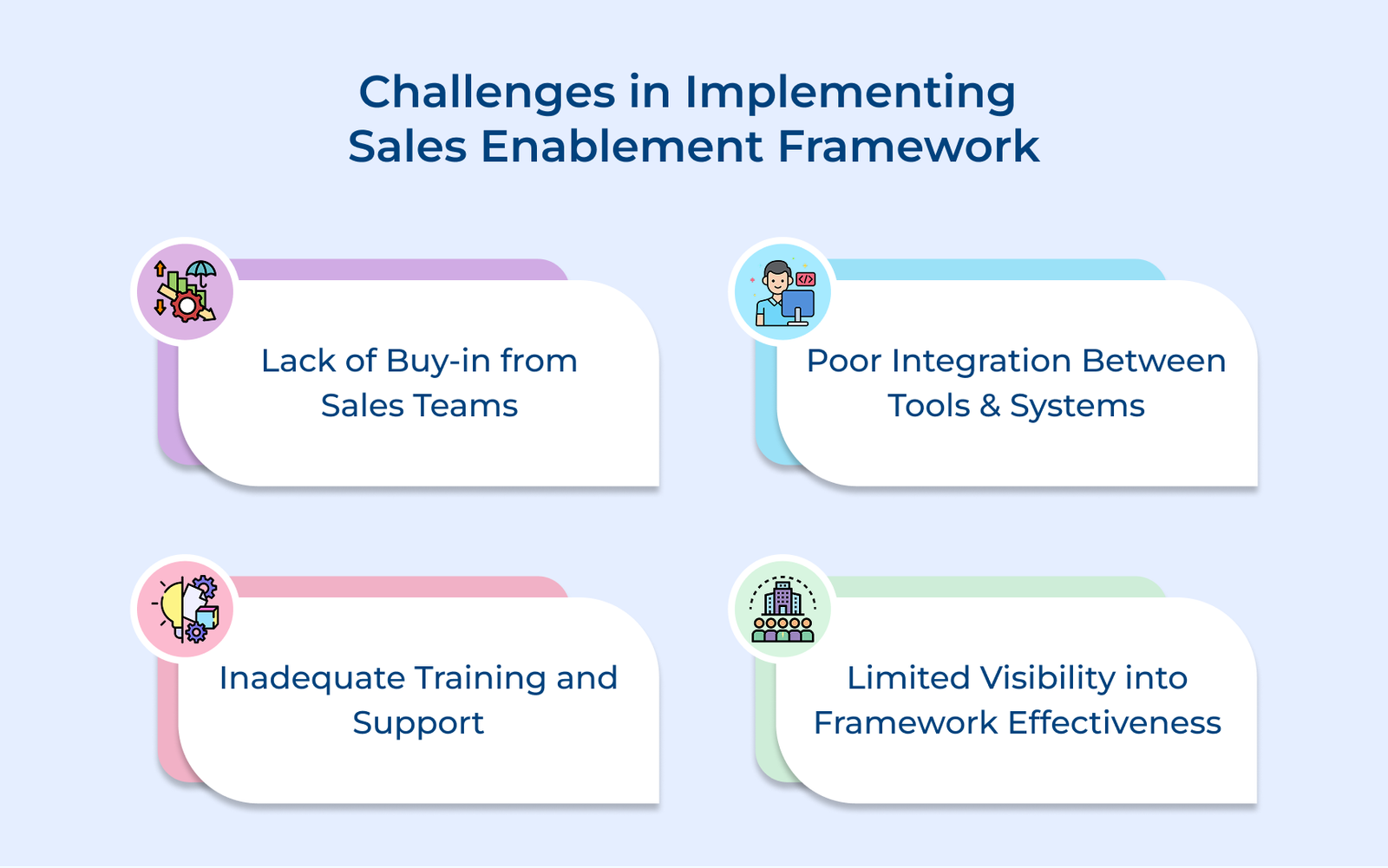
Lack of Buy-in from Sales Teams
Sales representatives may resist new processes and tools, perceiving them as added administrative tasks rather than valuable support. It leads to reliance on traditional methods and reluctance to adopt the framework.
Overcome the challenge by piloting with select teams to showcase how the framework saves time and boosts sales. Involve representatives in the design process to ensure it meets their needs and create champions within the team to drive adoption.
Poor Integration Between Tools and Systems
When tools don’t integrate, data becomes siloed and sales teams waste time switching between systems. It creates frustration and reduces productivity.
Perform a technology audit and select tools with strong integration capabilities. Build a unified tech stack that ensures seamless data flow and implement a single sign-on solution for a smoother, more efficient user experience.
Inadequate Training and Support
Training programs often overlook specific skill gaps and support resources can be hard to access, leaving new hires overwhelmed. Ongoing development gets sidelined by sales pressures.
Create role-specific training with practical applications and provide easily accessible microlearning resources. Set up a dedicated support team for quick issue resolution and establish a mentoring program for continuous guidance.
Limited Visibility into Framework Effectiveness
Organizations often struggle to measure the impact of enablement efforts, with misaligned KPIs and inconsistent data collection. It makes it difficult to demonstrate the ROI.
Define clear metrics aligned tied to business objectives and implement comprehensive tracking systems from the start. Create regular reporting schedules with actionable insights and use dashboards for real-time visibility into key performance indicators.
Let us first look at the key questions to ask when assessing success, followed by the essential metrics to track and optimize your sales enablement efforts.
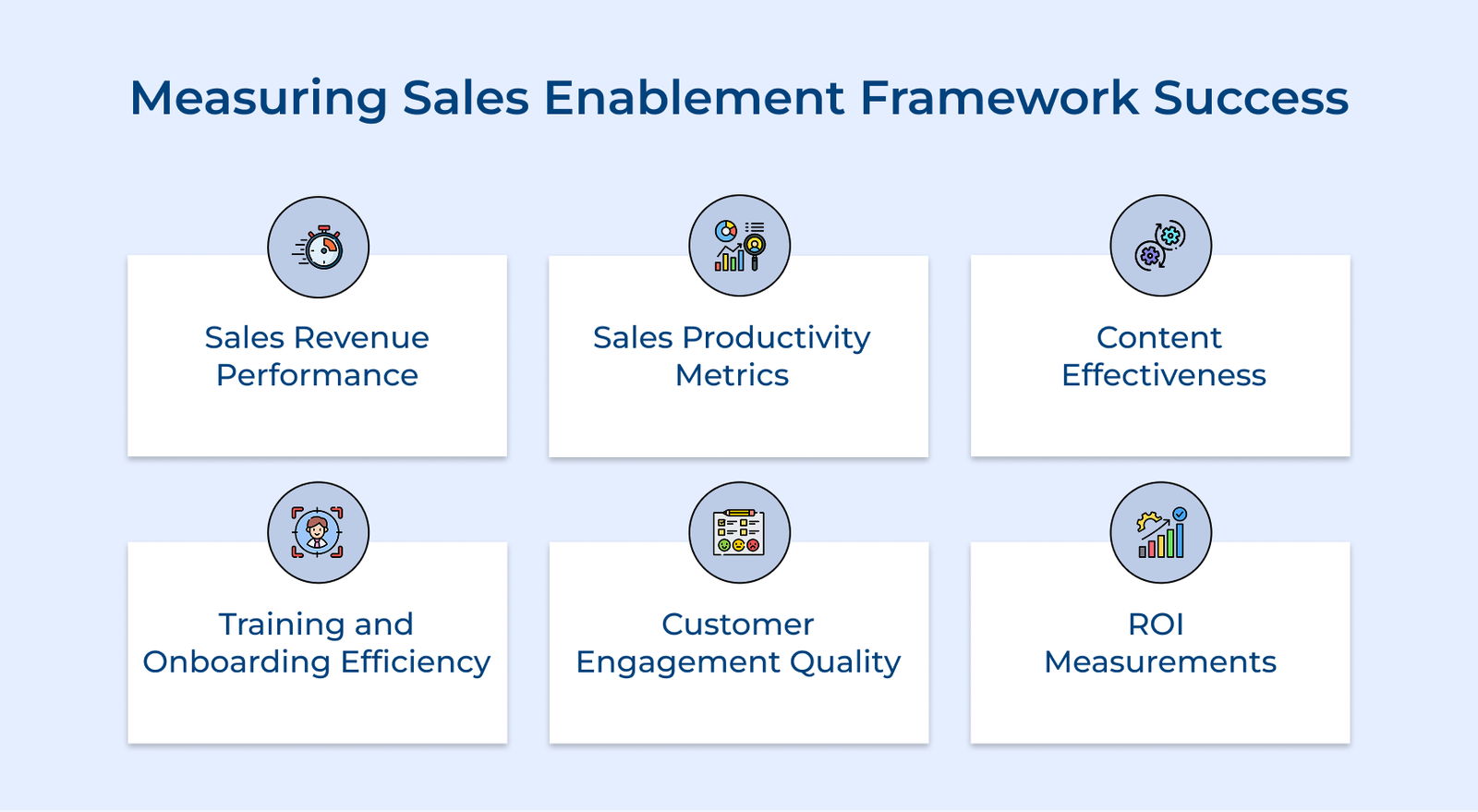
Track revenue growth, average deal size and win rates to measure the framework’s impact. Compare year-over-year and quarter-over-quarter performance. Compare results between teams using and not using the framework. It shows clear evidence of the framework’s impact on bottom-line results.
Track time spent on selling versus administrative tasks, along with the number of customer meetings and proposals generated. Measure the time taken for key sales activities to assess the efficiency gains from the framework.
Analyze the use of sales materials and their impact on deal progression. Track content patterns and their correlation with successful outcomes, while measuring customer engagement to optimize content strategy.
Track how quickly new hires reach full productivity by monitoring completion, certification levels and knowledge retention through assessments. It helps measure the effectiveness of your enablement programs in building sales skills.
Measure customer interaction quality through feedback scores and satisfaction ratings. Track retention rates and expansion opportunities to assess how effectively sales reps address customer needs, highlighting the framework’s impact on relationship building.
Evaluate the ROI by comparing enablement costs against revenue growth. Track key metrics like cost per sale and customer acquisition costs, while also assessing the impact on sales cycle duration. The approach highlights how sales enablement drives measurable improvements in performance and profitability.
Check out the examples of sales enablement frameworks that demonstrate how businesses successfully align their teams, optimize processes and provide the necessary resources.
Impactful statistics:
1. Amazon
Amazon built a powerful digital sales enablement platform that delivers real-time product data, customer insights and predictive analytics to its sales teams. They enhanced customer relationship management by implementing standardized training and an AI-driven content recommendation system. Sales representatives gained a deeper understanding of customer needs, allowing them to offer tailored solutions and boost customer satisfaction scores.
2. Apple
Apple launched a unified sales enablement program centered on product expertise, customer experience and consultative selling. They transformed their stores into immersive experience hubs with specialized training and a mobile-first approach to accessing resources. The boost in customer engagement helped Apple achieve some of the highest sales per square foot in the industry.
3. Airbnb
Airbnb developed a host-focused sales efficiency framework centered on education and support. They launched digital learning platforms, community forums and automated tools to help hosts optimize their listings. The initiatives boosted host retention, increased booking values and significantly improved listing quality. Hosts felt more supported in their operations, leading to higher satisfaction scores.
4. Zappos
Zappos built a customer service-driven sales enablement framework, investing in training that emphasized emotional intelligence and problem-solving. They set the standard for legendary service with comprehensive product knowledge and customer interaction guidelines. The approach empowered sales reps to handle complex situations with ease, boosting customer loyalty and repeat purchases.
5. Microsoft
Microsoft launched a global sales enablement program focused on cloud services and digital transformation. They smoothly transitioned from traditional software sales to cloud solutions with virtual reality training, interactive demos and a centralized knowledge system. The framework enabled sales teams to communicate complex technical offerings more clearly and address customer challenges with greater precision.
Sales enablement has evolved from a support function to a key driver of revenue growth and customer success. Organizations can create a unified approach to customer engagement by aligning marketing, sales and customer service. Leveraging technology, data analytics and continuous learning, sales enablement empowers teams to adapt to market shifts and customer needs.
The agility, combined with easy access to resources and tools, streamlines the sales process, making it more effective for modern buyers. Success in modern selling requires continuous optimization of sales enablement strategies. Organizations that focus on both team development and customer satisfaction will be better positioned for sustainable growth in a competitive market.

Sales training is a specific component within the broader sales enablement framework. While training focuses on teaching specific skills, sales enablement encompasses the entire ecosystem of resources, tools, content and processes that help salespeople succeed. Think of sales training as learning to use specific tools, while sales enablement provides the complete workshop, including tools, materials, guidance and ongoing support.
Implementation typically takes 6-12 months for a comprehensive rollout, following a phased approach. The timeline varies based on organizational complexity, existing infrastructure and scope. The first phase often focuses on foundational elements like content organization and basic tools (2-3 months), followed by process integration (2-3 months) and finally, advanced features (2-6 months). Success requires a sustained commitment beyond initial implementation.
Organizations implementing comprehensive sales enablement frameworks typically see a 10-40% increase in win rates within the first year. The ROI calculation includes improved sales velocity (20-30% faster deal cycles), increased average deal size (15-25%) and reduced onboarding time (30-40%). Additional benefits include higher customer satisfaction scores and improved sales team retention, though these metrics take longer to materialize.
Sales enablement ideally reports to a senior executive who can bridge sales, marketing and operations. It could be a dedicated Chief Sales Enablement Officer, VP of Sales Operations, or Chief Revenue Officer. The key is ensuring the function has sufficient authority to drive cross-functional collaboration while maintaining close alignment with sales leadership and field sales teams’ needs.
Essential technology investments include a robust content management system, learning management system, and sales engagement platform. These core systems should integrate with your CRM and include analytics capabilities. Advanced implementations might add conversation intelligence, revenue intelligence, and AI-powered coaching tools. The technology stack should scale with your organization’s maturity and needs.
Grow Customer Relationships and stronger team collaboration with our range of products across the Conversational Engagement Suite.
Omnichannel Customer Support & Help Desk Software
AI Enabled Business Messaging and Chatbot Software
Sales Engagement & CRM Software
Call Center Software & Virtual Phone System
Product Marketing & Experience Platform
Customer Experience & Feedback Management Software

 How to Create Effective Technical Documentation?
Scroll to top
How to Create Effective Technical Documentation?
Scroll to top