How to Create Effective Buyer Persona Questions in 2026
Learn how to create effective buyer persona questions that uncover valuable insights, helping businesses understand the audience better and tailor marketing strategies for greater success.

Learn how to create effective buyer persona questions that uncover valuable insights, helping businesses understand the audience better and tailor marketing strategies for greater success.
Understanding your customers is harder than ever. Businesses collect plenty of data, but turning it into meaningful insights is what they find challenging. Without a clear picture of who your customers are, marketing efforts miss the mark, resources go to waste and potential sales slip away. Generic messaging and poorly targeted products often result from this disconnect.
If businesses want to create buyer personas that truly reflect their customers, they need to ask the right buyer persona questions. 71% of companies that exceed lead generation and revenue goals have documented buyer personas. These questions help uncover their needs, motivations and challenges to give you the foundation for better marketing, stronger customer relationships and smarter product decisions.
A buyer persona refers to a semi-fictional profile of your ideal customer, crafted using market research and real customer data. It’s like creating a character for your business, representing your target audience’s behaviors, motivations, pain points and characteristics.
Instead of broadly targeting “working professionals,” you can focus on a specific persona like “Sarah, a 35-year-old marketing manager balancing work and personal life.” The targeted approach helps refine your messaging, product development and customer service.
Key principles:
A negative buyer persona, or exclusionary persona refers to the profile of customers you should avoid—those who are unlikely to be profitable, difficult to serve or not aligned with your business goals. It’s essentially your “do not sell to” list, helping you save resources by identifying unfit prospects.
Creating a negative buyer persona helps businesses avoid chasing leads that are unlikely to convert. It saves time, resources and effort by identifying prospects who don’t fit the ideal customer profile.
Key features:
Let’s go through some essential steps to develop comprehensive buyer personas that truly represent your target audience.
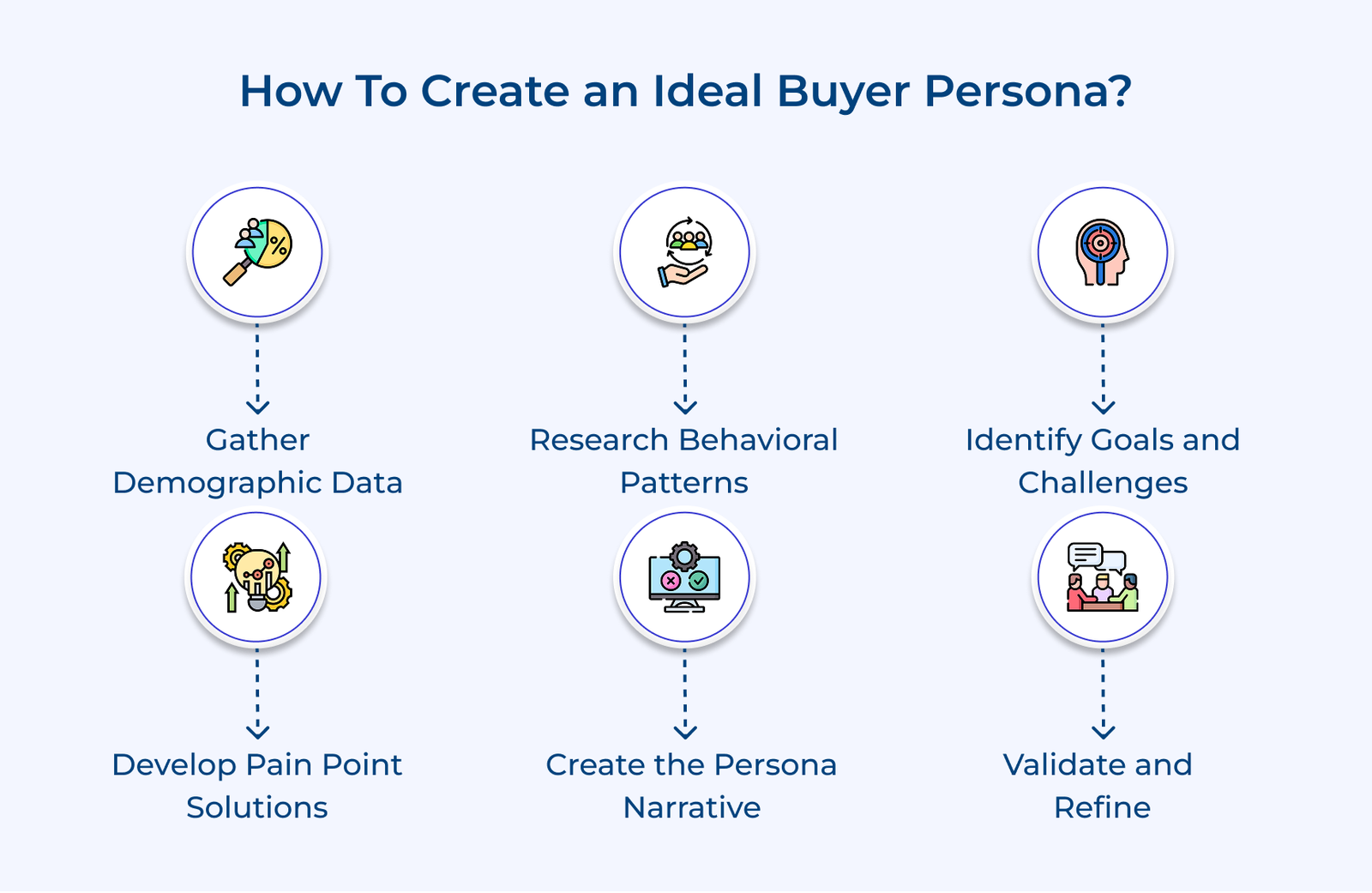
Creating a buyer persona begins with gathering key demographic details about your target audience such as age, location, income, education and profession. Start by analyzing your existing customer data, CRM insights and website analytics to spot common trends.
Incorporate external data from social media, customer surveys and market reports to validate your findings. Combining both internal and external sources ensures a more accurate, data-driven persona—one that reflects real customer characteristics rather than assumptions.
Understanding how your customers behave and make decisions is essential for building an effective persona. Start by analyzing their buying patterns, preferred communication channels and common objections during the purchase process.
Go further by interviewing current customers and your sales teams to uncover specific pain points. Pay close attention to the customer journey, including research methods and decision-making criteria, to gain deeper insights into what drives their purchases.
Every customer has goals they’re trying to achieve and obstacles standing in their way. Start by identifying their primary objectives, whether personal or professional and how your product or service helps them reach the goals.
Next, pinpoint the challenges and pain points holding them back. The insight allows you to position your solution more effectively and craft messaging that speaks directly to their needs.
Once you understand your customers’ challenges, focus on how your product or service directly addresses their pain points. List the features and benefits that directly solve your customer’s problems.
Create scenarios showing how your solution fits into their daily lives or workflow. It helps refine your marketing messages and product offerings, ensuring they directly meet customer needs.
Bring your buyer persona to life by turning your data into a compelling story. Start by giving your persona a name, job title and key characteristics to make them relatable to your team.
Craft a narrative that outlines their typical day, decision-making process and interaction with your product or service. Include quotes and specific scenarios to make the persona feel authentic for everyone involved.
Testing and validating your buyer persona is key to ensuring its accuracy. Share it with your sales and customer service teams to gather feedback from their direct customer interactions.
Regularly collect insights from customers through surveys, interviews and analytics to refine your persona. Keep in mind that buyer personas are dynamic, evolving with shifts in the market and customer needs over time.
Following are the essential buyer persona questions you ought to ask while creating your ideal persona, setting you on the path to more impactful marketing initiatives.
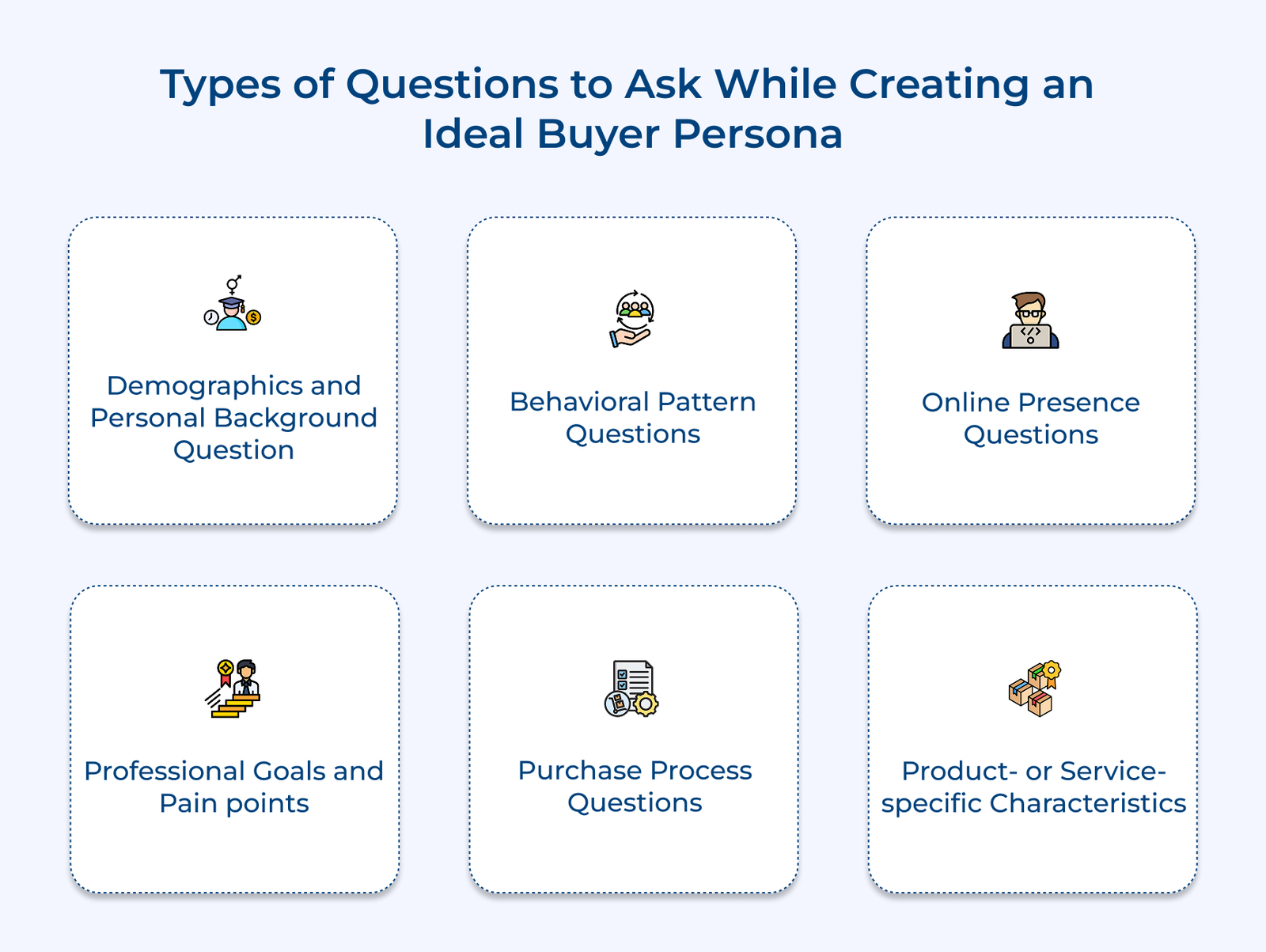
Demographic and personal background information forms the base of your buyer persona, offering context for purchasing decisions.
1. What is your educational background and how has it influenced your career path?
The question delves into your target customer’s education and career development. The response uncovers their expertise and approach to learning as well as professional growth.
2. What is your current family structure and how does it impact your lifestyle choices?
The question explores how personal life dynamics shape decision-making. Understanding family composition highlights key stakeholders and reveals time constraints or lifestyle priorities that influence buying behavior.
3. What is your current income range and how do you approach financial decisions?
The question examines financial capacity and spending attitudes. Understanding income levels reveals price sensitivity, purchasing power and their approach to budgeting as well as financial planning.
4. Where do you live and how does your location influence your daily routine?
The question explores geographic and cultural factors that influence customer behavior. Understanding location-specific preferences and considerations helps tailor product or service delivery to meet regional needs.
Understanding behavioral patterns reveals how customers interact with products daily. The insight into habits, preferences and decision-making helps predict future behaviors.
5. How do you prefer to learn about new products or services in your field?
The question explores how your audience discovers and researches solutions. The response reveals their information-gathering habits and preferred content types. Understanding it helps you choose the best channels to reach and educate them.
6. What does your typical workday look like from start to finish?
The question looks at your audience’s daily routines, revealing when and how they might interact with your product. Understanding their schedule helps identify the best timing for communications and integration points.
7. How do you typically make important decisions in your professional life?
The question uncovers key factors in your audience’s decision-making process, revealing the information and validation they need before purchasing. It also highlights other individuals involved in their decision.
8. What are your preferred methods of communication for business interactions?
The question explores communication preferences, highlighting preferred channels and response expectations. Understanding them helps create effective engagement strategies and ensures you meet their desired contact methods.
Understanding your audience’s online behavior is key for effective marketing. The insight into their digital footprint helps craft targeted strategies with the right message.
9. Which social media platforms do you use regularly and what type of content engages you the most?
The question explores social media preferences and content habits, revealing where your audience spends time online and what content grabs their attention. It helps identify opportunities for targeted engagement and distribution.
10. How do you prefer to consume professional or industry-related content online?
The question explores how your audience prefers to access professional content, through blogs, podcasts, webinars or other formats. Understanding it helps tailor your content strategy and timing for maximum engagement.
11. What role does online research play in your decision-making process?
The question examines how your audience uses online resources to inform their choices, revealing trusted touchpoints and how they validate information before making decisions. It helps identify key moments in their digital journey.
12. How do you interact with brands online and what influences your digital engagement?
The question explores how your audience engages with brands online, revealing their expectations for digital interactions and factors that encourage or discourage engagement with businesses.
Understanding your audience’s career goals and challenges helps position your solution effectively, allowing you to align your product as a tool to overcome obstacles.
13. What are your primary professional goals for the next 2-3 years?
The question explores your audience’s short- and medium-term career goals, revealing how your product or service can support their journey toward the goals. It reveals what success looks like from their perspective and what milestones they’re working toward.
14. What are the biggest challenges you face in your current role?
The question uncovers daily obstacles that hinder work performance, revealing pain points your solution can address. It highlights the urgency and impact of the challenges on their professional success.
15. How does your organization measure success in your role?
The question explores the performance metrics shaping their professional priorities, revealing how success is measured. Understanding the metric helps align your solution with their key outcomes and organizational goals.
16. What resources or support do you need to be more effective in your role?
The question identifies gaps in their professional toolkit, revealing resources they lack. Understanding them helps pinpoint opportunities where your solution can add value and improve job performance.
Understanding your audience’s purchasing approach helps optimize your sales process. You can create a tailored experience by exploring their evaluation criteria and preferred methods.
17. What information do you need before making a significant purchase decision?
The question uncovers the key data points and validation factors in their buying process. Understanding what information they need helps shape your sales materials and addresses their risk assessment for confident decision-making.
18. Who is involved in your purchase decision process and what roles do they play?
The question explores the decision-making dynamics within their organization, identifying key influencers and stakeholders. It uncovers internal relationships and approval processes that shape purchasing outcomes.
19. What factors most influence your final purchase decision?
The question identifies the key factors that drive their solution choice. Understanding their decision criteria helps you prioritize features and benefits in your sales approach, balancing both rational as well as emotional drivers.
Understanding how your audience evaluates product features and service attributes is key for product development. The insights guide priorities and highlight the characteristics most important to your target users.
20. What features or capabilities are absolutely essential for any solution you consider?
The question identifies the must-have features that shape their product evaluation. Understanding the requirements helps prioritize development and ensures your solution meets their core needs, forming the foundation for purchase consideration.
21. How do you evaluate the quality and reliability of a product or service?
The question uncovers the criteria they use to assess product performance and reliability. Understanding their quality metrics helps highlight key aspects of your product that need validation and align with their standards.
22. What level of customization or flexibility do you expect from a solution?
The question examines their need for product adaptability and customization. Understanding their customization requirements helps define how flexible your solution should be, balancing standardization with personalization in tools and services.
Check out the importance of buyer persona questions in shaping targeted marketing strategies, helping uncover key insights that drive product development.
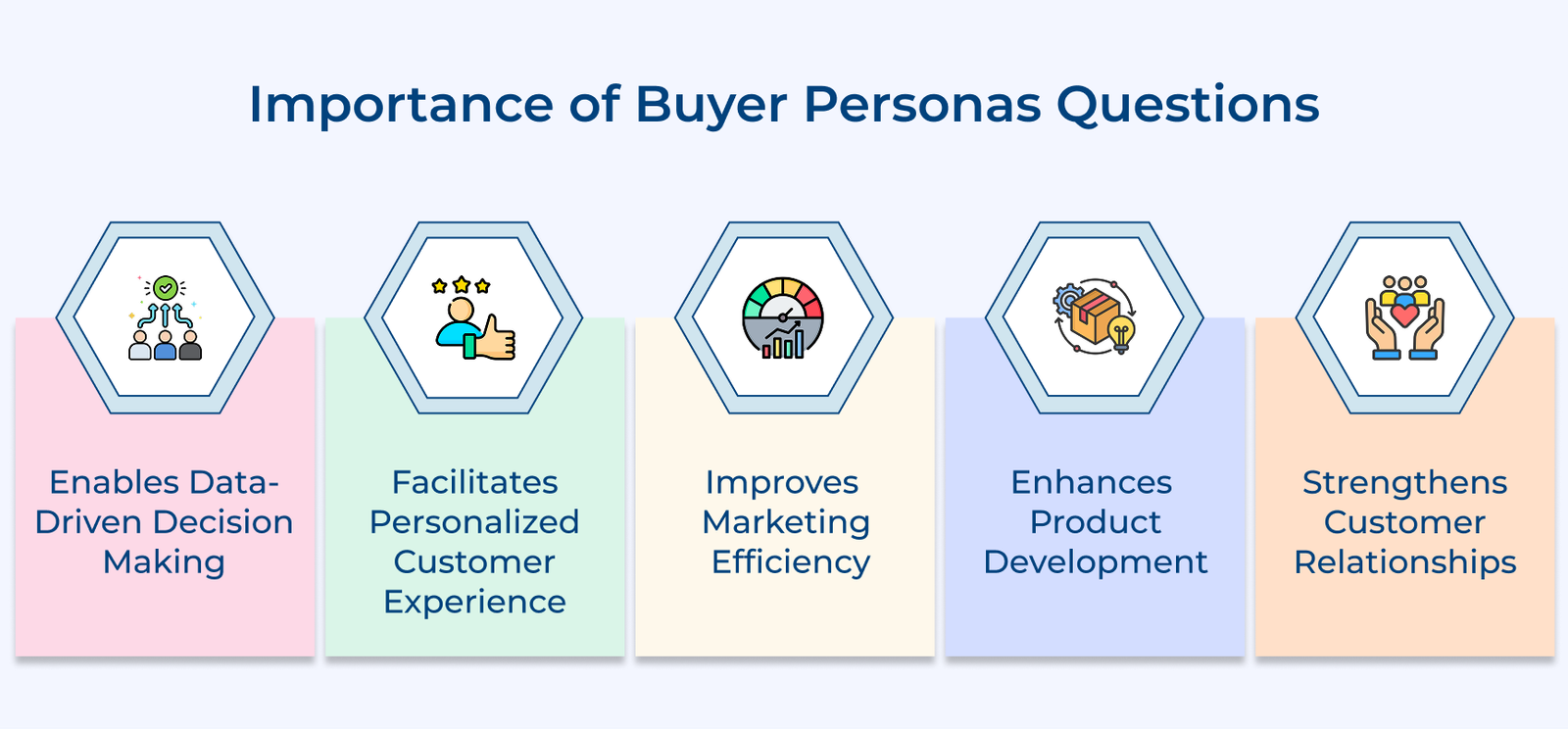
Enables Data-Driven Decision Making
Buyer persona questions turn vague customer insights into actionable data. Businesses can make informed decisions on product development, marketing and resource allocation by gathering details on preferences, reducing assumptions
Facilitates Personalized Customer Experience
Asking the right questions about your target audience is key to crafting personalized experiences throughout their journey. Businesses can tailor interactions at every touchpoint by understanding their communication preferences, pain points and goals. The personalization strengthens connections and boosts customer satisfaction.
Improves Marketing Efficiency
Detailed user persona questions optimize marketing by pinpointing the best channels, messages and timing to reach target customers. The insight helps businesses allocate their marketing budget more efficiently and craft content that truly resonates with their audience’s needs.
Enhances Product Development
Comprehensive buyer persona questions provide businesses with key insights into customer challenges and desired solutions. The understanding guides product development, ensuring features align with real customer needs and prioritizing efforts that deliver true value.
Strengthens Customer Relationships
Asking insightful questions about customer motivations, fears and aspirations enables businesses to form deeper emotional connections with their audience. Emotional intelligence enhances empathetic marketing and customer service, building trust over time.
Following are the real-world examples that demonstrate how thorough persona development through strategic questioning can transform business outcomes.
Nike: “Everyday Athletes”
Nike transformed its strategy by diving deep into the motivations and challenges of recreational athletes. Conducting persona research helped them understand that many potential customers felt intimidated by traditional athletic marketing.
The insight sparked the creation of the “Just Do It” campaign and more inclusive product lines. Shifting the focus from competition to personal achievement, Nike built stronger emotional connections and expanded its reach beyond professional athletes to everyday fitness enthusiasts.
Spotify: “Music Enthusiasts”
Spotify gained valuable insights by exploring how and when people listen to music. It helped them focus on emotional connections, discovery preferences and sharing habits. They discovered that music discovery was a major pain point for many listeners.
This understanding led to the creation of personalized playlists and features like Discover Weekly. Spotify evolved from a basic streaming service into a personalized music companion by addressing these needs.
Airbnb: “Experience Seekers”
Airbnb explored travelers’ desire for authentic experiences and concerns about staying in strangers’ homes. They uncovered that people sought more than just accommodation—they wanted local, personalized experiences.
The transformation led to features like Superhost badges and Experiences offerings. Airbnb revolutionized the accommodation industry and created a new travel category by expanding into curated travel experiences.
Amazon Prime: “Convenience Shoppers”
Amazon created Prime by delving into shoppers’ frustrations and convenience needs. Their research uncovered that high shipping costs and long delivery times were major pain points, leading to abandoned carts.
The insight fueled the launch of free two-day shipping and a suite of additional services. Amazon Prime transformed online shopping and reshaped customer expectations by addressing these pain points.
Effective buyer personas are the foundation of modern marketing and business strategy. You can develop offerings that truly align with their needs by asking the right questions across demographics, behaviors, psychology and context. The insights help create targeted marketing campaigns and meaningful customer experiences.
The key to impactful buyer personas is asking comprehensive questions that go beyond assumptions. The approach uncovers genuine insights, driving innovation and customer satisfaction. When businesses commit to detailed persona development, they enhance lasting relationships and sustainable growth.
Key takeaways:

The best buyer persona questions cover key areas like demographics, behavior, goals and pain points. Dive into their daily routines, decision-making processes and emotional triggers, while also considering both professional as well as personal factors that shape their purchasing choices.
Buyer personas are the foundation of marketing strategy, guiding content creation, channel selection and messaging. The insights enable you to craft targeted campaigns that truly resonate with specific audience segments by aligning marketing efforts with customer preferences and behaviors.
Negative buyer personas typically have economic characteristics that make them unprofitable such as extremely limited budgets or expectations of deep discounts. They often display behavioral patterns like excessive support demands relative to purchase value. Their organizational traits might include decision-making processes that create prohibitively long sales cycles.
Buyer personas guide content creation by revealing what information resonates with specific audience segments at each stage of their journey. They inform channel selection by identifying where different personas consume information. Personas shape messaging tone and complexity based on technical sophistication and role-specific pain points. They also help prioritize marketing investments by focusing resources on campaigns targeting your most valuable personas rather than spreading efforts across all potential customers.
Buyer personas should undergo quarterly light reviews to incorporate fresh sales and marketing insights, with more comprehensive updates annually to reflect market evolution. Major business events like product launches or expansions into new markets necessitate immediate persona reassessments. Customer behavior shifts, emerging industry trends or changing competitive landscapes should trigger targeted updates to specific persona elements. The goal is to maintain personas as living documents that accurately reflect your current and desired customers, not static profiles that become increasingly disconnected from market realities.

Grow Customer Relationships and stronger team collaboration with our range of products across the Conversational Engagement Suite.
Omnichannel Customer Support & Help Desk Software
AI Enabled Business Messaging and Chatbot Software
Sales Engagement & CRM Software
Call Center Software & Virtual Phone System
Product Marketing & Experience Platform
Customer Experience & Feedback Management Software

 9 Benefits of Sales Enablement for Businesses in 2026
Scroll to top
9 Benefits of Sales Enablement for Businesses in 2026
Scroll to top