9 Benefits of Sales Enablement for Businesses in 2026
Sales enablement empowers teams with the tools, resources, and training to drive productivity. Learn about the benefits of sales enablement to improve customer engagement and boost revenue.

Sales enablement empowers teams with the tools, resources, and training to drive productivity. Learn about the benefits of sales enablement to improve customer engagement and boost revenue.
Sales teams struggle to meet customer expectations and hit revenue targets. Complex sales processes, too much information and changing buyer behavior make closing deals more difficult. Sales enablement helps by equipping teams with the right tools, content and training to work more efficiently. More than 80% of sales reps close the forecasted deals and achieve their quotas when their employer incorporates an effective sales enablement strategy.
Yet, many businesses overlook the full impact and benefits of sales enablement strategy. So we will be breaking down its key benefits, from boosting revenue to improving customer interactions. Let’s dive in!
Sales enablement refers to a strategic approach that empowers sales teams with the resources, tools, knowledge and support to sell more effectively. It’s like building an engine that fuels sales performance by providing everything salespeople need to engage buyers throughout their journey.
Sales enablement ensures that reps have access to up-to-date content by enhancing collaboration between sales, product and marketing teams. Let’s assume that marketing-created case studies and white papers are delivered to sales teams at the right time in the right format.
Key principles:
Let’s go through the powerful benefits of sales enablement to understand how they can elevate your sales performance and unlock your organization’s true potential.
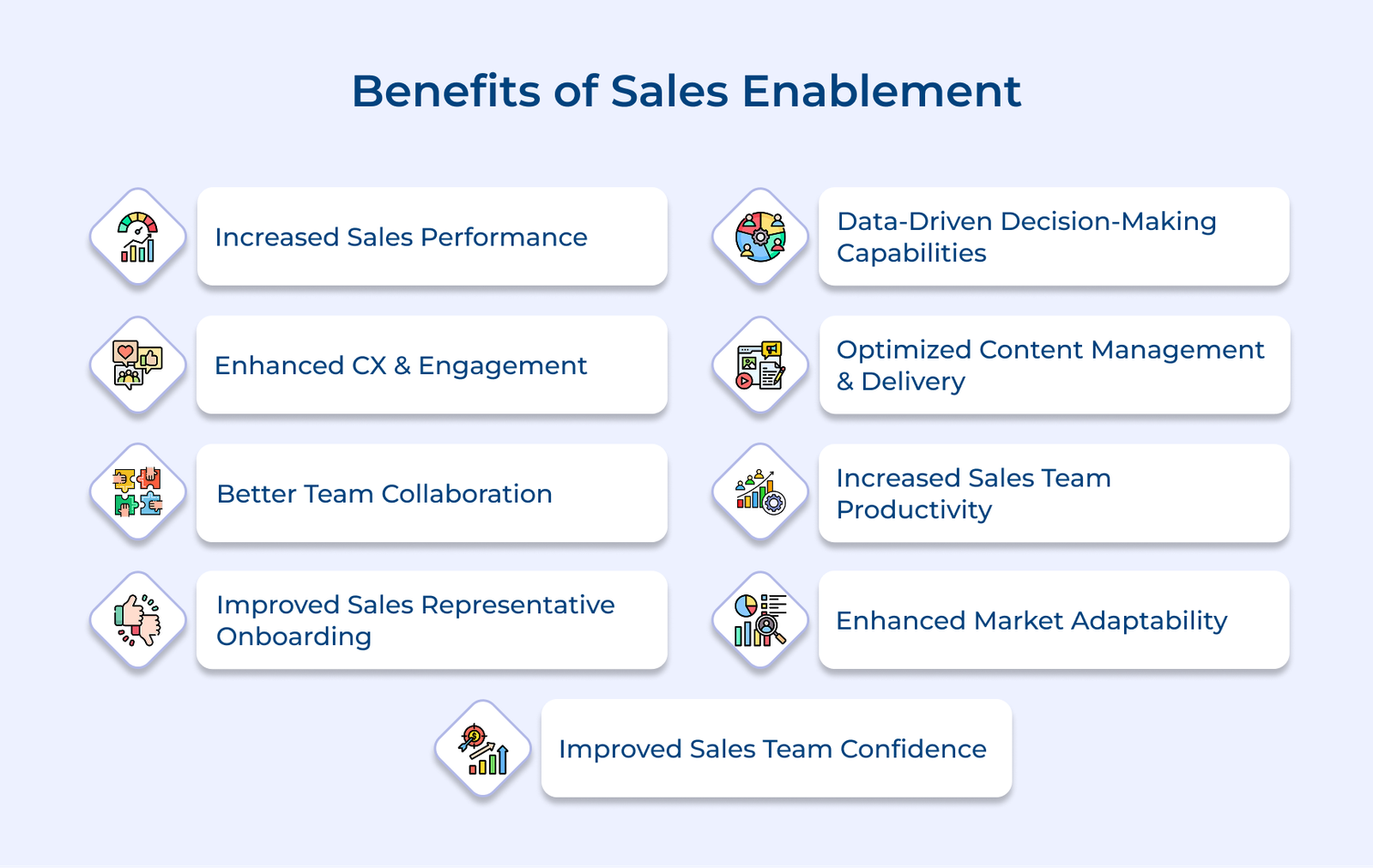
Sales enablement boosts sales effectiveness, driving sustainable revenue growth. It streamlines operations and accelerates deal closures by equipping sales teams with the right tools. Efficient workflows reduce sales cycles which helps sales reps to move prospects through the pipeline faster without sacrificing quality.
Sales enablement strategies lead to an 8% increase in quarterly revenue and a 49% win rate on forecasted deals. The teams see higher win rates with better-qualified leads and improved processes. Equipped with the right insights, they can focus on high-potential deals, boosting success rates.
Key takeaways:
The benefit focuses on delivering meaningful interactions at every stage of their buying journey. Sales enablement ensures each touchpoint maximizes value while maintaining brand consistency. Sales teams can effectively communicate the value proposition with access to approved content and messaging guidelines, building trust with customers.
Personalization tools allow sales teams to tailor their approach to customer needs, while quick access to relevant resources enables timely responses to inquiries. Responsiveness strengthens relationships and boosts customer satisfaction.
Pro tips:
Team collaboration and alignment are essential for successful sales operations, breaking down silos between departments. Sales enablement enhances a unified ecosystem where marketing. Sales and product teams work together seamlessly toward shared goals. Streamlined communication ensures vital information flows freely, keeping teams updated on product changes, market insights and new developments, maintaining momentum in sales activities.
Shared objectives create a sense of collective purpose, encouraging knowledge sharing, collaboration and joint planning. The cross-functional approach ensures everyone plays a key role in the sales process.
Actionable tips:
Sales representative onboarding is crucial for quickly getting new team members up to speed and contributing to sales goals. A well-designed sales enablement program accelerates the process with clear learning paths and comprehensive resources. The structured approach ensures consistent training in product knowledge, sales techniques and company processes, helping new hires build confidence.
Sales enablement reduces the time it takes for the new sales reps to become fully productive by offering readily available resources and continuous support. It also ensures a consistent onboarding experience for all team members, regardless of location or hiring date.
Best practices:
Sales enablement turns intuition-based selling into a data-driven strategy with comprehensive analytics and tracking tools. The shift empowers sales teams to make decisions based on concrete data rather than gut instinct. Real-time performance tracking gives sales managers instant visibility into key metrics like opportunity progression and engagement, helping identify potential bottlenecks in the sales process.
Clear ROI measurement allows organizations to pinpoint the most effective sales enablement initiatives, track strategy success and allocate resources more efficiently. The data-driven approach enhances continuous improvement in sales processes.
Key takeaways:
Sales content management ensures that sales materials are easy to access and highly relevant to each selling situation. Sales teams can quickly find up-to-date presentations, proposals and collateral by centralizing content in one repository, eliminating time wasted searching.
The system also recommends targeted content based on specific sales scenarios, helping representatives pull relevant case studies or industry-specific resources that resonate with their potential customers. The tailored approach boosts the effectiveness of sales conversations.
Pro tips:
Sales enablement transforms how sales teams allocate their time by automating routine tasks and optimizing workflows. It allows reps to focus on building relationships and closing deals, rather than administrative work. Automation eliminates time-consuming processes like data entry and report generation.
Streamlined workflows help sales representatives move seamlessly through the sales process, dedicating more time to understanding customer needs and delivering tailored solutions. The focus on customer interactions leads to better sales outcomes.
Pro tips:
Sales enablement boosts market adaptability, giving organizations the agility to respond quickly to shifting market conditions. Sales enablement provides the infrastructure to rapidly distribute updated content and messaging across the team, allowing sales reps to adjust their strategies on the fly.
Agile strategies help maintain a competitive edge, enabling teams to incorporate new competitive intelligence and market insights into their approach. The adaptability ensures that organizations stay ahead of trends, rather than reacting to them.
Actionable tips:
Sales team confidence flourishes when representatives have easy access to the knowledge and tools that drive success. The confidence leads to more impactful customer interactions and better sales results. Sales enablement ensures continuous learning, keeping teams up-to-date on product features and market trends.
Ongoing training also sharpens presentation skills, enhancing reps’ ability to communicate value propositions clearly and address customer challenges. The improved communication drives stronger customer engagement and sales success.
Key takeaways:
Following are the key ways technology enhances sales enablement, streamlining workflows and providing data-driven insights that empower teams to deliver efficient experiences.
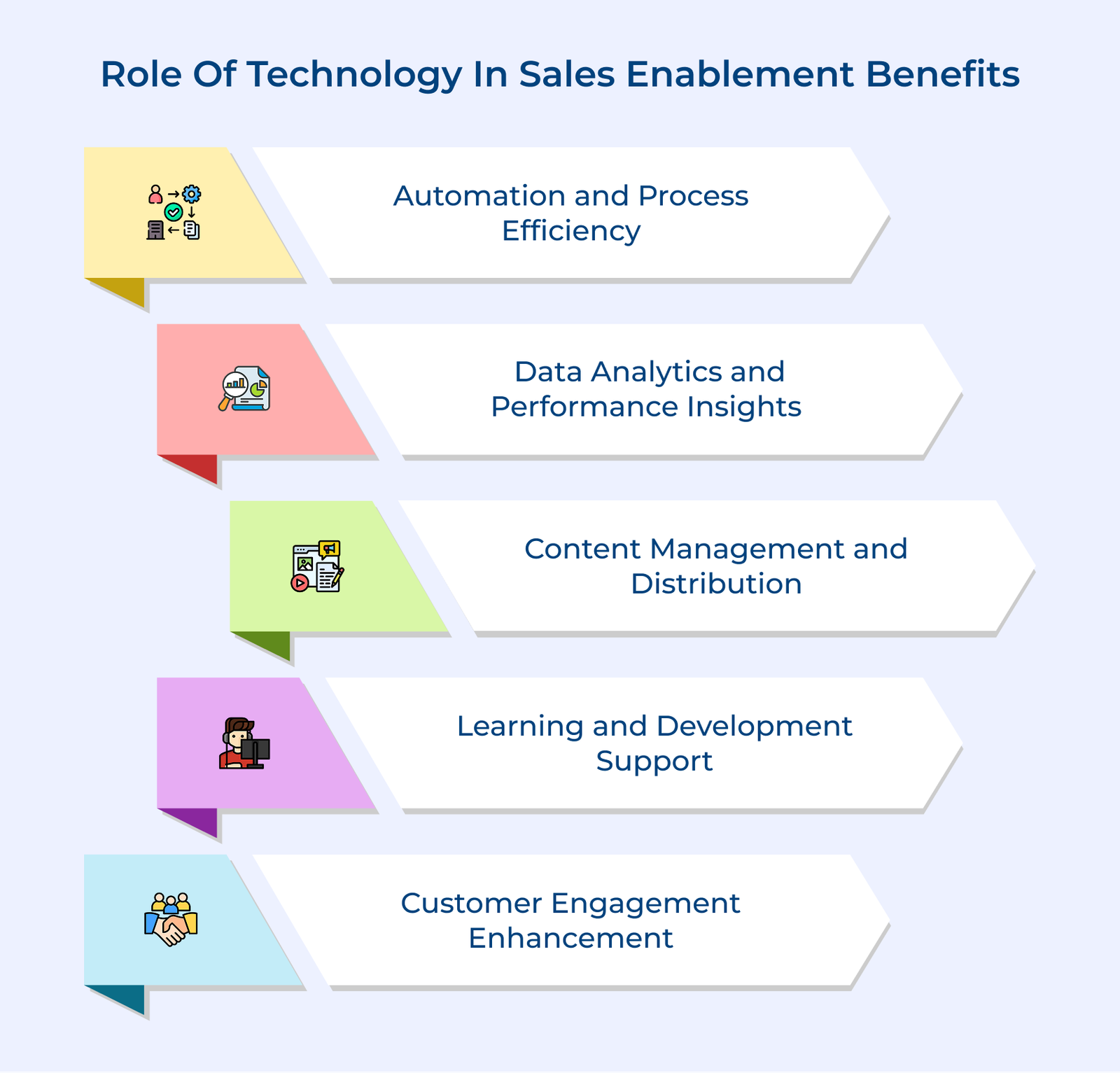
1. Automation and Process Efficiency
Technology automates repetitive tasks and streamlines sales workflows. Customer relationship management (CRM) systems track interactions and update records automatically, while sales automation tools handle routine tasks like follow-ups and scheduling. It frees up sales reps to focus on building relationships and closing deals, instead of getting bogged down by administrative work.
2. Data Analytics and Performance Insights
Modern sales enablement platforms turn raw data into actionable insights with powerful analytics. The tools track key performance indicators, analyze sales patterns and uncover hidden trends. Sales leaders can monitor team performance in real-time, identify bottlenecks and make data-driven decisions to boost effectiveness.
3. Content Management and Distribution
Technology powers advanced content management systems that centralize all sales materials. Using AI, the platforms recommend relevant content based on selling scenarios and customer profiles. Sales teams can quickly access updated materials, personalize content for prospects and track effectiveness with usage analytics.
4. Learning and Development Support
Digital learning platforms enable continuous training for sales teams through interactive sessions, virtual training and personalized learning paths. Sales reps can access materials on-demand, learn at their own pace and track progress to identify improvement areas.
5. Customer Engagement Enhancement
Advanced technology tools boost customer engagement by offering insights into behavior and preferences. Customer intelligence platforms track buying patterns and engagement, helping sales teams connect at the right time with personalized, impactful interactions that drive better results.
Following are the essential steps that will help you build a robust foundation for your sales enablement strategy.
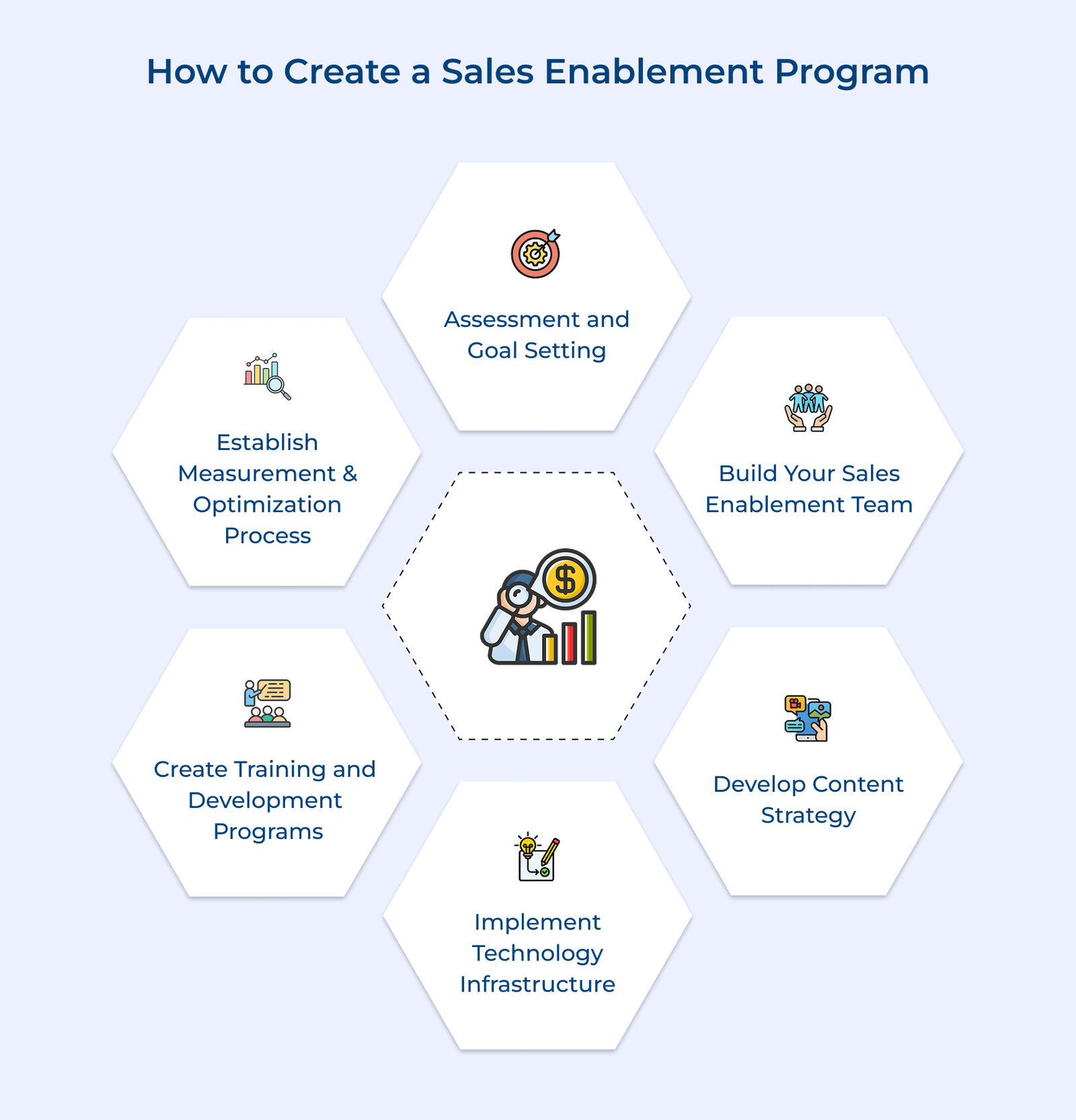
Start by analyzing your current sales processes and identifying performance gaps. Gather insights from sales, marketing and leadership to pinpoint pain points or opportunities. Set clear, measurable goals aligned with business objectives to guide your program’s development.
Form a dedicated team to develop your sales enablement program, including members from sales, marketing, training and technology. Clearly define roles, establish reporting structures and secure strong leadership support to ensure the program’s success.
Develop a content strategy that supports your sales team at every stage of the buyer journey. Map existing content to sales stages, identify gaps and set guidelines for creation. Use a content management system to ensure easy access to relevant materials whenever needed.
Choose the right technology stack to support your sales enablement, including CRM systems, learning platforms, content management tools and analytics solutions. Ensure seamless integration for efficient sales processes and data-driven decisions.
Create training programs that cover product knowledge, sales skills and technology usage. We suggest you to do it through a mix of in-person, virtual and self-paced modules. Offer continuous learning to keep reps updated on market trends and customer needs.
Establish regular monitoring to track program effectiveness by defining KPIs aligned with goals. Analyze data and create feedback loops for continuous improvement based on real-world results.
Sales enablement transforms how organizations approach sales, shifting from intuition-based methods to data-driven, systematic strategies that deliver consistent results.
Sales enablement supports teams holistically by creating an integrated ecosystem of training, content, technology and analytics, empowering sales reps to perform at their best while providing managers with clear insights into performance. The cohesive approach ensures all elements work together seamlessly to drive success.
As market competition and customer expectations evolve, sales enablement has become a necessity, not just an advantage. Investing in the right tools leads to improved sales performance, stronger customer relationships and sustained revenue growth. Organizations position themselves for long-term success by embracing sales enablement.

Sales enablement is essential in tackling the complexity of sales processes and evolving customer expectations. It provides a comprehensive support system that equips sales teams with the tools they need to succeed, ensuring consistency, efficiency and adaptability to market changes. Without it, teams risk facing scattered resources and inconsistent practices.
Sales enablement dramatically improves productivity by centralizing all necessary sales resources in one accessible location, eliminating time wasted searching for materials. Automating routine tasks like proposal generation and follow-up emails helps the reps gain more time for actual selling activities. The analytics component provides insights into which activities yield the best results, allowing them to focus on high-value actions rather than unproductive busy work.
Sales enablement transforms customer engagement by equipping representatives with detailed buyer insights and relevant content for each stage of the purchasing journey. Contextual knowledge allows for more personalized interactions that address specific pain points rather than generic pitches. The ability to quickly access subject matter expertise through knowledge bases or expert networks means salespeople can answer complex questions in real time, building trust and credibility.
Sales enablement revolutionizes new rep training by replacing overwhelming information dumps with structured, bite-sized learning modules that can be consumed on demand. Interactive simulations allow the safe practice of difficult conversations before facing real customers. Managers can identify specific knowledge gaps and provide targeted coaching rather than generic feedback tracking individual performance metrics. Perhaps most importantly, new reps can observe successful approaches through recorded call libraries and battle card repositories.
Sales enablement directly impacts revenue growth by shortening sales cycles through more efficient processes and better-prepared representatives. When businesses improve their conversion rates at each pipeline stage, more opportunities progress to closed deals rather than stalling out. The coaching component helps middle performers adopt the practices of top sellers, raising the performance floor across the entire team.
Grow Customer Relationships and stronger team collaboration with our range of products across the Conversational Engagement Suite.
Omnichannel Customer Support & Help Desk Software
AI Enabled Business Messaging and Chatbot Software
Sales Engagement & CRM Software
Call Center Software & Virtual Phone System
Product Marketing & Experience Platform
Customer Experience & Feedback Management Software

 9 Strategies to Improve Customer Experience Banking
Scroll to top
9 Strategies to Improve Customer Experience Banking
Scroll to top